
Genesis at Work: Evaluating the Effects of Manufacturing Extension on Business Success and Job Quality


Manufacturers looking to improve productivity and efficiency often turn to Manufacturing Extension Partnerships (MEPs), public-private partnerships supported by the US Department of Commerce that provide consulting services to support their growth and competitiveness.
These partnerships often focus on implementing lean manufacturing strategies to cut waste and eliminate production bottlenecks. But what if they also adopted people strategies, focusing on job quality alongside process and product strategies to help businesses solve their problems?
IMEC took just this approach with its Genesis initiative, working with manufacturers to implement “good jobs” strategies to improve workforce engagement, productivity, and stability, alongside process and product improvements. Launched in 2014, with the support of the Chicagoland Workforce Funder Alliance (CWFA), the Genesis initiative is based on the premise that workforce practices are central to a firm’s operations, productivity, and competitiveness.
Through Genesis, IMEC fine-tuned a strategic planning approach that helped companies explore process- and product-related challenges that were deeply interwoven with people-related challenges.
A four-year evaluation of IMEC’s implementation of Genesis, conducted by the Aspen Institute’s Workforce Strategies Initiative in collaboration with the University of North Carolina at Chapel Hill and Portland State University found that this people-process-product approach not only benefited workers, but also helped businesses save money and grow. Key findings based on IMEC’s work with these 22 manufacturers include:
- 55% of all Genesis companies and 61% of the most actively participating companies reported increases in annual sales, compared to 37% of non-Genesis companies that IMEC worked with.
- 71% of all Genesis companies and 79% of the most actively participating companies reported cost savings, compared to 47% of non-Genesis companies that IMEC worked with.
- Average annual earnings for all workers employed by Genesis companies increased by 12% in real, inflation-adjusted terms from 2014 to 2017.
- Average worker turnover rates among all Genesis companies declined from 5.5% in 2015 to 4.3% in 2017. Among the most actively participating companies, turnover declined even more — from 5.8% in 2015 to 3.3% in 2017.
This report details the process IMEC followed to implement Genesis, how it worked with manufacturers, results from the initiative, and key considerations for other MEPs, funders, and policymakers looking to learn more about this approach and how they can support similar work in their communities.
We thank the Chicagoland Workforce Funder Alliance, the Hitachi Foundation, and the W.K. Kellogg Foundation for their generous support of this work.
About the Workforce Strategies Initiative
The Workforce Strategies Initiative, part of the Economic Opportunities Program, uses research and evaluation to explore strategies that help workers attain stability and mobility, including through training, education, and broader systems change.
About the Economic Opportunities Program
The Aspen Institute Economic Opportunities Program advances strategies, policies, and ideas to help low- and moderate-income people thrive in a changing economy.
Join Our Mailing List
To receive occasional emails about our work — including new publications, commentary, events, fellowships, and more — join our mailing list.
Connect on Social Media
For news and updates every day, connect with us on the social media platform of your choice.
Race and Gender Wealth Equity and the Role of Employee Share Ownership

Enhancing Conversations Between Employers and Workforce Professionals
Voices from the Field: Engaging Employers to Connect Young Adults to Good Fit Employment
The Benefits of Bridging Divides: How YouthBuild Philly Shares its Supportive Practices to Build Business Value and Better Jobs

Genesis at Work: Evaluating the Effects of Manufacturing Extension on Business Success and Job Quality
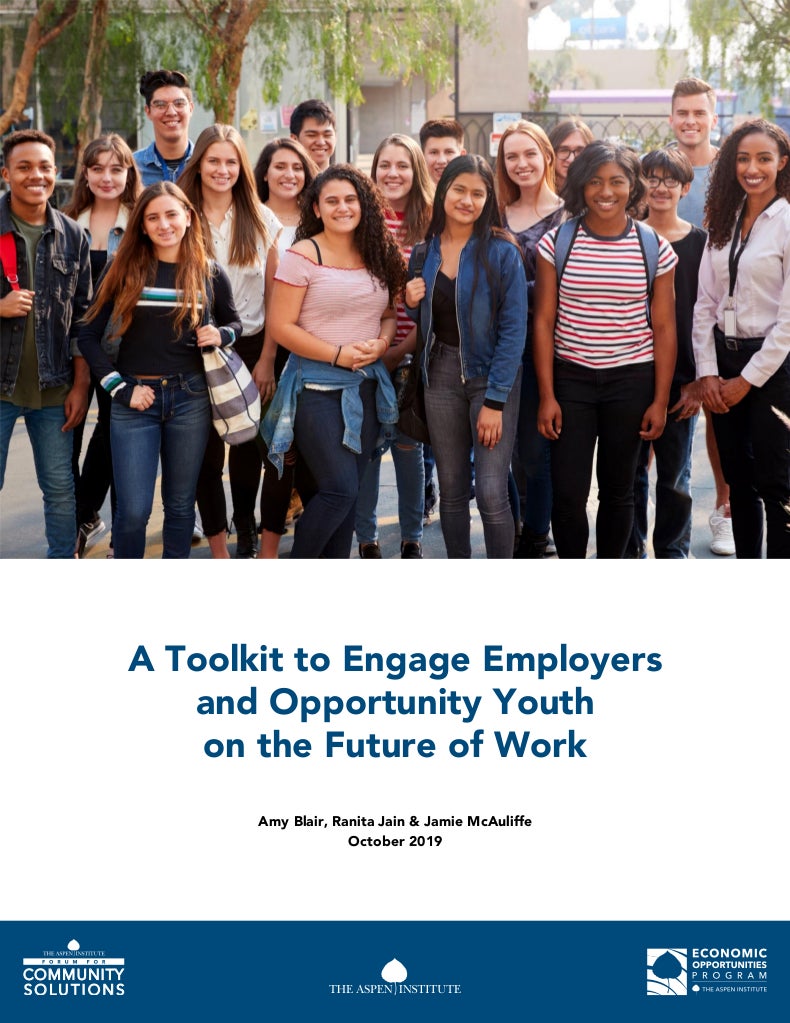
A Toolkit to Engage Employers and Opportunity Youth on the Future of Work

