Solving the Consumer Debt Crisis
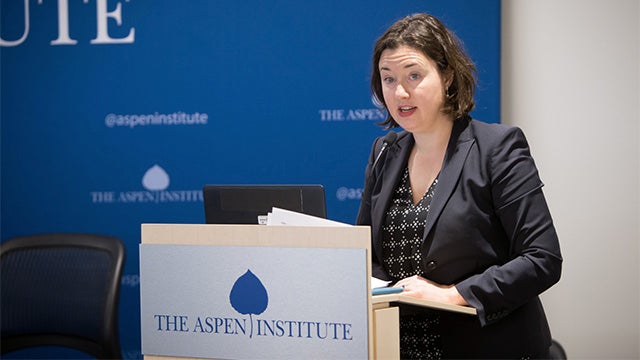

Genevieve Melford
Managing Director
On November 14, the Aspen Institute Financial Security Program’s Expanding Prosperity Impact Collaborative (EPIC) hosted a launch event for the release of its Consumer Debt Solutions Framework. Genevieve Melford, Program Director of EPIC and Director of Insights and Evidence for the Aspen Institute Financial Security Program, gave the following opening remarks about EPIC’s work on consumer debt.
Good morning and welcome to everyone in the room and watching online. I am so pleased to have such a diverse and powerful set of stakeholders here with us today – in person and online – for the release of our consumer debt solutions framework.
None of it would be possible without the incredible work of our whole FSP team, the brilliant and generous experts who work with us to inform the EPIC process, and our core EPIC funders, to whom we extend our warmest thanks: the Annie E. Casey Foundation, JP Morgan Chase & Co., MetLife Foundation, and the W.K. Kellogg Foundation.
This framework launch is a culmination of the last 18 months of work through our EPIC process. EPIC is designed to harness the knowledge of a wide cross-section of experts working in non-profit, academic, government and industry settings to generate deeply informed analyses of one issue at a time. And to forge consensus and broad support to implement solutions.
The first issue we investigated through this process was income volatility. Eighteen months ago, we turned to consumer debt.
The two criteria we use to choose an EPIC issue are that it represents a deeply consequential challenge to the financial security of millions of American households, and that it is not fully understood. Consumer debt meets both criteria.
“The problems of consumer debt are systemic, consequential, and solvable.”
In the United States, consumer debt has reached record levels and is a reality for most Americans. Since World War II, every generation of Americans has carried more consumer debt than the generation before. Today, 77 percent of Americans have at least some debt, and the current total non-mortgage debt held by American households exceeds $3.95 trillion.
Consumer debt includes student and auto loans and money owed on credit cards, but not all debt is a result of borrowing. Out-of-pocket medical expenses, government-imposed fines and fees, and unpaid bills also add to total consumer debt burdens. One indication that these debts are not sustainable for many people is that debt in collections appears on one-third of all consumer credit reports.
Consumer debt is a complicated issue. One of the challenges to finding effective solutions is that most experts tend to study a single category of debt. So the EPIC process chose to look at debt from the consumer perspective, specifically exploring the aspects of debt most harmful to households and the country, their causes and consequences, and the types of solutions that can make a difference.
The core message from these 18 months of work is this: The problems of consumer debt are systemic, consequential, and solvable.
The story of the American economy since at least the 1970s is the story of a shift from manufacturing to knowledge and services. This means that good jobs increasingly require a college degree. Concurrently, the cost of college has outstripped the consumer price index by more than 500 percent. As a result, 70 percent of today’s college students cannot enroll without borrowing; the average debt upon graduation for a member of the class of 2017 exceeds $39,000.
Stagnating incomes and thin margins are another major driver of consumer debt. Too many households simply do not have sufficient income to meet basic needs and provide a cushion for the unexpected. Such households have to borrow to smooth consumption — often on terms that trap them in a debt cycle from which it can be very difficult to break free — or simply cannot afford the basics. One-third of all delinquent debt is from unpaid bills.
Medical costs, despite the partial relief provided by the Affordable Care Act, exacerbate the consumer debt problem. American families are struggling with both increased medical premiums and increased out-of-pocket expenses. One in five consumers have a medical collections tradeline on their credit report, and more than half of those with medical debt have otherwise clean credit histories.
Another systemic driver of consumer debt is that state and municipal governments increasingly rely on fines and fees to make up for revenue shortfalls. Those fines and fees disproportionately affect low-income households already struggling with debt, and the unique power of the state to impose escalating penalties can cause government-imposed debts to snowball quickly to crisis proportions for vulnerable households.
All this debt is consequential. It has impacts at every level: individual, family, community, and for the nation as a whole.
Individual debtors face a range of possible responses from creditors that can make a bad situation worse: loss of income from wage garnishments, loss of necessary transportation to earn income from repossessed cars, higher interest rates, penalties and late fees, loss of driving privileges, and even jail.
Individuals who struggle with debt have worse physical health and are more than twice as likely to suffer from depression and anxiety disorders. Debt-stressed people tend to postpone marrying and starting families until they are on more stable financial footing — a state of affairs that may be far in the future and difficult to achieve. And if already living in a family, debt-stressed parents have less time and energy for their children. Debt-stressed people also have a harder time engaging in civic life, and a community of stressed out, socially isolated people is not healthy.
At the national level, most student loans are guaranteed by the federal government and already 11 percent are in default. Consumer debt also imposes real costs to the economy: in the present (such as higher health care costs for the higher rates of illness debt-stressed people suffer), in the future (when lower levels of retirement savings among the debt-stressed will mean more public assistance requirements in their old age), and in opportunity costs (through lower worker productivity and lower levels of the consumer spending that is a major driver of the economy).
The good news is that the consumer debt crisis is also solvable.
The solutions framework we are releasing today outlines seven specific consumer debt problems that are a source of financial insecurity for millions of people and lays out a menu of actions that leaders in all sectors can take to lift the weight of consumer debt from families, communities, and future generations of Americans.
A Financial Security Threat in the Courtroom

Medical Debt and its Impacts on Health and Wealth: What Can Philanthropy Do to Help?
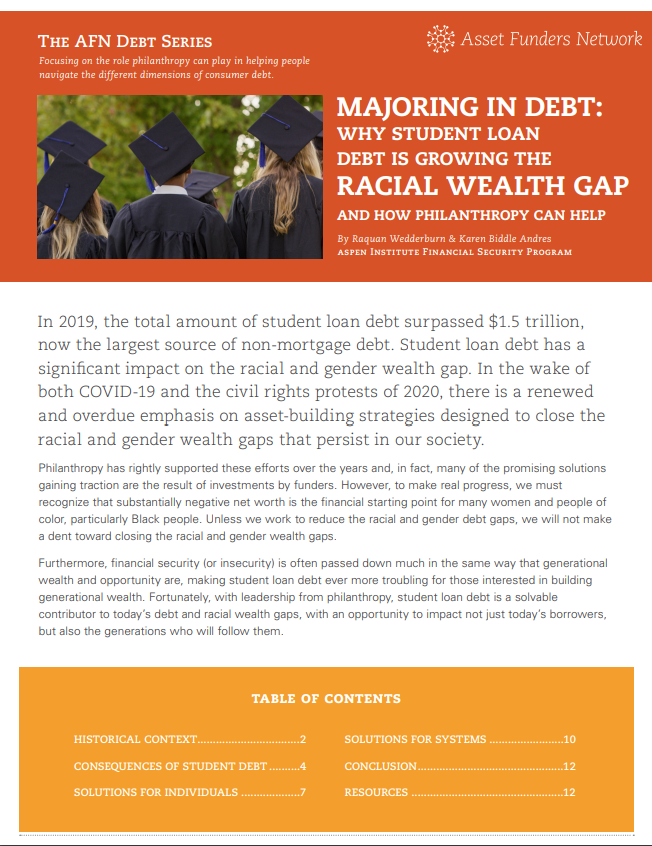
Majoring in Debt: Why Student Loan Debt is Growing the Racial Wealth Gap and How Philanthropy Can Help

Set Up to Fail: Fines, Fees & Financial Insecurity
Strong Foundations: Housing Security Solutions Framework
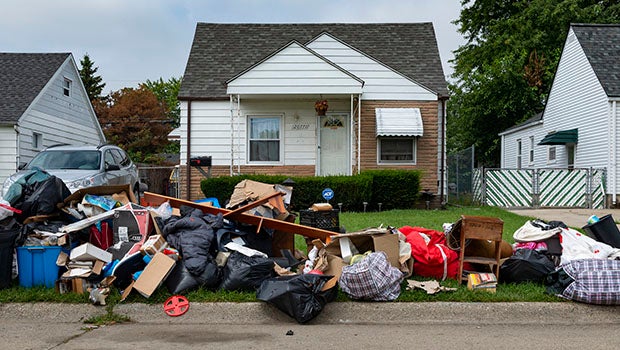
The COVID-19 Eviction Crisis: an Estimated 30-40 Million People in America Are at Risk
The True Cost of Caregiving
Strong Foundations: Financial Security Starts with Affordable, Stable Housing