
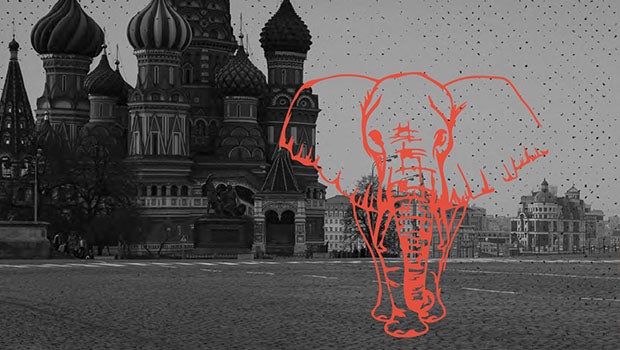
George Orwell’s “Shooting an Elephant” tells the story of a policeman asked to shoot an innocent elephant at the bequest of an angry mob. As he struggles with the decision, Fellows are challenged to grapple with questions of what it means to lead with integrity and how one stands up to a crowd to do what is right. But have you considered what it might mean to be the elephant?
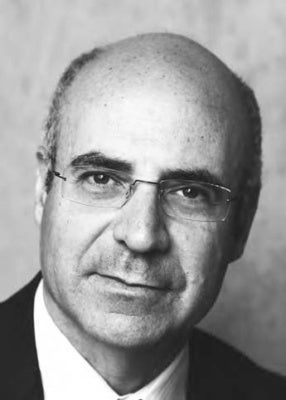
In this piece, Henry Crown Fellow Bill Browder explores what it is like to be in the crosshairs. For the past nine years, Bill has been fighting for justice in the memory of his lawyer, Sergei Magnitsky, who died while in the custody of Russian police. As the founder and CEO of Hermitage Capital Management, one of the largest investment funds in Russia, Bill encountered many leaders lapsing on their integrity and succumbing to the pressures of corruption. Now he is on a global campaign to pass laws to punish human rights violators in Russia. It has not been easy. In this piece, we see a snapshot of what it takes to lead with fearlessness.
When most people read George Orwell’s “Shooting an Elephant,” they probably ask themselves the question: “What would I do if I were a policeman in Burma and had to decide how to respond to angry villagers demanding I shoot an elephant rampaging through their village?”
Would I succumb to the group pressure? Would I have the strength to overcome the chanting of the locals with pitchforks wanting me to kill the elephant? Interestingly, my reaction to the 1936 story was totally different. I didn’t think about the policeman at all. I looked at it from the perspective of the elephant. That may sound strange, but the reason is that I was in a very similar situation to the elephant’s. On Wednesday May 30, 2018, I was arrested in Madrid, Spain, on a Russian Interpol warrant that had been cooked up by Vladimir Putin to go after me for exposing him and his cronies’ money to financial sanctions in the West.
In my case, the locals and their pitchforks took the shape of Putin, the General Prosecutor of Russia, Yuri Chaika, officials in the Interior Affairs Ministry of Russia, and their representatives at Interpol. This group has consistently demanded to have me arrested ever since the passage of the Magnitsky Act by the U.S. Congress in 2012. The Magnitsky Act imposes visa bans and asset freezes on human rights violators in Russia, including those Russian officials who killed my Russian lawyer Sergei Magnitsky. Since then, like the elephant in the story, I’ve been on the rampage, stepping on all sorts of Russian officials and their assets all over the world.
I have now been successful in getting seven countries to pass Magnitsky Acts, and 15 countries to open criminal money laundering investigations into the crime that Sergei Magnitsky discovered, testified about, and was killed over. Like the elephant in the Orwell story, I’ve been going from village to village, and in each village the Russians demanded that I should be arrested.
For the most part, their demands fell on deaf ears. In Britain, the government said arresting me was contrary to public order and rejected Russia’s request. Interpol said the Russian allegations against me were political and contrary to Interpol’s Constitution. Germany said it would refuse the Russian requests because they were illegitimate. Holland said it would reject the Russian approaches because of their abusive nature.
In all these cases, the policemen did not shoot — in spite of the chanting and pitchforks. However, that all changed in Madrid. I was going on another rampage, this time to meet with a famous Spanish prosecutor, Jose Grinda, renowned for his prosecutions of Russian organized crime. Alexander Litvinenko, the famous Russian spy who defected to the U.K., was killed in London with polonium-210 as he was planning to meet with Grinda to discuss evidence against Putin. More recently, Grinda prosecuted dozens of Russian mafia and government officials in one of the largest prosecutions in history.
In my case, I had evidence for Grinda that showed €30 million connected to the fraud that Magnitsky had exposed, and was killed over in Russia, had been used to acquire luxury property on the coast of Spain.
I was scheduled to meet with the prosecutor at 11 a.m. on Wednesday, May 30, in Madrid.
I checked into a hotel on Tuesday night, got a good night’s sleep, and started to prepare my thoughts for the crucial meeting the next morning.
As I was tying my tie at 9:40 a.m., there was a knock on the door. I answered it. Outside the door were two Spanish police officers.
They asked for my identification. When I produced it, they compared it with a piece of paper they were carrying. It was a match. I was indeed the person they were looking for and they told me I was under arrest. I asked “why” and in broken English one of the officers said two words – “Interpol Russia.”
My heart jumped.
But the police officers then gave me a unique opportunity. They let me collect my belongings before leaving the hotel room.
I seized on the brief time to send out a tweet. It said: “Urgent: Just was arrested by Spanish police in Madrid on a Russian Interpol arrest warrant. Going to the police station right now.”
As the officers loaded me into a car, an entirely new set of villagers with pitchforks started chanting, but these new villagers did not wish to shoot the elephant. These were the ones who wanted to save the elephant.
Within minutes, thousands of people retweeted my tweet.
Politicians, friends, citizens – all demanded to know why Putin’s biggest foreign critic was arrested on a bogus Russian arrest warrant.
Calls started to come into the Spanish police, the Spanish Ministry of Interior, the Foreign Ministry, and Interpol headquarters. Journalists wanted an update. Citizens demanded that I be released. I could see the screen of my phone on the police officer’s desk buzzing bright and wild with messages and calls. I saw an incoming call from Boris Johnson, the U.K. foreign secretary. I couldn’t answer any of them – my phone was confiscated by the police.
It all reached a fever pitch within an hour.
And then, as I was sitting in a windowless room at the local police station, I was suddenly informed that the Russian warrant was not going to be honored.
I was free to leave. The elephant had survived.
About the Aspen Global Leadership Network
The Aspen Global Leadership Network (AGLN) is a dynamic, worldwide community of nearly 4,000 entrepreneurial leaders from over 60 countries. Spanning business, government, and the nonprofit sector, these leaders share a commitment to enlightened leadership and the drive to tackle the most pressing challenges of our times. Through transformative Fellowship programs and gatherings like the Resnick Aspen Action Forum, AGLN Fellows have the unique opportunity to connect, collaborate, and challenge each other to grow and commit to a lifelong journey of impact.