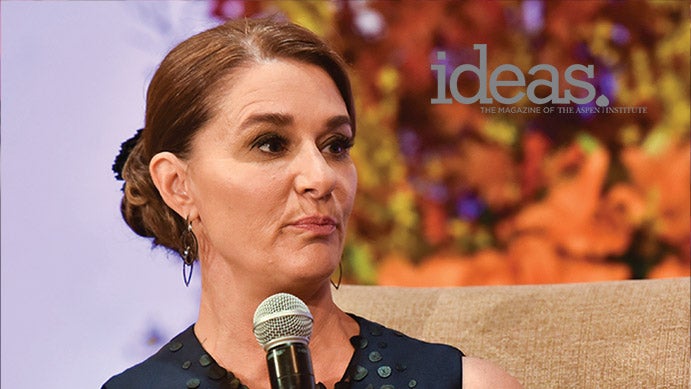
Bill and Melinda Gates have become as famous for their philanthropic work as they are for the company that launched their success, Microsoft. “We knew the wealth from Microsoft would go back to society,” Melinda Gates told Institute CEO Walter Isaacson last November at the Institute’s Annual Awards Dinner at the Plaza Hotel in New York City. “It was a matter of when, not if—and then it became how.” The Aspen Institute awarded Gates its 2016 Public Service Award to honor the contributions in global health and education that she and the Bill & Melinda Gates Foundation have made around the world. She spoke with Isaacson about birth control, empowering women, and the value of data.
On contraceptives:
There are 225 million women crying out for birth control. I was out in the field talking about vaccines, and women were constantly asking me for birth control.
As I learned how global health backed away from contraceptives—I realized I had to do it.[/quote_embed]
In Africa, they predominantly get a shot every three months. It’s painful, but it’s covert, so their husbands don’t know about it. The women would say to me: “You’re asking me about shots for my children. I know about those, and they’re in stock. But what about my shot? I go to that clinic, I walk ten kilometers, make up an excuse to leave my field, take my babies…” It was a rallying cry. That’s what happens when you listen. I kept wanting to turn away, to say, “No, let’s keep working on vaccines.” But eventually, as I started to learn the history of this field—and how global health has backed away from contraceptives—I realized I had to step up and do it.
The pill works in the United States. But women around the world will tell you they can’t use the pill. They can’t hide it from their husbands or remember to take it every day. This shot that they were getting is what they want, but they want it more easily and in greater supply. So, with our partners, we got a shot you can give to yourself: a blister pack with a tiny needle that a health care worker can put in her kit and go out and give to women. We’re working on registration in a few dozen countries, so that women will be able to get it, take it home, and take it themselves. That’s a game changer. That’s how technology is helping women.
On gender:
When I first got into philanthropy, I wanted to stay away from gender issues. I saw them as soft things. I thought, I’m a hard-core technologist. I believe in data. But I realized that women are the ones carrying the burdens—not only in the developing world but in the United States. Women do the unpaid labor, the second shift at home. In the developing world, women come up against these inequities over and over, and we don’t collect the data.When you empower a woman, she empowers everyone around her. She decides who eats in the house. She’s in charge of malarial medication or paying school fees. We don’t invest at a huge scale in women, and that’s a big mistake. Unless we make the investments, we won’t change.
[quote_embed]When you empower a woman, she empowers everyone around her.
On data:
How will I know if I’m fixing the West African reproductive-health supply chain unless I have data? But there’s also value in the women telling us the story of their lives. Women will tell you: “Nobody has asked for my story. No one has every cared enough about me to ask.” Sometimes the man of the house will turn the researcher away, and the woman will find a way to come out and say, “Meet me at the well in an hour.” Without those stories, we don’t know how to act.
Our foundation’s resources may look enormous. But given the depth of the problems in society, they are tiny. It takes governments to scale programs up. I can’t call on the government to invest unless I know that I personally am willing to put down my dollars—and I won’t unless I have the data to know its a good investment.
For more from this conversation, check out the full video here: