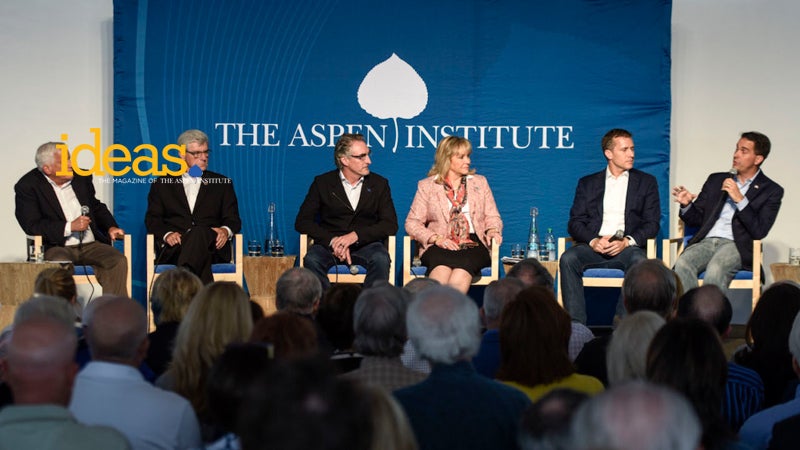

Republican Governors: Power to the States

Give the management and the money for health care over to the states, a panel of Republican governors said at a McCloskey Speaker Series event in August. Just when the health care debate returned to the Senate in late July, most of the nation’s 33 GOP governors were attending the annual meeting of the Republican Governors Association in Aspen. Mississippi Governor Phil Bryant, North Dakota Governor Doug Burgum, Oklahoma Governor Mary Fallin, Missouri Governor Eric Greitens, and Wisconsin Governor Scott Walker made time to speak with Institute CEO Walter Isaacson about health care, opioids, cybersecurity, and more—pointing out their ability to get problems solved as debates over issues and budgets drag on at the federal level.

Walker suggested states be given full-scale block grants for health care. “The best approach is to give full responsibility and resources to the states,” he said, noting that although Wisconsin did not take the Medicaid expansion under the Affordable Care Act, the state does not have an insurance gap—that is, few Wisconsin residents earn too much to qualify for Medicaid but not enough to qualify for tax credits. Greitens made the case for “maximum flexibility” so states can do what works for them. For example, he said, Missouri is a leading center for telemedicine, which has lowered costs and expanded care in rural areas yet is restricted under Medicaid. And Bryant suggested just starting over from scratch with health care—determine a budget first, then borrow good ideas from the states. “We need to stop politicizing this issue,” Bryant said. “Lives depend on what we do.”


Longform Publications Section 4: Strengthening Practices to Improve Job Quality

Tools: Employee Ownership

View tools and resources related to employee ownership.

Blog Posts Job Quality Fellows Profile Series Longform

Centering Workers in Workforce Development

The Chicagoland Workforce Funder Alliance collaborates with employers and stakeholders to boost employment, earnings, and equity for local workers.

Blog Posts Job Quality Fellows Profile Series Longform

Lessons and Leadership To Foster Economic Justice for Illinois Workers

LEP trains workers to promote equity, enforce rights, build unions, develop leaders, ensure workplace safety, and advance economic justice.

Blog Posts Job Quality Fellows Profile Series Longform

Worker Owned and Worker Driven

While the rideshare apps have increased convenience, they’ve eroded job quality. See how the Drivers’ Cooperative is helping to end exploitative conditions.

Blog Posts Job Quality Fellows Profile Series Longform

Creating Employee-Owned Businesses That Provide Good Jobs and Succeed

Through employee ownership, The Industrial Commons is building a new Southern working class that erases the inequities of generational poverty.

Blog Posts Job Quality Fellows Profile Series Longform

Strengthening the Hidden Resilience Workforce

We see the effects of climate change, but we rarely see the people who help to rebuild — and they often lack safe conditions, decent pay, or benefits.

Blog Posts Job Quality Fellows Profile Series Longform

Advancing a Pro-Worker, Pro-Climate Agenda in Texas

The Texas Climate Jobs Project advances a pro-worker, pro-climate agenda — helping to solve the climate crisis while creating millions of good jobs.

Blog Posts Job Quality Fellows Profile Series Longform

Organizing and Coalition Building for Structural Change

LAANE, led by Job Quality Fellow Roxana Tynan, is fighting to build an economy rooted in good jobs, thriving communities, and a healthy environment.

Blog Posts Job Quality Fellows Profile Series Longform

Organizing Unemployed and Underemployed Workers

UWU, led by Job Quality Fellow Neidi Dominguez, engages unemployed/underemployed workers, a population that has not been mobilized at scale since the 1930s.

Blog Posts Longform

How Local Journalism Can Bring Communities Together

MIT Center for Constructive Communication Director Deb Roy explains how the caricatures Republicans and Democrats paint of each other diverge from reality, and the ways local newsrooms can leverage their “trust capital” and emerging technology to promote listening and understanding amid disagreement.