How one lunch lit a weaving fire
Subscribe to Weave’s Newsletter
This story was originally published on Weave’s newsletter. Every week, you’ll get resources on how to weave our communities and restore social trust.
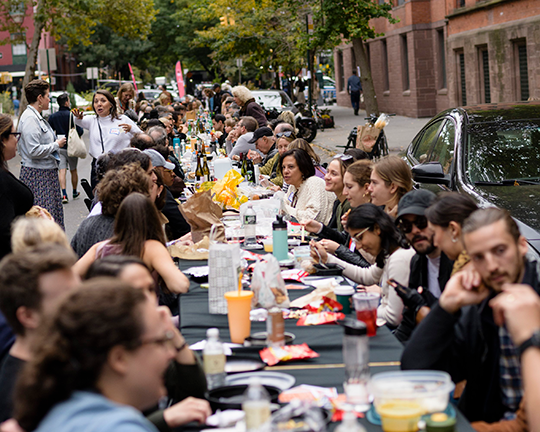
In a city where everyone lives on top of each other, you’d think neighbors know each other. But that’s not true in many cities. So eight people in the Chelsea neighborhood of New York City got a permit to close down their street and invited everyone to lunch.
They designed a flyer, rented tables and chairs, and told neighbors to bring a dish to share. Five hundred folks showed up on a Sunday morning. They all ate at a very long table in the middle of the street. They refer to it as the Longest Table and have held it every year since.
We normally don’t share one-off or annual events like this in the Weave newsletter. That’s because weaving is about neighbors coming together again and again to do things that make their communities stronger and build relationships over time. But Maryam Banikarim and Andrew Lerner, the co-founders, say that the Longest Table creates a contagious energy that has launched dozens of weaving efforts.
One set of neighbors decided to invite a group of opera singers from Brooklyn to come and perform concerts in the street. They even organized a full opera that had 160 neighbors show up with folding chairs. Another lunch group started a block association to tackle issues and celebrate successes together. Some decided they would go all out in decorating their homes for Pride or Halloween and that ritual traveled to other blocks.
The lunch experience also invited small changes. “I started having my morning coffee in my stoop instead of going to a coffee shop, so I could chat with passersby,” says Banikarim. “A couple weeks later, I saw my neighbor David having his coffee in the stoop and doing the same thing. I’ve seen it happen more and more down the block.”
The Longest Table organizers have discovered a few tricks to light the fire of connection at their lunches. “One of the key things that we do is that we have ‘table captains.’ They are volunteers who become part of the organizing committee and are mini-hosts who self organize a group at the table,” says Lerner. He and other organizers seek them out.
The table captains are weavers already active in the neighborhood. They have their own networks, which they bring into the Longest Table, but they don’t necessarily know other weavers. Lerner says, “We go to different parts of the community and reach directly to groups like the police, the Chelsea Garden Club, and the housing projects, and invite everyone.”
By having many hosts, it sets a welcoming and inclusive tone that fosters connections, says Debra Goetz, another organizer. “Hosts understand that their duty is as much to manage and engage with their group, as it is to also help their group meet other groups.”
She and Banikarim say the formula is pretty simple: You eat lunch with people you probably pass on the street all the time and have never met. After the lunch, you now recognize them and have something in common to talk about. Then you and they start noticing the community building happening around you and either get involved or organize something on your own block.
A professor from Columbia conducted a survey in 2023 and 2024 to understand the impact of the Longest Table in the Chelsea neighborhood. She found that 87% of the attendees connected with someone new, 79% felt less lonely, 82% wanted to get involved in their neighborhood, and 90% felt good about their neighborhood.
“People want to feel connected. But for many, it’s really hard to figure out how to get involved in the neighborhood,” says Banikarim. “The Longest Table provides a low-bar for entry. It’s a warm invitation that is very broad. Everyone can join. And when they do, they see that it’s not so hard after all to connect with your neighbors. ”
Intrigued to see if you can kickstart connections in your city neighborhood with a Longest Table? Learn more and get tips from Banikarim, Lerner, and Goetz on The Longest Table website. They say more than 200 folks have contacted them and they know of 36 tables happening this year.

Growing the Pie: Lessons on Wealth Building with Devin Murphy

What Will Great Business Leadership Look Like in 2026?

Fellows On Fellows: Leading with Purpose in the Public Eye
Standing in Hope and Gratitude: Leading With Vulnerability and Purpose
Bridging Divides with Humility: A Leadership Journey Rooted in Purpose

Young People Are Not Just the Future—They Are the Present
Turning Compassion Into Action: A Lifelong Fight to Protect Children