
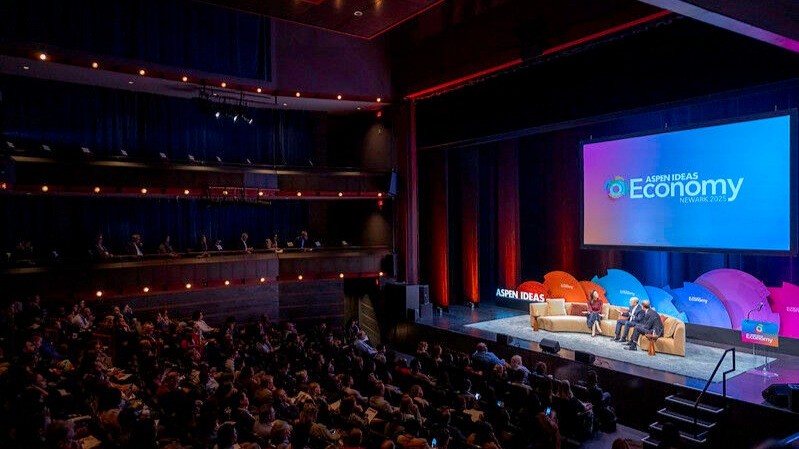

I just attended Aspen Ideas: Economy in Newark – the first edition of what will be an annual exploration of what holds the USA back economically, what propels us forward, and, importantly, who receives what size slice of the economic pie.
Hats off to Prudential Financial, which played an important role in hosting the event at the New Jersey Performing Arts Center, and to our colleagues, especially Ida Rademacher and the entire public programs team at The Aspen Institute
I learned a lot about my neighboring state on the other side of the Hudson; I was called to think about how investment in cities, infrastructure, and our energy future affect the health of the economy and wellbeing of our citizenry overall.
Interviews with Newark and New Jersey state officials offered a window into the consequences of lagging support for infrastructure – from mass transit to access to broadband. Cities are key to the health of the American economy; what should a robust program of investment look like (and why are cities under attack?).
New Jersey has a great story to tell. Garden State public schools consistently place at the top of national rankings, urban crime is way down, and there’s strong, bipartisan support to invest in the innovation economy. The population of our most densely populated state is growing, yet the “affordability crisis” is hitting New Jersey’s residents hard. Pocketbook issues, including access to affordable housing and skyrocketing energy costs, are front and center in the high profile race for governor.
This Heatmap News piece on New Jersey energy prices landed just in time for my train back into NYC. It explains why the state’s citizens suffer from some of the “highest and fastest-rising retail electricity prices in the nation.” Read it to understand the complexity. (Population growth may contribute to energy demand, but the backstory is about energy capacity deployed by data centers.)
The President’s war on renewables, including innovations and investment in wind, solar and battery storage, looms large as an economic issue, not just an environmental concern. Wherever you stand on fossil fuels, it is clear we will need all of the tools in the tool kit – solar, wind, and nuclear, as well as oil and gas – to meet energy demand for the foreseeable future. We are witnessing massive disruption in incentives and reversal of public investment in renewables – projects that were already shovel ready, or underway are coming to a screeching halt. Mind-boggling.
Regardless of the signals from the administration, demand for alternatives to fossil fuels continues to grow. It comes back to supply and demand, and the health of our economy.
One can try to reason through the winners and losers in the game being played now. But who can really win in this scenario, and for how long?
This blog post was originally published on LinkedIn. Follow Judy Samuelson for more insights on business and society.