Meet me in the living room on Main Street
Subscribe to Our Newsletter
This story was originally published on Weave’s newsletter. Every week, you’ll get resources on how to weave our communities and restore social trust.
A year and a half ago, Lisa Garcia received a big box in the mail at her home in Blacksburg, VA. It came from an organization in the UK. Inside, she found a bunch of goodies, including hanging lights, mugs, a visitor book, and a vinyl sign.
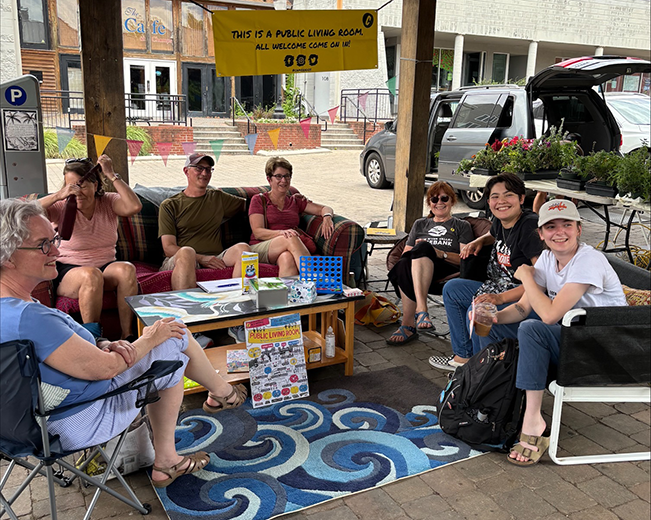
The next week, she asked her husband to help her pack all the furniture in their living room into the car, so she could bring it to the local farmers market. “We had all the signs and stuff, but we needed furniture, so we used ours,” says Garcia. “A part of me thought, ‘this is insanity, what will people think when they see a living room in the middle of the market?’”
Within 15 minutes, it was standing room only. “Folks would walk by and ask what we were selling. I told them that we were selling nothing, that it was a public living room. Everyone is welcome to sit and chat,” says Garcia. “And that’s it, they’re just off to the races. It’s simple, but it really strikes a chord.” Folks stayed for hours and asked when the next one was happening.
So, she kept it going. She and a group of other volunteers from the New River Valley TimeBank host regular “public living rooms” at the university, the thrift store, and in parks. She now uses easy-to-move furniture that has been purchased specifically for the events.
The public living room was invented in 2015 by the UK nonprofit Camerados, which believes that “the answer to our problems is each other.” Why? Because connection with others can get us through the toughest of times. More than 460 have been started, mainly in the UK, but also in Canada, Australia, the US, and a few other countries.
Garcia says each of her public living rooms is different. Sometimes someone brings an instrument and plays music, other times people play games like Connect Four. But all provide a welcoming space for neighbors to meet each other and have conversations. “We don’t really have a set schedule, but we organize them regularly. The only constant is that someone new always sits in and before we are ready to leave, they ask to get involved.”
“Anyone can be a Camerado and start a public living room,” says Yvonne Dawson, head of Learning and Partnerships at Camerados. When folks are ready to create a public living room, they apply to receive a box, like the one Garcia got. “We only ask them to follow six principles to be a Camerado to someone else and to create a sense of mutuality.”
The six principles are 1) Mix with people who are not like you; 2) It’s ok to disagree respectfully; 3) No fixing, just be alongside; 4) Ask someone struggling to help you; 5) Have fun, to be silly is to be human; and 6) It’s ok to be a bit rubbish sometimes.
“Our American friends struggle with the last one, they think we mean that they should be ‘trashy,’” says Dawson. “We mean that it’s ok when we make mistakes or not show up being our best. We all have bad days, but the most important thing is that we show up.”
Dawson says that while they are intentional about asking folks not to “fix” each other during the public living rooms, as people develop relationships, they naturally help each other and tackle issues affecting their community together. “We regularly see camerados gather for community cleanups, to start mentorship programs, and do food drives,” she says.
The organization uses a methodology called Community Reporting to capture the effect of public living rooms on people and the community. They share these reports on a website they call The Brain. For example, in Cumnock, Scotland, people received peer support for various emotional, recovery, and isolation issues and the community saw improvements in the way public services were delivered, after housing officials and police started attending the public living rooms.
But the deepest impact, says Garcia, is that the living rooms create spaces for trust building.”They remind us that generally people are nice and good. They are caring.” She says we need more of them, many more.
Intrigued? Learn more and apply at the Camerados website.

To Help Small Businesses Recover From the L.A. Fires, Invest in Community Lenders


Growing the Pie: Lessons on Wealth Building with Devin Murphy

What Will Great Business Leadership Look Like in 2026?

Fellows On Fellows: Leading with Purpose in the Public Eye
Standing in Hope and Gratitude: Leading With Vulnerability and Purpose
Bridging Divides with Humility: A Leadership Journey Rooted in Purpose

Young People Are Not Just the Future—They Are the Present