Never Waste a Crisis: How Colleges Can Find Opportunities in this Moment to Deliver for Students and Communities

Josh Wyner
Vice President, The Aspen Institute; Founder and Executive Director
Today, college and university leaders are confronted with multiple challenges. Enrollments are uncertain, driven by demographic trends, immigration policies, and legal restrictions on recruitment. Budgets are constrained due to diminished tuition revenue as well as federal cuts in grants for research and programming. New laws and guidance are, in some places, limiting what can be taught and how students can be advised. And some college leaders are trying to figure out whether (and how) to respond to targeted demands from the federal government.
At such moments, the tendency is for college leaders to be reactive—to spend all available time trying to predict and navigate change until a new normal emerges. But past crises have shown that moments of disruption can be used by college leaders as an opportunity to advance their mission. Among the most important opportunities colleges ought to pursue: increasing the connection of every college credential to economic mobility for students and talent development for society. These goals matter now for three core reasons.
First, as revealed in the Georgetown University Center on Education and the Workforce’s report, the vast majority of jobs paying at least a livable wage through 2031 (and likely beyond) will—as has been the case for many decades—go to those with a college credential. And an increasing percentage will be held by those with a bachelor’s degree.
Number of good jobs (in millions)
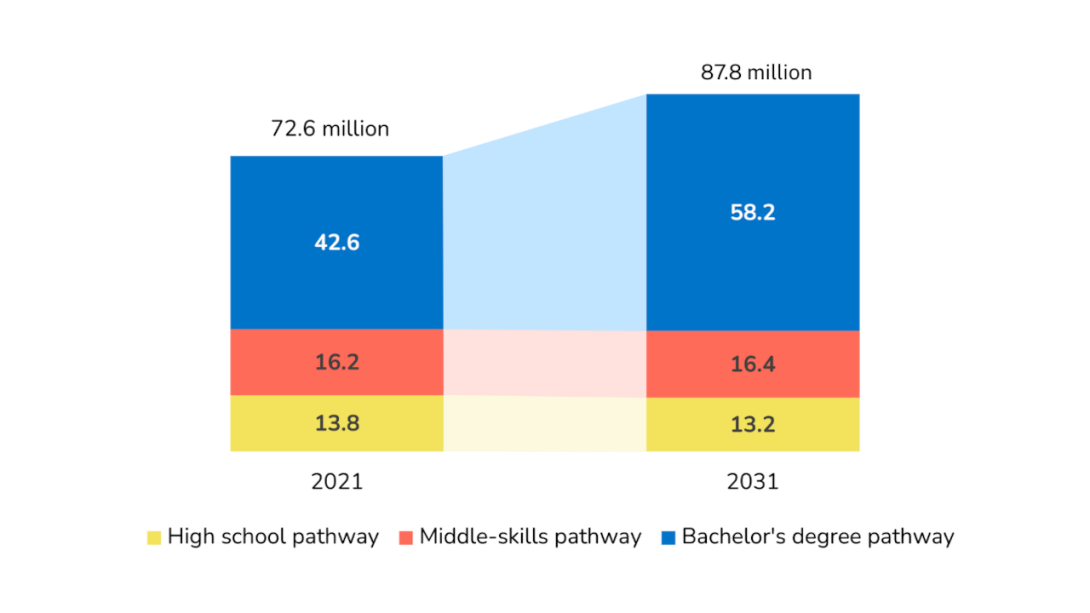
Jeff Strohl, Artem Gulish, and Catherine Morris. The Future of Good Jobs: Projections through 2031.
Washington, DC: Georgetown University Center on Education and the Workforce, 2024.
cew.georgetown.edu/goodjobsprojections2031.
Second, Georgetown also projects shortages of over five million workers over the coming seven years in several fields that require college degrees, including management, nursing, teaching, and engineering. Third, not enough lower-income Americans are being awarded the bachelor’s degrees needed to fill most of that shortfall. Specifically, while nearly 60% of Americans who come from families in the top income quartile have a bachelor’s degree by the age of 24, the average for the bottom economic half is only 20%.
Here are three ideas of what college leaders can do to advance talent development and economic mobility, even in the face of multiple challenges:
Community colleges should strategically recruit dual enrollment students. The data are clear: community college students who take college-level courses while in high school are much more likely to complete degrees, both those conferred by community colleges and bachelor’s degrees after transferring. And, dual enrollment is growing at a remarkable rate. In 2023-24, 2.8 million high school students took a dual enrollment course, up 12.7 percent from the prior year and more than double what it was a decade ago. Community colleges—which deliver about 70% of dual enrollment courses nationally—should see dual enrollment as a strategy to advance their mission. To do this effectively, colleges need to intentionally develop stronger partnerships with high schools that have large numbers of students who might otherwise not attend college and enroll those students in college courses embedded in valuable college programs. To learn more about college business models for scaling purposeful dual enrollment, read this new report by the dual enrollment experts at the Community College Research Center (CCRC).
Universities should recruit more transfer students and serve them well. Every year, hundreds of thousands of students graduate from community college with an associate degree in general studies/liberal arts, and many never transfer to a four-year college to pursue a bachelor’s. An estimated 50,000 high-achieving community college students who have earned GPAs of 3.0 or higher don’t transfer each year. Universities interested in securing enrollment—including for the disproportionately diverse students who attend community college—ought to be capitalizing on this ready source of talent. Doing so requires intentional partnerships with four-year colleges and universities to build clear four-year pathways from community college, as well as much better advising systems. To learn more about strengthening transfer systems, read Aspen and CCRC’s Transfer Playbook 2.0.
Leaders should make reform-minded budget decisions. When finances are tight, colleges often reduce the budget of every function equally, stop all new investments, and/or cut the most recent investment first (whether that’s a new reform, program, or hire). Thoughtful leaders understand that big strategic moves require maintaining focus on important priorities during lean times. So, if 3% of a college budget is dedicated to a major new reform aimed at increasing student success, everything else should be cut more to hold onto that 3%. Periods of budget austerity can also be a good time for college leaders to cut programs that may not lead to the best outcomes for students. That kind of thinking allowed Southwest Wisconsin Technical College, winner of the 2025 Aspen Prize for Community College Excellence, to eliminate culinary arts and auto mechanic programs, which led to low-wage work, preserving resources for expanding nursing and other programs that lead to good-paying jobs. The college has determined that focusing cuts on programs that graduate students into poverty will improve the college’s long-term value proposition. That, in turn, will help secure future enrollments.
It is not easy for presidents to lead major reforms when so much is in flux. At the same time, things have become more challenging for the many students and families who rely on higher education leaders to deliver the kind of educational experience that can improve students’ lives. By carving out time and space to consider how current conditions offer opportunities, college leaders can continue to advance their core mission even now.

Standing in Hope and Gratitude: Leading With Vulnerability and Purpose
Bridging Divides with Humility: A Leadership Journey Rooted in Purpose

Young People Are Not Just the Future—They Are the Present

Turning Compassion Into Action: A Lifelong Fight to Protect Children
Dignity, Trust, and Legacy: What Aspen FSP’s Community Advisory Group Has Taught Me

A Blueprint for Action: Lessons from the National Strategy to Prevent Scams with Nick Bourke
What Did You Learn in 2025?