

I am thrilled to announce that my book, Making Work Matter: How to Create Positive Change in Your CoThe new sports documentary drama, Nyad, tells the remarkable story of Diana Nyad, a champion swimmer, who sought to achieve a life-long ambition – to swim 110 miles, non-stop from Cuba to Florida. She had tried in her 30’s and failed. Now, at 60, she was determined to realize her dream.
As I watched this movie, I couldn’t help but note that Nyad passionately quotes a line from “The Summer Day,” a beloved poem by Mary Oliver, as a prompt for attempting this seemingly impossible feat:
Tell me, what is it you plan to do
with your one wild and precious life?
Poetry can have that effect on us. Poetry inspires. It surprises. It enriches. It perplexes. With compressed, lyrical language, it invites us in to think differently and gives expression to emotions we didn’t know how to name. It illuminates. As 19th century English poet Percy Bysshe Shelley wrote, “Poetry lifts the veil from the hidden beauty of the world.”
Perhaps more surprisingly, poetry can also help us become more effective leaders. In “Why CEOs Need to Read Poetry – yes, Poetry – to Lead in a Post-Covid World,” Clare Morgan and Massimo Portincaso explain that reading poetry trains leaders to develop the kind of mindset needed for these disruptive times: “to live the questions now, while simultaneously developing answers for an unknown and brutally complex future.” Poetry, they write, offers “a way to tune in to undercurrents, accept ambiguity and the absence of answers – embrace lack of closure and relish complexity and uncertainty.”
Years before, in HBR, John Coleman made a similar case for why professionals should read poetry. It helps them become better able to “conceptualize the world and communicate it,” he explained, and makes them more empathetic and creative and to be more hopeful and purposeful.
In consideration of all the ways poetry can enrich us and in celebration of National Poetry Month, I suggest we offer a small thanks to the poets who create these gifts by heading to our local bookstores and buying a book of poems.
If this idea appeals, unless you are already a poetry connoisseur, you may be asking: What book should I buy? I have written about poetry in the past and have been asked this question before. I’m hesitant to recommend since my knowledge of the vast scope of poetry across time and cultures is limited; I know only what I have discovered along my own path. But to get you started on your exploration of options for your next poetry purchase, I’ll name five favorite volumes that have enriched my love of poetry. And I invite you, dear readers, to supplement this small list with suggestions of your own.
1) Devotions: The Selected Poems of Mary Oliver. “The Summer Day” is included in this collection, along with other treasures such as “Wild Geese,” “The Journey,” and “In Blackwater Woods.”
2) A Book of Luminous Things: An International Anthology of Poetry. The volume is edited by Nobel Prize winner Czeslaw Milosz, who explains in the introduction that he selected contemporary and ancient poems that are relatively short and “clear, readable, and . . . loyal toward reality . . . .” The result is a magnificent selection of verses to savor.
3) Leading from Within: Poetry that Sustains the Courage to Lead. Sam M. Intrator and Megan Scribner, the editors of this volume, reached out to leaders in every sector of society and asked them to select a poem that mattered to them and offer a short commentary about their choice, giving us a glimpse at the inner lives of leaders.
4) Ten Poems to Change Your Life is the first in a series of anthologies chosen by Roger Housden, who offers insightful commentary on each poem in the collection. “Good poetry has the power to start a fire in your life,” Housden asserts in his introduction to this volume. And throughout this series, he helps us see how such fires are ignited.
5) Reflections on a Gift of Watermelon Pickle, published in 1967, is a collection compiled by three professors of English who sought to introduce poetry to young people. I encountered the volume decades ago when I was a student teacher in an 8th grade English classroom in Eaton Rapids, Michigan. I fondly recall that the book inspired at least one of my students to write his own verse.
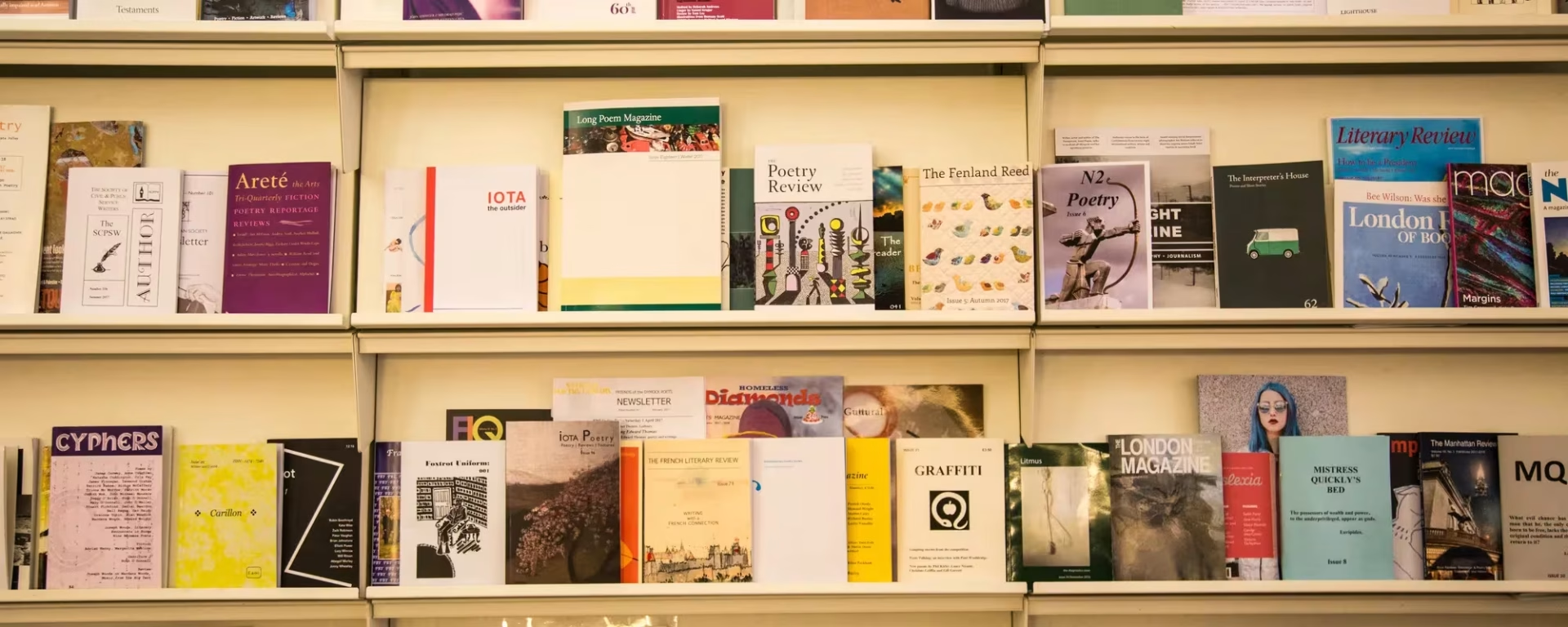
With all the benefits that poetry can bring, poetry books should be flying off the bookstore shelves. Not so. According to Wordsrated.com, although there was an increase in poetry book sales from 2013 to 2017, interest in this genre is declining. It is now at almost half of 2004 levels. Maybe as we celebrate National Poetry Month and find our way to the poetry sections in our favorite bookstores – in person or online – we can shift the trend in the opposite direction.
And as you consider augmenting your own poetry collections, I look forward to hearing about the dog-eared poetry books already on your shelves.
This blog post was originally published on LinkedIn. Follow Nancy McGaw for more insights on business and society.