

This year marks the 10th anniversary of the passage of the Pension Protection Act of 2006 (PPA), widely considered the most important piece of retirement legislation since the passage of the Employee Retirement Income Security Act of 1974 (ERISA). The PPA touched on many aspects of retirement policy. For 401(k)s and other similar defined contribution plans, it authorized a series of streamlined tools – automatic enrollment, automatic escalation, and default investment choices – for the first time. As employers and financial services providers have put these provisions into practice, we have seen real progress in participation rates in firms that offer retirement plans and a shift in the allocation of assets towards more balanced investments. For employees at firms that do not offer plans, however, retirement security remains an elusive goal.
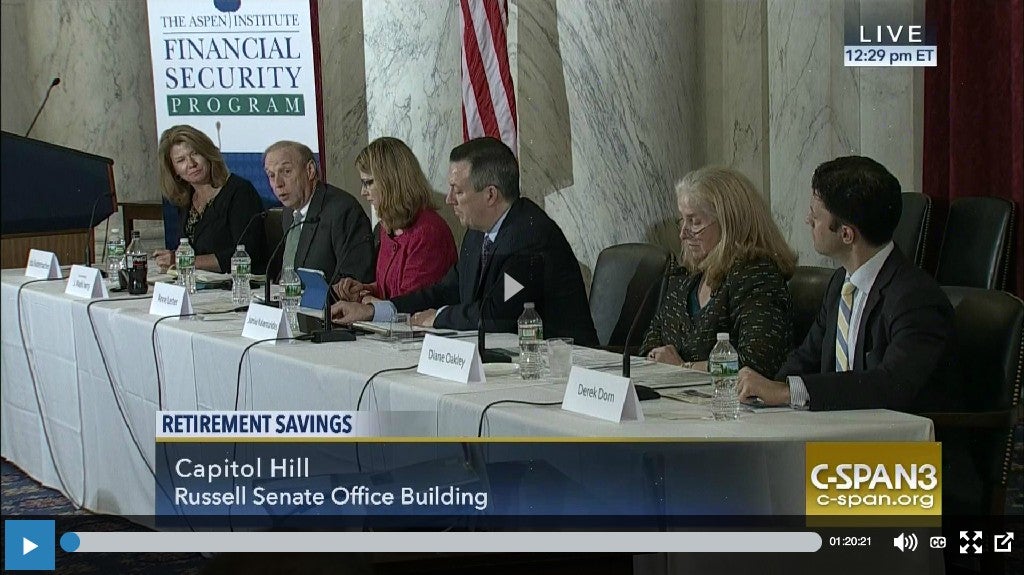
How can we apply the successes of the PPA to ensure that all families can take advantage of proven strategies to save for retirement? This event, which was hosted by the Aspen Institute Financial Security Program (FSP) and broadcast live on C-SPAN3, explored answers to this critical question with insights and dialogue from some of the nation’s leading thinkers and policymakers.
The discussion was launched by FSP Executive Director Ida Rademacher, who noted the results of an Aspen Institute poll conducted a few weeks earlier.
Nearly nine in 10 Americans believe that retirement security should be a significant issue in this year’s election, and two-thirds of the public say that Congress should do more to help Americans save for retirement.
“While the Pension Protection Act took significant steps to better ensure Americans’ well-being in retirement, too many people have so little savings that they face the grim prospect of poverty later in life,” Ms. Rademacher said. “Bold action on many fronts is essential to enable tens of millions of working Americans and their families to achieve retirement security.”
“Retirement security impacts every American family, and Congress must be committed to finding innovative solutions to solve our growing retirement gap,” said Rep. Jared Polis (D-CO), who offered opening remarks at the event. “Helping families plan for retirement is not a partisan issue; it’s an issue that needs problem solvers. That’s why I’m pleased to be participating as a guest of the Aspen Institute, and to be joining other public officials and industry experts as we look for solutions that work for the next generation of retirees.”
“Our nation is facing an urgent saving and retirement security crisis – one that we must address now,” said Rep. Joe Crowley (D-NY), who also made opening remarks. “With too many Americans not saving enough for the future, fewer private-sector workers being offered pensions, and a host of other challenges facing potential retirees, the dream of a secure retirement is slipping away for millions of Americans.”
Watch Ms. Rademacher’s introduction and the Congressmen’s opening remarks:

The Congressmen’s opening remarks were followed by a panel on the PPA’s key impacts and accomplishments, moderated by Jeremy Smith, Aspen FSP’s Associate Director, and featuring Lew Minsky, President and CEO of the Defined Contribution Institutional Investment Association; Jack VanDerhei, Research Director at the Employee Benefit Research Institute (EBRI); Kilolo Kijakazi, Institute Fellow at The Urban Institute; and Keith Ambachtsheer, Director Emeritus at the International Centre for Pension Management at the University of Toronto’s Rotman School of Management.
A keynote address from Edmund F. Murphy III, President of Empower Retirement, came next. “Some of the most beneficial factors that lift retirement readiness can be traced to the 2006 Pension Protection Act,” Mr. Murphy said. “We have a great opportunity to make this country more prosperous and more just.” For the full text of Mr. Murphy’s remarks, as prepared, CLICK HERE.
Watch the first panel and the keynote address:

The keynote was followed by a second – and final – panel, this one focused on what more needs to be done to build retirement savings for all American families. It included presentations from J. Mark Iwry, Senior Advisor to the Secretary and Deputy Assistant Secretary for Retirement and Health Policy at the U.S. Department of the Treasury; Anne Lester, Portfolio Manager and Head of Retirement Solutions for Global Investment Management Solutions at JP Morgan Asset Management; John J. (Jamie) Kalamarides, Head of Institutional Investment Solutions and CEO of Prudential Bank & Trust, FSB at The Prudential Insurance Company of America; Diane Oakley, Executive Director at the National Institute on Retirement Security; and Derek Dorn, Managing Director and Head of Regulatory Engagement and Policy at TIAA.
Watch the second panel:

The Aspen Institute Financial Security Program (FSP) connects the world’s best minds to find breakthrough solutions for America’s family financial security crisis. FSP advances a new generation of policies, products, and services that enable more Americans to meet basic financial needs and withstand financial shocks, while saving for long-term goals like college, homeownership, and retirement.
Back to the FSP homepage.This year marks the 10th anniversary of the passage of the Pension Protection Act of 2006 (PPA), widely considered the most important piece of retirement legislation since the passage of the Employee Retirement Income Security Act of 1974 (ERISA). The PPA touched on many aspects of retirement policy. For private savings, it authorized a series of streamlined tools – automatic enrollment, automatic escalation, and default investment choices – for the first time. As employers and financial services providers have put these provisions into practice, we have seen real progress in participation rates in firms that offer retirement plans and a shift in the allocation of assets towards more balanced investments. For employees at firms that do not offer plans, however, retirement security remains an elusive goal.
How can we apply the successes of the PPA to ensure that all families can take advantage of proven strategies? Over the course of the morning, we will explore answers to this critical question with insights and dialogue from some of the nation’s leading thinkers and policy makers.
The Aspen Institute’s Financial Security Program will bring together an array of business, research, and nonprofit leaders to highlight key accomplishments of the PPA related to automatic enrollment and other features that have expanded participation in private retirement plans, assess the impact of these provisions over the past decade, and explore what more needs to be done to build retirement savings for all American families.
Featuring keynote remarks from:
The Honorable Jared Polis
U.S. Representative, Colorado, 2nd District
Edmund F. Murphy III
President, Empower Retirement
The Honorable Joseph Crowley
U.S. Representative, New York, 14th District
And featuring two distinguished panels, including:
Keith Ambachtsheer
Director Emeritus, International Centre for Pension Management, Rotman School of Management, University of Toronto
Derek B. Dorn
Managing Director, Regulatory Engagement and Policy & Associate General Counsel, TIAA
The Honorable J. Mark Iwry
Senior Advisor to the Secretary and Deputy Assistant Secretary for Retirement and Health Policy, U.S. Department of the Treasury
John J. (Jamie) Kalamarides
Chairman & CEO, Prudential Bank & Trust and Senior Vice President, Prudential Retirement, The Prudential Insurance Company of America
Kilolo Kijakazi
Institute Fellow, The Urban Institute
Anne Lester
Head of Retirement Solutions for Global Investment Management Solutions, JP Morgan Asset Management
Lew Minsky
President and CEO, Defined Contribution Institutional Investment Association (DCIIA)
Diane Oakley
Executive Director, National Institute on Retirement Security (NIRS)
Jack VanDerhei
Research Director, Employee Benefit Research Institute (EBRI)
The Aspen Institute Financial Security Program (FSP) connects the world’s best minds to find breakthrough solutions for America’s family financial security crisis. Millions of workers, families and retirees endure chronic financial insecurity due to ongoing fallout from the Great Recession, foreclosure crisis and disruptive changes to our economy. FSP advances a new generation of policies, products and services that enable more Americans to meet basic financial needs, and withstand financial shocks, while saving for long-term goals like college, home ownership and retirement.