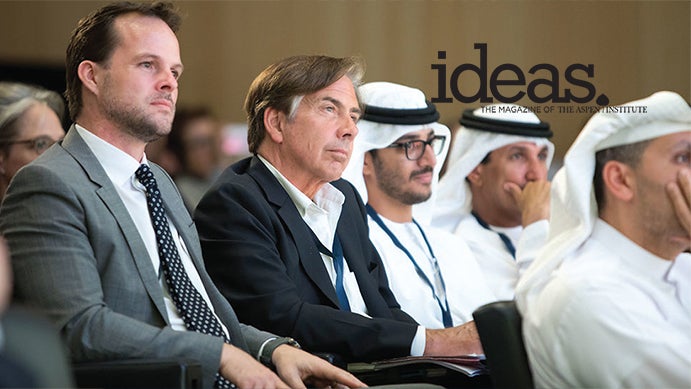
If you cross Abu Dhabi from the sand beaches of Saadiyat Island toward the marble grandeur of Sheikh Zayed Grand Mosque, you will see a series of stunning projects—a testament to the city’s architectural mastery and the symbols of the United Arab Emirates’ dedication to building innovative solutions from the ground up. That’s why the Institute headed to the UAE in March to host the Aspen Abu Dhabi Ideas Forum 2017. More than 30 experts from a variety of disciplines came together with an audience of business leaders, entrepreneurs, students, politicians, venture capitalists, and humanitarians to discuss today’s most pressing issues in one of the world’s most international and interconnected cities. Through two packed days participants explored physics, biology, economics, and political science, and each was challenged to understand new phenomena and the connections between them. The Institute engenders this type of critical thinking in order to advance meaningful solutions. For this, there was no better setting than an exploding knowledge hub like Abu Dhabi.
The forum focused on four major themes: combating global anger and the politics of fear, discovering new measurements of economic success, enhancing healthy lifespans, and living sustainably on Earth. Historian Niall Ferguson talked about the seismic changes taking place in the United States. Rima Al Mokarrab, the chairman of the economic-development group Tamkeen, questioned former British Prime Minister Tony Blair about how governments can defuse rising global tensions. George Osborne, a conservative member of Parliament and a former United Kingdom chancellor, examined whether or not economics can evolve beyond GDP. Freakonomics’ Stephen Dubner quantified the highs and lows of happiness. And that was all just day one.
There is no better setting for innovative solutions than Abu Dhabi.
After such weighty meditations, the forum’s second day was buoyed by hopeful speculation and fueled by talk of scientific progress. Anthony Atala, the director of Wake Forest’s Institute for Regenerative Medicine, demonstrated how human beings in grave medical danger can literally be rebuilt. Discussions on the future of science also left the stratosphere: Naveen Jain, the chairman of MoonExpress, explained the imminence of lunar tourism; former astronaut Buzz Aldrin looked at the best methods of traveling to Mars; and former NASA Chief Scientist Ellen Stofan explained the promise of colonizing Mars.
The forum crowd also visited New York University–Abu Dhabi, where a long, breezy thoroughfare featured a small city of wonders: virtual-reality displays, robot-creation stations, family art projects, flight simulators, pop-up shops, lectures, and live music. The whole event was inspired by the Aspen Ideas Festival, brought to life halfway around the world and tailored for Abu Dhabi, a city that is no stranger to interdisciplinary thinking.