The Aspen Institute New Voices Fellowship is designed to bring voices from the developing world into the global development discussion. Development experts from Africa and other parts of the developing world take part in a year-long program of media support, training, and research under the guidance of experienced mentors. Fellows sharpen their message, elevate their stories, and communicate their insights to provide crucial grassroots perspectives to a worldwide audience. newvoicesfellows.aspeninstitute.org.
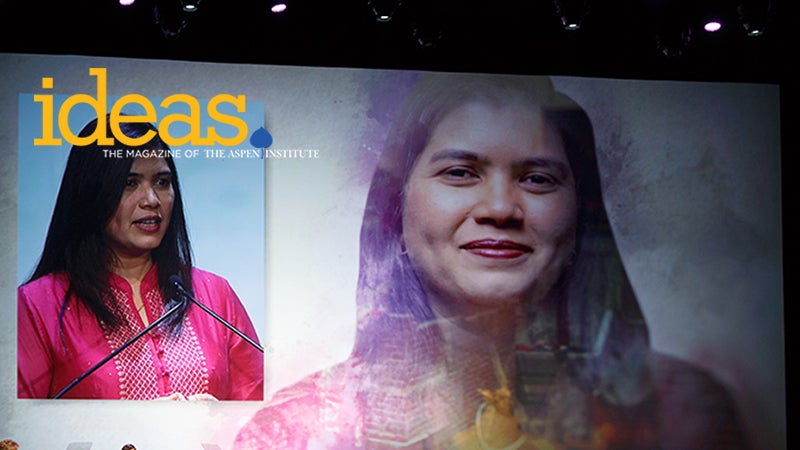
Choosing to Act
By Elsa D’Silva
There are moments in your life when you have to make a choice. For me, hearing about the horrific gang rape of a young woman on a bus in Delhi, India, was one of those moments. It pushed me to launch Safecity, a crowd map of sexual violence in public spaces.
At the time, I was working for one of India’s leading airlines as vice president of network planning. While the work was challenging, I was looking for my purpose in the world. The incident in Delhi caused me to think about relevant incidents in my life, and I began to talk to other women about similar ones in their lives. I was so moved by what I heard that I decided to quit my job and use my skills to end violence against women and girls.
Although I had no experience working on women’s rights and no background in the development sector, I took the plunge and co-founded Safecity in December 2012. The aim is to encourage people through crowdsourcing to anonymously share their stories of sexual violence in public spaces. The stories we receive range from leering and verbal harassment to stalking and other physical harassment. We collate and aggregate the stories as location-based trends, or “hot spots,” on an online map. We use the online data that women and girls share to identify factors that may lead to sexual violence and to help us think through strategies to find solutions. We partner with other NGOs, citizen organizations, and student groups that work in local communities to create awareness and collect information on sexual violence through workshops and meetings. The data highlight trends that are used to mobilize communities to rally around the issue.
Having equal access to safe public spaces is critical for women.[/quote_embed]
Since we began, more than four years ago, we have collected over 10,000 personal stories from all parts of India, Kenya, Nepal, and Cameroon. We have used the information to engage with more than 400,000 people, municipal authorities, and police in Delhi, Mumbai, and Goa as well as transportation authorities in India and Nepal.
Being an Aspen New Voices fellow helped me crystallize my vision and use my voice to amplify this vital issue. I have written over 100 op-eds, blog posts, and articles for international and national news outlets on a range of issues affecting women’s rights. I have presented at the technical meeting for the UN Women’s initiative Safe Cities and Safe Public Spaces, UN Habitat 3, the Aspen Ideas Festival, CityLab London, and TEDx. I have far more requests to speak and write than I can keep up with.
The fellowship has taught me that I have a responsibility to use every opportunity to further my cause. After all, having equal access to safe public spaces is critical to a girl’s receiving an education and to a woman’s taking up employment, advancing in her career, and achieving financial independence.
Elsa D’Silva is the founder and CEO of Red Dot Foundation (Safecity), a platform that documents sexual harassment and abuse in public spaces, and an Aspen New Voices Fellow.
A Life Changing FellowshipBy Regina Agyare
I had just quit my job at a bank in Ghana to begin a social enterprise teaching science, technology, engineering, and mathematics skills to children in rural communities. I started with a lot of passion, but I didn’t know how to communicate my work. Through teaching, I became even more convinced that what the African continent needed to transform itself was a new generation of innovators and critical thinkers. With my visits to rural areas, I saw that many young girls were not allowed to reach their full potential. Most girls had been taught that science and technology were too difficult, and not for them.
I remember the sexism and discrimination I personally faced as a female in a male-dominated field. I wanted to change that for the next generation of women—to bridge the gender gap in technology. New technologies were sorely missing a female perspective. In 2013, the same year I became an Aspen New Voices fellow, I started the Tech Needs Girls Project.
Through the fellowship, I learned how powerful my voice could be if used effectively: how to communicate my mission statement, the elevator pitch, body language during an interview, which communication channels are most effective. After our initial meeting, I was even more determined to change the single dominant narrative of Africa. I went home with a renewed passion—and started a movement. I was able to bring together community leaders and volunteers to help young girls use technology to reach their full potential and break the cycle of poverty. I have now trained more than 3,500 girls in eight regions in Ghana and expanded our impact to Burkina Faso. With the help of the fellowship trainings, I started to write articles and op-eds, and I became the face for the women and girls in technology in my country.
[quote_embed]The sexism I faced as a female in a male-dominated field made me want to change that for the next generation of women.[/quote_embed]
Our mentees have gone on to do amazing things. Some have started foundations or tech companies, and some received full scholarships to study computer science at university. Others were given the opportunity to intern at software companies. These are all girls who came to us with little or no knowledge of computers.
When I got my first international exposure by being profiled on the CNN program African Start-Up, I was prepared to establish my global presence to raise awareness of my work. I was then featured on BBC, Al Jazeera, DW-TV, and local TV and radio stations. I have been asked to speak in over 15 countries. With this new visibility, I have received so much support. A single donor gave 45 laptops to the Tech Needs Girls Project after reading an article about us. Another donated a vehicle that helped us expand into other regions in Ghana. And we are still looking forward. We have started Soronko Academy, the first coding and human-centered design school in West Africa. Now, we have introduced coding as part of the curriculum in a school in Ghana—the first time it has been taught systematically here. We plan to scale this to all public schools in Ghana to change the way STEM is taught and to develop Africa’s future innovators.
Regina Agyare is the CEO of Soronko Solutions and an Aspen New Voices Fellow.
My New Bold Inner VoiceSathya RaghuFebruary 2016
This is the first time I have left the Indian subcontinent, and I am in Johannesburg, South Africa, for my first Aspen New Voices seminar. I find myself in a room with other fellows from almost 15 countries—scientists, doctors, development experts, policymakers…the list is unending. They are so accomplished that I feel like an impostor in this fellowship. But Aspen Institute Vice President Peggy Clark started off the proceedings by giving us all an equal mission. Do development differently. Make ideas reach the light. Enable creative dialogue. Amplify new voices as changemakers. The four points sound very noble to me, but I have no clue how to bring them to life. We debate about whether we are experts in our respective fields. We conclude that we are “experts” but not the only experts.[quote_embed]I resolve more than ever that my voice will be heard.
April 2016
For the first time, I see the power of my amplified voice at the agriculture department of the government of Telangana, where I explain to the minster of agriculture that the policy on climate-smart agriculture that the state currently adopts needs to change. The policy costs the government almost 13 billion rupees each year, but barely benefits even 200 farmers. Earlier in the morning, I questioned myself: should I really say this to government officials? My new, bolder inner voice told me, “I am an expert. We have to do development differently. I should voice the need for change.” I am pleasantly surprised that the government takes my advice seriously. The current policy is later withdrawn, and new policy is introduced —policy that can benefit 20 times more farmers.
December 2016
Writing was never fun for me. But on the last day of the fellowship, as I am lassoing my thoughts with the rope called “op-ed format,” another fellow, Carl Manlan, says: “Sathya, just express yourself by ignoring the format. Write about what you see and what moves you. Then see which tweaks can cover the elements of a good op-ed.” That changes the way I looked at writing. Over the next ten months, I write more than ten pieces for different Indian and international outlets. Carl cares for me and my work, even today.
What changed? First, collaborators began to take our work more seriously as the op-eds started lending credibility to both me and my organization. India’s secondlargest bank agreed to partner with us to roll out a unique financing model. One of the largest greenhouse fabricators in the country considers our organization to be an adviser, not just a customer. The Society for Elevation of Rural Poverty, a joint venture between the World Bank and the government of Andhra Pradesh, reached out to us to make sure our technology reaches millions of farmers in the state.
I know that this is just a beginning for many more things to come. I represent 100 million small farmers who are largely unrepresented in the agricultural policymaking process in my country. I resolve more than ever that my voice will be heard.
Sathya Raghu is the co-founder of Kheyti & Cosmos Green, and an Aspen New Voices Fellow.