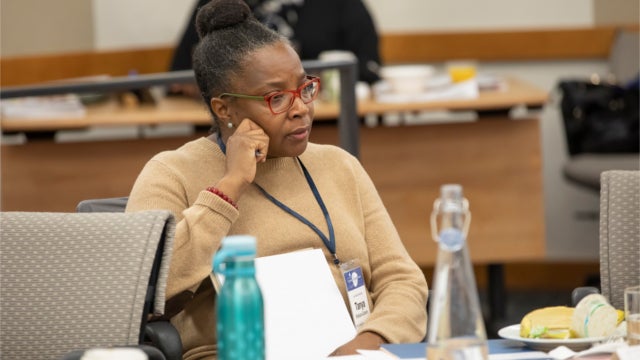

Executive Director, National Black Worker Center Project
The National Black Worker Center Project (NBCWP) is working to address a “two-dimensional jobs crisis” facing Black communities in the US: unemployment and low-wage work. According to Bureau of Labor Statistics data, since 1974, the unemployment rate for Black Americans has been at least twice the rate for White Americans the majority of the time. Black Americans are also experiencing rising wage inequality: As of 2015, Black men make 22% less, and Black women 34% less, relative to White men’s average hourly wages even with the same education, work experience, metro status, and region of residence. These disparities stem from historical and structural factors, as well as persistent racial discrimination.
Founded in 2011, NBCWP is a network of Black worker organizations formed in response to the jobs crisis confronting Black Americans. NBCWP collaborates with existing labor and social change organizations to advance workers’ rights, improve the quality of jobs in key employment sectors, and prevent racial discrimination in hiring and other employment practices and policies. The organization provides technical assistance and support to eight Black worker centers located in cities with high numbers of Black residents: Los Angeles, Chicago, New Orleans, Baltimore, Raleigh, Greenville, Washington, and Oakland.
“One of the things our organization does to ensure quality work is to focus on the barriers and policies that contribute to people lacking access to work,” says Tanya Wallace-Gobern, executive director of NBWCP.
For instance, one of NBWCP’s affiliates, Stand with Dignity, launched a campaign to reduce fines that lead to driver’s license suspensions in New Orleans. Combined with unreliable public transportation, these suspensions often prevent individuals from getting to work. Stand with Dignity’s campaign led to the development of a traffic clinic within the worker center that helps residents confront the court system. One individual reduced his fines from $23,000 to $9, allowing him to have his driver’s license reinstated.
“It’s huge to be able to remove those barriers and give people access to go to work,” says Wallace-Gobern.
Using social media to raise awareness about job quality
Social media is a powerful tool that NBWCP harnesses to capture public attention and build movements that can lead to changes in policies and practice. “We’re inspired by the Black Lives Matter movement and its use of social media to mobilize the African-American community, bolster coalition building, and change the national conversation to create awareness of economic and workplace inequities,” says Wallace-Gobern.
NBWCP partnered with Fight for $15 to host a Black Labor Day “Twitter storm,” which celebrated the achievements and challenges of Black workers using the hashtags #WorkingWhileBlack and #BlackLaborDay. The campaign gathered national attention, including over 120,000 interactions on Twitter.
Currently, Wallace-Gobern is focused on expanding the reach of local Black worker centers. The organization plans to develop new centers in three cities in the next five years and to launch the Black Future Work Program. “This new program will build the capacity of Black workers to effectively address challenges and opportunities emerging from new technologies and work arrangements, with the goal of minimizing racial inequities in the future,” says Wallace-Gobern.
Share
TweetUnder the leadership of Aspen #JobQuality Fellow Tanya Wallace-Gobern, @NBWCP is working to address a two-dimensional jobs crisis facing Black communities in the US: unemployment and low-wage work.Tweet.@NBWCP, led by Aspen #JobQuality Fellow Tanya Wallace-Gobern, collaborates with labor and social change organizations to advance workers’ rights, improve job quality, and prevent racial discrimination.Tweet“Quality jobs and quality work mean a quality life. And when you have a quality life, you’re able to have a vision of quality for yourself, for your family, and for your community.” -Aspen #JobQuality Fellow Tanya Wallace-Gobern @NBWCPTweet“One of the things our organization does to ensure quality work is to focus on the barriers and policies that contribute to people lacking access to work.” -Aspen #JobQuality Fellow Tanya Wallace-Gobern @NBWCPTweetOur economy needs more quality jobs. Learn how leaders like Tanya Wallace-Gobern of @NBWCP are innovating to boost opportunity in communities across the country.
Learn more
is a member of the Job Quality Fellowship, Class of 2018-19. The Job Quality Fellowship is a project of the Aspen Institute Economic Opportunities Program.
The Economic Opportunities Program advances strategies, policies, and ideas to help low- and moderate-income people thrive in a changing economy. Follow us on social media and join our mailing list to stay up-to-date on our work, including publications, events, blog posts, and more.