
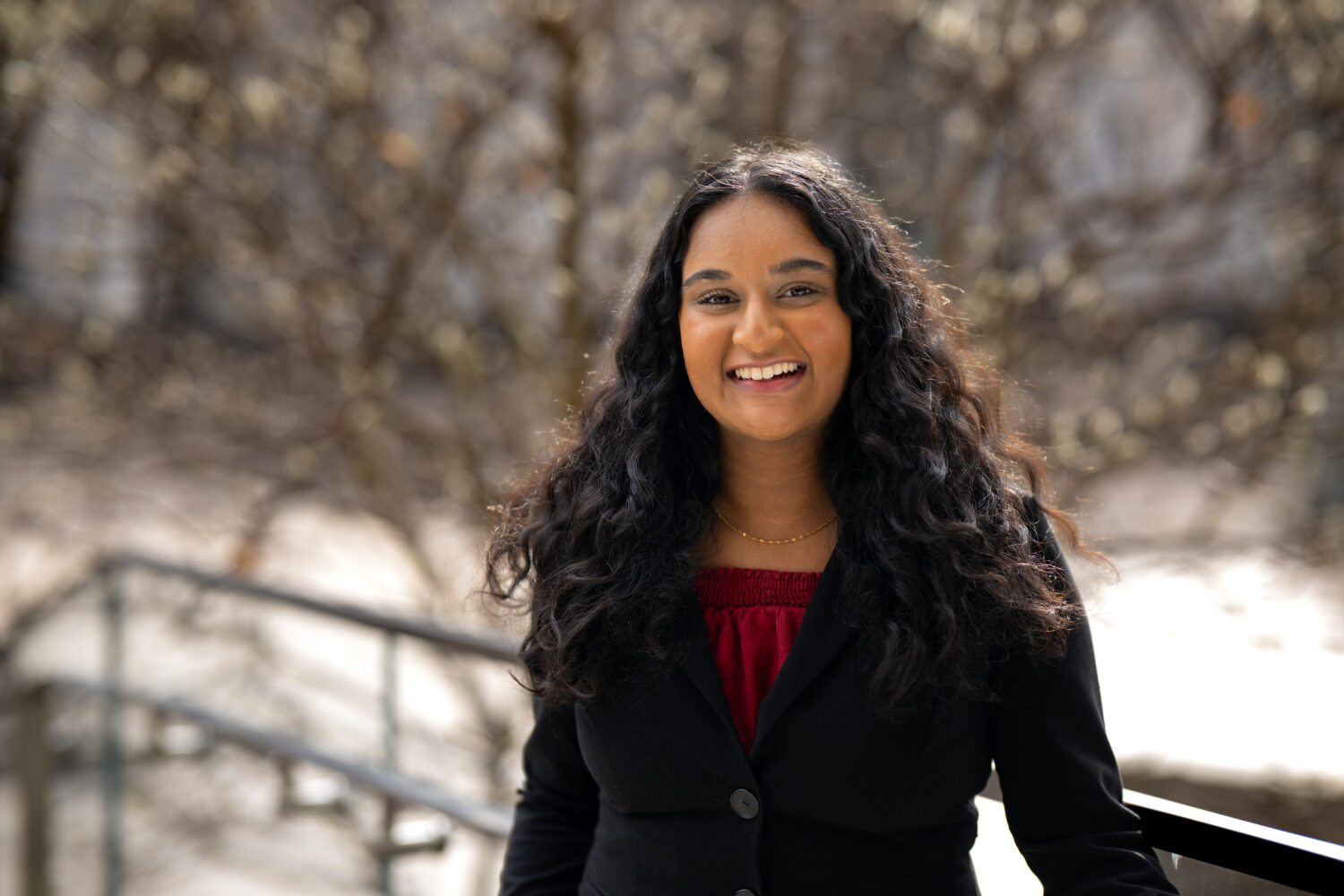
Sejal Goud is an MPA candidate and Scholars in the Nation’s Service Initiative (SINSI) Graduate Fellow at Princeton University, where she is pursuing studies in international relations. As the Program Associate within the Science & Society Program, Sejal works with a special focus on convening roundtables and authoring the Program’s signature publications. She is committed to leveraging her backgrounds in public service and in journalism to promote the link between civic engagement and science communication.

Sejal graduated Magna Cum Laude and Phi Beta Kappa from Princeton University with a B.A. in public policy. Her independent research has spanned Indigenous autonomy in sea level rise adaptation projects, tensions between environmental protection and affordable housing law, and multilateral climate mobility negotiations. She has experience briefing senior officials within the U.S. and foreign governments, including during her previous role at the Department of State’s Bureau of Oceans and International Environmental and Scientific Affairs.

Sejal first joined the Aspen Institute as an Intern in Civic Service (2022). She then supported the Science & Society team as Communications Coordinator (2022-2024) before being promoted to Program Associate.

Authored by Sejal:

Realizing the Potential of the Science Community to Support Rising Generations in STEM
Blog Posts Publications

Realizing the Potential of the Science Community to Support Rising Generations in STEM

America’s rising generations—the youth and young adults best positioned to meet the country’s growing need for STEM professionals—are on the front lines of recent and rapid policy shifts within the federally-funded research and higher education ecosystems. Attracting and supporting their training and development at a time when uncertainty is high and alternative pathways abound will require significant and sustained coordination across STEM sectors. Whether situated in formal and informal learning institutions, industry, government, or civil society, we must all come together to support, reform, and enhance our collective investment in the future leaders of STEM. This report, developed as part of the Aspen Institute Science & Society Program’s 2025 roundtable series, synthesizes insights from practitioners in K–12 education, higher education, science research, professional associations, science communication, and civic science.

Aspen Institute Science & Society Program Partners with the Open Research Community Accelerator (ORCA) to Promote $1.5 Million MA3 Challenge to Strengthen and Modernize Academic Hiring and Promotion in U.S. Universities
Blog Posts

Aspen Institute Science & Society Program Partners with the Open Research Community Accelerator (ORCA) to Promote $1.5 Million MA3 Challenge to Strengthen and Modernize Academic Hiring and Promotion in U.S. Universities

The Aspen Institute Science & Society Program, together with the American Academy of Arts and Sciences, is proud to partner with the Open Research Community Accelerator (ORCA) and on the launch of the Modernizing Academic Appointment and Advancement (MA3) Challenge. This initiative invites colleges and universities from across the U.S. to explore and implement improvements to their academic hiring, review, promotion, and tenure processes. 

A Two-Way Street for Art and Science: Toward an Integrated Vision of Meaningful STEAM
Blog Posts Publications

A Two-Way Street for Art and Science: Toward an Integrated Vision of Meaningful STEAM

This report builds on prior efforts to integrate art and science, offering actionable recommendations to strengthen STEAM initiatives through interdisciplinary collaboration, innovative education, and meaningful public engagement