
Bet on Human Connection with Your Own Vulnerability
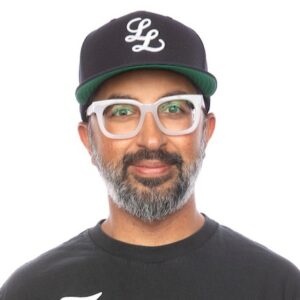
Rahul Raj
Founder & CMO, 5&Vine
Lessons in Leadership with Rahul Raj
Rahul Raj is the Founder & CMO of 5&Vine, where he builds, launches, and grows companies that disrupt categories and drive positive change for people and the planet. Prior to starting 5&Vine, he led Walmart’s Social Innovation Incubator in San Francisco, transforming costly returns into a multi-billion-dollar circular economy win. He is an Aspen First Mover Fellow and a member of the First Movers Design Team.
What early professional experience shaped your approach to leadership?
My worst boss taught me how not to lead. My best taught me it’s worth going to bat for people.
My worst boss was at Procter & Gamble, my first job out of school. He was a quant, a marketing leader who didn’t invest in training, and any gap I showed, he would publicly ridicule me for. It was horrible, and confusing to experience as a young person, because you have no familiarity yet with the way things are supposed to be. My main reference point was television, and my real working life looked more like a courtroom than the supportive workplace I’d expected.
That said, it was extraordinarily useful, because sometimes it is so helpful to learn how you don’t want to be rather than how you do. It was also a window into culture, and it taught me to focus on the result rather than the process. Those insights carried into every job after.
My best boss came right after, once I left Procter & Gamble. He was a delight. I felt seen and heard and understood, and my creativity was unleashed. I saw opportunities to turn around or transform brands, and I had a leader who was willing to bet on me, and willing to go to bat with me to convince an organization to do something it wasn’t naturally inclined to do.
It was fascinating to have that dichotomy, to see that there isn’t a singular way of being, there isn’t a singular leadership model, and that over a career, hopefully you have the good fortune, or the privilege, of being able to choose. But regardless of whether you get to choose, sometimes you still have to figure out how to be a full-sun plant and still thrive in a full-shade environment.
What professional advice do you wish you’d received earlier in your career?
Scout the traps before you step in them, and never chase more spotlight than your work can carry.
Two lessons rise above the rest, and I wish I’d had both sooner.
The first is that you can forecast the quicksand, or the booby traps, that exist in your job through conversations with other people of similar competencies or temperaments who have held similar roles. You can essentially go, “Got it. This job involves a tremendous amount of data analysis, or a reliance on Excel formulas, or public speaking, or strategy.” Then you can prep for it, either before starting the job or in your spare time, so the vulnerability isn’t exposed when it matters, instead of purely learning on the job.
I wish I had understood that. I was very much of the mindset that I needed to figure it out as I went, or wait, in an old-school kind of way, for a formal training opportunity.
For example, on the way home from the Aspen First Mover seminar, I decided I wanted to improve my skills as a moderator, so I put into Claude: “Please research all the Aspen moderator training that exists on the web and through forums, and prepare a 10-to-12-week training program so I can improve my ability to moderate at Fellowship seminars.” That was me practicing the insight, because I didn’t want to wait to get a series of reps under my belt. As part of the design team, I want to improve my craft, and with these tools I don’t have to rely on costly or inaccessible trainings; I can build my own little training program, very much aligned with that first point.
The second is around profile. There’s a real sweet spot to sit in when it comes to profile. You certainly want the senior people, whoever your boss and their boss are, to have a high-level sense of the work you do. But it’s possible to have too much profile, which can invite critique, jealousy, and a whole host of other negative consequences. Finding that pocket of enough profile, but not too much, is really helpful. Enough profile gets you tapped for exciting projects, or for speaking or leadership opportunities, without feeding the perception that you’re using the company for personal gain, or delivering more style than substance. There are only so many people who can be Beyoncé, when really the world needs a bit more of Destiny’s Child.
What makes it possible for a person to lead with courage and conviction?
Conviction takes three things: a belief worth the risk, a room that rewards it, and enough cushion to absorb the loss.
I’ll start with the cushion, the baseline. It’s easy to assume courage is just character, that you simply decide to put your reputation or economics at risk. It isn’t that simple. Lived courage and conviction rely on the ability to absorb loss. If you can’t afford to lose your job, truly, not just figuratively, it’s not that you lack courage or conviction, it’s that you have no room to demonstrate it, because there’s so much else at stake. Especially if you’re the first in your family to have done something, or you’re supporting multiple people, or it was a once-in-a-lifetime job, you’ve been given an opportunity you deserve and can’t risk. So that’s the baseline.
From there, what makes it possible is an environment that welcomes it, and embraces courage and conviction not just with words but through actions. When you contrast the stated values and the lived values of an organization, they’re often not the same. One is lovely marketing polish; the other is the truth of your operating principles. But when it’s clear a company values courage, and you can see people like you who are celebrated for it, or for having the conviction of their values, it certainly makes it a lot easier.
The final piece is clarity, or the reflection it takes to arrive at clarity, where you actually know what your values are and what your purpose is. More often than not, courage and conviction are tied to something you deeply believe in. If you’re unclear about your belief system, your morality, your purpose, your values, there’s less opportunity to engage with courage and conviction, because you don’t know what you’re willing to risk to do the right thing, or to act in alignment with something that matters to you.
What professional accomplishment are you most proud of?
The proudest thing I’ve done is bet on myself and start my own company, showing my kids that entrepreneurship is a model worth choosing.
It’s not even about the impact we’ve had, which is lovely. It’s about the courage and conviction it took, because I genuinely didn’t realize starting an agency was possible. We grew off referrals, and one VC firm in particular referred us to about 75% of their portfolio, which is how I knew we were really making a difference for our clients.
We make decisions based on the models we’re exposed to. The children of doctors have a higher propensity to become doctors, the children of teachers to become teachers. When you deviate from the models you’ve been exposed to, whether that’s to become an artist, an actor, a social worker, or an entrepreneur, and it works out, I think that’s beautiful and really powerful, because there’s no familial playbook to rely on. A lot of it is just running into a wall and deciding to get back up again.
The clients we work with know we’re a B Corp. They know we’ll tell the truth, even if it gets us fired, even if it’s uncomfortable. So I’m not just proud of starting something, but of creating an organization that lets me live and work in alignment with my values.
That makes me the most proud, not for me, but because I’m showing my kids that another model is possible. The model I was exposed to was doctor, lawyer, engineer, and I chose none of those, having originally wanted to be a fashion designer or a stand-up comedian. But here I am. And the potential for economic reward is disproportionate as an entrepreneur: value does not get distributed evenly in society.
How has your Aspen experience shaped your view of the world?
Aspen gave me a shared root system, and the proof that I’m never doing this work alone.
That root system started forming in 2013, when I began as a Fellow. I found it so transformational, and so validating, that as soon as the advisory board launched I was on it, and I’ve been ever since. Over the past four years I’ve been on the First Movers Design Team, and I’ve attended the Action Forum twice. I’m constantly trying to find more ways in, largely because I get to have the kinds of conversations I want, the ones I wish were my daily norm. I don’t want it as dessert. I want it as my entrée.
How has it shaped my view of the world? It started as validation, at its most trite: I’m affiliated with the Aspen Institute, I received a Fellowship, that’s a lovely checkbox to associate with my personal brand. But that’s not the central reason. That’s just a gift-with-purchase, sprinkles on the cake.
What I’ve found is something very similar to the shared root system of aspen trees. I feel like I’m part of a shared root system of people around the world who hold a very similar value set and aspiration for the world. That helps so much, because this kind of work can feel very isolating, but knowing you have such a strong connection to so many people, it feels like you can draw on reserve power, that you’re not alone. You have people to commiserate with and get strategic counsel from when you’re in a moment of crisis or opportunity.
Before joining the design team, meditation was not a regular part of my day. Knowing that was going to be a core part of the role I was playing, meditation is now a daily practice, and I feel more grounded and clear than I’ve ever felt in my life. I think that’s largely why.
The final piece is that I’ve always been okay to lead with vulnerability, because I’d rather have a thoughtful and authentic relationship, or quickly find out that’s not possible. Betting with my own vulnerability is the way to a tremendous reward. It doesn’t always play out. Sometimes you lose, and it really hurts. But it’s so consistently lovely that when I put my chips on the table, I can go all-in with any Fellow, even a new one still going through the program. It is just so sweet, because we share so much life history and personal experience. It deepens my understanding of the human experience, and bonds us for life.
It shows me that the personal and professional coexist. It’s not just about titles and salaries and impact, it’s really about who you are at your core, how you were sequenced, and how that experience shapes the way you approach problem-solving, and what I can learn from it. I feel more aware, with a deeper understanding of humans than ever, because I can understand where people have come from, the struggles they’ve gone through and continue to go through, whether that’s being people of color, or women, or LGBTQ, or living in rural America versus urban America, or families that have dealt with substance abuse, whatever it happens to be. I only know my own life experience in depth, and this isn’t like watching a movie, it’s like having dinner with people. The intimacy and the depth are unparalleled.
What was the impact of your Fellowship experience?
The through line of my career is simple: there’s beauty and value in what the world calls waste.
That instinct took shape during my Fellowship, which had a huge impact on me. There was the project, and then there was the theory of change. The project was to build a refurbishing infrastructure for Walmart U.S., where we could monetize high-value customer returns that would otherwise have gone to landfill, and also teach customers that there’s value in things that already exist. In the first three years, it generated $3 billion in incremental revenue for Walmart, and created a mechanism where we not only sold our own refurbished products as refurbished, but let customers bring back their used electronics for market value in cash, or 1.1x as a Walmart gift card, to increase their purchasing power in store.
The theory of change was that if we could manufacture items with an eye to value retention, then all we needed to solve for was clarity of market: how much is it worth, in liquidity. Because if you could bring items in, and you knew the value degradation of an iPhone plotted along a particular curve, and you knew you could get liquidity right away, then we’d have fewer items losing value by the day in desk drawers or basements, more items in circulation, and it would hopefully put a damper on the predatory payday loan industry. That refurbishing program is now known as Walmart’s Restored Program, which has expanded to include a refurbishing component at each Walmart return center.
The through line in my career is that there’s value in what people deem waste. It’s played out in so many different ways, many related to the circular economy. But there’s a secondary set that’s less about tangible items and more about what we undervalue in society, and how you can create systems or understanding that let people go, “Oh, I previously discounted that person, that idea, that byproduct of a process.” Really, it’s food. It’s fuel. There’s value in there.
What keeps you grounded?
I stay grounded two ways: a protected morning routine, and the company I choose to keep.
The first is routine, as practical as that sounds. I have a morning meditation practice, a gratitude journal practice, and a four-kilometer morning walk. My day starts not with the freneticism of email, or the consumption of generally terrifying news, but with something more about inner peace, gratitude, appreciation, and observation in nature. That helps tremendously. It’s somewhat analogous to “you are what you eat.” I want to make sure what I’m consuming first thing in the morning is nourishing, not antagonizing or provocative.
The second is a quote from Jim Rohn that I read years ago: “You are the average of the five people you spend the most time with.” That lands so deeply, and it’s also why Aspen is so critically important to my life and so deeply appreciated, because who I spend time with matters. It defines my normal, and it also defines what’s possible. Through the company I keep, my friends, because they’re so beautiful and have such lovely values, that keeps me grounded. It’s not like I have to defend myself, or my choices, or my morality, or my politics with them. I feel at peace, and if anything, I feel supported and pushed to do more.
The Business & Society Inside View
Want more insights like these? Sign up to receive thought leadership and updates from the Business & Society Program each month!
