
Create the Conditions for Courage

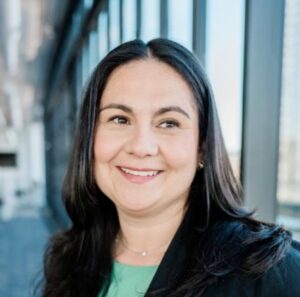
Monica Tijerina
Director, EEDI Strategic Partnerships & Employee Networks, AbbVie
Lessons in Leadership with Monica Tijerina
Monica Tijerina is the Director, EEDI Strategic Partnerships & Employee Networks, at AbbVie, where she works to advance inclusion for all, expand talent outcomes, and drive business impact. Prior to this role, she worked as the Senior Director of Social Impact at McDonald’s. Monica is an Aspen Economic Mobility Fellow, has served on numerous not-for-profit boards, and has also been recognized as a Young Hispanic Corporate Achiever by the Hispanic Association on Corporate Responsibility and as Campaign Coordinator of the Year by the United Way of Southeastern Connecticut.
What early professional experience shaped your approach to leadership?
Early in my career, I was leading philanthropy work at Pfizer when there was a re-org, and I ended up with a new boss. In our very first one-on-one, he shared a lot of ideas about what he wanted to do. I remember thinking, “Here is my new boss. I disagree with a lot of what he has just said. What do I do with that?” So I politely said, “If I may, I disagree,” and explained my perspective. I thought it could be career suicide.
He paused, looked at me very intensely, and said, “What you just did, I need you to always do that. Always push back if you don’t agree.”
That moment shaped the environment I now try to create for my own teams. I want people to know that I value their perspectives, especially when they disagree with me. Sometimes, when I come in with what I think is a brilliant idea, I’ll proactively say, “I’m about to say a bunch of things. I’m not married to any of them. Tell me what you think.” As a leader, it is incumbent upon me to create a space where people feel safe speaking honestly, even when they disagree.
What professional advice do you wish you’d received earlier in your career?
I have a master’s degree in social welfare policy, and I never envisioned myself working in corporate America. Right out of graduate school, I was working in the public sector doing human services work that felt very aligned with my values.
Through that work, I met a woman from Pfizer who ultimately offered me a position on her Community Impact and Philanthropy team. I really struggled with whether I should accept the offer. Honestly, I was young, and I wondered, “Am I selling out?”
I went to my boss at the time and walked him through all the pros and cons. He looked at me and said, “Don’t be ridiculous. Of course you’re taking the job.” Then he told me something I carry with me to this day: “You can do more good from within the belly of the beast than you can sitting here talking to me.” His point was that the people around our table were already convinced. He encouraged me to go inside a company and use my capabilities, values, and sense of mission to influence people there.
Frank essentially told me, “I see your idealism but that doesn’t always have the biggest impact. Take the job, get in there, and influence from within.” I wish I had understood early that it was possible to create social impact from within the business sector – and that I could do it in a really meaningful, more impactful, and global way.
What makes it possible for a person to lead with courage and conviction?
First, it starts with you. It’s important to be crystal clear about who you are, the impact you want to make on the world, and what your principles and values are. If you aren’t clear about those things, it becomes easy for the lines to get fuzzy. My mom always encouraged me to both know my own values and to understand that it was okay to step away from, or argue with, something that fell outside of them. You need to have thought through and defined your own boundaries.
Second, you need to find leaders and environments that value courage. I have been on the receiving end of so many great leaders who saw potential in me and wanted to draw it out. They didn’t simply imply that honesty and disagreement were welcome. They explicitly said, “This is what we value. This is how we are going to work together.”
To the extent that you can, you have to purposefully create that kind of environment. When I was considering my next role, the one I have today, I decided that two things had to be true: I needed to be doing purpose-driven work, and I needed to work for a leader I found authentically inspiring. Being intentional about the work you do, the people you work for, and the environment you enter makes it much easier to lead with courage and conviction.
What professional accomplishment are you most proud of?
I want the highlight of my career to be the lasting impact I’ve had. That might be through the people I’ve had an opportunity to elevate, continuing the legacy of leadership that I received, or through the impact of the work itself. I want to know that I created a ripple.
When Frank retired, I remember listening to people talk about him and thinking, “That is what I want people to say about me when I retire.” What he had built and what he had instilled in people was going to continue affecting lives far beyond the end of his career.
One accomplishment that represents that kind of impact came during my time at McDonald’s. I was tasked with developing the company’s public-facing social impact goal for its ESG reporting. In partnership with external organizations and colleagues across the company, we developed an ambitious goal to reduce barriers to employment for two million young people and to collect the data necessary to demonstrate that we had done it.
We ultimately reached that goal a year ahead of schedule. Those two million young people will never know who I am but knowing that I played some role in helping them find employment and unlock opportunities for their future is the professional accomplishment I am most proud of.
How has your Aspen experience shaped your view of the world?
Like many people in the Aspen community, I have been fortunate to receive a lot of investment from schools, companies, and other organizations through different leadership programs. With most of those programs, I did the work, took the classes, participated in the networking, and then it was over. I never felt a strong need to remain engaged.
Aspen has been different. It continues to be valuable to me day after day in a way that none of my other leadership experiences have been.
The greatest impact has been the community of people, thought leaders, and like-minded peers I found there. The work I do has never sat squarely within one box at a company. I have reported through Marketing, HR, Corporate Relations, and other functions, but the kind of impact I am trying to have has remained constant. Meeting other people who have had that same experience, and learning from them, gave me something I didn’t realize I needed.
I sometimes describe us as the “misfit toys.” We aren’t always traditional business leaders, and our work can be difficult to categorize or measure in the same way as work that directly drives revenue. Aspen validated my leadership journey and reminded me that this work is valuable, that I belong in these rooms, and that there is a community of people committed to helping one another get better at leading change from within. From a leadership perspective, it is the place where I have felt a sense of belonging more than anywhere else.
What was the impact of your Fellowship experience?
My Fellowship project was anchored in the Youth Opportunity program I worked on at McDonald’s. I wanted to take that work to the next level and make greater use of the data we had collected. Unfortunately, I wasn’t able to move that particular project forward because of changes in the external environment around ESG, social impact, and philanthropy.
But the lessons from my Fellowship experience continue to show up in my work all the time. There are moments when I reach out to my Aspen cohort and say, “Remind me, what was that exercise we did? I want to use it with my team.” The tools create a ripple effect. Even more importantly, the Fellowship gave me a framework for tackling difficult projects. It gave me resources, processes, and a network I could draw upon. It ultimately taught me how to drive change in a difficult environment.
I joke that I am always the person who gets handed the big, hairy problem. One day, I’d like a job where I come in, make a widget, and walk out—but that isn’t what I do. I don’t think it is a coincidence that I am now trusted with these big, hairy problems. My Aspen experience helped give me the skills to address those problems.
What keeps you grounded?
Getting outside. I enjoy putting everything I need into a backpack, hiking until I reach the next water source, filtering my own water, and sleeping on the ground in a tent. That really keeps you grounded. That’s why the emphasis the Fellowship placed on nature and the outdoors was something I appreciated. The hikes, yoga, and time outside made me think, “Oh, this is me. These are my people.”
I can’t go camping in the woods every day, but I do walk my dogs every day, and I’ve been practicing being fully present during those walks. I have two dogs, so I have one in each hand so I can’t be on my phone. I purposefully don’t put in headphones or listen to podcasts. I just try to pay attention to what is happening around me, even if it is only for the length of the dog walk.
The Business & Society Inside View
Want more insights like these? Sign up to receive thought leadership and updates from the Business & Society Program each month!
