

Why might leaders move from isolated competition to constructive collaboration in a moment rife with conflict and turbulence?
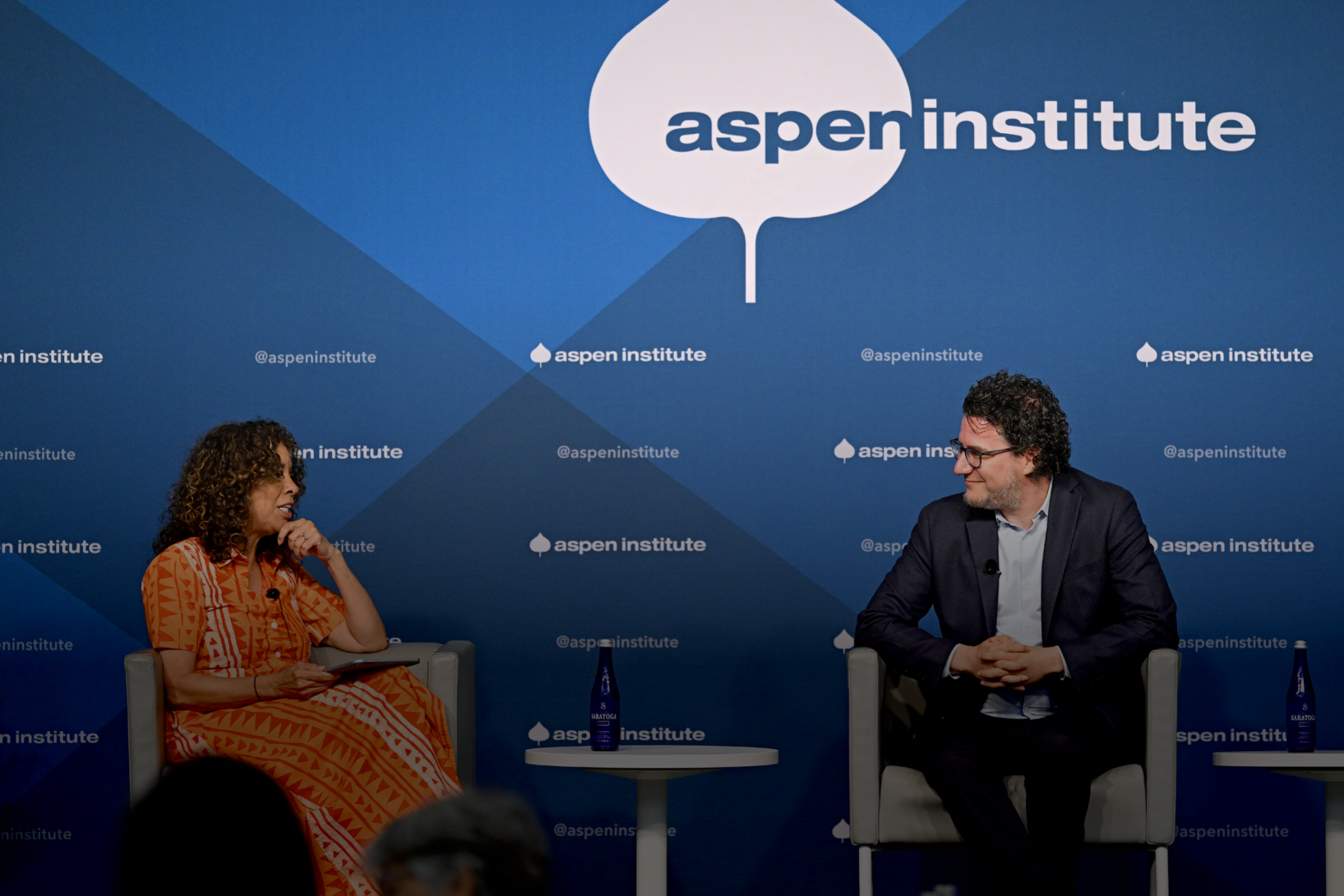
The Design of Business | The Business of Design podcast returned this fall with a season built around radical collaboration, which is a question the Aspen Institute has been asking since its founding. As Todd Breyfogle explains in the season’s first episode, Walter and Elizabeth Paepcke invited some 2,000 artists, thinkers, and business leaders to a former mining town in 1949 because they believed no single sector or discipline could meet society’s problems alone. More than seven decades later, host Ellen McGirt brought that same question to our fifth Aspen Business & Society Summit: what does it take to collaborate when common ground is scarce? She put this question to eight leaders from business, academia, crisis communications, and the Institute itself.
Check out their answers in the episodes below.
Todd Breyfogle: On the Aspen Institute’s humanistic roots
“The quality of our dialogue reflects the quality of our civilization, which is a reflection of the quality of the things that we value.”
What can community and connection teach us about coming together in challenging times? Todd Breyfogle, the Institute’s Senior Advisor for Humanistic Studies and Practices, makes the case that “Aspen’s radical, artistic roots are a key that unlocks a better way of thinking about… how we can all do more meaningful work, together.”
Judy Samuelson: The purpose of a corporation
“Shareholders do not own the corporation. They own shares of stock that come with some important but limited rights.”
How can business be a force for good? The founder of the Business & Society Program looks back on the Business Roundtable’s 2019 shift toward stakeholders. She shares stories from the room where some of business’s most powerful leaders worked to redefine the corporation, and discusses the impact of that statement, now and in the future.
Chris Hyams: AI as a civil rights issue
“AI is the single civil rights and human rights issue of our time.”
Why would the former CEO of Indeed leave his job? To take up what he sees as the defining civil rights question of our time. He now teaches responsible AI, sits on the founding board of the Guardrails Alliance, and is openly skeptical of the claims made by those who profit from AI.
Erika James: Leading with discipline
“Leaders need to have that frame of mind that normal will never be again.”
What is one key to leading through crisis? Discipline, argues Wharton Dean Erika James and author of The Prepared Leader. She also describes how to prepare students and faculty to succeed in an AI-reliant economy, shares how she sees DEI today, and what it takes to make principled decisions in a world that may never get back to “normal.”
Linda Hill: Innovation is a team sport
“You rarely get innovation from working with people who have the same point of view as you.”
The Harvard Business School professor and Genius at Scale co-author explains what innovative companies share, from Pixar to Pfizer. They treat people decently, kill ideas that aren’t working, and refuse to treat genius as a solo act. She also highlights one of the problems of the AI transition: “With AI, no one knows what the destination is, and no one knows how we’re going to get there.”
Steve Goldbach: Motivating people is a design challenge
“Culture is an outcome. It’s the collective of people’s behavior. The way you change that behavior is by changing the motivators, because everyone shows up at work wanting to be successful in some way.”
Deloitte’s Steve Goldbach, co-author of Hone, argues that motivating constructive change in an organization is the ultimate design problem. He also discusses how to help the next generation build judgment and taste even as AI takes on more “knowledge” work.
Dave Fleet: Proactivity as survival
“It’s much easier for me to convince you of something if you haven’t heard a different side to it first.”
Why does Edelman’s head of global crisis believe that, in a world of permanent volatility, reputation is a company’s best defense? Here, Dave Fleet shares why coalition building matters and why empathy has commercial value. He also makes the case that “in a world where trust is local and volatility is permanent, raising media literacy and fighting disinformation is essential.”
Eric Ries: An apology, and a blueprint
“We know how to do this. All we have to do is have the courage to say that we will do what has been proven to work.”
The Summit closed with a live interview between Ellen McGirt and Eric Ries, author of The Lean Startup. He revisits the unintended consequences of his 2011 book and lays out a new model, from Incorruptible, of how to design a profitable company that keeps its soul.
Collaboration can be challenging. It requires compromise and often takes longer than acting alone. But it is also incredibly rewarding. When people come together with a shared intent, more becomes possible.
We’re grateful to Ellen McGirt and the Design Observer team for helping to bring that extraordinary possibility into focus.
The Business & Society Inside View
Want more insights like these? Sign up to receive thought leadership and updates from the Business & Society Program each month!
