
Everyone Deserves Dignity

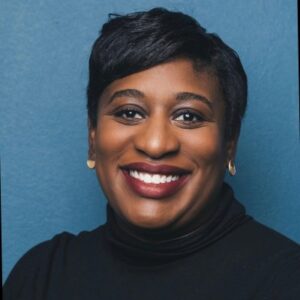
Jewel Jones Truxon
Global Inclusion & Health Equity Practice Leader, Real Chemistry
Lessons in Leadership with Jewel Jones Truxon
Jewel Jones Truxon is a health equity practice leader and strategist as Real Chemistry, where she focuses on how people actually experience healthcare, not just how it’s designed to work. She advises healthcare organizations at the intersection of business strategy and communications, turning insights into actions to improve trust, engagement, and outcomes. She is an Aspen First Mover Fellow and serves on the Board of Visitors for the College of Nursing and Allied Health Sciences at Howard University.
What early professional experience shaped your approach to leadership?
In my first “big agency” job a couple of years out of undergrad, I encountered colleagues who naturally operated from a place of collaboration versus competing with one another. As they invited me in, that experience had a profound impact on my professional posture and eventually my leadership style.
It helped me think beyond a scarcity mindset and see collaboration as a force multiplier: one that creates value and opportunity you simply can’t achieve alone. That lesson has stayed with me and continues to guide how I build teams, develop talent, and lead today.
What professional advice do you wish you’d received earlier in your career?
No matter what organization you’re in, you need to know what actually drives growth, what drives impact, what’s being measured, and what the priorities are.
It’s not enough to just be excellent at your job—understanding the “business of the business” is foundational to being excellent. It’s something you can never learn too early.
What, in your experience, makes it possible for a person to lead with courage and conviction?
It starts with having a clear set of personal values. Your values serve as a framework for decision-making and should guide your behavior. Without that framework, it’s easy to sway with the wind.
I revisit my values regularly and take time to journal about what’s changed and whether anything needs to be reprioritized. In moments of transition, I also use a broader reflection exercise where I ask myself: “What are my non-negotiables? What are my superpowers?” It is ultimately about keeping values at the center.
What professional accomplishment are you most proud of?
I’m a builder by nature. What brings me the most pride is identifying a problem, finding the right solution, bringing the right people together, and then seeing the change that results. One example is work I led shortly after joining Real Chemistry. We made a pro bono investment to support the Black Coalition Against COVID, and launched a campaign called A Love Letter to Black America from America’s Black Doctors and Nurses.
Black health professionals were deeply engaged in the COVID‑19 response from the earliest days of the pandemic, particularly in caring for the communities most affected. What was missing early on was consistent national visibility and amplification. The Love Letter to Black America marked a turning point, bringing a Black health coalition together in a unified, trusted voice and elevating it into the national conversation at a critical moment.
We created this campaign to Black America that was rooted in love as a driver of change, to connect public health guidance to how we care for one another. It ended up generating 6 billion in earned media reach and led to collaborations with organizations like Google and the Kaiser Family Foundation. The case study is now taught in public health programs at universities. It also informed the creation of the Global Inclusion and Health Equity practice that I now lead at Real Chemistry. And all of it just kind of started with a problem that I was eager to solve.
How has your Aspen experience shaped your view of the world?
My Aspen experience was so timely and a literal breath of fresh air. It came at a moment of transition for me. I had recently stepped into leading the practice that I helped build and Aspen gave me space to refresh my toolbox and make sure I had the right tools to think about what’s next. It also helped me think from a place of fearlessness. If I wasn’t focused on urgency or the day-to-day pressures that typically occupy my time, what would I actually be doing? It was one of the first times in my career where I was able to strategically breathe.
My Fellowship project is a direct outcome of that shift in thinking. Aspen helped me rethink how I spent and designed my time so that I could focus on things that had exponential value.
What was the impact of your First Movers Fellowship project?
My project evolved over time. I ended up focusing on two related areas: the intersection of AI and health equity, and this emerging topic of health dignity. On the AI side, I developed and launched a solution called Diagnosis. It surfaces hidden assumptions and provides recommendations to ensure that we are strategically addressing challenges in a way that supports our clients.
At the same time, I began developing what became the Health Dignity Initiative. We define health dignity as the experience of being seen, heard, and taken seriously in healthcare interactions. To explore this, we analyzed over 200 million sources and surveyed over 300 providers, caregivers, and patients to understand what dignity actually feels like in healthcare.
Dignity is foundational to better health outcomes. When patients feel dismissed or unseen, they disengage—they don’t follow up, they don’t adhere to treatment, and trust erodes. We created a short video that shows the power of these moments of misconnection in healthcare. Ultimately, we want to share our research and insights on health dignity because we don’t want to lose the humanity of healthcare, even as it becomes more technologically advanced. We see health dignity as a lens that can be applied across the entire health ecosystem to improve both experiences and outcomes.
What keeps you grounded?
My community, without question. I ask myself, “How can I show up with intention, without stretching myself in ways that are unsustainable?”
The Business & Society Inside View
Want more insights like these? Sign up to receive thought leadership and updates from the Business & Society Program each month!
