

What First Movers Have Learned
How are leaders inside large companies advancing initiatives that improve the health and well-being of people and the planet in this moment of dramatic change?
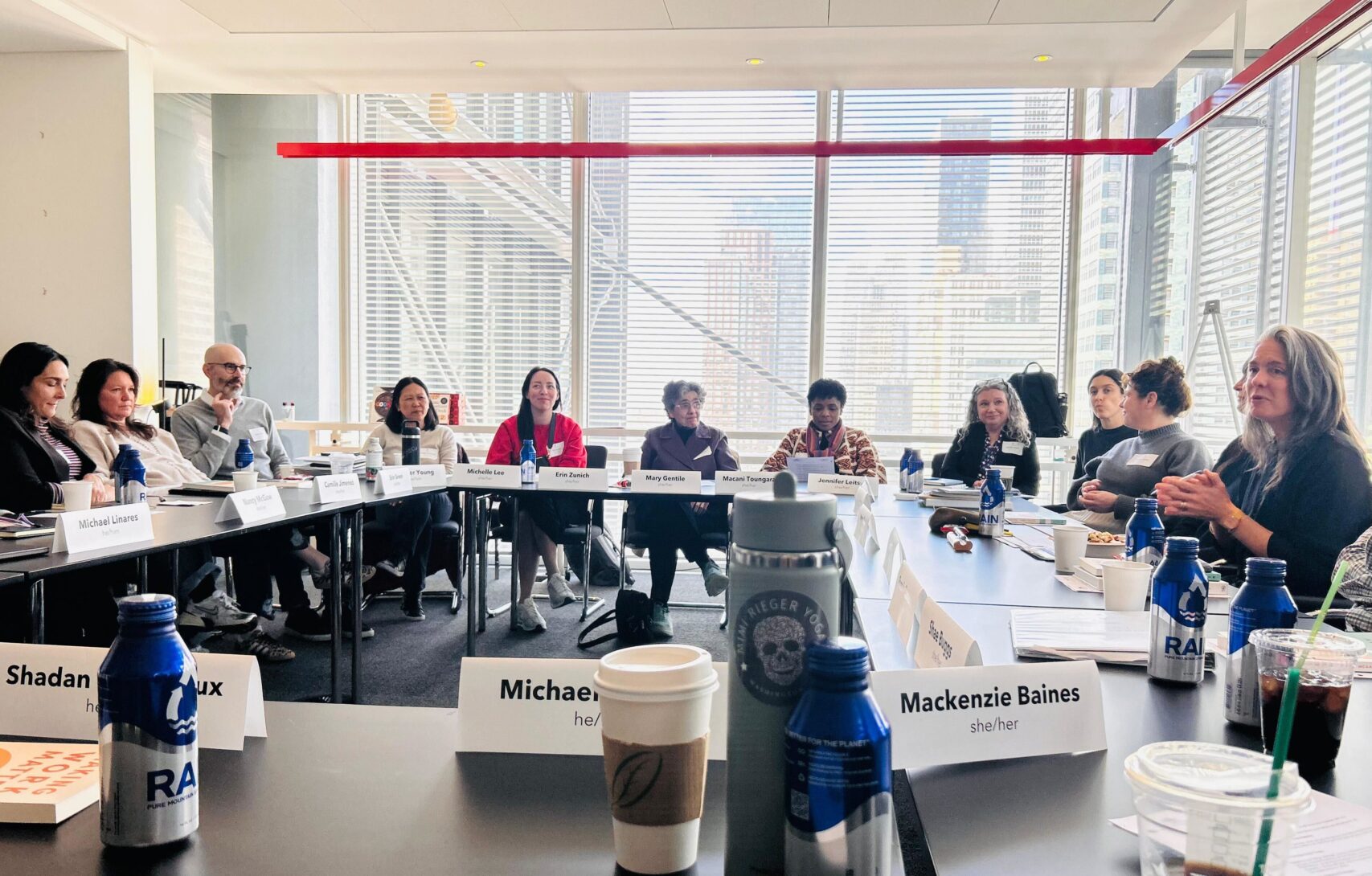
This question anchored the conversation that took place at the final First Movers Fellowship seminar last month, in the process revealing effective approaches that corporate intrapreneurs are currently using to deftly navigate complex systems. In a moment defined by changing incentives, rising scrutiny, and organizational whiplash, First Movers are learning how to navigate systems, redefine success, and build personal endurance to lead over the long term.
Reframe problems until they’re solvable
Many Fellows began the fellowship with a clear vision of the issue they wanted to address, only to discover that their organization wasn’t yet ready to engage with it in the way they initially proposed. Instead of pushing harder on the original framing, progress came from Fellows repeatedly redefining problem until it aligned with the organization’s current priorities, incentives, or risk tolerance. “You have to keep reframing until you get to the problem your company is ready to solve,” one Fellow said.
Persistent iteration didn’t dilute ambition, but instead increased their traction while creating more durable, undeniably relevant initiatives.
The ability to reframe—to treat the problem definition itself as iterative work—proved to be one of the most critical leadership skills in this moment. Especially as external pressures shift, the “right” entry point for change is rarely obvious or static.
Change moves at the speed of trust
If reframing opens the door, relationships determine whether anything walks through it.
Fellows described investing significant time in listening deeply, identifying champions, and building trust. The data and the business case mattered, but were rarely sufficient to motivate engagement. Movement happened when people felt heard, when concerns were surfaced early, and when stakeholders saw themselves in the work.
“Inquiry is powerful,” one Fellow said. Asking questions—rather than arriving with answers—creates space for alignment that persuasion alone could not. While building alignment, Fellows unlocked another truth: change inside organizations is often relational, not rational. In a time of heightened sensitivity and scrutiny, the work of building strong relationships is even more important.
Small wins are not a compromise—they are the strategy
In a volatile environment, big visions often stall. What moved forward instead were small, tangible experiments. Fellows ran pilots, tested ideas, and generated just enough evidence to unlock the next step. As one Fellow noted, “the right evidence makes pilots possible.” This shift from planning for perfection to learning through small actions helped Fellows build credibility, reduce perceived risk, and create momentum for larger successes.
Resistance is information
Fellows encountered friction at every stage. But over time, many began to see friction as a wayfinding strategy to effectively navigate their ecosystems and the structures that shape them.
Resistance reveals where misaligned incentives and perceived risks continue to protect the status quo. One Fellow invoked the W. Edwards Demings adage that “every system is perfectly designed to get the results it gets.” To get a different result, the system itself must be redesigned.
Resistance, in this sense, is often structural rather than personal. Organizations are designed to protect stability. They do not move simply because an idea is right. Effective leaders work within that reality: mapping influence, adjusting strategy, and finding leverage points within the system as it exists.
Leadership is enabling others to advance the work in your absence
Many Fellows deeply identified with their proposed projects. Over time, they realized success required setting ego aside and focusing on what would move the work forward, even if it meant stepping out of the spotlight.
This often means relinquishing direct control in favor of enabling others to advance and embed the work. For some Fellows, releasing ownership was a painful loss, which they acknowledged before moving forward.
What emerged from this approach was a more durable form of leadership that can continue when the Fellow is no longer directly orchestrating the work. As one First Mover said, “Success is measured by what you set up, not just what you do.” As Fellows became more self-aware of their leadership strengths, several elected to transition ownership of their projects to colleagues who are well-suited to take their initiatives to the next level.
Meeting the moment
In this moment of dramatic economic and geopolitical disruption, leading change inside companies is increasingly more iterative, relational, adaptive, and challenging than ever before. Leaders who can reframe problems continuously, build trust across difference, act through small experiments, and navigate systems as they are rather than as they wish them to be will be those best positioned to lead in this new environment of sustained uncertainty.

SUBSCRIBE TO OUR MONTHLY NEWSLETTER:
The Business & Society Inside View
Want more insights like these? Sign up to receive thought leadership and updates from the Business & Society Program each month!
