
Aspen Ideas: Climate and UChicago’s Collaboration: Decades in the Making
March 10th, 2026
The University of Chicago and the Aspen Institute have long been closely linked – both in history and tradition.
Dating back to 1949, the Aspen Institute was born out of its first event: the Goethe Bicentennial Convocation and Music Festival. Although the gathering took place in Aspen, Colorado, it was conceived and led by three Chicagoans: Giuseppe Antonio Borgese, Robert Maynard Hutchins, and Walter Paepcke. Notably, Hutchins had served as President of the University of Chicago from 1929 to 1945 and, by 1949, was chancellor of the institution.
The three men initially planned the festival as a single international convocation to mark the 200th anniversary of Johann Wolfgang von Goethe’s birth. Designed as a three-week gathering, it was not intended to become a permanent institution. Yet, from that confluence of ideas and leaders emerged the Aspen Institute, with Borgese, Hutchins, and Paepcke at the helm.
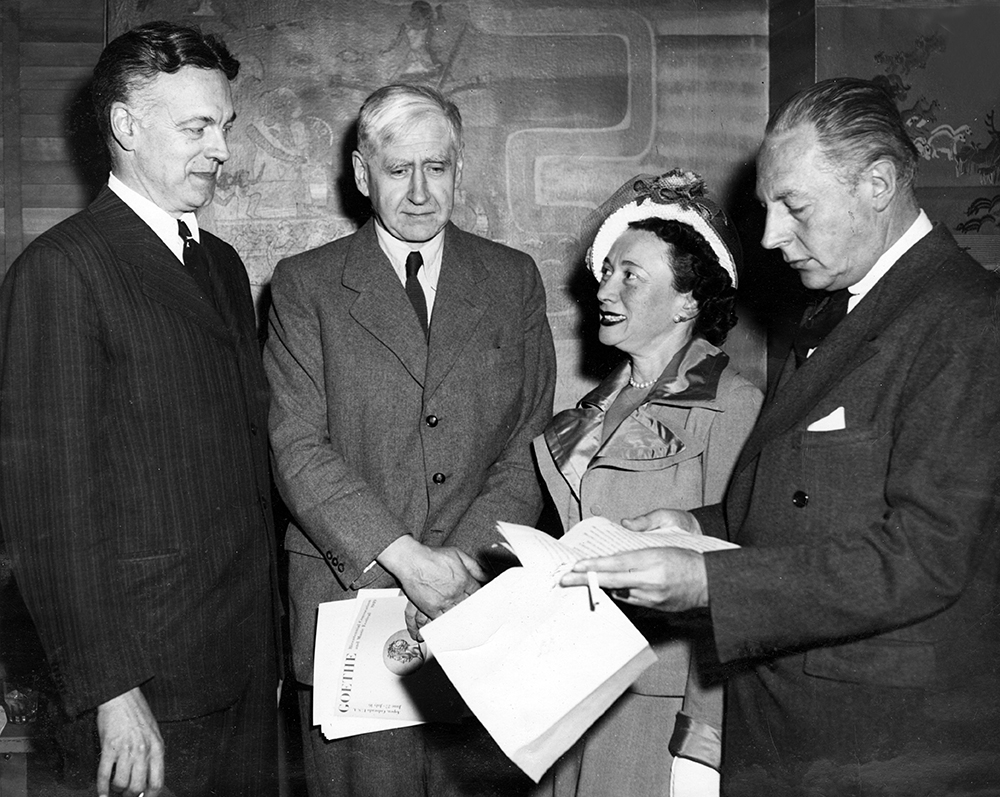
Under their direction, the festival reflected many of the educational traditions that had taken shape at the University of Chicago under the leadership of Hutchins. Through what became known as “The New Plan,” the university reimagined its core curriculum and shifted general education away from traditional lecture-based instruction toward a model centered heavily on rigorous discussion. Hutchins was doing something revolutionary in teaching students how to think rather than simply memorize.
It was this model of discussion and spirit of inquiry that was adopted in the mountains in 1949 and that has become a defining feature of Aspen-style convenings and seminars to this day. The Goethe Bicentennial and the budding philosophy of the Aspen Institute were grounded in this approach of sustained dialogue and cross-sector communication, and are reflective of the University of Chicago’s commitment to ideas, inquiry, and structured conversation.
As the Institute has evolved into a global policy organization and the University of Chicago has grown into one of the world’s leading research universities, so too has their partnership. One of the clearest examples of this shared intellectual tradition is the Great Books program. In 1947, University of Chicago’s Hutchins and Mortimer J. Adler created the Great Books Foundation to bring readers together to discuss enduring ideas and issues. Today, the Aspen Institute’s Great Books Discussion Series invites participants to explore some of the most significant works in the Western intellectual tradition through an organized 5 week dialogue.
This partnership also lives on through Aspen Ideas: Climate (AIC). AIC is one of the Aspen Institute’s flagship convenings and is designed to bring the public into conversation with policymakers, scientists, business leaders, innovators, artists, and community voices working on climate and energy solutions. After three successful years hosting the event in Miami Beach, the decision to move the event to Chicago was a natural one – reflecting the Aspen Institute’s origins in Chicago and its deep investment in the region and its partners there. Nearly eight decades after the three Chicagoans set out to host a single convocation, AIC Chicago continues their spirit of dialogue and collaboration.
Core to carrying this spirit and tradition into the event, is the University of Chicago’s Institute for Climate and Sustainable Growth, who have served as the official academic thought partner for the past two years. As core thought partners to AIC in 2025, the University of Chicago’s expertise was woven throughout programming around carbon markets, climate systems engineering, battery storage, and both domestic and international climate policy.
From July 20-22, 2026, AIC will return to Chicago with three action-packed days of programming designed to accelerate climate solutions. As the leading academic thought partner for 2026, the University of Chicago will host the opening day of programming on its Hyde Park campus – an occasion that will showcase both institutions’ expertise, enduring convening tradition that links these two institutions nearly eight decades later, and the fantastic power of bold ideas, curiosity, and collaboration.
Learn more about Aspen Ideas: Climate and other Public Engagement work of the Aspen Energy & Environment Program.
