

Today’s economy is an unsettling split screen of opportunity and anxiety. On one side, the emergence of AI promises massive productivity gains, historic investment, and wealth creation. Large US tech companies have announced more than $1T of investments in 2026 alone. The three forthcoming IPOs of Open AI, Anthropic, and SpaceX are reported to be worth more than all US IPOs in the last 45 years combined. On the other side, AI is generating a level of economic anxiety that has only been seen twice this century: during the Global Financial Crisis of 2008 and at the peak of post-pandemic inflation in 2022. One strains to recall a time when the gap between opportunity and risk in the US economy has been so wide.
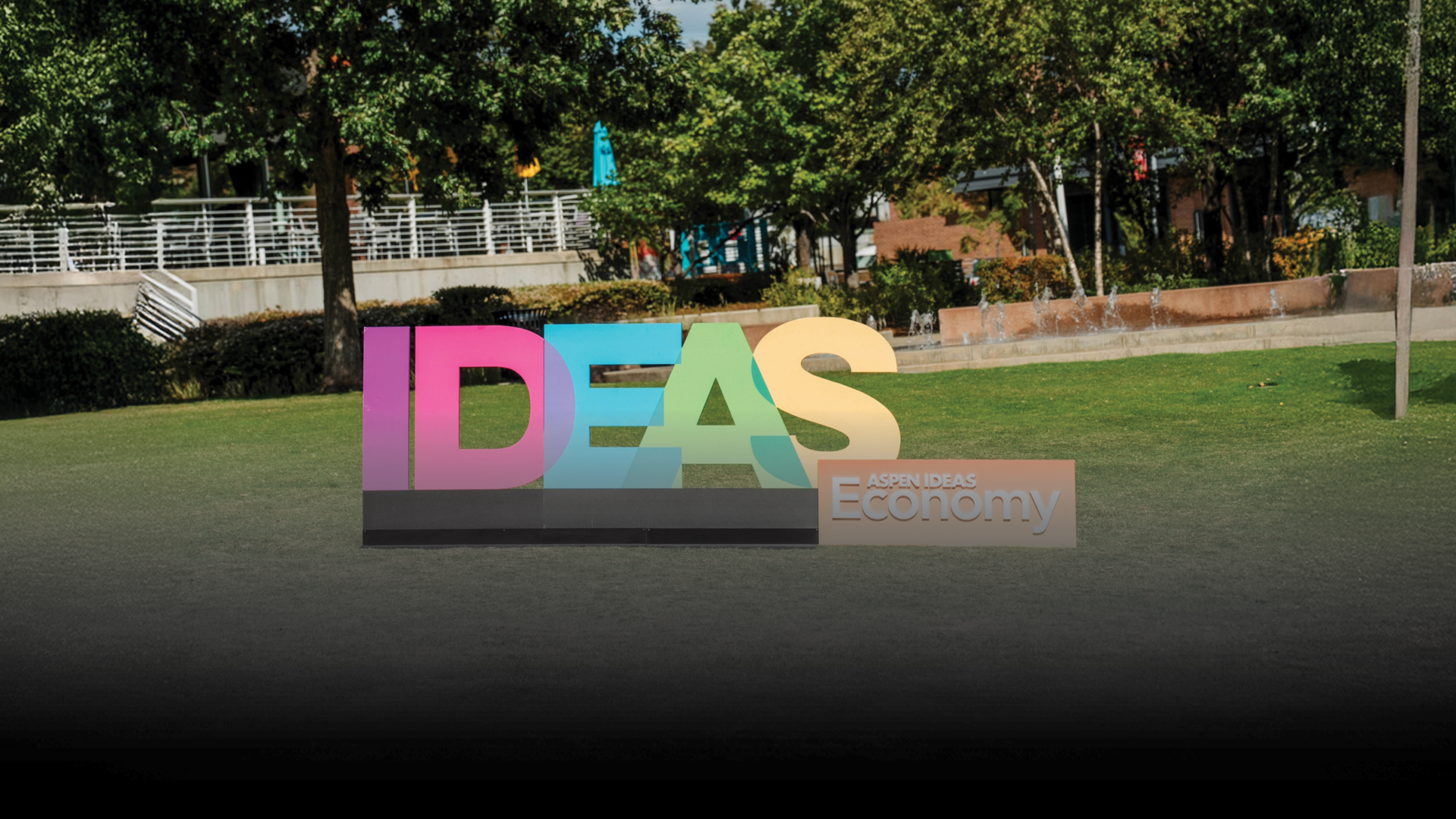
At last week’s Aspen Ideas: Economy in Tulsa, the tension between AI’s potential benefits and the pitfalls for economic opportunity was unavoidable. Getting the design, deployment, regulation, and management of AI right may be the most important economic challenge of our lifetime.
AI has arrived in the US at a time when opportunity and prosperity are extraordinarily unequal. While wealth in tech and financial hubs like Silicon Valley, New York City, and Miami has exploded, one third of US counties are economically “distressed.” Rising costs of essentials like food, medical care, childcare, housing, and utilities weigh heavily on households. There are approximately 53 million low-wage working adults in the US, who are especially vulnerable to AI job loss. Previous economic shifts like the globalization of trade have ravaged many communities, and the prospect of an even more powerful transformation being imposed on them is a bitter pill.
Bipartisan resistance to data center development is a telling symptom. On a recent webinar hosted by HeatMap, it was noted that over $960B of investment in datacenter construction is currently being held up by local opposition across the US. Whether the concern is noise, impacts on local utility rates, abatements and tax incentives, environmental damage, or simply the aesthetics of massive data centers, communities are pushing back on a massive change thrust on them by outsiders who have tried to steamroll approval processes before locals could start to ask questions. In addition to the immediate concerns of data center impacts, the mistrust slowing construction has been earned through previous economic disruptions and the subsequent narrowing of economic opportunity.
AI leaders have also done very little to ease economic anxieties. They’ve celebrated vague concepts like Universal Basic Income, essentially conceding mass job loss as a foregone conclusion. They’ve achieved trillion-dollar valuations on Wall Street in part on the hope that AI will eliminate the costs and constraints of a human workforce. As Shah Ahmed from Anthropic noted on a panel in Tulsa, market incentives to deploy AI to benefit workers and broaden economic opportunity are not always there. Meanwhile, workers are now so fearful of losing their jobs to AI that they are loath to negotiate better wages and conditions for themselves. Lauren McFerrin from the AFL-CIO put it succinctly, “AI is coming for your pay before it comes for your job.” Left to current market forces, the AI-driven economy looks bleak for humans.
On the other hand, we were also reminded that AI is a general-purpose technology and can be used to any ends we choose, including to generate more widely shared prosperity and opportunity. In an AI-empowered world, intentions are the first prompt. If we want the power of AI to drive broadly based prosperity, we should see it reflected in policy, education, business, investment, and in the incentives throughout the economy.
I heard a range of suggestions over the course of those few days in Tulsa. Many emphasized strengthening strategy, investment, and opportunity at a community level. Federal policy was discussed with tempered expectations. Individual agency came through, reminding us that paralysis offers no path through uncertainty. The role of employers also loomed large as ground zero for how AI will affect jobs.
What tied many of the ideas together throughout the event, whether they came from the politicians on the Right or Left, business leaders, labor unions, foundations, economists, or non-profits, was trust.
Trust in the US is a complicated picture. Polls show deep mistrust of government, yet people still trust their local elected officials. Gallup’s polling reveals high confidence in small business and deep skepticism of big business. This suggests that the path to more shared economic opportunity in the AI age begins at the local level, where people have confidence in the competence and intentions of institutions and their leaders, and just as important, where they have a voice to make those institutions better and hold them accountable.
I left Tulsa imagining an AI revolution that builds trust across society by expanding and sharing opportunity. AI can be an equalizer if we choose to make it one, but current market incentives do not point in that direction. We will need to make it happen through different choices, rules, and policies.
After writing all of this, I thought it would be interesting to ask Claude for ideas on how to make a positive vision for AI a reality. My prompt: “What are the five most important things that could make the AI revolution expand and share economic opportunity more equally?” Claude’s response:
- Broad access to the tools themselves so that access to AI doesn’t compound existing advantages for firms and individuals at the top
- Skills and adaptation support to narrow performance gaps within roles
- Steering tax rules, procurement choices, research funding, and company incentives towards complementing workers rather than replacing them
- Wider ownership and sharing of the gains
- Strong institutions and local diffusion.
The good news? This response suggests that knowledge and ideas aren’t our limiting factor; all were shared by the humans in Tulsa last week. But for these ideas to have an impact, we need things that AI can’t provide: committed leadership and collective action.
The Business & Society Inside View
Want more insights like these? Sign up to receive thought leadership and updates from the Business & Society Program each month!
