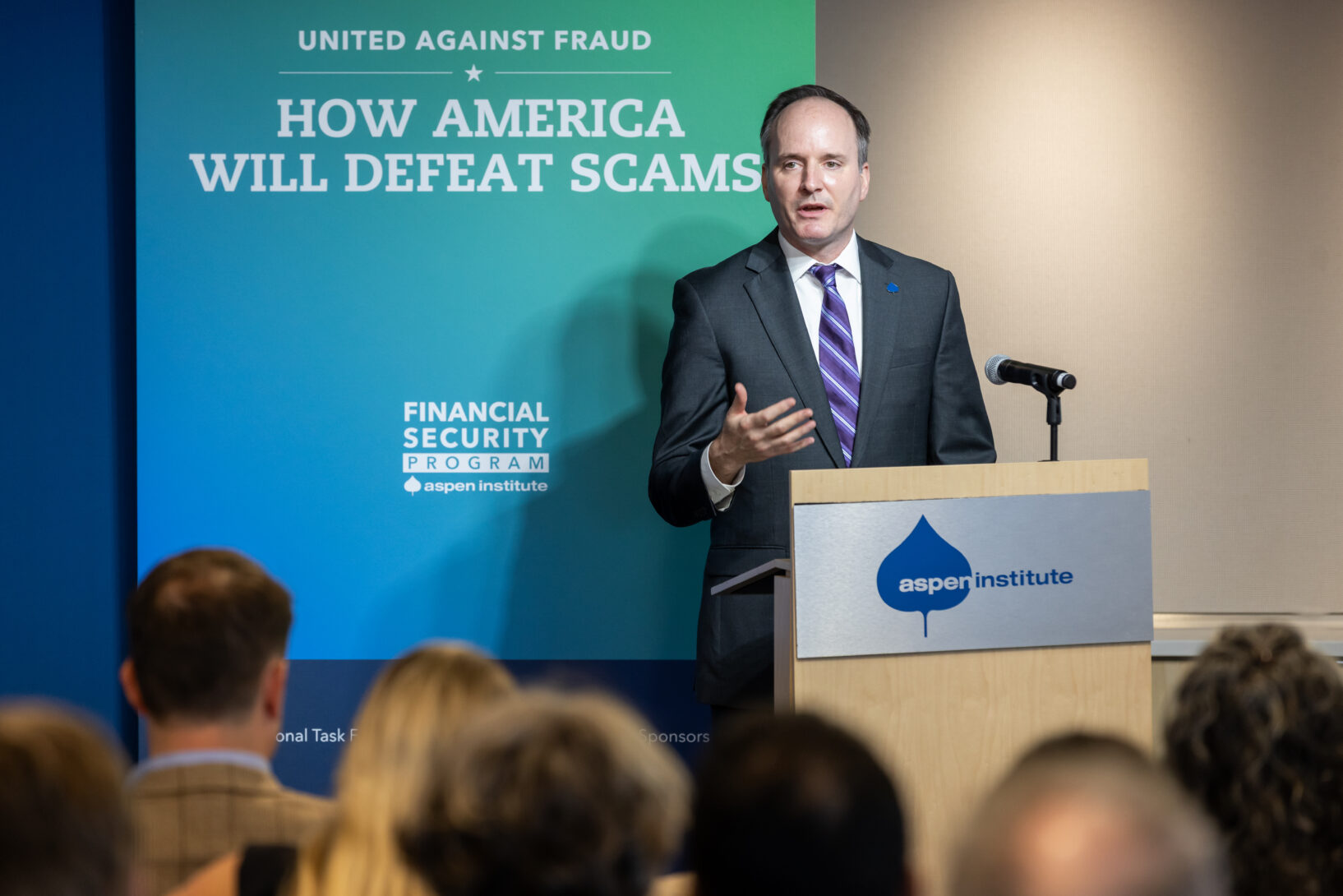

Throughout his career spanning financial services, technology, and policy, Nick Bourke has focused his efforts first and foremost on protecting consumers. As an Aspen FSP fellow, he brought that consumer-oriented lens to the development of our recommended strategy to prevent fraud and scams, serving as the report’s lead author. In this Q&A, Nick takes us behind the scenes of what it took to create the strategy and what comes next for the National Task Force on Fraud and Scam Prevention.
What first sparked your interest in finance, technology, and consumer protection?
I’ve always found our financial system to be a fascinating mix of technology, human behavior, and trust. Early in my career, while working on payment card networks, I told a mentor that I thought the system was remarkable, but its legitimacy was at risk. At the time, practices like hair-trigger penalty interest rate hikes on credit cards were common, and I complained to this mentor that unscrupulous practices were eroding trust and imposing unfair burdens on people. He encouraged me to do something about it, which ultimately led me into public policy. One of my first major policy gigs was helping develop what became the Credit CARD Act of 2009, which, among other consumer protection measures, required credit card companies to give users 45 days notice before an interest rate increase.
Share more about your relationship with Aspen FSP. How have you collaborated with this team over the years?
In my prior role as director of the consumer finance and housing program at The Pew Charitable Trusts, I worked with many leaders across research and advocacy, and that’s how I got to know Ida Rademacher and Kate Griffin at Aspen FSP.
In 2024, I published a white paper calling for a national effort to prevent scams. When Ida and Kate saw it, they told me that they had just such a project underway. I was so thrilled when they asked me to get involved, and we quickly found that my experience and relationships were good complements to theirs. It was my first formal collaboration with them and Aspen, but instantly it felt like we had worked together for a long time.
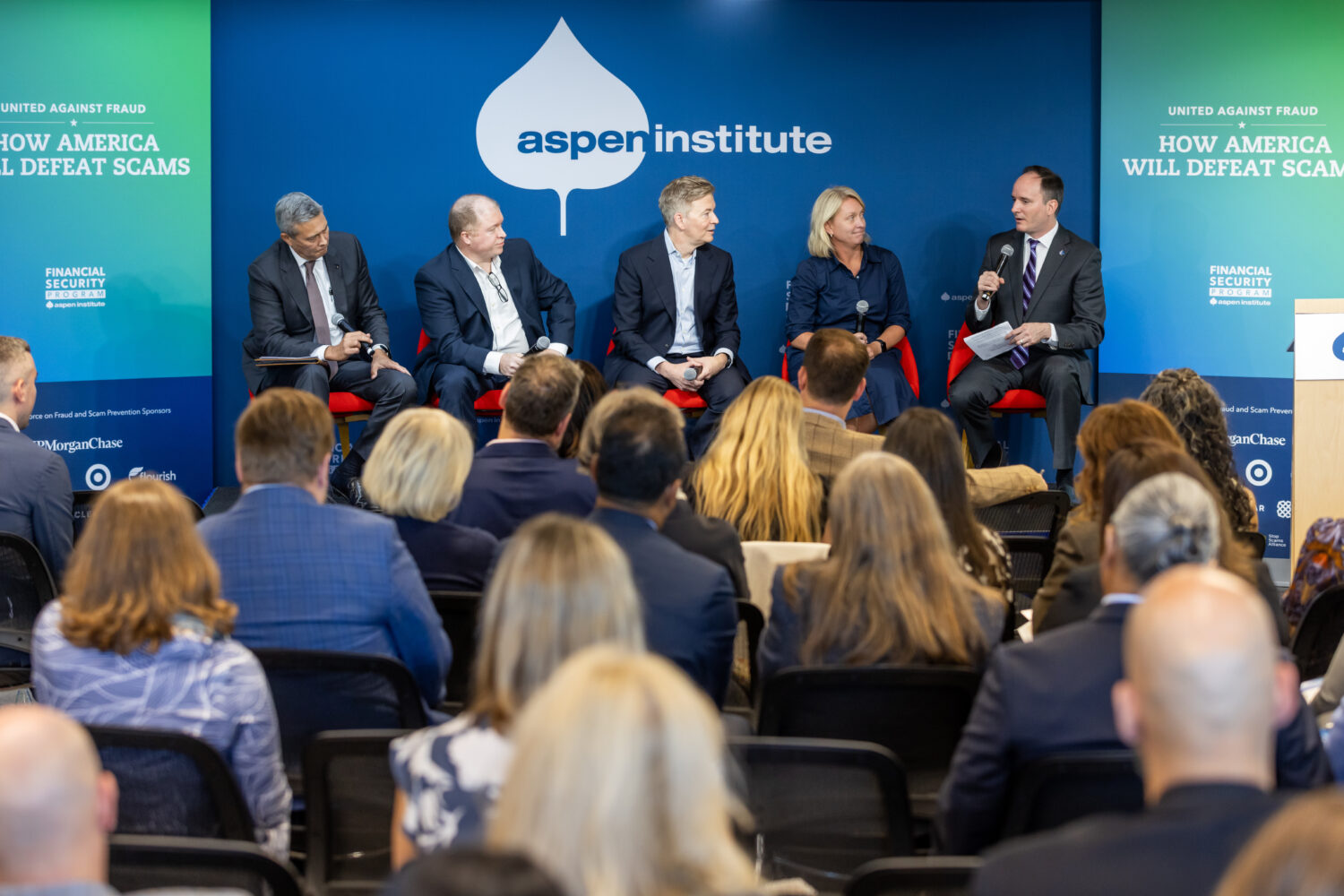
For the last year, you have been part of our National Task Force on Fraud and Scam Prevention, and you were the lead author on the proposed strategy to prevent fraud and scams that we released in October. Take us behind the scenes of that process. What were you looking to achieve with the report? What did it take to convene a task force of 300+ experts from over 80 organizations and distill that knowledge in digestible ways?
Getting competitors together to address common problems is really fun but challenging—and more so when it involves government officials and companies that don’t typically work closely together. They need an appropriate way to meet and build trust, explore assumptions, and agree on–and achieve–common goals.
All credit goes to the Aspen FSP team for creating a space where that happened quickly, among hundreds of expert participants from across the ecosystem (digital platforms, telecommunications, retail, banking, law enforcement). We set up working groups exploring things like private sector information sharing and law enforcement engagement. This blended corporate practitioners with representatives from government and consumer groups. Through meetings and other interactions, we generated a tremendous volume of insight and content that was well structured and actionable.
We wanted the report coming out of that to be a blueprint for action. One of the hardest challenges, for me, was adequately representing the breadth of the problem/solution set while also providing useful ideas and information for practitioners, which is something Task Force members said they wanted. Together with other experts we consulted, their feedback helped us do it.
I hope the report will be useful for what happens next—like when a business executive decides to lean into the challenge of setting bolder corporate anti-scam policies, or when a policymaker wants to empower institutions to get better at preventing scams, or when a law enforcement leader wants to promote better resources and guidance for their teams. They’re the experts in their domains, but hopefully our report will help them grasp the scams problem more fully and tackle it more effectively.
What are the main takeaways from the strategy? What do different sectors need to know and do to combat the fraud and scams crisis?
Scams are a whole-of-society problem because criminals find it far too easy to deceive and harm people almost anywhere online—social media, dating, messaging, retail, payments—while companies and law enforcement agencies struggle to understand or control what’s happening. The human and financial toll is staggering. In the face of that, we must all take steps to make scams less appealing to criminals. Put simply, the goal of the national anti-scam strategy is to promote actions that make scam activity harder, less lucrative, and riskier.
Aspen FSP’s recommendations call for a formal national strategy to deter and prevent scams against consumers, backed by clear federal policy goals and meaningful modernization of our law enforcement capabilities. Many firms are already making major investments, and a national strategy would help scale that. The report outlines how corporate leaders, empowered by a national strategy, can act decisively to suppress and respond to scam activity on their platforms. That includes things like maintaining strong corporate anti-scam policies and collaborating with peer organizations to exchange anti-scam intelligence.
What, if anything, did you learn that surprised you during your work with the Task Force?
It is hard to fathom how deeply fragmented America’s defenses are against a global threat that, per FTC estimates, costs U.S. households about $158 billion per year, which is more than a billion dollars every few days. Each sector sees only a slice of the problem, and scammers exploit every gap between them. We learned that there’s a lot of scope for the private sector to act, but they need a national strategy, backed by modern data systems, law enforcement support, and a clear legal framework for fighting back. The opportunity is enormous and so are the stakes.
What’s one thing you wish everyone knew or understood about fraud and scams?
Scams succeed not because individuals make mistakes, but because it is too easy for criminals to exploit them. This is organized crime at a global scale, and our country’s defenses have not been keeping up. Being the victim of that is a system-level failing.
What happens if we get it right? What will a successful national effort to stop fraud and scams mean for U.S. families?
Success means billions of dollars stay in the pockets of American families instead of being siphoned off by transnational crime. That’s rent paid, savings protected, college funds intact. That’s financial security and the ability to trust banks, social media and communications channels, and each other.
As the Task Force moves into its second phase of work, what are you most excited about?
Up next is the chance to turn alignment into impact. Dozens of institutions and policymakers want to act together, and I’m eager to help them. We’re designing solutions forums so leaders can explore ways to improve, align, or create things like information sharing, law enforcement capability, measurement standards, and a national anti-scam center. We’re helping them connect and form groups to refine priorities, compare outcomes, and build shared accountability mechanisms. I’m optimistic that this will help leaders coalesce around a bold national strategy that drives scam losses down and promotes trust in our communities.

A Pervasive Threat: Analyzing Recent Survey Data on Fraud and Scams

United We Stand: A National Strategy to Prevent Scams
Five Forces of Change Shaping the Next Decade of Inclusive Finance