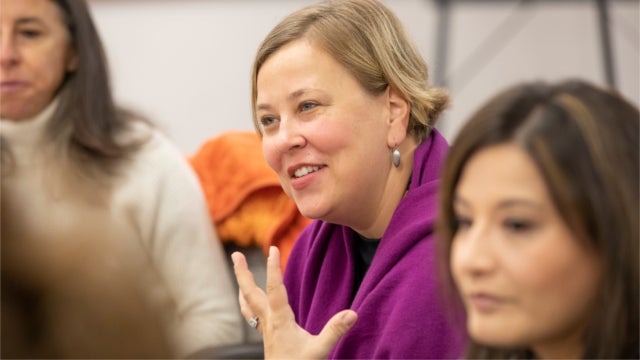
believes that workforce development leaders need to think about job quality in the same way they think about qualified workers. Seeing that workers were not getting the same status as businesses, Kusner’s work enables conversations and collaboration between workforce stakeholders from across the region’s philanthropic, government, nonprofit, and business communities in Northeast Ohio.
“I do a lot of thinking, talking, and doing around aligning programs and services to meet the needs of both businesses and job seekers, and that includes a focus on job quality,” says Kusner. “One of my principles is that workers and businesses should be of equal priority in the workforce system. Quality jobs matter as much as qualified job-seekers.”
Kusner consults with workforce development leaders on all stages of strategy development, informing and guiding the work taking place in communities across Cuyahoga County. The organization draws on Kusner’s experience and relationships in the community to help guide the development of partners’ workforce strategies, focusing on job quality as a key component of this work. In each project, Kusner works with clients to consider job quality as they develop and execute their broader strategies. For training organizations, this can include using job quality criteria to determine which businesses to refer job seekers for employment. It can also mean encouraging business partners to offer stable scheduling or other job quality components that match job seekers’ needs.
Addressing job quality through a racial equity lens
Kusner prioritizes racial equity in her work to advance job quality. “Across Northeast Ohio, workforce programs and policies are delivering disparate outcomes by race, including disparate job quality outcomes, and this must change,” says Kusner. One resource that has informed Kusner’s work is the Annie E. Casey Foundation’s Jobs and Race report, which shares lessons and resources for advancing racial equity in complex workforce systems. In her work with community stakeholders, Kusner raises awareness of systemic inequities, sharing data on racial disparities in income and opportunity and supporting partners to disaggregate data by race. Kusner also supports Generation Work, a local partnership that engaged Race Matters to develop a “back map” for Cuyahoga County, with the goal of surfacing root causes of racial disparities in the region. Regional stakeholders are using the tool to identify funding and programmatic strategies that aim to address systemic inequities.
Kusner also works to develop a shared understanding of job quality across the region’s workforce stakeholders, exposing leaders to frameworks that outline different components of job quality. Recently, Kusner engaged a cross section of local partners in discussions about the role of job quality in workforce development. The partners convened specifically to explore how job quality influences job seekers and workers approaching benefit cliffs. Providers, funders, industry associations, and government stakeholders each considered what role they can or should play in helping to mitigate the impact of benefit cliffs through improved job quality. Since then, several of these organizations have committed to driving community conversations about job quality and piloting ways to track job quality components with business partners.
Kusner also works directly with business and industry associations to help them better understand different aspects of job quality. “When job quality is raised, business partners assume that wages are the primary target,” explains Kusner. “Offering alternative measures of job quality, including scheduling and training policies, can allow conversations to happen in a way they would not otherwise.”
Kusner’s work in this space extends beyond Cuyahoga County and into the Mahoning Valley. Partnering with the Mahoning Valley Manufacturing Coalition and other local stakeholders, Kusner has helped elevate the importance of quality jobs in workforce conversations. For example, Nordson, a global manufacturer headquartered in Northeast Ohio, is building its workforce pipeline by providing paid training to low-income community residents. Nordson provides ongoing training for employees and partners with community organizations to offer retention and advancement coaching. Through its work with Kusner, the company is working to align job shifts with public transportation schedules and offer up-front tuition assistance to employees.
Share
TweetPartnering with local stakeholders, #JobQuality Fellow @rkkusner works to elevate the importance of quality jobs in workforce conversations.TweetWorkforce leaders need to think about #jobquality in the same way they think about qualified workers. In Northeast Ohio, Job Quality Fellow @rkkusner promotes collaboration across the region’s philanthropic, government, nonprofit, and business communities.Tweet“One of my principles is that workers and businesses should be of equal priority in the workforce system. Quality jobs matter as much as qualified job-seekers.” #JobQuality Fellow @rkkusner.Tweet“Across Northeast Ohio, workforce programs and policies are delivering disparate outcomes by race, including disparate job quality outcomes, and this must change.” #JobQuality Fellow @rkkusner.TweetOur economy needs more quality jobs. Learn how leaders like @rkkusner are innovating to boost opportunity in communities across the country.
Learn more
is a member of the Job Quality Fellowship, Class of 2018-19. The Job Quality Fellowship is a project of the Aspen Institute Economic Opportunities Program.
Learn how the Economic Opportunities Program is helping low- and moderate-income Americans connect to and thrive in a changing economy. Follow us on social media and join our mailing list to stay up-to-date on publications, blog posts, and other announcements.