We almost named the conference something safer
What a 47-page communications playbook is actually for, and the day it told us to stop being careful


Roger Santodomingo
Senior Fellow
When I joined the Aspen Institute’s ANDE network in 2023, the communications function was a service desk. Program staff would send a request—execute the deck, post the panel, send the recap—and we would carry it out. Nothing was wrong with what we were doing. The requests were reasonable, and the work carried out was competent. Yet my objective, the reason I was hired, was to find out whether a service desk can properly address the one question that really matters: has any of this contributed to directing resources towards the small business sector for which we exist? And if not, change our approach and help develop a more strategic unit.
Three years on, a project I have the pleasure to see completed this Spring was a new ANDE Strategic Communications Playbook: a 47-page operating manual intended for global staff, the communications coordinators in the three regions (Asia, Africa, and Latin America), and its eight chapters, and to assist the communications specialists at our member organizations. I would like to share what I learned while preparing it—since I believe the lesson applies to any communications function asked to work faster than its headcount.
The problem a playbook solves is memory
An experienced, skilled communications team will be familiar with most of the content in a playbook. The problem is that they might forget about it when, at the 6 p.m. Zoom meeting, leadership wants the announcement released by tomorrow and a chapter in Bangkok has already drafted something in a different frame. Process can’t teach people what they don’t know. But it can make the right question impossible to ignore when no one has time to remember to ask it.
The playbook’s sections are based on questions, not rules. Before launching a campaign, what is the specific goal and by when? Who is the decision-maker—by name, not as a representative of an organization? Which of our audiences are already with us, which ones we can win over, and which will never change no matter how much energy we devote to them? Each week during the campaign, did we deliver what we promised, are we moving closer to the next milestone, and has anyone we’re trying to influence actually changed their position?
Outputs are what you do. Outcomes are what happens because of it
The most useful element in the document is a two-column table. On the left-hand side there are the outputs (publish a learning brief, run a four-week LinkedIn campaign, place an op-ed) and on the right-hand side the outcomes we expect (three members cite the brief in their next funder report; registrations exceed the last series by 25 percent; two partnership conversations start from readers). A plan that includes only outputs has no way to know whether it is having an effect. Indeed, of all the communications plans I have seen over the course of thirty years, most list only outputs.
This contributed to ANDE increasing its social media engagement by 40 percent, alongside follower numbers doubling on platforms such as LinkedIn. There was a tangible rise in registrations for events. ANDE membership had finally begun to recover after the pandemic had greatly reduced it. All of this was, to some extent, a result of the table. Of course, the table isn’t magic, but it encourages program leads to discuss what ‘worked’ would mean before the work begins.
The hard truth squad
In each campaign team, as outlined in the playbook, two or three individuals must have a role whose sole responsibility is to point out flaws in the plan. At the beginning of every planning session, they read out a short list of pre-established questions. Does this indeed appear to be the correct campaign at this time? Is our organization the right group to lead it? What would a skeptic say if they stated it fairly, and what is our honest response? And what is the smallest version of the campaign that could still be considered a win?
I expected the squad to use its time to slow us down. The experience demonstrated the opposite.
This Spring, we’ve been working on the campaign for the next global conference, to be held in South Africa. The word that repeatedly surfaced was Sisonke—approximately meaning “we are together”—a term that embodied the spirit of post-apartheid solidarity and the Ubuntu concept of collective progress. The word captured in a single term what a network meeting could achieve in a shrinking funding environment. Yet it also frightened us. Since a team based in Washington was naming a global event in a language from southern Africa, it might be seen as appropriation or as Western people attempting to appear local and more fashionable than they actually were. On the other hand, funders and members from other regions could interpret it as a national, o r regional event that just happened to have a global guest list. We had already listed ‘cultural-framing failure’ on our risk register as medium likelihood and high impact, and had begun moving toward a safer English title.
People from the host community must sit on the campaign team as partners, not as beneficiaries, and a host-region voice must clear any culturally loaded language before publishing. So the question went to our Africa coordinator and to South African members. We expected a cautious yes, but they said the fear was ours, not theirs: the word was right, and the risk we were managing didn’t exist. Thus, our mistake would be to flinch. Sisonke became the campaign name, with pronunciation and provenance on first use and South African partners fronting its introduction. Critically, the decision was theirs.
That is the purpose of the process: to ask the person who actually knows the answers all the necessary questions and at an early stage, when it still makes a difference.
Is it really a crisis?
The section I had hoped to use the least was, in fact, the one my colleagues asked about most. It is a decision matrix consisting of eight questions: whether reputation will be harmed, whether the impact will reach members and funders, whether there will be media attention, whether silence is likely to make it worse, and so on. In this case, if any of the answers is yes, then treat it as a crisis and call the small team together; if all the answers are no, then it is a distraction, and the proper course of action is to refrain from engaging.
The vast majority of items that end up on a communications desk marked ‘urgent’ do not pass the test, and writing the test down lets the team say this without it looking like a judgment call.
When process gets in the way
I can be wary of the playbook too. It can become the thing people hide behind, and the worksheet may be completed instead of the thinking. So we need criteria to decide when to skip the manual: a newsletter to existing supporters doesn’t need a campaign plan. A member’s award does not need a SMART objective when a post can be written within the hour with a pre-cleared approval path. The real job is judging when structure creates clarity and when it slows the room down. The playbook exists to make that judgment easier to exercise, not to replace it.
Beyond ANDE’s Comms
ANDE, like many of its members, has navigated over the hardest funding environment international development has seen in a decade. The playbook is part of our efforts to renew the organization and offer our members solid tools to use. It will stay on the shared drive, available to every member organization in the network. That’s why we wrote it with members and chapter leaders in mind, not just our Comms team: a communications function that lives only in the heads of its staff ends when the staff leaves.
If you’re in charge of a small communications team and are wondering whether it’s worth putting your operating model in writing, my answer is yes. Although people won’t read it all the way through, it will be there the next time someone needs to recall something they already know.

Access the Strategic Communications
PLAYBOOK
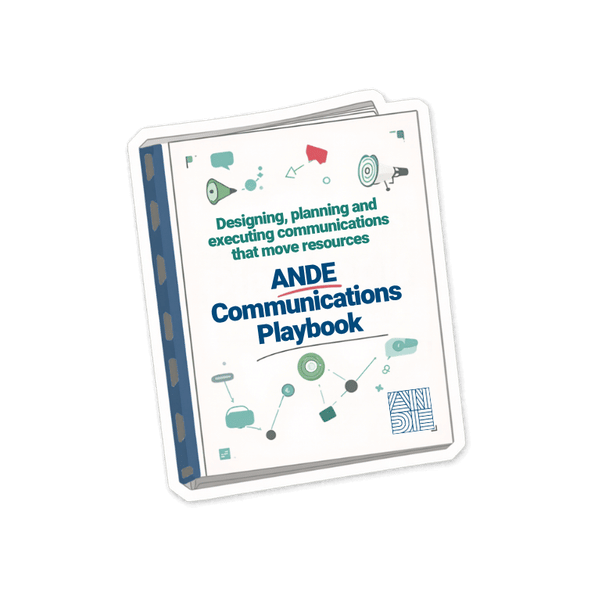 A working guide for communications teams working in the intersection of international development, entrepreneurship and finance. A working guide for communications teams working in the intersection of international development, entrepreneurship and finance.Download it here. |

The Changing Face of Retirement and the Future of Work: Big questions and Bold Solutions

The Potential for Scaling Technology: Increased Labor Productivity … If We Get It Right

Second and Third Order Effects of AI

Our Primer on Responsible Data in Product Equity: Demographic Data Collection and Use in Product Development

Responsible Data Practices for Product Equity


Beyond Automation Anxiety: Shifting the Narrative from Technological Fears to Worker Power

Cybersecurity Policy Recommendations for the New Administration

Navigating Growth, Change, and Impact: Insights from Laela Sturdy, Managing Partner at CapitalG