Capturing the Impact of Public Benefits Coordination

Jason Ewas
Associate Director, Lifelong Saving and Investing

Rachel Black
Former Policy Advisor
After a year of hosting working groups to coordinate with state and federal governments around improving benefits delivery, we and our partners at the federal government’s interagency Facing a Financial Shock team are closing out the incubation phase and now supporting the transition of partnerships, ideas, and solutions to other spaces where they can embed and continue to grow.
Each group created space to share best practices, build networks and partnerships, and identify solutions to long-standing challenges in improving public benefits delivery. Here, we share an overview of the impact they had in the past year.
The working groups were attended by almost 400 people from politically and geographically diverse state governments, leading nonprofits, and the federal government. About half of those participants came from state governments, with participation from staff from 29 states and D.C. The map below demonstrates the breadth of participation.
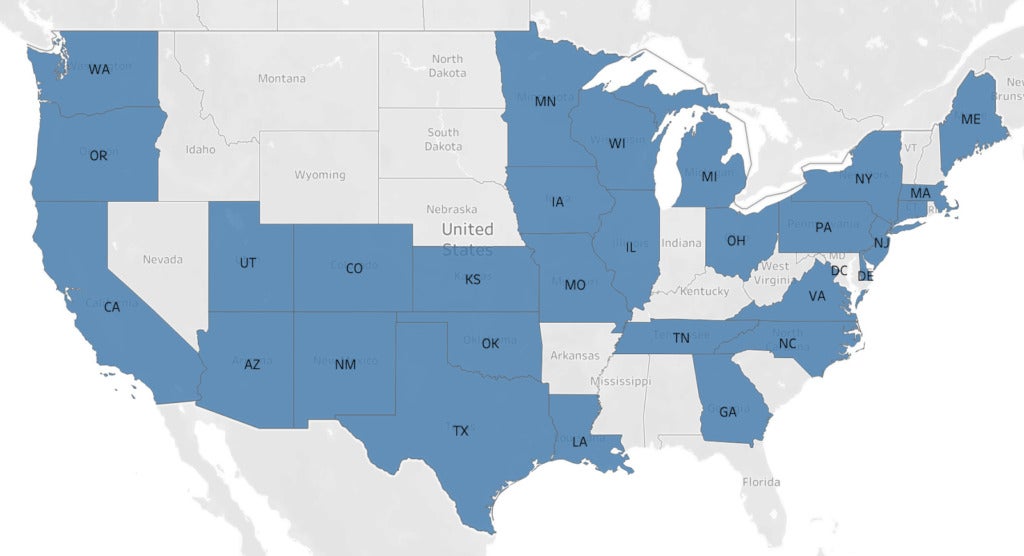
States with staff who attended the benefits working groups. (Included but not pictured: Alaska and Hawaii.)
Government and nonprofit leaders held over 40 meetings in total across the working groups, with about half of all participants attending more than one meeting, demonstrating a strong commitment to making progress on public benefits.
Through surveys and conversations conducted by Aspen FSP, we learned that many participants found value in hearing from and connecting to other states and federal partners. The meetings helped states learn from their peers who had already developed similar programs, gather best practices from other states and leading organizations in the field, and work together on common challenges across states.
Themes across the survey and interviews we conducted included key lessons to consider as the work moves forward:
- States need space to support peer-to-peer learning that surface shared challenges and possible solutions.
- Federal policies provide lots of flexibility, but states need more specific resources and tools to exercise those flexibilities effectively.
- Nonprofits have a critical role to play in establishing collaborative spaces shared by stakeholders across the benefits ecosystem, and these spaces are essential infrastructure to catalyze tools and partnerships that sustain progress in improving the public benefits system.
One state government employee said, “[There were] learning opportunities that I don’t see happening in many other national groups.” Another noted that the greatest value of the groups came from “connecting with colleagues in other states and getting access to larger resources/understanding of initiatives, in particular around data matching.” And a third participant shared that a session changed their perception on a topic and allowed them “to think more creatively about potential service delivery options and also where to encourage CMS [Center for Medicare and Medicaid Services] to work more closely with FNS [Food and Nutrition Services].”
Another benefit of the working groups was the list of resources, experts, and practitioners compiled as a result of them. That helped centralize communication on an important range of activities during a critical period for public benefits and will help align communication in the field moving forward.
The themes and topics addressed by the working groups were underscored at the 2024 Financial Resilience Summit, with even more work outlined in the years ahead. For example, Cash & Benefits will continue through 2024 in response to a recurring pain point voiced by states occurring when receipt of cash payment jeopardizes benefits through other safety net programs, and other components of the work have already taken on new forms as participants have built on the connections made during the working groups.
Overall, we have been deeply inspired to see leaders, across sectors and across the country, collaborate and coordinate to improve access and delivery of public benefits for millions of people. While some of the resulting materials are already available on the Digital Benefits Hub, we at Aspen FSP will share more resources from working group partners in an upcoming blog and highlight other opportunities to address the critical challenges facing public benefits delivery.
North Stars in a Moment of Constraint
Bridging the Information Gap: How Organizations Can Assess and Use Benefits Screeners
From Band-Aids to Stepping Stones: How We Can Rebuild Young Adults’ Trust in Public Benefit Systems
OBBBA’s Impact on Young Adults and 5 Strategies to Support Them
Leading with Empathy: Strengthening Benefits Delivery with Mike Wilkening

A Persistent Challenge: How Financial Shocks Continue to Undermine Family Financial Security

Beyond Income: Worker Financial Security and the Role of Benefits Inside and Outside of the Workplace