How State and Local Governments Can Advance Early Wealth Building for All

Jason Ewas
Associate Director, Lifelong Saving and Investing

Karen Biddle Andres
Director, Lifelong Saving and Investing

Ray Boshara
Senior Policy Advisor
Contents
Introduction
Trump Accounts have arrived. Following the official launch on July 4, 2026, over 7 million accounts are opened, and at least 500,000 accounts have been seeded with a $1,000 deposit from the federal government for eligible children. For the first time, the United States has a federally funded early wealth-building policy—and every state and local government now has an opportunity to help build wealth for their residents, starting at birth.
At the Aspen Institute Financial Security Program, we are committed to working with leaders from government, the private sector, community organizations, philanthropy, academia, and beyond to help to answer the question: With Trump Accounts here, what can state, local, county and Tribal governments do to advance early wealth building for their residents? (We often use both “state and local governments” to describe this collective audience, though we will identify some ideas that will likely only be feasible for state governments).
Our answer, developed after conversations with state and local leaders across the country: States and some local governments are well positioned to develop and run early wealth account systems for residents, delivering all available resources—federal, state, local, and private—to all households, and especially to low- and moderate-income households. We identify three major categories of action. Addressed separately, they would all be positive. If done as part of a strategy, or as part of an early wealth account system, they could represent significant progress toward more assets for families. State and local government can:
- Build infrastructure to open accounts and engage families
- Contribute resources to grow family balance sheets
- Change state policy to support wealth building at birth
When we refer to early wealth building accounts (EWBAs), we mean accounts that offer meaningful seed deposits, have the potential to generate meaningful rates of return and build substantial wealth, and intentionally aim to include all and especially lower-income children. (For a full definition, see our report, The Case for Early Wealth Building Accounts.) 529s and Trump Accounts are both vehicles that can qualify as EWBAs, as long as they feature meaningful seed deposits and maintain an intentional focus on reaching low- and moderate-income families. (For our full perspective on Trump Accounts and other early wealth building tools, see our resource hub.)
Before we go further, we need to acknowledge that America has state and local leadership to thank for the idea of early wealth building. For decades, state and local government leaders, in partnership with nonprofits and researchers, have made early wealth building a tangible reality for millions of children across the country and documented how to do it well. (For a list of design principles for early wealth building that have emerged from decades of state and local innovation, see the CSD 10).
To name just a few places that have led the way: Oklahoma, Pennsylvania, Maine, California, Connecticut, and New York City have all implemented best-in-class early wealth building programs, reaching millions of young people.
Most EWBAs are built on 529 College Savings Plans, but not all 529 plans qualify as EWBAs. Nearly every state offers a 529 plan, which are retail accounts that any person can open and fund. There are over 17 million active 529 accounts across the country, though they are largely opened and used by—and chiefly benefit—higher-income households. For a quick comparison to Trump Accounts, that 17 million number for 529s took 30 years to achieve. There have been 7 million sign-ups for Trump Accounts in the first six months of the program, though we do not yet know how many of those accounts have been officially opened.
Where do Trump Accounts fit into this? Much of the discourse among state and local governments focuses on the unknowns of Trump Account implementation. Will states be able to manage the accounts like they do 529s? What will the implementation details of foster-care-focused Fostering the Future Accounts, which use the Trump Account platform, look like in practice? What do we know about Trump Accounts and asset limits? These are all important questions, and we and others will aim to answer them in the coming months. (On asset limits, the Administration for Children and Families has already issued important guidance that, for “youth age 18 and older, Trump Accounts are handled similarly to traditional IRAs when determining eligibility.”)
Despite these outstanding questions, state and local governments are well situated to develop and administer early wealth account systems. In fact California already has, because:
- They have access to key administrative data and can reach nearly every eligible child. Even as the law and Treasury guidance now stand, state and local governments have an important role to play in ensuring residents know about and open federal, state, and local early wealth building accounts and accumulate resources in them.
- And with Trump Accounts alone, there is real money—$15 billion dollars—on the table, with the $1,000 federal deposit for kids born from 2025-2028 and major philanthropic funding announced for older kids, with more philanthropic announcements likely to come. We also note that families can claim the $1,000 at any time before the year in which the eligible child turns 18, meaning governments will be able to help families claim meaningful seed funds in these accounts for the next 20 years.
- They already run or facilitate a number of wealth-building programs for residents and can help simplify the user experience and build wealth. To name a few accounts where the government plays a key role: 529s, Children’s Savings Accounts (CSAs), which are primarily but not exclusively built on the 529 platform, Auto-IRAs, and Baby Bonds.
- They can address some policy challenges, like asset limits for some programs, and activate other necessary stakeholders to drive momentum (e.g., businesses, nonprofits, etc.).
How State and Local Leaders Can Build Wealth for All Their Residents
Now to implementation. State and local governments can take a number of steps to drive their residents’ success with federal, state, and local early wealth building accounts across each of our three action categories:
Build Infrastructure to Open Accounts and Engage Families
Right now, opening a Trump Account is a multi-step process. Eligible individuals or entities can open an account by submitting an application, which they can access through a number of channels, and then activate the account on the official app or web portal once the application is approved. Additionally, parents or guardians can opt-in to receiving the $1,000 deposit from the federal government into the account.
Aspen FSP continues to push for federal automatic enrollment—both automatic account opening and automatic $1,000 deposit. Even with full federal automatic enrollment, states would still have important roles to play on awareness, account claiming, and streamlining. Without it, they can help open accounts and raise awareness now by:
- Opening Fostering the Future Accounts. State governments now have an official role to play in 530A Account opening for some of their most vulnerable residents: children in the foster care system. The program enables state agencies to open accounts for children in foster care, though state agencies cannot claim the federal $1,000 deposit on behalf of the eligible child. So far, 23 states have already agreed to participate.
- Sharing data to raise awareness of EWBAs. States can develop systems to identify the eligible population and communicate with them about Trump Accounts and any state and local wealth building programs, including 529s to ABLE (Achieving a Better Life Experience) accounts, in a coordinated, consistent, and comprehensive manner. By building these systems, state governments can build or amplify their own programs and help deliver federal and philanthropic resources to their eligible residents.
There was precedent for data sharing to open and raise awareness of early wealth building vehicles well before Trump Accounts. Alfond Scholars in Maine, Keystone Scholars in Pennsylvania, NYC Kids RISE in New York City, and CalKids in California, to name a few, all established data-sharing systems that allowed them to open state or city accounts and consistently communicate with eligible families about them.
California in particular is already integrating Trump Accounts into their work. California’s Early Wealth Partnership recently announced the launch of an Early Investment Account Navigator, which will make it easier for families to claim and access federal, state, and local programs from a single place. And by the end of 2026, this tool is expected to be available to states beyond California.
Why should residents not access all resources available to them, regardless of which level of government delivers them?
Some states have built new systems since the launch of Trump Accounts. Kansas recently created a system for sharing information on all resources for families with children eligible for government early wealth building resources, including Trump Accounts and the state’s 529 program. Other states could follow this template. State and local governments could embed these resources in existing financial education programs—especially in schools—using them as a tool to show the power of investing and long-term planning.
We also note that several stakeholders have expressed interest in states playing a more active role in the administration of Trump Accounts, modeled on 529s or state-facilitated Auto-IRA programs. We think there is promise in the idea of states playing a more formal role in Trump Accounts to secure buy-in for the policy and allow easier coordination across state wealth building programs. Short of federal automatic enrollment, the U.S. Treasury allowing some form of state-facilitated automatic enrollment would be a positive development as well.
But we emphasize that even as a federally run program—that is, even if states can only play a somewhat limited role in implementation—there are still real resources for residents on the line. In addition to the $15 billion federal investment, the Dell Foundation’s contributions are now officially hitting accounts—meaning millions more children have $250 they could access if they have an account. And a federally run program has real benefits, not least of which is that children in every state can benefit from it and more easily track it if they move to a different state. Plus, many states build entire programs around accessing federal resources administered by the federal government. Why should residents not access all resources available to them, regardless of which level of government delivers them?
To make the most of these accounts, governments can also leverage trusted partners (e.g., schools, nonprofits, churches, employers) to maximize their benefit to residents by:
- Raising awareness among the eligible population
- Driving account opening for those without accounts
- Ensuring all eligible elect to receive the $1,000 federal deposit (even if there is federal automatic enrollment into accounts, families may still need to “elect” to receive the $1,000, though an ideal policy would have automatic opening and automatic $1,000 deposit)
- Facilitating ongoing engagement with the accounts (families contributing to and interacting with the account over time)
For example, California’s Early Wealth Account System developed a comprehensive plan to leverage the state’s full outreach networks to reach families. Another example: Community partnership and stakeholder engagement is the bedrock of NYC Kids RISE’s innovative model, which leverages their existing financial education initiatives (e.g., tax time wealth-building initiatives), local nonprofits and trusted messengers, including employers, to reach residents. These models should serve as a template for the country to drive momentum for early wealth building.
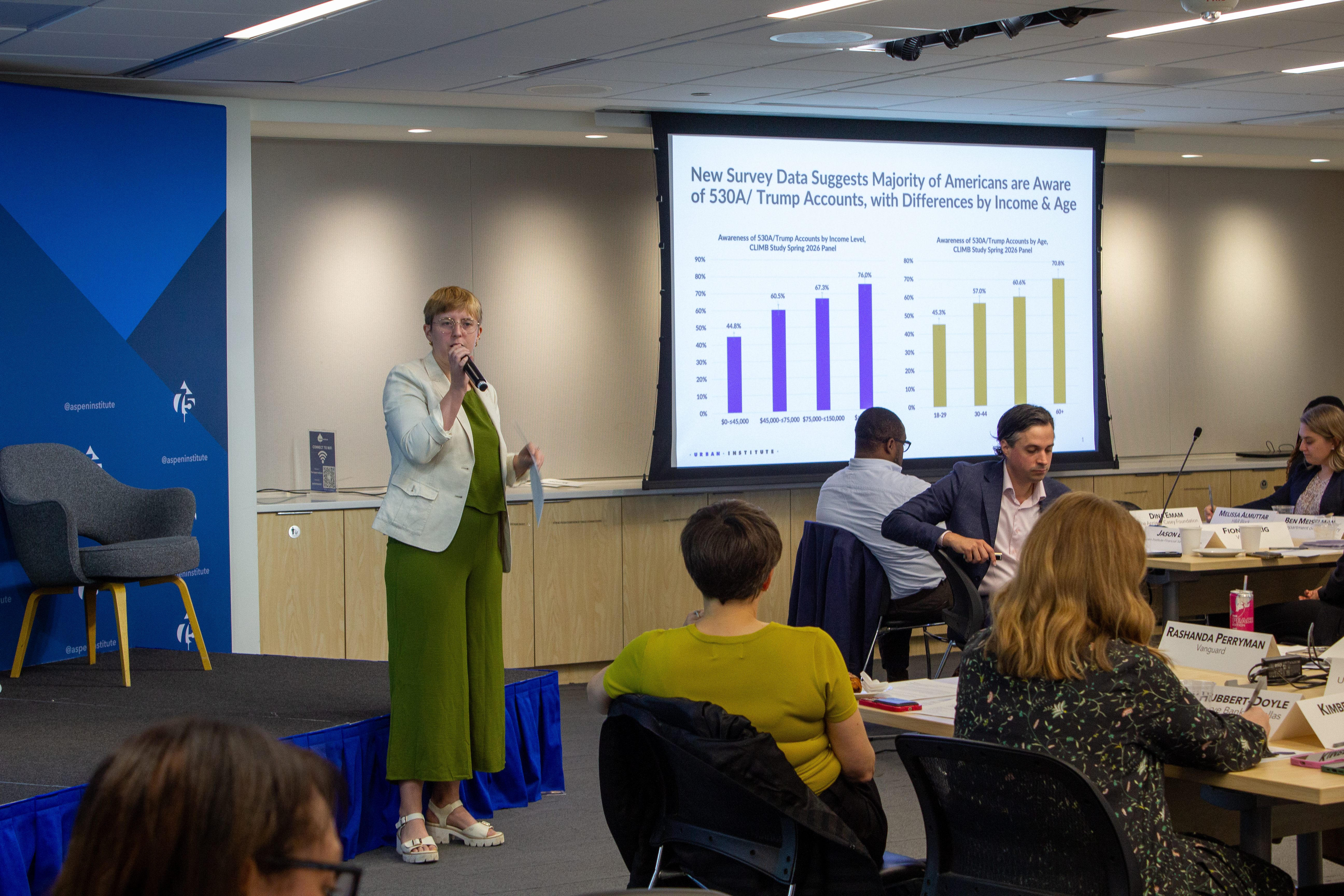
As practitioners know well, the message can matter as much as the messenger. States need the right messaging and information on the program to address residents’ questions and concerns. Early results suggest emphasizing the money available—in particular the $1,000 federal seed deposit for eligible newborns—will drive uptake.
On top of all this, states and local governments need consistent data and information from the federal government to effectively communicate about Trump Accounts. We hope that the U.S. Treasury and other organizations with relevant data will share insights on implementation to equip different sectors—philanthropy, the private sector, nonprofits, as well as state and local governments—with the information they need to target outreach and drive account opening and engagement. For example, a regional philanthropy will likely want to know how its region is faring on account opening, and even further how certain segments within its region are faring, in order to target investment and address any gaps in account opening.
Contribute Resources to Grow Family Balance Sheets
State and local governments can make direct contributions to Trump Accounts or other state and local early wealth building accounts in a few ways, including:
Make “unlimited qualified general contributions”
Per statute, state and local governments, Tribal entities, and 501(c)(3) organizations can make unlimited “qualified general contributions” to cohorts of Trump Account owners who fall into one of three categories: an age cohort in the country, an age cohort within a state, or those within a “qualified geographic area” with at least 5,000 Trump Account owners. While a number of questions remain about how this process will work in practice, it involves working with the U.S. Treasury to approve the contribution and then distribute funds—that is, working with the federal government.
Enact legislation to enable additional contributions
At least one state has already enacted legislation appropriating funding to make additional contributions: Oklahoma will seed Trump accounts with $250 for the first 50,000 children under age 18 who complete an application. The state has set aside $12.5 million for this first-come, first-served fund. Their experience will answer many questions on how the process will work. And in Texas, Lt. Governor Dan Patrick intends to propose a $1,000 match of the federal $1,000 deposit for all Texas newborns.
States and local governments could follow Oklahoma’s or Texas’s lead for a statewide approach, or take a more targeted one for certain qualified geographic areas (though we do not yet have great clarity on what, beyond 5,000 Trump Account holders, a qualified geographic area means).
Explore approaches tailored to reach LMI households
Several states have expressed interest in approaches that more directly target low- and moderate-income households and that enable direct contributions to accounts, as opposed to working with the federal government as an intermediary.
Can states or local governments follow the examples of the Dell Foundation and the Dalio Foundation and target pre-tax, “general contributions” to certain geographic areas within their state?
At this point, the answer is unclear. States may be able to follow that model or a similar one (targeting additional contributions in zip codes with a median family income below a certain threshold, with the Dell Foundation’s being $150,000), as long as the total number of recipients in the geographic areas is at least 5,000 children and the total gift is at least $125,000, meaning at least $25 per child (Treasury set those minimums in March 6, 2026 guidance).
Politically, however, determining eligibility by geography could pose challenges for a state for obvious reasons; some residents will be and may feel excluded.
We will track developments on this front as the U.S. Treasury issues guidance and states experiment.
Can states and local governments contribute toward the $5,000 annual after-tax limit on contributions? That is, are they required to contribute through the pre-tax “general contribution” provision, or is there a mechanism to contribute after-tax dollars as well?
States (and philanthropy, for that matter) might be able to contribute to targeted populations via after-tax contributions, meaning help families “fill up” their $5,000 annual contribution limit. Doing so would allow for more targeted contributions than the more strict “general contribution” requirements mentioned above, though many questions remain about how contributions will work, and the answers will determine how feasible this approach is for state and local governments, along with philanthropy. We will watch and report on these developments closely.
State and local governments can also contribute to their existing early wealth building programs, as many already do. We discuss this further in the next section.
Change State Policy to Support Wealth Building at Birth
Many states have asked us: What do Trump Accounts mean for state and local EWBAs?
As we noted at the start, there is much more to early wealth building than Trump Accounts. Nearly every state offers a 529, with a few offering programs designed for low- and moderate-income households. These programs range from income-targeted matched savings programs with modest uptake to statewide CSAs with a government-provided seed deposit and automatic enrollment. Outside of the 529 platform, Connecticut successfully launched a first-in-the-nation state-wide Baby Bonds program for Medicaid-eligible children. (For a detailed comparison of Trump Accounts, see our overview of Trump Accounts).
To maximize resources for households, we recommend states adopt an “all of the above” early wealth building strategy—especially since CSAs, Baby Bonds, and Trump Accounts cannot currently work together seamlessly, as they are structured differently in terms of the account type used to house the funds, the assets held within the account, and the distribution platform. Even states that decide not to take immediate action on Trump Accounts can take action on early wealth building by focusing on the policy levers within their control.
Furthermore, we recommend all states take an objective look at their own programs to assess whether they are reaching and have the potential to build wealth for young people from low- and moderate-income households. (Some programs have goals besides wealth building, and those are important but not our focus here).
States should see Trump Accounts as an opportunity and a challenge to make sure every resident has—not just has access to, but has—a universal, high quality early wealth building account, if not several.
Many of the fair criticisms leveled at Trump Accounts could also be leveled at state and city programs. To name a few design features not widely adopted in states: automatic enrollment, automatic government seeding (some do offer matches), and more funding for low- and moderate-income families. On the last point, we note that several states offer generous tax incentives for contributions to 529s, which only wealthy households could maximize, while many state-run matched savings programs directed at low- and moderate-income households have modest reach despite best efforts.
Crucially, many states also do not exempt amounts in 529s from savings penalties/asset limits. Some of these design decisions—depending on the program—are often firmly within the power of state governments, though of course writing them here is infinitely easier than finding money in strained state budgets, passing legislation, or implementing a program.
Several people have also noted the issue of state-level tax treatment of 530A Accounts, particularly as states work through the effects of the full set of tax changes in the One Big Beautiful Act. To mitigate the confusion, state governments that don’t automatically conform to federal tax changes can consider adopting the federal government’s tax treatment at the state level, as California has.
States should see Trump Accounts as an opportunity and a challenge to make sure every resident has—not just has access to, but has—a universal, high quality early wealth building account, if not several. And if there are several, as we mention above, families should be able to access them from a single point.
Why State and Local Governments Need to Think Big on Early Wealth Building
Many state and local leaders have told us that now, even with significant changes and reductions in other parts of the safety net, is the moment to think big and build new systems that set up residents for short-term stability (income) and long-term prosperity (assets). As cited, several of those leaders have started the work of creating early wealth building systems in both Republican- and Democratic-led states.
For early wealth building to become a national movement, for every child in the U.S. to begin life with a stake in our economic system and an investment in their future, we need bold leadership focused on building lasting infrastructure.
Many leaders are already advocating for changes to federal policy, which will over time likely strengthen the program. But even as they advocate for policy changes, we encourage these leaders to maximize resources on the table now for their residents, especially for low- and moderate-income households.
For early wealth building to become a national movement, for every child in the U.S. to begin life with a stake in our economic system and an investment in their future, we need bold leadership focused on building lasting infrastructure. As has been the case with every improvement to our social contract, it will require the forward-thinking actions of state and local governments.
We focus on early wealth building here, but we can see the beginnings of a broader movement toward public policy that advances lifelong saving and investing. For example, states with Auto-IRA programs can begin to think through how to combine early wealth building programs and retirement savings—how to create lifelong saving and investing systems that complement the federal safety net and give everyone a strong start towards achieving the American Dream.
So while Trump Accounts have arrived, the task of making them work for everyone has just begun. We look forward to learning from and working with state and local government officials across the country as they navigate this new landscape and deliver meaningful, tangible stability and assets to their residents.

Five Things We Heard About Making the Saver’s Match Work for 69 Million Workers

Lessons From Down Under: What Australia’s Retirement System Really Teaches Us About Trump Accounts and Social Security
The Future of Advice: Going from Fragmented Help to Person-Centered Guidance

Trump IRAs Are Coming. Let’s Make Them Work for Those Who Need Them Most.

Lab Notes: 2025 Workers’ Wealth Lab

Wealth Building at Work: How Canary’s Emergency Relief Fund Helps Workers Maintain Assets and Avoid Debt

What’s the Future of Retirement Savings? We Get to Choose