Trump IRAs Are Coming. Let’s Make Them Work for Those Who Need Them Most.
With possibilities informed by tensions and insights surfaced at the 10th annual Aspen Leadership Forum on Retirement Savings

Karen Biddle Andres
Director, Lifelong Saving and Investing

KC Boas
Retirement Initiative Lead, Lifelong Saving and Investing
Contents
Something big just happened in retirement policy.
President Donald Trump has signed an Executive Order aimed at expanding access to retirement savings for uncovered workers, marking one of the most significant federal actions on the access gap in decades.
At its core, the EO for Trump IRAs appears to center on a federally facilitated IRA marketplace—a platform, expected to launch by 2027, that would allow workers to compare and select retirement accounts based on features like cost, minimum contributions, and investment options. The timing aligns with the rollout of the Saver’s Match, a new federal matching contribution of up to $1,000 for eligible low-income workers—millions of whom today lack access to a plan or account where they could receive it.
We’re asking 4 questions right now about Trump IRAs.
Many elements of this order look familiar, but some unique elements prompt questions, such as:
- The order aims to provide access to retirement savings accounts to workers who currently lack them, but can anyone open an IRA through the portal?
- Section 4 refers to “charitable contributions” to retirement accounts made by tax-exempt organizations, but can IRA rules be modified to accommodate those contributions?
- Currently, only traditional IRAs and qualified plans can receive the Saver’s Match. Is that still the case, or can we expect an expansion in the kinds of IRAs that can accept the Saver’s Match?
- And while we’re on the topic, does this EO signal that expanding the Saver’s Match is a legislative priority?
At the highest level, the President has referred to these accounts as being “TSP”-like (that’s the Thrift Savings Plan, the retirement plan that federal workers have access to). We see a similarity between the TSP and this order in the low-cost investment option, but how can we move from the initial building blocks laid out in this order to the full experience of the Thrift Savings Plan—namely, automatic enrollment into a plan with a 5 percent employer contribution?
Still, the potential here is real.
An EO on retirement is significant. Federal action toward addressing the access gap is significant, even if the initial design falls short of what we know to be true about the importance of automatic enrollment to drive participation for lower income workers. And the potential to improve outcomes for millions of low-income workers is significant … if implemented well.
So it’s worth getting right.
This infrastructure could be a powerful foundation to reduce friction in retirement account opening and contribution, but we know it’s coming during an affordability crisis for everyone in America, hitting workers with low income particularly hard. Workers have never had to pay more for housing, childcare, or higher education. While we build retirement savings options for these workers, we must also prioritize making daily life affordable for American households. And critically, we must design incentives that make saving feel possible, not punitive (as with asset limits).
It’s also important to be clear about what this is—and what it is not. Expanding access to retirement accounts cannot and should not replace Social Security. Even as urgency around solvency grows, Social Security remains the foundation of retirement security for low- and moderate-income households. Any new approach should be designed to complement—not substitute for—that foundation.
Because access to a marketplace alone is not enough. The important question is: How does this Executive Order improve workers’ access to and usage of a retirement savings account—and how is that account designed?
As this policy conversation evolves, a few important clarifications are worth noting. Recent comments suggesting that this Executive Order could move the U.S. toward a system that replaces the need for Social Security reflect a fundamental misunderstanding of both this proposal and international models often cited for comparison. An IRA marketplace for uncovered workers is not equivalent to systems like Australia’s Superannuation, which operates alongside—not instead of—a foundational public pension. Social Security remains the bedrock of retirement security in the U.S., and proposals to expand access to supplemental savings should be understood as complements, not substitutes.
There are also key implementation questions to address. The Executive Order’s call for all-in fees capped at 0.15 percent likely reflects a misreading of structures like the federal Thrift Savings Plan, where administrative costs are subsidized; in a retail IRA marketplace, achieving that level across both investment and administrative expenses may not be economically viable.
Finally, as policymakers and market participants respond, it will be important to watch how investment options are shaped—particularly in light of recent discussions about expanding access to alternative assets in retirement accounts—so that efforts to broaden access do not inadvertently introduce new risks for the very workers this policy is intended to serve.
Now that this approach is beginning to take shape, we can start to see where the building blocks are strong as well as where they’ll need refinement:
1. Driving Participation
The concept of a retirement marketplace is not new. Some state-facilitated programs have similar platforms, but the evidence is clear: Marketplaces alone do not drive participation. Uptake is strongest in states that have a mandate for auto-enrollment—where saving is the default, not the exception. At the individual level, participation increases. And at the system level, mandates have also been shown to spur private plan formation, driving competition and market growth rather than crowding it out.
This evidence raises a critical question: How will participation be driven at scale? Without clear pathways—whether through auto-enrollment, payroll integration, or other default mechanisms—there is a real risk that access exists in theory, but not in practice. We believe that some form of auto-enrollment or default pathway will be critical.
2. Designing High-Quality Accounts
A marketplace introduces choice. But choice without structure can quickly become complexity, which is the enemy of action-taking for people up and down the income spectrum.
Early reports indicate that workers will be able to evaluate options based on fees. We need to make that as easy as possible for them. But we also know from decades of experience that fees alone are not a sufficient proxy for value, particularly for low- and moderate-income savers.
The most effective accounts embed what works:
- Thoughtful defaults (like auto-enrollment and auto-escalation and investment options)
- Simple pathways to get started
- Mechanisms that support sustained contributions over time (including an expanded Saver’s Match—in both the contribution amount and the income threshold for eligibility—alongside the option for a well-structured employer and third-party contributions)
- Access to liquidity (like emergency savings solutions) when needed.
These are not “nice to have” features—they are essential to turning access into outcomes.
The opportunity here is not just to expand access but to leapfrog—to build a system informed by what we already know works, rather than repeating a decades-long learning curve from the world of 401(k)s.
At Aspen FSP, we have spent more than a decade convening leaders across policy, industry, and research to tackle these exact questions, and to make retirement security a policy priority for our nation’s leaders. And a mere three weeks ago—before this Executive Order took shape—we brought more than 80 leaders together at our 10th annual Aspen Leadership Forum on Retirement Savings to do just that.
The bright minds we convened had a lot to say about what it would take for an Executive Order like this to deliver for the American workers currently left out of our retirement savings system.
What follows is what we heard.

How the 2026 Forum Met the Moment
For a decade, the Forum has been a place for candid dialogue under Chatham House Rule for leaders from across sectors: policymakers, financial services executives, advocates, state program administrators, researchers, and others who don’t always sit at the same table, but need to.
This year was no different in composition, though it was different in ambition. We set out to do something more specific—and more difficult.
Rather than revisit familiar debates about expanding access, we asked a sharper question: If the U.S. were to move toward a national approach to retirement savings access, what should it actually look like—and what would it take to make it actually work for the low-to-moderate income workers who need it most?
That question comes at a moment of real inflection:
- For the first time, retirement accounts have outpaced home equity as the largest share of household wealth, underscoring just how critical these accounts are to lifelong wealth-building—as well as how much more work we have to do to ensure that people across the income spectrum can benefit from a retirement account.
- Yet 56 million workers still lack access to the gold standard in retirement accounts: a workplace retirement plan.
- Plus, there’s breaking news that the Social Security trust fund is now set to hit its depletion date in 2032, which would significantly reduce the only safety net that most low-income retirees have.
- To help fill the void, state-facilitated auto-IRA programs have grown over the past decade. Now available in 17 states, these programs have demonstrated real progress in reaching uncovered workers because they require employers to enroll employees into either a private retirement plan or the state-facilitated IRA. But they remain unevenly distributed, with zero “red” states requiring employers to enroll their employees.
- Meanwhile, federal proposals are emerging, including this Executive Order announcing the Trump IRAs model that President Trump previewed during the State of The Union in February.
- And, lurking in the background, the nature of work itself continues to shift at an accelerating pace thanks to AI, changing demographics, and other socioeconomic tailwinds, giving old questions about portability, emergency savings, and continuity of savings renewed importance.


At the same time, new data is challenging old assumptions about plan design. Discussions throughout the Forum pushed on foundational questions:
- Under what conditions are low-income workers able to save?
- Is auto-enrollment always the right answer, especially for low-income workers?
- What actually drives participation and persistence over time?
- And what have we learned about what it takes to make a universal requirement that employers automatically enroll their workers into a retirement savings program both durable and enforceable?
Against that backdrop, we brought together leaders not just to react but to pressure-test ideas, surface tradeoffs, and begin to sketch what a more universal, household-centered system could be. The goal was not consensus for its own sake. It was something more practical: to better understand where alignment exists, where it doesn’t, and whether we can start to “till the soil” for what may come next.
Because whether perfectly designed or not, and whether sparked by this Executive Order or whether it emerges in the “SECURE 3.0” policy discussions already underway, some version of a national access solution is coming. The question is how we can help shape it—together.
Have We Been Here Before?
From the outset, we asked a lot of our participants—specifically, to hold multiple possible futures in their minds at once.
Today, America’s retirement system already has many “front doors.” People can enter through the workplace, through state-facilitated retirement savings programs, or through opening a retail IRA on their own. In that sense, we are already operating in a kind of multiverse.
Where things become more complex is with the addition of a new dimension: a federal solution. Because it’s been unclear whether that solution would sit alongside these other front doors, or on top of it. (Here again, multiple possible futures.)

Over the years, ideas for a federal solution have taken many forms. Some proposals have advanced in Congress—like Ranking Member Neal’s (D-MA) Automatic IRA Act of 2025 and the Retirement Savings for Americans Act of 2025, introduced by Sens. Hickenlooper (D-CO) and Tillis (R-NC), and U.S. Reps. Sewell (D-AL) and Smucker (R-PA). Others remain earlier in their development, such as AARP’s Auto-IRA Plus whitepaper. And then there is the recent Executive Order.
From Aspen FSP’s vantage point, it’s hard to ignore the sense of déjà vu. This moment echoes the recent emergence of Trump Accounts (also known as 530A Accounts), another idea with bipartisan support and progressive roots that came together quickly under this Administration. From the outset, we have been clear: 530As are a down payment on a promising concept, with real potential if implemented thoughtfully. Since they were signed into law in July 2025, we have been working across the early wealth building and retirement ecosystems to help advance policy improvements that will ensure that 530As work for the kids who need them most, leaning in hard to evolve the policy to include both automatic enrollment and permanent, progressive deposits for kids from low-income households.
We see this Executive Order through a similar lens of clear-eyed, principled pragmatism. Now that this approach is beginning to take shape, the questions we explored at the Forum feel less hypothetical and more immediate. Our role now, and the role of the broader retirement community, is to help ensure that what emerges ultimately works for the households who need it most.
of Forum participants said they would support a government-facilitated option for workers without employer plans
And importantly, even in this evolving landscape, we are not moving toward a single, unified system with one point of entry. The Administration is signaling that Trump IRAs are targeted—that is, focused on workers who currently lack access to a workplace plan. We take that to mean other “front doors” in today’s system such as employer-sponsored retirement plans, state-facilitated retirement savings programs, and retail IRAs will remain, even if their roles evolve.
And that’s the way the leading minds in this field want it. We know—because we asked. While the vast majority (71 percent) of Forum participants reported that they would support a government-facilitated option for workers without employer plans, only one-third of the room would support such an option for all workers, reflecting a desire to keep the multi-door model intact.
The emergence of a federal solution does not replace the work ahead; it expands it.
That, in turn, reinforces a critical point: Those existing doors are still worth improving—and need improving. We should continue striving to make the best possible 401(k) system, and to scale what works, so that access is not only universal but meaningful. Similarly, there is much to learn from state-facilitated programs, even as some participants noted that they may ultimately serve as “a bridge to something better.”
In other words, the emergence of a federal solution does not replace the work ahead; it expands it.
3 Tensions That Emerged
Expansion is never without tension. And while there was meaningful alignment among participants on what features of access expansion policy are needed to better serve households, there was far less agreement on how to deliver them. In some cases, these tensions felt (to us) like natural growing pains; in others, they surfaced potential deal-breakers.
Who is this system for? (And who might it put out of business?)
Even before it was clear that Trump IRAs would be limited to workers who lack access to a workplace plan, participants raised important questions about what this could mean down the line:
- Will state-facilitated retirement savings programs eventually be displaced?
- Could some employers step back from offering workplace retirement plans, either due to fiduciary concerns or because a federal option is perceived as “better” or “easier”?
- And what happens when a worker moves from being uncovered to covered by a new employer? Do they remain in the federal system, or are they effectively “kicked out” and placed into their employer’s plan?
At its core, this discussion pointed to deeper questions about the placement of fiduciary responsibility in our retirement system—and, more fundamentally, whether public and private systems can truly coexist.
“It’s not like [asset managers] are serving the 56 million uncovered workers today. They can’t; there’s no real path to reach them. But with a federal plan for uncovered workers, maybe there could be.”
There is reason for cautious optimism. Evidence from state auto-IRA programs suggests that automatic enrollment requirements for employers can actually increase private plan formation rather than crowd it out. But whether that dynamic would hold at the national level remains an open—and consequential—question.
At the same time, some participants saw a potential upside. As one noted, “It’s not like [asset managers] are serving the 56 million uncovered workers today. They can’t; there’s no real path to reach them. But with a federal plan for uncovered workers, maybe there could be. And if you take the longer view, then those workers transition to a private plan, they’re bringing bigger balances with them.”

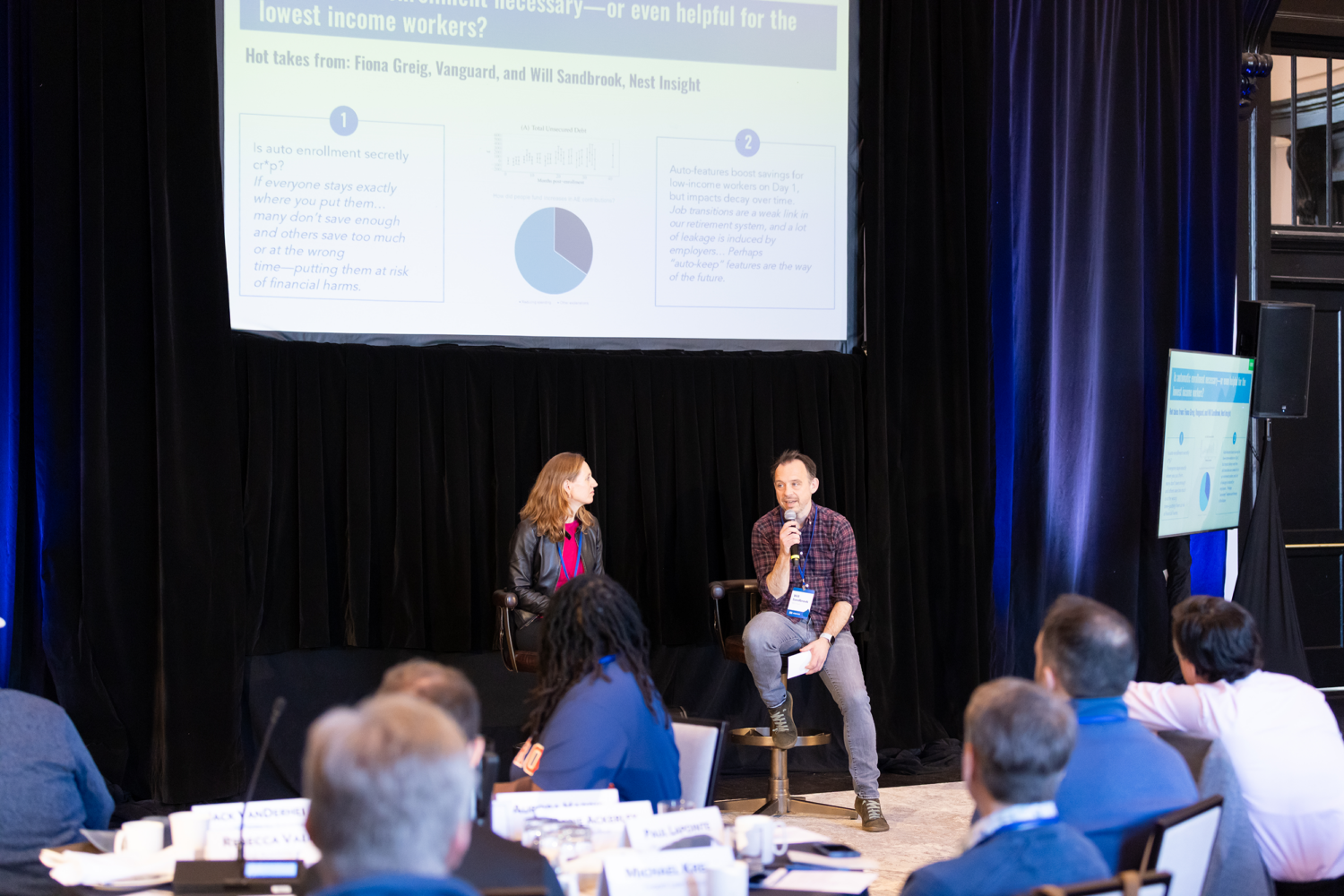
In that sense, the conversation wasn’t just about risk; it was also about reimagining the opportunity set. Across the Forum, participants wrestled with what it would take to create a true “all ships rise” system that expands access without undermining existing plans or innovation.
Is auto-enrollment essential? (And, if not, can we let go?)
Auto-enrollment has long been treated as a cornerstone of retirement policy. It’s hardly surprising that 93 percent of participants would support an auto-enrollment feature with opt-out as part of a federal solution. But new data—as well as lived experience—is beginning to complicate that assumption.
of participants would support an auto-enrollment feature
Participants pointed to emerging evidence that while auto-features such as auto-enrollment and auto-escalation do increase participation and contributions for lower-income workers, their impact can decay over time, particularly as workers change jobs. At the same time, the bluntness of auto-enrollment can produce two very different outcomes; some workers save too little, while others may be nudged into saving more than they can realistically afford, potentially leading them to take on debt elsewhere.
Taken together, these realities raise an important question: For some households, might liquidity matter more than default contribution rates? The implication is not that auto-enrollment doesn’t work. Rather, it may not be sufficient—and in some cases may not be the right tool—for every target population.
A case study has recently surfaced in this context: 530A Accounts. As of April 2026, more than 5 million children have been signed up for an account, with over 1.2 million qualifying for the $1,000 pilot program contribution for eligible children born between 2025 and 2028.
When 530As were first introduced, few would have predicted this level of uptake. (In fact, even when the details were presented at the Forum, some participants had a hard time accepting the data as true.) It’s still early, and time will tell how participation breaks down across income groups. But one takeaway is already clear: The way we design enrollment pathways should reflect how people actually make decisions using today’s digital financial tools, not how we assume they do.
As participants grappled with the political challenges of requiring traditional automatic enrollment through an employer, they considered alternative pathways to drive participation in a federal retirement option such as through tax filing, payroll systems, or government touchpoints.
Political feasibility, durability, and the role of brand
A recurring theme throughout the discussion was the tension between what is politically feasible today and what is likely to endure over time. Participants emphasized that durable solutions are rarely the most technically elegant ones; instead, they are those that build on existing structures, reflect established precedents, and can survive shifts in political leadership.
of the room was in favor of expanding the Saver’s Match
In that context, there was interest in whether a federal model could serve as a viable chassis for reform, leveraging familiar features such as the contribution limits of a traditional IRA, the outside contributions allowed within 530As, and mechanisms like an expanded Saver’s Match to enhance both scalability and bipartisan durability. Nearly 90 percent of the room was in favor of expanding the Saver’s Match—in both the amount awarded and those eligible. The underlying premise was that anchoring new ideas in recognizable frameworks may increase their resilience and adoption.
A well-designed federal solution could help…ensure that a worker’s ability to build retirement savings at work is not determined by where they live, the politics of their state, or the size and sophistication of their employer.
This conversation naturally extended to the role of branding and framing. Participants noted that even the naming and positioning of proposals can shape their trajectory, with political or institutional affiliations capable of either accelerating uptake or creating resistance. In this sense, how a solution is presented may prove nearly as consequential as how it is designed.

What A National Retirement Plan Could Solve—If Done Well
For all the tensions, there was also a shared sense of possibility, as a thoughtfully designed national approach to retirement savings access could help address several persistent—and emerging—challenges:
Expanding access—especially where it doesn’t exist today
State programs have made meaningful progress, but they are uneven. Most states, including red states and those states that have a program but lack an automatic enrollment mandate, remain un-or-under-served. A well-designed federal solution could help close those gaps and ensure that a worker’s ability to build retirement savings at work is not determined by where they live, the politics of their state, or the size and sophistication of their employer.
Creating true portability
Today’s system is fragmented across jobs, plan types, and providers. A more unified approach could allow savings to move seamlessly with workers, reducing leakage and improving long-term outcomes.
Addressing the “small pots” problem
As workers move more frequently between jobs, retirement savings are often left behind in small, disconnected accounts. A system designed to aggregate and consolidate savings over time could make those assets more meaningful, particularly when paired with pathways to lifetime income.
Meeting the needs of a changing workforce
The rise of gig work, nontraditional employment, and potentially higher labor market volatility—especially among younger workers—requires a system that is not tied exclusively to a single employer. Participants noted that this moment may be particularly well-timed to rethink how we deliver retirement savings in an AI-shaped economy.
Integrating liquidity and resilience
Pre-retirement withdrawals are at historic highs, underscoring a core truth: People cannot lock up money for decades if they lack short-term financial stability. And today’s affordability crisis has put more demand on people’s savings than ever before.
of Forum participants supported a federal option for uncovered workers that would include a separate emergency savings account
There was strong interest in designs that incorporate emergency savings “sidecar” accounts or buckets and greater flexibility without undermining long-term goals. In fact, 75 percent of Forum participants supported a federal option for uncovered workers that would include a separate emergency savings account alongside retirement savings.
Perhaps most importantly, a well-designed system could move beyond retirement as a narrow objective and toward a broader vision of household financial security—one that reflects how people actually live, save, and navigate risk.
Toward a Set of Shared Principles
If the Forum made one thing clear, it’s that we do not yet agree on a single model—and that’s ok, because creating a retirement system with one single front door was never the goal.
But we may be closer than it seems to something equally important: a shared set of principles that could guide what comes next and serve as an essential, shared blueprint to building retirement savings that work for everyone in America, no matter which “door” a worker walks through.
Throughout the Forum, participants began to sketch what those principles might include. For example:
- A federal focus on uncovered workers, not a one-size-fits-all system
- Designs that are household-centered, not employer-dependent
- Portability and simplicity as core features, not afterthoughts
- The ability to accept contributions from multiple sources—workers, government, and potentially others
- Built-in liquidity and flexibility, recognizing real financial lives
- Strong consumer protections and low costs
- A system that complements—not replaces—Social Security
- And critically, a system that is uniquely American in its embrace of fair competition—whether between federal and state programs, or a race to the top among private plan providers (or some combination thereof) the goal is for the worker to ultimately win.
And perhaps the most important takeaway of all: to move forward pragmatically and not let perfect be the enemy of the good.


What Comes Next
This year’s Forum was intentionally different. In our 10th year, we wanted not only to reflect but to push. To surface tensions, yes—but also to begin aligning around what it would take to move forward together.
In the coming months, we will build on this work by:
- Continuing to convene stakeholders to help shape the implementation of what could be foundational policy infrastructure in Trump IRAs, ensuring it delivers for the households it is intended to serve.
- Hosting a series of virtual roundtables on implementation considerations.
- Convening a May event focused on educating Hill staff about core retirement policy issues.
- Continuing stakeholder engagement across policy and industry.
If the last decade of this Forum has been about building a field, the next may be about shaping a system. And if there was one unified signal from participants, it was this: There is both urgency—and a real opportunity—to get it right.
Read the full report, which includes reflective insights from Forum Advisory Board members on the field’s progress, outstanding questions, and thoughts on the next chapter of retirement policy and practice.
Aspen FSP thanks AARP, BlackRock, Prudential, T. Rowe Price, H&R Block, Betterment, and Gusto for their generous support of the Forum. The findings, interpretations, and conclusions expressed in this report—as well as any errors—are Aspen FSP’s alone and do not necessarily represent the views of its funders or other participants.

Five Things We Heard About Making the Saver’s Match Work for 69 Million Workers
How State and Local Governments Can Advance Early Wealth Building for All

Lessons From Down Under: What Australia’s Retirement System Really Teaches Us About Trump Accounts and Social Security

The Future of Advice: Going from Fragmented Help to Person-Centered Guidance

Lab Notes: 2025 Workers’ Wealth Lab

Wealth Building at Work: How Canary’s Emergency Relief Fund Helps Workers Maintain Assets and Avoid Debt


What’s the Future of Retirement Savings? We Get to Choose