Metrics that Matter: Financial Tools for Evaluating CDFI Mergers and Acquisitions
Date
2:00pm EST
Location
Contact
Hosts


About this Event and Why Now
Consolidate! Merge! Acquire! Partner! In this moment of scarcity, CDFI leaders are being asked to consider numerous approaches to going further with less. But few of those conversations offer tools to do the work. In this second installment of the “Metrics that Matter” series, we will walk through how to think about mergers, estimate benefits, and plot out the odds of success. With new clarity, decide whether to dive into further analysis or to direct your attention to other paths to resilience that better fit your mission and organization.
This session will explore how to use traditional event-based merger analysis tools for the work of CDFIs. To start, it will focus on potential tangible financial benefits of the transactions and ratios that can help get to baseline scenarios quickly. With those scenarios, CDFI leaders can explore the financial probability of success and compare that to the intangible challenges ahead, such as cultural and mission alignment.
Speakers

Joyce Klein
Senior Director, Business Ownership Initiative
LinkedIn: linkedin.com/in/joyce-klein-9472b1b/
Joyce Klein is the senior director of the Business Ownership Initiative, which works to expand the role of business ownership in generating economic opportunity. Ms. Klein assumed the leadership of BOI (formerly FIELD) in 2012, after working as a senior consultant since the program’s inception in 1998. She is recognized as a leading expert on microlending in the US, speaking at national and regional industry conferences and being quoted in a variety of news media, including The New York Times and NPR’s “Marketplace.” Joyce has more than 20 years of experience studying and supporting microenterprise and entrepreneurial development programs in the US, and she has authored or co-authored numerous publications, including funder brief and strategy guides, evaluation and research reports, case studies, and policy briefs. She has also designed and managed grant programs aimed at supporting innovation in the practice of microenterprise development in the US.
Under Ms. Klein’s leadership, BOI launched the Microfinance Impact Collaborative and helped to create the Entrepreneur Backed Assets Fund and the Responsible Business Lending Coalition. A central focus of BOI’s work includes examining the potential role of business ownership and the microenterprise field in addressing the challenges of racial inequity and the racial wealth gap.
Ms. Klein also has worked as a consultant in the microenterprise field, providing assistance to clients including the Community Development Financial Institutions Fund of the US Department of the Treasury and CFED (formerly the Corporation for Enterprise Development). Prior to her work with BOI, Ms. Klein led CFED’s work in microenterprise development. She holds a master’s degree in public policy from the University of California, Berkeley, and a bachelor’s degree in economics from Boston College.

Brett Simmons
Principal, Blue Aster Advising and Senior Fellow, The Aspen Institute
LinkedIn: linkedin.com/in/brett-simmons-4996aa12/
Throughout his career, Brett Simmons has gravitated toward difficult problems in need of new solutions and iteration to achieve success. His work has included program design, founding social impact companies, and working at a Fortune 150 manufacturing firm. He enjoys the opportunity to learn and take on diverse challenges. This played out in his education as he completed both an MBA and master’s degree in philosophy of religion (philosophical advice is free)!
About the Business Ownership Initiative
The Business Ownership Initiative, an initiative of the Economic Opportunities Program, works to build understanding and strengthen the role of business ownership as an economic opportunity strategy.
About the Economic Opportunities Program
The Aspen Institute Economic Opportunities Program advances strategies, policies, and ideas to help low- and moderate-income people thrive in a changing economy.
Join Our Mailing List
To receive occasional emails about our work — including new publications, commentary, events, fellowships, and more — join our mailing list.
Connect on Social Media
For news and updates every day, connect with us on the social media platform of your choice.

Metrics that Matter: Improving Financial Analysis of CDFI Small Business Lenders

From Crisis to Continuity: Optimizing CDFI Capital and Partnerships for Natural Disaster Response
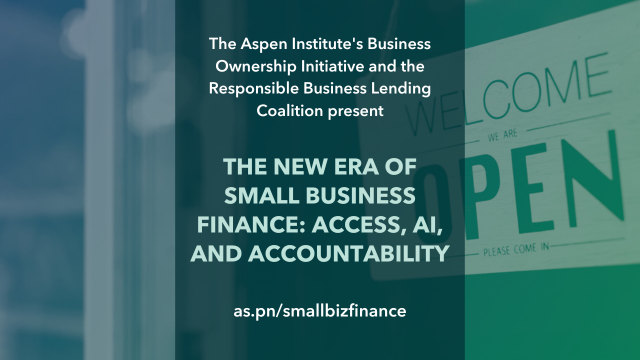
The New Era of Small Business Finance: Access, AI, and Accountability (Highlight reel)

The Changing Role of Small Business Ownership
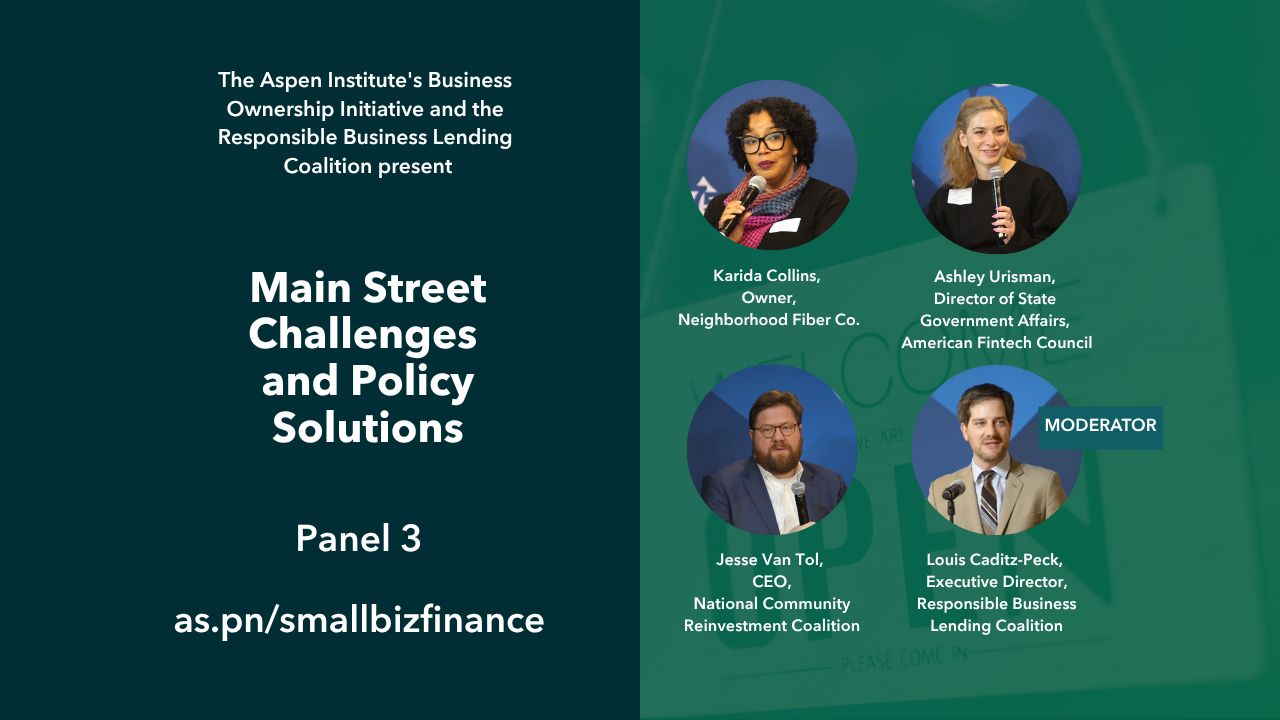
Main Street Challenges and Policy Solutions
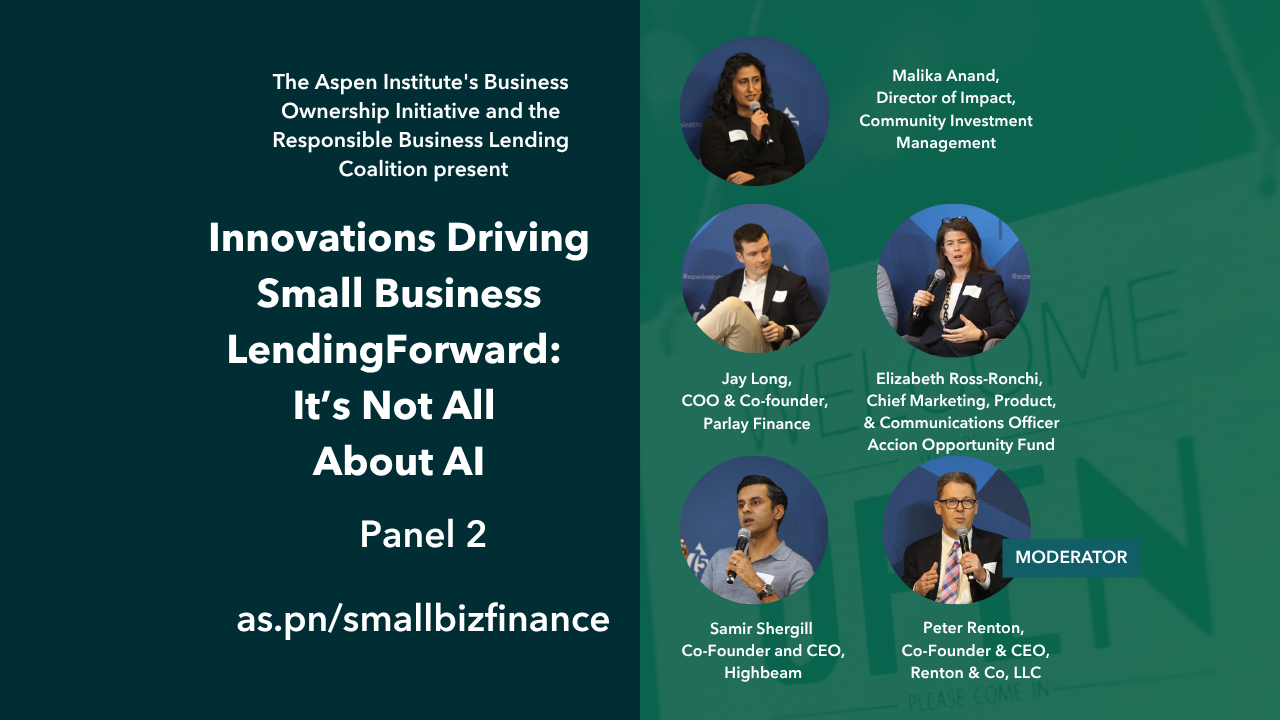
Innovations Driving Small Business Lending Forward: It’s Not All About AI

To Help Small Businesses Recover From the L.A. Fires, Invest in Community Lenders