
“From Enemies to Partners” the Book

More than four decades after the end of the Vietnam War, the United States and Vietnam are addressing the negative consequences of Agent Orange, the dioxin-contaminated herbicide used during the war. In this groundbreaking book, Le Ke Son and Charles R. Bailey outline the moral reasoning for a full American response and present further steps the United States and Vietnam can each take in a joint humanitarian initiative to resolve the legacy of Agent Orange/dioxin in Vietnam. They address the critical issues of how victims of Agent Orange in Vietnam have been affected and what they need, whether dioxin pollution still exists in Vietnam, what needs to be done to finish the job of cleanup, and the impact of Agent Orange on relations between the United States and Vietnam.
Read new essays by the two authors here.
Download the English version here.

Tải phiên bản tiếng Việt tại đây.
Hardcover, Paperback and Kindle editions are also available on Amazon.
Also available from Barnes & Noble in Hardcover and Paperback.
Kindle edition now available on Amazon.
“There are no two people more qualified to speak on this subject than Charles Bailey and Dr. Le Ke Son. Their work has changed lives for the better.”
— Christine Todd Whitman, former governor of New Jersey and administrator of the U.S. Environmental Protection Agency
“[T]o address this legacy and to truly put the war behind us… is the right thing to do for Vietnam… and for a full-fledged and mature relationship between our two countries.”
— Ambassador Ton Nu Thi Ninh, former vice chair, Foreign Affairs Committee, National Assembly of Vietnam
“This is a powerful book about all the problems [Son and Bailey] encountered focusing governments on the task and all that is left to do.”
— Pat Schroeder, former member of Congress from Colorado
“[A] must-read for anyone interested in understanding Agent Orange’s complicated legacy and the way these two nations continue to navigate it.”
— Darren Walker, president, Ford Foundation
“This is exactly the book that is needed to advance the conversations surrounding Agent Orange, dioxin and the legacies of the American War in Vietnam…. This book should be read by leaders, policy makers and all students of wars and their legacies.”
— Dr. Edwin A. Martini, author of Agent Orange: History, Science, and the Politics of Uncertainty
From Enemies to Partners: Vietnam, the U.S. and Agent Orange
Le Ke Son & Charles R. Bailey
TABLE OF CONTENTS
Introduction: The Aftermath of War
Essay: How We Got Here and What’s Next
Chapter 1. Is there still dioxin pollution in southern Vietnam?
Chapter 2. Who has been exposed to Agent Orange/dioxin and how many victims of Agent Orange are there in Vietnam?
Chapter 3. Does dioxin exposure lead to birth defects and reproductive failure?
Chapter 4. Has the forest ecology recovered from the spraying of Agent Orange?
Chapter 5. What do Americans know about Agent Orange?
Chapter 6. What is Vietnam doing for the victims of Agent Orange?
Chapter 7. What has the United States done so far?
Chapter 8. What do Agent Orange victims need?
Chapter 9. Can the Agent Orange issue be resolved through the courts in the United States or elsewhere?
Chapter 10. How has the bilateral relation on Agent Orange changed over time and what is the situation today?
Acknowledgements
APPENDICES
A1. What is Dioxin?
A2. 55 Years of Agent Orange — A Time Line of Key Statements, Events and Decisions 1975-2016
A3. Government of Vietnam Research Program on Impacts of Agent Orange/Dioxin 2011-2015
A4. The Ford Foundation’s Agent Orange/Dioxin in Vietnam Program 2000-2011: Grant Recipients


Day 36
Charles Bailey talks about faith, practice, and the legacy of Agent Orange.


Vietnam 35 Years Later: Agent Orange
Vietnam Reporting Project fellow and CBS5 anchor/reporter travels to Vietnam to report on the impact of Agent Orange on Vietnam, 35 years after the end of the war.
What is Agent Orange?
Agent Orange was a herbicide mixture used by the U.S. military during the Vietnam War. Much of it contained a dangerous chemical contaminant called dioxin.
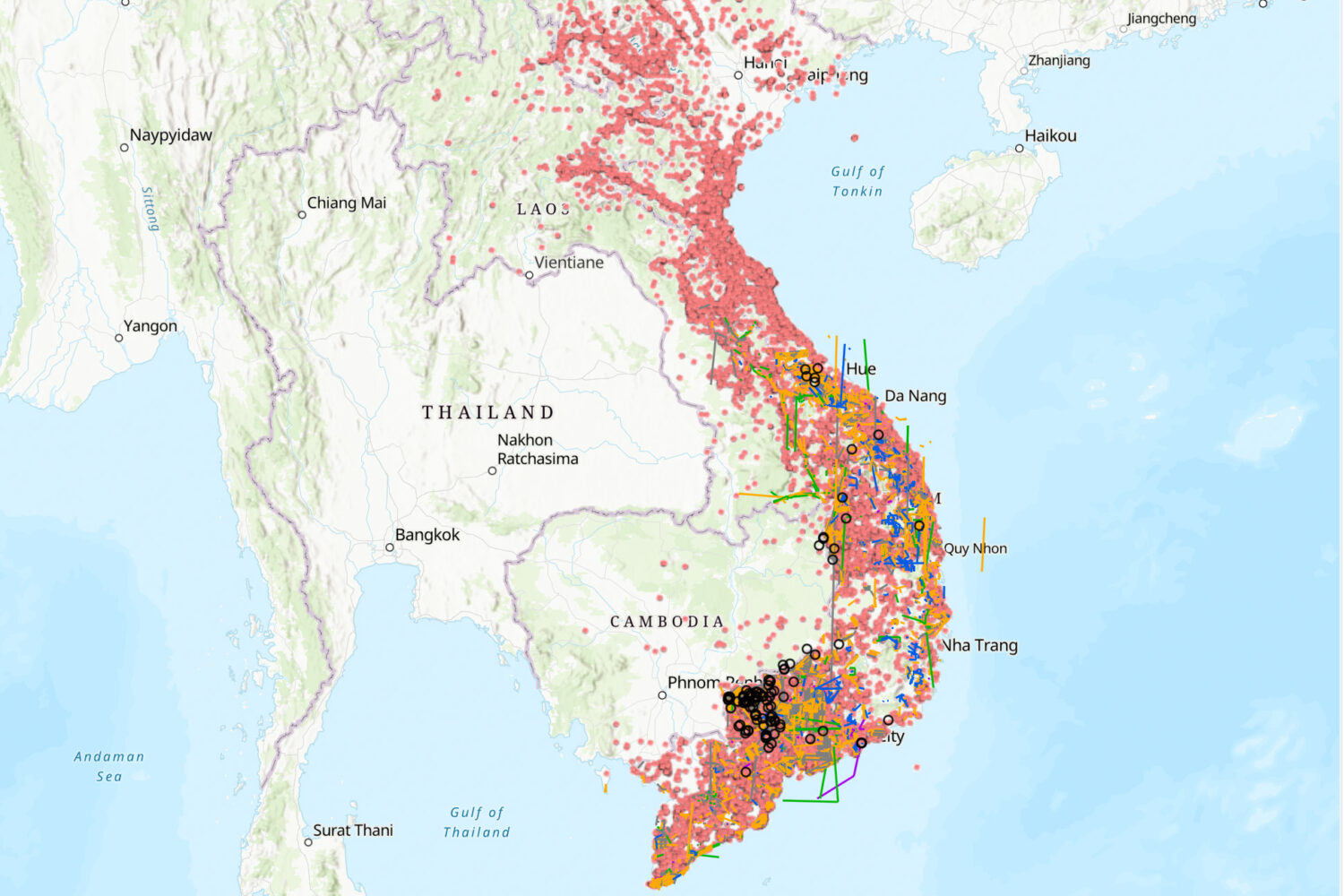
Heavily Sprayed Areas and Hot Spots
The most effective approach to reduce the legacy of Agent Orange in Vietnam is to focus assistance to health and disabilities services to heavil-sprayed areas and hot spots.
Agent Orange History
Agent Orange was one of a class of color-coded herbicides that U.S. forces sprayed over the rural landscape in Vietnam from 1961 to 1971.
Understanding the Health Effects of Agent Orange
Dioxin even in tiny amounts (parts per trillion) is associated with severe health damage that can shorten the lives of people exposed to it, and potentially that of their offspring and future generations.
Information on Clean Up Efforts
Agent Orange/dioxin residues in Vietnam can be and are being cleaned up, using well-known and cost-effective methods. Additional resources would allow scale-up and expansion of these best practices to all existing “hot spots.”
Agent Orange and U.S. Veterans
Thousands of U.S. veterans returning from Vietnam reported health problems almost immediately and rapidly associated them with Agent Orange/dioxin exposure.
Promoting Hope and Dignity
Agent Orange, a chemical used by the U.S. military during the war, continues to have harmful impacts in Vietnam today. The Red Cross estimates that three million Vietnamese have been affected by Agent Orange, including at least 150,000 children born with serious birth defects.
Chronology
Explore the chronology of Agent Orange in Vietnam
Glossary
Understanding the terms used around Agent Orange in Vietnam
Recent Publications
Review recent publications regarding Agent Orange in Vietnam.
Media Coverage
Read about Agent Orange in Vietnam in the news.
CCN: Effects of Agent Orange in Children
CNN report unveils the devastating effects of Agent Orange in children in a photo series – “Effects of Agent Orange ‘ Ongoing Silently’ in Children.”

U.S. sailors visit victims of Agent Orange
Sailors from a U.S. aircraft carrier on Wednesday visited a Vietnamese shelter for people suffering from the effects of Agent Orange, a chemical used by the U.S. military during the Vietnam War to destroy foliage. READ THE FULL PIECE BY Minh Nguyen in Reuters

Chau, beyond the lines
Oscar-Nominated Documentary: Chau, a teenager living in a Ho Chi Minh care center for children disabled by Agent Orange, battles with the reality of his dream to one day become a professional artist. Screened at the United Nations, NY (2016) Screened at the United States Senate, Washington DC (2017)

US Begins Agent Orange Cleanup at Air Base
Vietnam and the U.S. have kickstarted the process of cleaning up the dioxin around Bien Hoa Airport, a heavily contaminated zone just outside Ho Chi Minh City. READ THE FULL PIECE in the VN Express International Photo courtesy of the U.S. Embassy in Hanoi


Dioxin 2017 Symposium – Vancouver
Learn about the Agent Orange session of the Dioxin 2017 Symposium in Vancouver (August 2017), the 37th gathering of the International Symposium on Halogenated Persistent Organic Pollutants (POPs). Photo credit: Tim Shields

Capitol Hill Agent Orange Film Screening
On June 28, Senator Patrick Leahy of Vermont and Vietnamese Ambassador Pham Quang Vinh spoke at a screening of “Chau, Beyond the Lines” on Capitol Hill. Photo credit: Courtney Marsh
