
Cross-Partisan Education Policy Leaders Network
About the Network
The Cross-Partisan Education Policy Network was built on an ambitious premise that leaders across the political spectrum can find genuine common ground on the challenges that matter most to students, families, and communities.
Convened by the Aspen Institute Education & Society Program, the network brought together senior leaders from philanthropy, education policy, K-12 and higher education, nonprofits, and think tanks over two years of candid off-the-record discourse, in-person retreats, and experiential site visits. Over time, those conversations surfaced something significant: despite real differences in ideology and approach, leaders shared deep commitment to addressing what students need and what stands in their way.
The network organized itself around four urgent challenges — career-connected learning, student engagement, public school choice, and civics education — each taken up by a dedicated working group that moved from dialogue to shared analysis, public-facing work designed to reach practitioners and policymakers, and a growing body of partnerships that will continue to shape the national conversation on education.

Research foundation
Crossing the Partisan Divide in Education Policy
While education has historically enjoyed widespread bipartisan support, the aftermath of the pandemic, among other factors, has dramatically reshaped the field’s political climate away from traditional educational policy practices. This paper offers five key success factors to serve as a roadmap for advocates, policymakers, and other education leaders on how to effect meaningful policy change in education amidst our polarized climate.
“None of us need better tools to fight each other. We all need better skills to collaborate, compromise, and value each other.”
– Cross-Partisan Network Member, March 2026
Our Impact
Career-Connected Learning
When students disengage from school, it is rarely because they have given up on their futures. More often, they have lost the thread connecting what happens in the classroom to the life they want to build. This working group examined that disconnect through research, cross-partisan dialogue, and an up-close look at what it looks like when schools close it.
Those conversations drew on expertise from across the policy and practice spectrum, and were enriched by a March 2026 site visit to North Kansas City Schools — one of the country’s most compelling examples of student-centered career pathways at scale. Together, they produced a shared definition of quality career-connected learning and a clear conviction: this work is about ensuring every student, regardless of zip code or background, has access to the real-world experiences, meaningful skills, and professional networks that make education matter.
Pathways, Not Pitfalls: Career-Connected Learning for All is released in partnership with the National Center for Education and the Economy. Read the paper and register for the virtual launch event (October 15 at 11 AM ET) below.
Civics Education
10 Career Skills That Students Learn In Civics Class
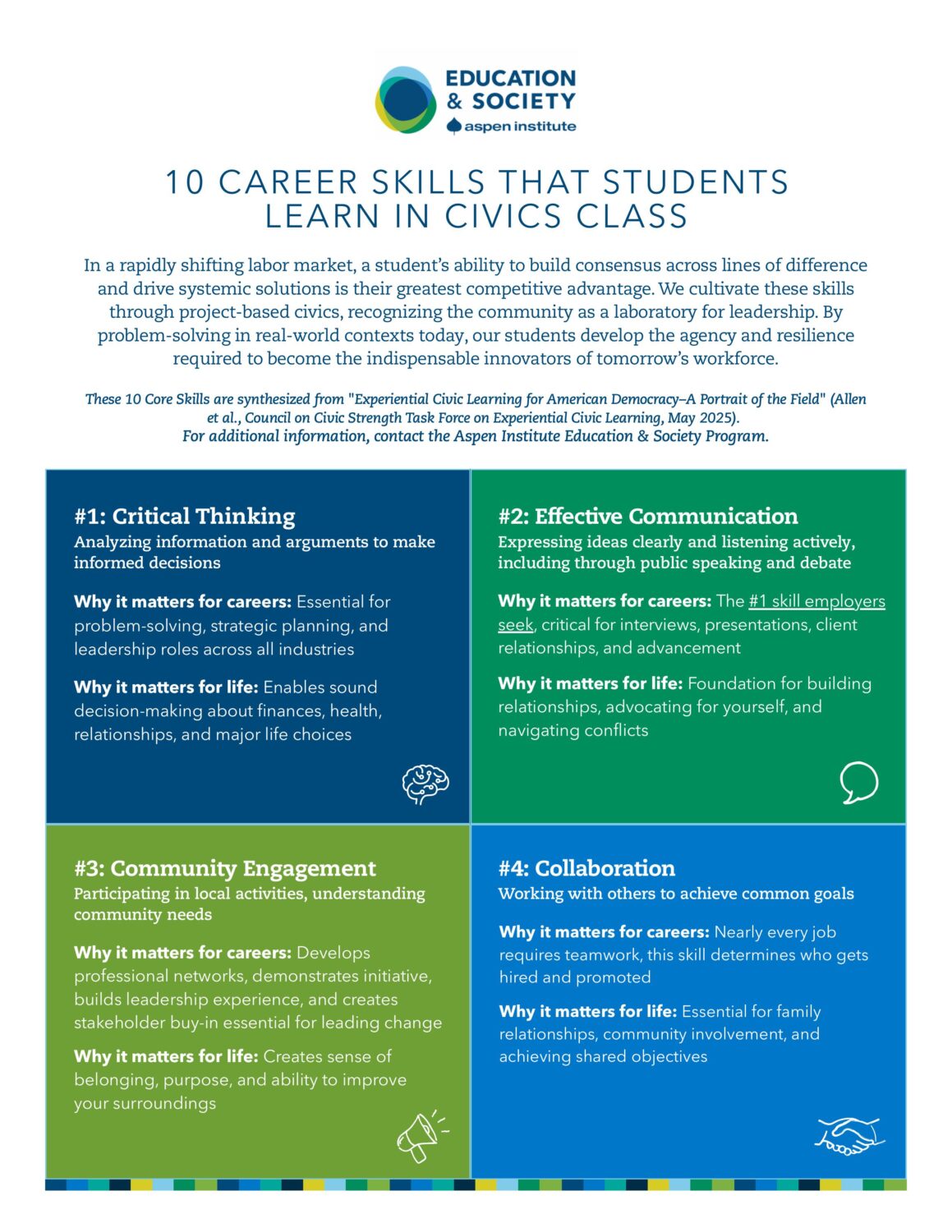
Ask employers what skills they seek in the workforce, and they consistently point to the ability to collaborate across differences, think critically under pressure, and communicate with clarity and purpose.
Civics education builds these skills.
This working group built the case for why experiential civic learning is central to a well-rounded education, translated into practical resources for the parents, employers, businesses, and community organizations. Explore the resources below.
Public School Choice
The question of what school can look like has grown more complex and interesting. What began as debates over public school choice and open enrollment has expanded into a broad ecosystem including charter schools, dual enrollment, virtual academies, education savings accounts, microschools, and a growing array of state and federal tax credit programs. The conversation has diversified along with the options.
This group explored that evolving landscape with the specific purpose of better understanding where new narratives are taking hold, where there is untapped common ground across perspectives, and what lessons from longer-standing models can inform the emerging ones. The goal was not consensus for its own sake, but a clearer, more complete picture of where the field is heading, and what that means for students and families.
School Choice in the Federal Tax Credit Era: State Strategies and Emerging Models
This webinar brought together Democratic state leadership from Colorado, Republican state leadership from Virginia, and the Children’s Scholarship Fund for a conversation focused squarely on implementation: what states are actually doing, and what accountability, access, and program design require.
Student Engagement
Genuine student engagement — the kind that shapes how young people show up for their education and their communities — turns out to be an opportunity to bridge partisan divides in American education. It is also one of the least understood. The Redefining Student Engagement series set out to change that.
Across a number of sessions, researchers, practitioners, policymakers, and students examined what authentic engagement could look like, and what it takes to move from surface-level participation toward genuine co-agency. Additionally, representatives from the working group hosted a live roundtable at the Civic Learning Week National Forum in Philadelphia, exploring how civic participation extends beyond the classroom.
From Student Voice to Co-Agency
This session explored what it would take to move beyond tokenistic student voice toward genuine shared power in education governance featuring student board members, superintendents, and nonprofit leaders from across the country.
From Achiever to Explorer
This conversation examined how an AI-driven world demands a different kind of learner, and how curiosity-driven and nature-based learning models are already meeting that challenge.
Civics, Community, & Family
The webinar brought the threads together — connecting civic skills to career readiness, centering family, and closing with an interactive simulation led by Gen Z working group members and panelists.
Though the initial iteration of this network has concluded, the Aspen Institute Education & Society Program will continue championing cross-partisanship on behalf of students, educators, and families through ongoing programming, publications, and partnerships.
