Announcing the Job Quality Fellowship Class of 2025-26
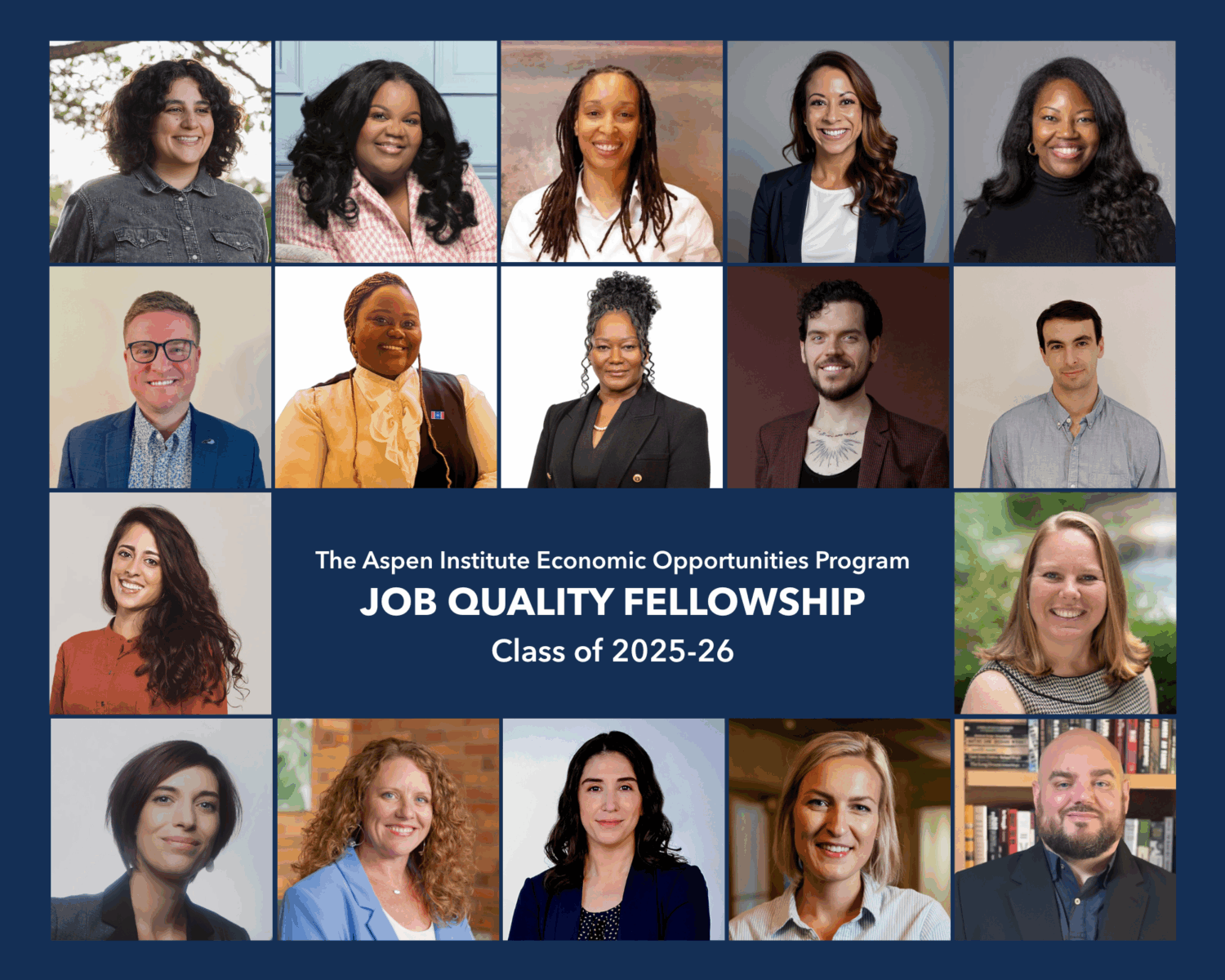
The Aspen Institute Economic Opportunities Program is pleased to announce its new class of Job Quality Fellows, leaders from differing lines of work who are working to expand the availability of quality jobs in the American South.
Fellows will work together from October 2025 to July 2026 to expand their networks and engage in peer learning, self-reflection, and strategic analysis to support their efforts to improve job quality in the region.
“In order to face today’s economic challenges, including rising costs and growing insecurity, people need more than just a job — they need a good job,” said Maureen Conway, a vice president at the Aspen Institute and executive director of the Economic Opportunities Program. “Yet the United States is in a job quality crisis, with millions of jobs failing to provide wages and working conditions that allow people to live and work with dignity. That’s why we’re excited to work with our new class of Job Quality Fellows, leaders with varied experiences, perspectives, and institutional homes, but with a common goal to make more jobs in their communities into good jobs.”
This year’s Fellows were selected from a large and competitive pool of applicants, representing a range of perspectives and organization types, including labor unions, community lenders, worker centers, workforce and economic development entities, policy organizations, philanthropy, and organizations focused on employee ownership. The 2025-26 Job Quality Fellows are:
- Cecilia Behgam, Research Director, Texas Climate Jobs Project
- Sherra Bennett, Program Officer, Winthrop Rockefeller Foundation
- Kelly Brooks, Organizational Development Manager, Civic Works
- Kim Eckert, Head of Apprenticeship Design and Instructional Innovation, Craft Education, Western Governors University
- Jennifer Epps, Executive Director, The LIFT Fund
- Colby Hall, Executive Director, Shaping Our Appalachian Region, Inc.
- Shuh-Marraka Johnson, Senior Mississippi Researcher, Jobs to Move America
- Daniel Waid Marshall, Board Chair, Alabama Center for Employee Ownership; Senior Manager, Communications and Ownership, Ginkgo Bioworks, Inc.
- Laurie Mays, Senior Workforce Development Program Manager, Kentucky Chamber of Commerce Foundation
- Thelma Adams Johnson, President and CEO, Albany Community Together
- Dom Kelly, Founder, President and CEO, New Disabled South
- Rachel Merfalen, Interim Executive Director, Tennessee State Center of Employee Ownership; Founder, Good Future
- Maya Ragsdale, Co-Executive Director, Beyond the Bars
- Sarah Reed, President and CEO, Metafund Corporation
- Alexis Tsoukalas, Senior Policy Analyst, Florida Policy Institute
- Alex Weld, Executive Director, Generation West Virginia
- Ben Wilkins, Director, Union of Southern Service Workers
What sets this class of Job Quality Fellows apart from its predecessors is its geographic focus on the American South. Compared to the rest of the country, research shows that working people and families in the South often have higher rates of poverty, poorer health, shorter lives, and other negative outcomes, which are often a direct result of poor job quality. Through their efforts, the Job Quality Fellows will lay the groundwork for an economy that addresses these challenges by creating good jobs for all: those that provide economic stability, mobility, and a voice in the workplace.
“Southern workers have long been part of the backbone of this country — driving growth, powering industries, and uplifting communities,” said Matt Helmer, director of job quality and worker well-being with the Economic Opportunities Program. “Their labor has fueled the South’s recent economic boom and contributed to our nation’s prosperity. Yet, far too often, they’ve been excluded from the very gains they’ve helped create. Public policy and business practices have frequently sidelined, and at times actively undermined, the interests of working people across the region. It’s a pattern that must change — and change is possible. That’s why we’re proud to support the Aspen Job Quality Fellows, who are committed to advancing shared prosperity and building an economy that works for everyone.”
By bolstering the work of these forward-thinking job quality practitioners, the Fellowship aims to inspire others who are striving to bring about an economy that works for all.
Organized by the Economic Opportunities Program and formed with generous support from the W.K. Kellogg Foundation, the Surdna Foundation, Prudential Financial, and the Gates Foundation, this is the fourth class of Fellows since the program’s launch in 2017.
To learn more about the 2025-26 Job Quality Fellows, visit https://www.aspeninstitute.org/programs/job-quality-fellowship/class-of-2025-26/
About the Economic Opportunities Program
The Aspen Institute Economic Opportunities Program advances strategies, policies, and ideas to help low- and moderate-income people thrive in a changing economy.
Join Our Mailing List
To receive occasional emails about our work — including new publications, commentary, events, fellowships, and more — join our mailing list.
Connect on Social Media
For news and updates every day, connect with us on the social media platform of your choice.
MillerKnoll: Developing Operations Leaders from Within and Beyond — A Case Study in Structured Talent Development

A Typology of State-Supported Work-Connected Learning Programs



Work and the Social Contract in the Age of AI: How did we get here?