What Employee Ownership Means to Workers
Transcript
Matt Helmer [00:00:00]
I’m Matt Helmer. I’m the director of Job Quality and Worker Wellbeing at the Aspen Institute Economic Opportunities Program. It’s great to be with you today, and great to welcome you to our conversation, What Employee Ownership Means to Workers. This conversation is part of our Opportunity in America series, where we take a look at the economy, what’s working, what’s broken, and really how we fix it to make sure that everyone can succeed in today’s economy.
Lots of challenges out there, but also lots of solutions, and we’re going to talk about a promising one today with employee ownership. Before we get started, just a quick review of our technology. All of our attendees are muted. Please use that Q&A button at the bottom of your screen to submit and upvote questions. If you have resources, ideas, perspectives, share them in the chat as well.
If you have any technical issues today, hopefully you don’t, but if you do, please message us in the chat or email us at [email protected]. We are recording this event, and we will post it on the website. You will also get a copy of that in your email inbox. Finally, closed captions are available for the discussion, so you just got to click that CC button at the bottom of your screen to activate them.
To today’s event, I want to take a few minutes and talk about where this event came from and some of the research we did leading up to it. We wrote a research report with the same name as today’s event, What Employee Ownership Means to Workers, and it was based on focus groups that we did with employee owners around the country. I wrote that with my colleague, Maxwell Johnson, who did a lot of great work putting that together and writing it as well.
Why did we do this report? Employee ownership, I think, is a great tool for our time, given where our economy is at, the lack of good jobs we have, and the issues we face around wealth inequality. There’s a lot of fabulous research out there around employee ownership from folks at Rutgers University, NCEO, DAWI. A lot of it, though, rests on ESOPs and all the promising outcomes that they achieve both for workers and businesses.
It’s been pretty well documented, both quantitatively and qualitatively, and there’s been a lot of great research on cooperatives as well from folks at Rutgers as well as DAWI, as I mentioned, but there’s new forms of ownership are emerging all the time. There’s lots of innovations going on. What we really lack in some respects or that we don’t have enough in some respects of is the kind of qualitative experience of employee owners under different forms of employee ownership.
These models, which we’ll talk about, work very differently. They create different outcomes and different experiences for workers. There are also some things that unite them, but we should understand and discuss these things. I think we can talk all day long about where we disagree about ownership and how we should define it. I think what matters most at this moment is that we actually talk to the workers who share in ownership and profits at their company and what they say about their experiences, so now is really the time to listen.
We have a lot of wind at our backs with employee ownership. It’s got bipartisan support, capital’s flowing towards the model, but we really need to hear from the people who live inside of it every day to make sure that as we grow this model, we’re doing it in the best way possible so that it meets the outcomes we desire. What we did with this research was we did focus groups with 85 employee owners at 12 different companies across the United States.
We also spoke to their managers. We talked to five companies that operate under the ESOP model, employee stock ownership plans. We talked to three companies with employee ownership trusts, two worker-owned cooperatives, and two companies that partner with Ownership Works on broad-based equity plans. We talked to workers of all sorts. Machine operators, truck drivers, care workers, swim instructors, cooks, engineers, people who work in vegetation, a lot of different types of people doing different types of work, which I think is one of the beauties of the employee ownership model is that it can fit into different places.
One honest caveat is that we talked to a lot of companies who we got through referral, through our networks, and we talked to a lot of companies who we knew had strong ownership cultures because we thought that’s where we could learn the most from. Our report in no way is a representative sample of the employee ownership field. Nonetheless, we think there’s some really rich data in there that can help guide this work forward.
When we did this work, we wanted to explore three fundamental questions with employee owners. We wanted to understand what ownership means to them, how do they define it. Second, we wanted to understand what practices and what workplace culture actually make them feel like owners, because we all know that that ownership mindset and that ownership culture is a key part of employee-owned company success, so we wanted to understand what makes that tick.
Then lastly, we wanted to hear from employee owners themselves about what they see as the benefits of being an employee owner. I hope you’ll read the report. I’ll just give you a quick rundown of some of the things we heard, what ownership means to employee owners. The thing we heard most commonly was it means a financial stake in the business, an ability to share in the ownership financially through profits or through shares, or through some other form of equity.
One worker at an ESOP told us, “You know you’re making money for your future and for yourself, not just somebody else at an employee-owned company.” That captured a lot of the sentiment, but ownership doesn’t just mean that financial stake to the workers we spoke to. It also means having shared goals and accountability to their colleagues. They all feel like they’re rowing in the same direction and have a clear idea of where they want to go.
It means having real voice at their workplace, the ability to share ideas, to share input, to have some control over their work, the ability to innovate, and, in some places, particularly worker-owned cooperatives and trusts, employee ownership trusts, we heard about ownership as a way to codify a social mission that their business was focused on as well.
In terms of what we heard around workplace culture and what makes workers feel like owners, five things jumped out to us that I think, by and large, these companies shared in common, but practices differed, and the level of an intensity and execution sometimes differed, but we heard five different things. One was these companies really do a good job of communicating shared values and goals. Values aren’t something that just live in a framed picture on the wall.
These are values that people live and breathe every day and that they talk about. They also have shared goals. Again, they know where their company’s going, what it’s trying to do, so everyone’s on the same page as far as that. A key part of feeling like an owner is understanding how the ownership model works. It’s not something that just arrives in your benefits paperwork or is in the HR manual.
Whether you’re in an ESOP or cooperative or EOT, there’s a lot of education around the mechanics of that model and what it means for the workers and the company. Third was there’s lots of financial and business literacy. Some companies practice open book management, but there’s a lot of transparency around the business finances, and people really understand that, right? They understand how their own job connects to the performance of the business.
Fourth, getting back to this worker voice piece, these companies use a lot of different mechanisms to allow workers to shape decisions, to provide input. Sometimes it’s formal through committees, sometimes it’s informal through open-door policies. It’s different across different models, but there’s a lot of focus on really listening to workers and making sure that workers are helping guide continuous improvement.
Then finally, we heard a lot about mentoring and coaching and leadership development. These companies are very much growing their people from within, investing in them, and making sure that they’re growing their skills and capacity so that the company can thrive. What workers said they gained or where they benefited, the last question we really explored with them, again, it came back a little bit to the financial stake.
We heard a lot from people in ESOPs about gaining retirement security, really being able to retire with dignity and retire comfortably. With companies that partnered with Ownership Works on broad-based equity compensation, we heard about payouts that helped people pay off their mortgage or pay for their kids’ college. In cooperatives, we heard about profit distributions that helped raise pay and made people feel really valued. In employee ownership trusts, again, we heard about profit distributions that helped people set aside some more for retirement or just a greater ability to meet some day-to-day expenses, but people didn’t just talk about the financial benefits of ownership. They talked about a wide range of other things.
People in ESOPs and EOTs in particular talked about job security and how they felt safe that their job was insured because the company was not going to be sold out from underneath them. A lot of people across different forms talked about feeling really invested in, again, like their skills, their growth. Lots of people feeling like they had career paths internally that they could take advantage of, and for some people, these benefits were more personal. It changed their outlook on life and how they carried themselves in the world. Some became more engaged civically.
Some just approached life in a different way, with that ownership mindset backing that up. They just went out into their community thinking about participation and how they could show up in different ways that they credited, at least in part, with being an employee owner as well. Again, these models do differ. How much equity, profit, shares workers get differ under these different models. When they receive it differs under these different models.
The time horizon of ownership differs. With ESOPs, worker cooperatives, and employee ownership trusts, these are largely ownership structures that are built for the long term. With companies that partner with Ownership Works, it’s a shorter-term endeavor. There are differences in the way these things are structured that lead to differences in experiences and outcomes, as I noted.
There’s also differences in governance. Worker-owned cooperatives, controlled and managed by their workers. Much different in ESOPs, EOTs, and these other companies, which do a great job of engaging their workers and listening to their ideas and listening to their voices. As far as formal governance, it’s not the same compared to a worker-owned cooperative. There’s lots of differences. I hope you’ll read more about them in the report, but there’s also a lot that unifies these companies that they share in common.
Every company is invested in teaching their workers about their business and the financial performance of it. Frontline input from workers was commonplace and really truly valued. The workers we spoke to across companies felt like they had more voice and control than they had at previous employers. Across the board, many describe a sense of family at these companies, and most of them described job quality that was higher than they’d ever had during their careers. Lots that unites us again.
Where all of this points, I think, is that ownership is more than just about the form of it. It really is a practice, and the implementation matters greatly, especially around how the culture gets built and supported to reinforce ownership. This research also points to a lot of places we can innovate on, from the financial stake and how we think about what percentage should go to workers versus executive leaders or investors, to what else we can do to support workers’ financial security beyond the ownership stake.
Obviously, affordability is a huge thing right now. If your ownership payout’s in the far distant future, you may have some short-term pains, and maybe there’s some things employee-owned companies can do differently at this moment to address that. Many of them already do. As I noted, there’s also innovation, I think, that can be done around governance and how workers are involved in governance and decision-making. One ESOP we spoke to had a worker that was on the board, which was a unique practice. There’s even differences among the forms. Implementation can vary between ESOP to ESOP, between cooperative to cooperative.
Finally, I’ll just say much of what we learned about what these companies do doesn’t require employee ownership. It doesn’t require an ownership stake. When we think about open book management and financial transparency, when we think about mentoring and coaching and leadership development, when we think about avenues for workers to be able to share their ideas and input, that doesn’t require financial ownership. Any company can do those things and will benefit from those things.
I think there’s a lot to extract from employee ownership that we can help inform our greater environment around how we operate businesses and how we design jobs that many millions of more companies could benefit from. I’ll finally return into our workers now, who are the most important part of today’s event, but I do want to thank the Sorenson Impact Foundation for supporting this work. They believed in listening to workers’ experiences and being at the center of this conversation to do this project, and we’re really grateful for them. They’ve been great leaders in the employee ownership space.
I want to thank my colleagues too upfront, Merrit Stüven, who really conceptualized this research. Again, Maxwell Johnson, who helped co-author the report with me and who did a lot of the research as well. Then Maureen Conway for her leadership, as well as my comms team, Nora, Tony, and Francis, for all they’ve done. That was a mouthful. I’m taking a step back and bringing our employee owners into the conversation. They’re the most important ones in the room today. Everything I just described comes from the conversations we’ve had with these folks.
Let me just introduce them, and let’s jump into the conversation with them. We have Randy Gallo, who’s the Eastern Region Vice President of Threaded Fasteners, which is an ESOP. We have Paulette LaDouceur, General Manager at Capital Home Care Cooperative. Craig Moss, who’s the VP of Wholesale Transportation at Integrated Specialty Coverages, which had partnered with Ownership Works. Mary Wilder, who was the previous worker owner and board director at Shine Nurture Center. We’ve got two worker-owned cooperatives in the care sector, so we’re doubling down on care work because none of us would be here without the important work that care workers do.
Then finally, we have Kati Yanez, the People Lead at Ocaquatics Swim School and Employee Ownership Trust out of Florida. I’d like to get started by having you all just tell the audience a little bit about your company, what you do there. I think to start, maybe tell us a little bit about what you tell your family, friends, or people maybe you’ve just met about what it means to be an employee owner. Maybe, Kati, since I introduced you last, we’ll start with you.
Katiuska Yanez [00:15:31]
Perfect. Thank you. Hi, everyone. Thank you, Matt and Aspen Institute, for the invitation. I’m honored to be part of this panel. I’m Kati, People Lead at Ocaquatics Swim School. We have five indoor warm water beautiful facilities in Miami and about 150 team members. We have been teaching swimming lessons to babies, children, and adults since 1994.
In March of 2024, we became 100% employee-owned through an employee ownership trust, and we’re also certified as a big corporation. I oversee HR and Learning and Development Department, and that means that I get to work on the part of the business that I love the most, which is our people. I started at Ocaquatics in 2017 as a swimming instructor. Then I became a leader, then a supervisor, a location manager, and now I’m on the lead team. I’ve seen the company from the pool deck all the way to the leadership table.
When I talk to my families and my friends about it, I try to keep it simple. I tell them, “Hey, I don’t just work at a swim school. I’m one of the owners, together with my other coworkers.” Then I explain to them what it means. It means that when the school does well, we all share in it. I also tell them that the company can be sold to an outside buyer who doesn’t leave our culture or won’t care about our team or our families. I also share that the decisions that we make today have to protect the co-owners who come after us. Most people are usually surprised because they don’t expect a swim school to be employee-owned. Honestly, that’s one of the reasons why I’m so excited to be here today.
Matt [00:17:39]
Thanks, Kati. Mary, let’s turn to you next. Care work doesn’t stop, and I know you’re going to have to jump a little bit early from the event to get back into the classroom. You’re in a new job now, but tell us a little bit about yourself and Shine Nurture Center in Ohio, where you used to work.
Mary Wilder [00:17:54]
For sure. I was one of the original worker-owners at Shine Nurture Center Cooperative, which is a nature-based, Montessori-inspired, child-led childcare center. Essentially, it means we spent a lot of time outdoors and all the weather, and we taught our children to respect nature and all the things around us. What I did there, so I was the board president, which just meant that my name went on all the papers that needed signage.
I was also the director of building and safety, which means that I took care of our building. I subbed in classrooms. I was the face of the company while I was there, and apparently still today. The biggest thing that I tell people, and you guys may laugh, but I tell people, and it’s very important that people know, that I was a business owner, and I never have had a degree. I never finished college because I just kept having children, but been connected to Co-op since it gave me the opportunity to be a worker owner. That’s a little bit about me and Shine really quick.
Matt [00:19:06]
Thanks, Mary. Paulette, let’s jump to you.
Paulette LaDouceur [00:19:08]
Oh, Mary, that’s so resonant for me. I’m Paulette LaDouceur. I’m general manager here at Capital Home Care Cooperative in Olympia, Washington. We’ve been in operation since 2018. 2025 was a big year for us. We had our first distributable profit, but I started here as a caregiver five years ago. When asked if I wanted to work in the office, I believe I said, “Over my dead body.”
I have been able to learn so many important skills that I did not have in my younger life. I’m over-educated and under-certified. I stepped into the hot seat here because of our culture, because I had never felt so valued as a worker, and I didn’t want this thing to die. I am very proud that we are still here and more cohesive and growing in new ways all the time, practicing new things.
When I talk about this work with people, it’s really such a different model, and it has been so transformational to me personally, but also, I’ve been able to witness that with my co-workers. It’s a place where we get to practice skills, learn and unlearn things that we’ve never been able to do in our jobs before, so I’m very grateful for our place in the movement and grateful to be here. Thank you.
Matt [00:20:43]
Thanks, Paulette. During our focus group with Paulette’s team, I asked them to describe their workplace culture, and one of her colleagues said, “It feels like a hug every day,” which I just thought was the most beautiful thing I’d ever heard about a workplace, and I’d never heard that before. We’ll circle back around on culture here in a bit. Randy, let’s turn to you.
Randy Gallo [00:21:06]
Thank you, Matt. I’m Randy Gallo. I work with Threaded Fasteners. We are a fastener distributor and manufacturer. We have several subsidiaries that support what we do. We make product, we coat product, we own a company that coats products. I’m always looking to acquire other companies. Threaded Fasteners began transition to an ESOP company in 2007. It was fully 100% transferred to employee ownership in 2012. We currently have about 460 ESOP, or employee owners, I would call them.
When I talk about working for an ESOP company, I think the biggest thing that comes to my mind is, it’s just a teamwork. When you walk in today, everyone’s working for
and achieve the same goal. They know that every goal we achieve benefits them as well, so you just find the teamwork and the energy level is so much higher than– We don’t have people just coming in to make a paycheck. They’re coming in to make a difference. When people come in to make a difference, just being in that atmosphere, I tell people, “I love good work,” because I don’t work with grumpy, angry people. They’re making money for them and their future. That was probably the biggest takeaway I get when I talk about the company. Is just how much people put into it because they’re actually employee owners.
Matt [00:22:26]
A manufacturer in the South, based out of Alabama and not in the care sector and manufacturing, but when I recall when we spoke to your company and the employee owners there, Randy, that it did feel like people really cared for each other and there was a real family. It was a culture of shared goals, but also of just strong support for one another, and all of the things that come with life, as well as being there as colleagues pursuing a business mission. Last but not least, Craig.
Craig Moss [00:22:58]
Hello, everyone, all over again. It’s good to meet everyone. Hello again. My name is Craig Moss. I act as the Vice President of Transportation for Integrated Specialty Coverages, ISC. We are a wholesale/retail insurance operation, brokerage operation. We started in the employee ownership realm before I was hired. We started, I believe it was 2019/2020, and I came along in 2021.
When I talk to other folks about the model that we have, I talk about it from the beneficial side, how it affected me. I was there for what we call the first turn, which is the sale of our company, and what I tell people is that it’s not so much about the payoff for me, about the payout, it’s watching how the teams, how everyone — We’re 750 owners. We’re 1.2 billion written premium.
We’re not a small organization, but as soon as that turn happened– and right before, actually, it was really neat to see how everyone in all the different teams were coming together and pulling each other in and trying to figure out how to take everyday things and make them more efficient, make them better. We were all same ship, rowing in the same direction, and everyone was excited to be there.
At the end of the day, there was not a lot of conversation about the financial aspect of it, it was about how we all became comrades, just like that, and that hasn’t stopped. That turn
happened in November. As of this conversation, as we’re rolling into the next November, the momentum, the growth has been exponential. Everyone is on board, and everyone’s looking to outdo everyone else, all in the name of making it better for themselves, and for the company, and for their families later. That’s what I talk to people about, is just how everyone came together, and we’ve just blown up.
Matt [00:25:15]
Well, you set me up well for this next question.
Craig [00:25:19]
You’re welcome. I’ll send you an invoice.
Matt [00:25:21]
I appreciate it, Craig. This is a lightning round, so maybe just keep your answer to one minute here. I think for some people, employee ownership is not something they grasp or get or feel right away. Sometimes it takes a little bit of time. I’d be curious to hear from the five of you, like I said, in one minute or less, what have you observed personally or within your colleagues about when ownership clicks? When does that moment arrive? What is the thing that really helped people start to feel like an employee owner and get the picture of it?
Craig [00:25:55]
I can go.
Matt [00:25:57]
Yes, go ahead, Craig.
Craig [00:25:58]
I just want to go in order. If we have an order [crosstalk].
Matt [00:25:59]
No, go ahead, Craig.
Craig [00:26:01]
It all starts at the top. Our executive leadership team sent out an email, the very first of a series of emails, saying, “We are an employee-owned company, we are going to have a monthly meeting to discuss what gets discussed in the boardroom.” Not everything, because they’re probably talking about me, but the things that get discussed in the boardroom, but we have a quarterly meeting.
When they called that first meeting, one of the first things that they wanted to discuss were the financials. “This is where the money’s coming in from, this is where it’s going, this is the past, present, and future of where ISC is and where we’re going.” It really clicked with me, and the folks on my team, and others that I’ve heard chatter from when that happened, when the executive team pulled everyone in and said, “We’re going to talk about the things. We’re going to talk about the money and how it’s flowing and how you play a part in it, and talk about problems and solutions and how you were part of those problems and those solutions.”
When they pulled everyone in and made us one of them, to talk about how finances are affected by what we do, that’s when it clicked, boom, and we do it every quarter, and it clicks every quarter.
Matt [00:27:33]
Thanks, Craig. Let’s maybe go in reverse order this time, and we’ll go back to you, Randy.
Randy [00:27:39]
A lot of people [crosstalk] probably, when they get their first ESOP statement. That’s true with a lot of the employee owners that we have, getting into that first statement every year. Your first year, you get, like, this is what it’s going to look like, but when they get their first statement and show that they have shares, and how many shares, and what their worth, obviously they get their second statement.
A lot of it’s just seeing the excitement for people that have been there five or six years as they start getting statements every year. For me, it was just learning it’s real money. People are like, “Oh, you have this, you own this.” Do you really own this? It’s really good for me, just watching it, and [unintelligible 00:28:20] team. I echo what Craig says, that the transparency about what we do at every location, our managers share with our employee owners. “This is what we made this month. This is what our expenses were. We spent X amount of dollars.”
Now, if anybody wants to know, “Hey, how did we do this month?” They’re welcome to come on my office and say, “Hey, this is what we did in Chattanooga. I’m going to call from there. I’ll let you know; this is what we made.” I think having that transparency with the company, you really feel like an owner. Then just, again, it’s the culture we preach about, we talk about, that makes you feel like an owner. If you have a question about ESOP, you can get an answer. You don’t understand it, make a call, get an answer. Being able to actually get what you need from the company makes you feel like an owner. When you say that you own this company, we strive hard to make you feel like you do.
Matt [00:29:13]
Thanks, Randy. That’s great. Paulette, what have been your observations and takeaways personally or amongst the people you work with?
Paulette [00:29:18]
So different in-
Matt [00:29:21]
Different is good.
Paulette [00:29:22]
-my sector. We’re talking about chore workers who have been marginalized across time and throughout our culture. Again, this has impacted me personally as a caregiver, member, owner. I started feeling like an owner when I stepped onto the board of directors five years ago, when I started managing the phones, talking to clients, talking to other caregivers, just being more connected, but what I have seen, of course, distributing over $34,000 in shared profits last winter was incredibly empowering, engaging, exciting for all of us. Maybe there’ll be time to talk about that later.
The first time that I saw it with my crew was the first time that we needed to raise our wages and our client rates. It was a tense moment because we had been paying people money that wasn’t coming in. I had to go to my people and say, “We’ve got to fix this.” We came together. We made the solution of we’re going to change our client rates, we’re going to collect money for a couple of months, and then everybody is going to get a raise. That was an incredible night where I saw the light bulb go on above everybody’s heads. That was the first time that I really saw it in this wider way. It’s exciting anytime you get to see it. [laughs]
Matt [00:30:55]
That is exciting. Thanks for sharing that. Mary, pivoting back to you. What have been some of the moments you’ve seen click for people or yourself?
Mary [00:31:04]
Personally, for me, and it’s completely different than everybody else’s, because when I became a worker-owner, I was still in a classroom. The first time that it felt really real and really serious business, I actually own a business, was honestly the first time I fired somebody because it was a situation of I’ve got to protect the workplace, I’ve got to protect the employees, the children, and anybody that comes through these doors.
Having to have a board meeting to discuss letting somebody go and then having to have my name be the name that was on that termination letter, and everyone since then while I was there, made me really feel like an owner. Like, “Okay, this is serious business. I am determining if somebody can pay their bills next month.” That was the first time for me. I will say, for other people at Shine, it was probably the board meetings that we had. When we first started doing them twice a month, we were not getting paid for them.
There was a point in time where we were like, “We’re working, and we need to be getting paid.” That decision was made in a board meeting. I think for other people, that’s when it really clicked. When problems arose and we had to deal with them, that’s when it really clicked for people. “I don’t just work in a classroom and take care of people’s children. I own this business, and I have to protect it and the people inside of it.”
Matt [00:32:37]
It’s assuming that responsibility, right?
Mary [00:32:39]
Big responsibility. [chuckles]
Matt [00:32:41]
For sure. Kati, what about you?
Katiuska [00:32:44]
I think my experience is also a little different, just because I felt like an owner before it was official. Long before 2024, our leaders taught us about ownership mentality. We talk about owning our success and owning our mistakes, or how we call them here at Ocaquatics, learning moments. We practice open-book management before becoming an EOT. We saw numbers; we solved problems together. We took care of the business like it was ours.
Maybe when I saw it click, it could be like– I still remember the day that we met here at this location, and we invite all the co-owners, and we announced the trust to them. I will never forget their faces. They were surprised, and we were so emotional. We are so thankful because this is huge. I think in that moment is when it clicked to me it wasn’t just a title anymore. The company was real; it was ours. I think that’s when it clicked for me.
Matt [00:34:03]
I think that’s a common story that sometimes these cultures predate the actual conversion to employee ownership, right?
Katiuska [00:34:09]
Yes.
Matt [00:34:09]
Let’s dive a little bit into culture in this next round of questions. Kati, let’s just stay with you. I think Ocaquatics has been pretty dedicated to investing in its people and the growth. You also have this social mission as part of your work. Just talk to us a little bit about how those things live within the culture at Ocaquatics; this idea of investing in people, but also fulfilling these social responsibilities that the company has adopted.
Katiuska [00:34:37]
Of course. You’re right. We do this in a couple of ways, but one way is investing in our team, and another way is investing in social responsibility. We are who we are because we invest in our team. Here we say that our team is our number one customer because we believe that if we take care of our team, they will take care of the customers and the business. We call them families, so of the families and the business.
Even though we teach them how to be their best at their position, we also invest in them as people. We have book clubs; we have financial literacy training. We have a mentorship program, a leadership team, our MIT program because we grow future managers. All of these, we do it because we promote from within. I’m a good example of that, as I shared earlier. I started here as a swim instructor in 2017, and today I’m on the lead team. I’m not the only one. I’m no special. [chuckles] Many of the people in the highest position started in an entry level. We really invest in our team members.
Now, when it comes to investing in social responsibility, our mission goes beyond the pool. We were the first swim school in the world to be certified as a B Corporation. I’m still excited every time that I share that. This means that an independent group checks how we treat our team members, our community, and the environment. They’re not only about the profit. That’s huge for us.
Also, our team members lead beach and community cleanups. We offer scholarships so more children have access to swimming lessons. We work and attract very heart-led people who care about making an impact in the community, and they get to do that here at Ocaquatics. We are changing and saving lives every day that we go to work. That’s special because when you own the business, you care about how it shows up in the community.
Matt [00:37:18]
I love that. That was one of the surprising things we heard across the board too, was how deeply committed to community a lot of companies that practice employee ownership are because they care about their reputation, but they’re also a part of the community, and they realize that there’s a responsibility that comes with that, right?
Katiuska [00:37:34]
Yes.
Matt [00:37:35]
Randy, let’s turn back to you. I think one of the things that struck me about Threaded Fasteners was a focus on values and building character and building leaders. I think your CEO, Billy Duren, told me, like, “One of the things we do best here, and that we’re never going to stop doing, is building leaders. We don’t care if they leave the company and go elsewhere, but that’s something we’re committed to doing.” Talk to us a little bit about the attitudes and character that Threaded Fasteners tries to build, as well as this investment in leaders and how that looks at Threaded.
Randy [00:38:09]
Yes, that’s a real big part of our program at Threaded Fasteners. We heavily invest in our people because we want people to succeed. Some of the ways we do that is we have a Character Core meeting. Every month, we have a Character Core meeting that’s held at every location. We do the same topic to every location every month. Matter of fact, I just told you that we just did ours this Monday in our location in Tampa. It was on dependability. Could be on availability. We have about 20 or 25 different topics we just rotate through.
When we talk about character, we want to build character for employees that we want, but we want to build character that goes outside of TFI. What we bring in there and what we are teaching people there, enthusiasm could be a topic. We want not just to build a strong employee; we want to build a strong person. We want that person to go take that home to their– Teach their kids enthusiasm or whatever it is, dependability, and share that with other people outside of just work. We do a lot of mentorship programs. We host those. We will do one-on-one mentorship programs.
A lot of the stuff, again, we talk about this at the hiring stage. This is who we’re looking for. We want somebody to come in to be hungry to learn, somebody who wants to grow with the company, contribute to the company. We want to hire the right people that want to learn because we want to grow those leaders. At the end of the day, being an ESOP company, your payout is only as good as your succession plan. That’s what it is for us. We want to grow.
When I leave in three or four or five years, whenever it is, I want to know that I have trained and taught and have comfortably walked out of here that this place is going to continue to grow well beyond my means. It’s going to be successful for years. That is a big thing. Succession planning, right now, is a big thing for us in our company. Like I said, we’ve been around for a while. We have some more aging people at this point, so we see the value it creates.
The younger people, you give them the opportunities. They come in here, and they know they have a promise. They have somewhere to land, somewhere to go. Much like you said, if they leave the company, at least we know good that we’ve helped encourage somebody. We trained somebody that’s going to go out there and do well with another company and bring that success and help somebody else succeed. They could go down the road and work for somebody in Tampa, but it’s still our community that’s going to grow from it.
Matt [00:40:32]
That’s so powerful and so unique, and so unselfish. Just great to hear. Paulette and Mary, you both have been or are in the cooperative sector, in the care sector. Talk to us a little bit about what it means to be doing what I think of as perhaps the most important work in our society, care work, under this cooperative model, and what the role of culture, worker management, and ownership is in driving good, dignified care for the people who need it. Mary, I know you have to jump in about five or six minutes, so maybe we’ll start with you on this one.
Mary [00:41:12]
Sure. I heard somebody say earlier that– it might have been you, Paulette, that you guys felt like a family. Shine very much operates as a family dynamic. We believed in holistic care for the children, but also for our staff members. We want to make sure that the entire staff is okay that day. Your mental, your spiritual, your physical, everything is okay. In that essence, if a staff member came in and had too much of a heavy load on their shoulders, you can’t care for a child if you’re thinking about all the million things that are stressing you out right now. Take a mental health day. We incorporated mental health days and just checkouts for our staff members because we realized that mental health was a big thing to them and something that we all needed. While we couldn’t always pay them to be out of work, take the time that you need.
Some of the other things that we did to make sure and ensure that we stayed family-oriented is we did team interviews. If we needed to hire a toddler teacher, we would have the toddler teacher sit in that interview and ask questions of this person just to make sure that our personalities connect with each other, that we’re bringing somebody else in that understands what we are all about.
We believe that our staff members were our most valued assets. Without them, we can’t care for the children that we want to care for. We have just extended our doors to our staff members in any way that we possibly can. We’ve offered to put a staff member into a better housing situation than they were in. At one point during our expansion, we were considering doing in-home childcare centers that would have also given these staff members homes. The first lady that I terminated, we actually compensated her for being terminated just so that she would have extra couple dollars in her pocket until she got her last paycheck, but so that they didn’t have to worry about what they ate that night.
Shine was very much, if you need it and we can do it, we’re going to do it. We partnered with the Common Orchard to create a fruit orchard in the front of our property so that we could help feed the people in our community. We would host events where our entire team would go out. We’d go bowl. We go have a drink. We do fun things periodically and not on a schedule. It wasn’t quarterly. It was like, “Okay, we feel full this month. Let’s go hang out.” Or everybody’s having a crappy morning. Let’s go get some bagels and coffee for everybody. Whatever our team members needed to be better for our children, we’re going to do it because it makes the quality of care that much better.
Matt [00:44:03]
Paulette, I’m going to ask you to jump in just a second, but I know we’re going to lose Mary in a few minutes. I just want to ask you one final question, Mary, before you have to get back to your work. How did ownership change you? How did it change your life? After you left Shine, what have you carried forward since then?
Mary [00:44:21]
A sense of responsibility about myself and what I put out into the world. Being the face of a company and making sure that your P’s and Q’s are checked at every way, it taught me a different respect for other people. Shine, in general, shaped me into a better person, a better mom, a better wife, a better employee because I valued what I was doing. The education that I was getting from the people that I worked with, from our families, even from our children, I valued those things.
I look at children a little bit differently today. I respect them differently. I turned down about five different jobs because the staff members, I could immediately tell, did not respect their children as individuals. It is not our job to create who the child is going to be. It is our job to foster who they already are. If I walked into an environment like that, I’m walking right back out. It doesn’t matter how much money you pay me. It doesn’t matter that you got five stars on your wall. If you don’t take care of your children and respect your children, I don’t want that. The biggest thing for me is respecting everyone, even the little people, as individuals.
Matt [00:45:35]
Thank you, Mary. Thanks for joining us today and making time. I know you got important work to get back to, but we really appreciate you coming in.
Paulette [00:45:41]
I’m so moved by you, Mary, and I really want to connect with you. I think we met at the USFWC conference a few years ago and had lunch together. I want to connect again.
Mary [00:45:50]
I’ll drop my number and my email in the chat really quick. If there are any additional questions you guys have for me, feel free to shoot them over. I’ll answer them as quickly as I possibly can.
Paulette [00:46:02]
Awesome.
Matt [00:46:03]
Thanks, Mary. Paulette, would you like to build a little bit on Mary’s remarks and maybe just talk a little bit?
Paulette [00:46:07]
Oh, man, would I ever.
Matt [00:46:10]
Just go for it.
Paulette [00:46:11]
I want to build on– these businesses are all so different, but there are these places where it’s just deeply aligned and resonant. We were talking about the concern for community. All cooperatives are based upon seven international principles, and Principle 7 is concern for community, which is at the heart of our biz here. I think about this as a reciprocal relationship. People who feel passionate about what they are doing are going to be more patient. They’re going to offer a higher quality of care because they actually really care about what they’re doing, and we care about each other, in contrast to somebody that’s working for a big corporate agency to get a paycheck and health insurance.
We have been dealing with many systemic problems, being working poor people that have banded together. Every cooperative arises out of a need, and so we have come together because we truly are stronger together. I’ve never had the experience before of being able to work in a democratic workplace. Shout out to the US Federation of Worker Co-ops and the Democracy at Work Institute because I think it’s really about building authenticity and trust with each other, and that’s with my coworkers here, but that’s also with our clients. We’re talking about building relationships of trust across time, that we’re going to be reliable, that we’re going to make sure that we have things in place and take care of each other so we can do this work because it’s very difficult.
Like I said, we get to practice things together every day that we’ve never done before and that we’ve never had the opportunity to do before. We’ve all had terrible jobs where we have punitive managers. We talk about this as being the co-op difference where we are adopting new skills, practicing new skills together, working together, being inclusive, being as supportive as we can be to one another, and continually working toward improving our collective conditions against these large systemic issues like a lack of health insurance or retirement. Those are bigger conversations, but people that feel invested and cared for and passionate about what they’re doing, when we get together, it’s such a special thing. Thank you for the reminder, Matt, that CHC feels like a hug every day, because that should be on the back of a T-shirt or something, I think.
Matt [00:49:36]
It should be. It’s a great slogan. We’re going to get to audience questions here in about 10 minutes, so if people want to start shooting them in the chat, would appreciate that. Craig, let’s close out this culture conversation a little bit on your reflections on culture at ISC. I’m particularly interested, Paulette went there a little bit, in thinking about different ways that ISC has helped foster frontline input from workers to make sure that their ideas, their innovations, their concerns rise to the upper ranks for consideration and debate. How does that work at ISC?
Craig [00:50:12]
You want me to answer that in one to two minutes? [laughs]
Matt [00:50:16]
I’ll give you two-and-a-half. [laughs]
Craig [00:50:17]
No, I’m kidding. ISC, and I mentioned it earlier in a quick blurb, it all starts at the top. It’s going to start with your executive team. ISC does a great job at care in two ways. Self-care and how we give back to the community. They do a great job with that. The self-care: just a couple of practical examples. Every so often, we will get an email from– it comes from HR at ISC. It’s an all-encompassing group. We’ll get an email reminding all 700-and-some-odd of us: “Don’t forget to walk away for a few minutes. Take a few deep breaths. Come back and work. Don’t forget to walk away. If you need to walk away, walk away, come back.”
What they’re telling us periodically, maybe just once a week, is “Take care of yourself.” They verbalize this as well. “Don’t feel like your job is to pound it out the whole time you’re sitting there. If you need to walk away, walk away.” We’re in a service industry. We get phone calls. We’re making phone calls. We’re servicing. Management understands that, as employee owners, is what we call ourselves, employee owners, that we need to walk away and take care of ourselves as well. An unhealthy employee is not a good employee, mentally or physically, and they understand that. They do a great job at making sure that we understand that we need to walk away.
Financially, they make sure that we get periodic reminders. Check on your finances. Make sure your 401(k) is in order. Are you doing these things at this stage in your life? It’s not the stage in just my life. I’m getting something specific to me. Somebody else is getting something specific to them. Check on these things on your finances. Check on your health care. Make sure you’re scheduling appointments. We get these things from ISC. That’s a culmination of management sending out to all of us.
We’ve got a team called the Bright Ideas Team. The Bright Ideas Team was formed to keep management abreast of what all 700-and-some-odd of us are thinking and feeling about how to make the workplace better. The Bright Ideas Team will send out emails asking to take a survey. What can the company do to make your work environment better? A lot of stand-up desks happened after that first one, but [laughs] there’s an idea of what they do just internally for self-care for us.
Now, the outreach. We’ve got that same Bright Ideas Team, and we also have what they call the ISC Giving Team. The ISC Giving Team solicits from all of the ISC owners ideas, questions about where ISC can invest, where ISC can give money in my community, your community. Because what they ask for from the Giving Team is, “Where do you feel connected in your community that you would like for us to contribute?” Imagine sending that out to 750 people; how many responses you get. ISC does an excellent job at pulling 10 to 12 of those monthly and giving and giving, and they give in your name on behalf of ISC.
Whatever is important to you in your community as an owner at ISC, ISC contributes to that thing. They pull us all in. They want us all to be connected. They want us to be connected to each other. They want us to take care of each other because, and I’ll be remiss if I left this out, but that Giving Team where we’re taking in money, you can contribute monthly or per paycheck. It can be automatically withdrawn and put into this fund, and that is not just for outreach. That is internally as well. This economy has been tough on a lot of folks, and not everybody is an executive making six figures a year. Not everyone is independently wealthy like Matt Helmer, right?
We have created, or ISC, based on the bright ideas, created the Giving Team, and if you are facing a hardship, you submit anonymously to– I don’t even know who’s on the other side of this thing, but if you have a need, we are all there contributing to help someone in need if that need ever arises. ISC does a great job internally and externally at giving back and caring for folks inside and outside of ISC. Now, what y’all need to do is take everything that I just said, put it in ChatGPT, and say, “Make all this make sense.” [laughs] I bounced around a lot.
Matt [00:55:57]
Well, let’s bring in some audience questions here. There’s a few other questions I’ll ask as we close up, but so far, I think we’ve painted a pretty rosy picture of employee ownership, and there’s reason for that. That doesn’t mean it’s easy. That doesn’t mean it’s without challenges that need to be addressed and navigated. I’ll ask this audience question. It says, “What are some of the challenges or friction points that these companies felt and could be better addressed for future companies who are looking to transition to ownership?” Anyone could jump in. If there was a challenge in converting to employee ownership or just executing and implementing it that you think other companies or others could learn from in this work, we’d love to hear it.
Craig [00:56:41]
One of the things that we bumped into was when you tell a group of people, “We’re going to sell this company, and you’re going to make money if we hit these numbers,” right? You can tell them that, but what we found was unless you had something tangible to give them, saying, “You have this many shares, and it’s worth–” well, and I set up, it was worth zero the day you got it, because there was a floor. I mean, there was a number, there was a floor, but the challenge that we ran into was telling everyone that this is going to happen and we need to do these things, but they didn’t have anything tangible, like I was saying, that said, this is what it is.
What that did was, for a small period, you had folks who were like, “Nah, I don’t know about that.” It’s like a ghost. You can see it moving things around, but you can’t see it. You can see the things moving, but not it. What we did was create something tangible to hand and say, “You have shares, and you have this many shares in this company.” That was one of the challenges. What that did was take a large group of owners who were unsure, uncertain, because it sounded too good to be true, and give them something they could put their hands on. Immediately, they had buy-in and just took off like a rocket. That was one of the challenges. You can say it, but there’s going to be a large group of people who are going to want to have something tangible to hold on to.
Paulette [00:58:21]
So, so different in our sector, because in our sector, we’re talking about care workers who have been mistreated by management, and really giving them a voice is the buy-in, letting people to be able to have a say. I was just reading in a study recently, this piece about the larger corporate agencies not wanting to, like, for example, update people’s care plans, where we have a constant communication stream, and everybody is really involved and really cognizant and caring about what’s going on, but the greater systemic thing that we’re up against, that is the challenge for us. It’s a little bit different in my sector, I would say, in that regard.
Matt [00:59:20]
I think, too, Paulette, cooperatives are just a little bit more– it’s democracy, so it’s more messy too, right? Can you talk a little?
Paulette [00:59:27]
Well, yes. Is that going to be something that every person– not everybody is a crazy co-op lady like me. I love this stuff. It’s been transformative. It’s changed my life. I’ve been able to watch it transform other lives. Is it for everybody? No, because we’re working really difficult jobs, and then on top of that, you have the co-op stuff. Have there been periods of time where we were struggling to keep our board of directors’ seats full because everybody is working and maxed out? Yes, absolutely. I think a big part of our success is through recruitment, through who we choose to bring on board. We will give everybody a chance, but we want to make sure that people are really clear about where they are.
There’s a lot in interviewing and then initial onboarding, orienting people to where you are. This is a different kind of thing. You’ve probably never experienced anything like this, and we are going to keep front-loading you with information to help you to succeed and to have your voice here in this place because people don’t come in just ready to run a business. I was terrified. I didn’t want to be an employee-owner. That sounded like so much responsibility. The other piece, though, is that we’re not alone in this. We have each other. That does take some of the pressure off, I would say. I don’t know if that answers the question.
Katiuska [01:01:16]
I would like to share along with-
Matt [01:01:17]
Yes, go ahead, Kati.
Katiuska [01:01:18]
-the same lines as Paulette. It wasn’t issue with us, but I feel it’s really important, and everything start with the culture. I think that’s why, for us, because we build that culture of ownership before it was on paper. We share numbers with our team members. We teach them how the business work. Before it was real, they were already acting as owner. I think when you do that, the transition feels more natural. I think building that culture of ownership before having that on paper helps a lot.
Matt [01:02:07]
Yes. Randy, do you have anything to add to friction points or challenges with the ESOP model or Threaded in particular that you’ve navigated and what’s you’re feeling?
Randy [01:02:15]
No. For us, it’s just a buy-in. You really got to get people to buy into it because, again, you’re going to be successful as your employees are going to be. Getting them to buy in was one of the key things. That’s what we talk about. Once you get an employee to buy into what you do and who you are and what you are, and then they start to understand it. Once people understand what ESOP and ownership means, that’s the biggest thing.
If people they don’t understand what ESOP is, they don’t understand what being an employee owner is; you tell them that, but they don’t understand it. Having education, educating them really makes them strongly– make them understand what it means to them. Not just financially, but what it means to them personally down the road. I think it’s a huge asset to your company. Definitely strengthens your company if they know. They don’t want to go and say, “I’m an employee owner.” “What do you own? What does that mean?” I don’t know, but I’m an owner.
Teaching everyone. We have a lot of meetings about it. We do monthly get-togethers and talk about ownership and what it means, and little fun games. We’ll have Pie Month. Whether it’s a pie or a pizza, every owner gets to have their little slice of pie or just little fun months like that. We talk about different things on ESOP, how we’re doing, what it means, where we’re going with it. It really strengthens your company. For anyone looking to do that, I would make sure that you get that buy-in, you educate them on what it means, because then when they know what it means, they’re going to easily buy into what it is.
Matt [01:03:44]
Great. I’m going to reframe this other audience question just a little bit because it was on my mind too. As I noted up front, there’s a lot of good tailwinds for employee ownership right now. A lot of people want to invest in it. There’s more government action at the federal and state level of policymakers who want to do more to support it. What would you all add to the chorus to investors or to policymakers about why they should support employee ownership? What would it mean to have more employee ownership in our country, and if you have specific ideas on what they can do to support it, that would be great too, but just curious in terms of the argument you would make to policymakers or investors about why they should back these different models at this time.
Paulette [01:04:32]
Hey, I can go.
Matt [01:04:34]
Yes, go ahead, Paulette.
Paulette [01:04:35]
The data is clear. We have the data. Our sector has been studied, and the data proves that we are doing something different than the greater industry and that there are multiple benefits, but we need help. We need to ensure that everybody’s needs are being taken care of. That’s my main takeaway, and that’s again coming off of just looking at the study through UCLA and Rutgers on cooperative care and the differences that we’re finding in our sector that the corporate sector will never be able to replicate because they’re not practicing the same things. We need the advocacy of making sure that everybody has health benefits and that the people that need the recipients of care can access that care because it’s not–
Matt [01:05:36]
Real quick. I think we looked at the same information last week, Paulette, so I’m trying to remember. Cooperative home care providers have lower turnover than the industry average by significant margin, and they also have a longer tenure with those that they’re providing care for than the industry average. There was a third data point. I can’t remember, but maybe you can reinforce in your–
Paulette [01:05:59]
We’ve cut the overall industry turnover rate in half. It’s 79% industry-wide. It’s 34% in our co-op sector. I don’t have that third data point, and shout-out to the Aspen Institute, and thank you very much for shining a light on our sector and what we’re doing and why it’s different and what’s working and where we have room to grow. That was a big takeaway from this conference for me is that this has been vetted, this has been studied, we know it works, this is a place to put energy, this is a place to build momentum. We live in a time and space where we have a rapidly aging population. The need for care is going to only continue to exponentially rise. The need for workers in this sector is only going to exponentially rise. We have a lot that we can learn from what we’re doing here.
Matt [01:07:03]
Randy, Kati, Craig, anything to add in, like, one minute each on what investors or policymakers should know or why they should support this?
Katiuska [01:07:11]
Yes.
Matt [01:07:11]
Yes, Kati.
Katiuska [01:07:13]
I think that employee ownership is a great opportunity for investor and policymakers, especially those who cares about their communities, because when you invest in employee ownership, you help everyone who make that business successful. You reward the founder who took the risk and build it. You also help the team members who work hard to grow that business. The real impact happens when team members build wealth. They create more opportunities for their families and help close that wealth gap. Because the business stays locally owned, more of that money stays in the community, supporting other families and local businesses.
I don’t know if in this call we have investors, but if you want to make a financial return while also making a positive difference, employee ownership is worth considering because you’re not just investing in business, you are investing in people, families, and the whole community. I know we’re running out of time, but I would love to share some numbers because I’m super proud of who our co-owners are. I just want to share that about 60% of our co-owners were born outside the United States. 74% of them are women. Our youngest co-owner is 20 years old, while the oldest is 83. Isn’t that super cool? That’s why I want more people to experience this because ownership shouldn’t be only for a few. It can be for everyone who helps build a business.
Matt [01:09:02]
That’s a tough act to follow, but Randy, Craig, do you have anything you want to add there?
Randy [01:09:06]
[crosstalk] ownership, it’s a strong company. If you’re looking to invest in something, ownership it’s just proven people are going to be– they’re stronger companies, less turnover. You find that the workers work better together, more profitable. Everyone has a stake in the game, so they’re going to be at work when they need to be at work. We have a much safer place being ESOP-owned because employees are watching other employees to make sure they don’t get hurt and cost their money ESOP for them being out of work or having an injury. It is a safer thing.
I’m going to piggyback on what she was just saying. You’re investing in people, and people like that. They’re going to reward you by taking the opportunity to invest in them, and they’re going to want to give back. We look for ESOP companies we can support. I’ll be honest, when we’re doing things, I go outside. When I’m outside of work, I’m looking for ESOP companies that I can support locally in my community. Hey, there’s an ESOP company. I’m going to take my business there because I know that someone’s getting something out of that besides big corporate America. I think there are a lot of opportunities for that. If someone’s looking to invest, I think you build a strong company. You get a strong company and a good attitude from it.
Matt [01:10:23]
Thanks, Randy.
Craig [01:10:25]
I’ll piggyback on both of what Kati and Randy said. The employee ownership model, I think it creates a more motivated workforce. In my recent experience, I think right now there’s so much noise around wages. I think from an employee ownership standpoint, you would have less noise about wages with the employee ownership because you would have everyone bought in. They would know what was going on with the wages. Because a lot of what you hear about is from people who don’t know what’s happening behind the curtain. There might not be anything behind the curtain. [laughs]
I think in this model, if you’re an investor, and if you’re a business owner, this employee-owned model really works because it cuts out that noise and that constantly being beaten over the head. Not to say wages don’t need to increase; they do. We all know that, but from an employee ownership model, you’re going to hear less of that, almost none of that, because those people will already have their hands and know what’s going on. Again, that’s only as good as the management and the rollout. At ISC, we have quarterly meetings to discuss the finances and other things, but the finances primarily. From an investment standpoint, you get a more motivated worker, and you don’t have that noise about wages. Now, imagine that being an overreaching, overarching thing; what that would look like on a national level. That’s all I’ve got.
Matt [01:12:08]
I think we’re going to have to call it here, unfortunately, because we’re at time. I wish we could just take part of this conversation and turn it into a Super Bowl commercial or something because it’s been so enriching and so helpful and inspiring to hear how this model looks very different from place to place. Sometimes, that difference is good, and sometimes it maybe pushes others to think about innovations they can make within their own model or within their own work. What I hear too is just a unity around this broad idea that workers should share in the profits. They should share in the equity of a company. When they do that, that strengthens workers’ livelihoods. It strengthens the business. As we’ve heard today too, it has real community impact as well.
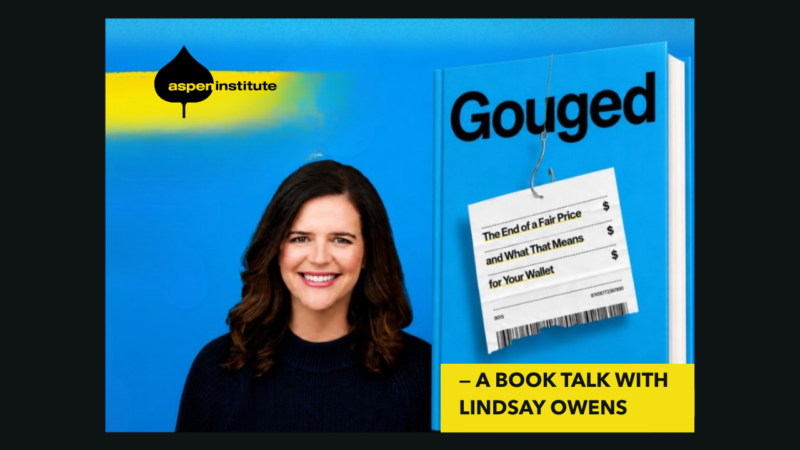
I just want to thank Mary, Paulette, Craig, Kati, Randy, and their companies for participating in this research, and to them for doing an extra thing and participating in today’s event. It’s been just great to do this research. Thanks again to Sorensen for supporting it. Please join us for our next event in December 8th. That’s going to be with Lindsay Owens from the Groundwork Collaborative on her new book, Gouged. A huge thank you to the team at Aspen. Special thanks to Tony, Frances, Nora, Maureen, Sinin, Colleen, and a special thanks to Max again, my co-author on this report, as well as Merritt, who really helped push this idea forward. It’s been a really great project, and we’re looking forward to doing this more.
If nothing else, the big takeaway is that at this moment, we need to be listening to more voices like the ones on the call today to make sure that as we grow this work, we’re continuing to innovate. Like the companies that are employee-owned, we’re continuing to foster a sense of continuous improvement where with this work goes. Thanks again for joining us today, and take care, and have a happy holiday season and Halloween this weekend.
[silence]
Resources
Publications
- Johnson, Maxwell, and Matt Helmer. “What Employee Ownership Means to Workers.” Aspen Institute. October 14, 2026.
- Schur, Lisa, and Janet Boguslaw.“Building the Assets of Low and Moderate Income Workers and their Families: The Role of Employee Ownership.” Rutgers School of Management and Labor Relations. March 2019.
Websites
- Capital Homecare Cooperative
- Integrated Specialty Coverages
- Ocaquatics Swim School
- Ocaquatics Swim School’s Ownership Countdown
- Shine Nurture Center
- Threaded Fasteners, Inc.
Highlights
For highlights from this discussion, subscribe to our YouTube channel or subscribe to our podcast to listen on the go. Check out our playlist or click below to watch.
About this event
What does employee ownership mean to the people who experience it every day?
In this conversation, the Aspen Institute Economic Opportunities Program shares findings from its report What Employee Ownership Means to Workers and hears directly from five employee-owners who participated in the research. Panelists discuss their experiences with different forms of employee ownership, including ESOPs, employee ownership trusts (EOTs), worker cooperatives, and broad-based equity compensation plans.
The discussion considers how workers’ perspectives can inform the design of ownership plans, workplace practices, and policies that help employee ownership thrive. The event was moderated by Matt Helmer, director of job quality and worker well-being at the Economic Opportunities Program.
Read the report:
https://www.aspeninstitute.org/publications/what-employee-ownership-means-to-workers/
Learn more about the event:
https://www.aspeninstitute.org/events/what-employee-ownership-means-to-workers/
Explore the Economic Opportunities Program:
https://www.aspeninstitute.org/programs/economic-opportunities-program/
About Opportunity in America
Opportunity in America, an event series hosted by the Economic Opportunities Program, considers the changing landscape of economic opportunity in the US and implications for individuals, families, and communities across the country.
About the Economic Opportunities Program
The Aspen Institute Economic Opportunities Program advances strategies, policies, and ideas to help low- and moderate-income people thrive in a changing economy.
Join Our Mailing List
To receive occasional emails about our work — including new publications, commentary, events, fellowships, and more — join our mailing list.
Connect on Social Media
For news and updates every day, connect with us on the social media platform of your choice.