Podcast and Resources coming soon
Description
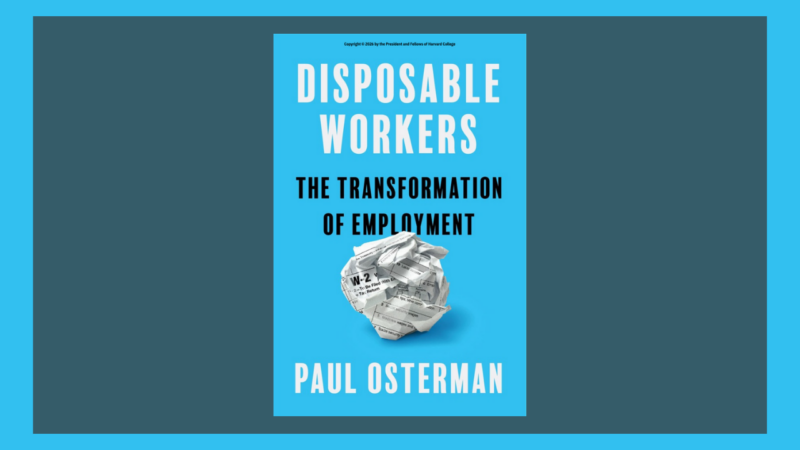
For decades, economists and policymakers have debated how to help workers get better jobs. But what if the more fundamental problem is that employers have systematically redesigned work itself to make a third of the workforce expendable? In his forthcoming book, “Disposable Workers: The Transformation of Employment,” MIT Sloan Professor Emeritus Paul Osterman examines this idea and what it would take to reverse it.
Osterman documents the rise of contract workers, freelancers, and what he calls “marginal workers” — W-2 employees who are cut off from training, advancement, and any real stake in the organizations they work for. Together, these three groups now make up more than a third of the American workforce. Osterman argues that this trend is neither an accident nor an inevitable byproduct of technological change. It is the result of deliberate choices employers have made about how to structure work and manage labor costs. Osterman traces both the logic behind those choices and their consequences for worker well-being, economic mobility, and the broader social contract.
Join the Aspen Institute Economic Opportunities Program on Wednesday, September 9, from 2 to 3 p.m. Eastern time, on Zoom, for a conversation about what drove this transformation, who bears its costs, and what it would take to reverse it.
Our speakers include Osterman and moderator Maureen Conway, a vice president at the Aspen Institute and executive director of the Economic Opportunities Program.
This event is part of our Opportunity in America series.
Speakers

Paul Osterman
Professor Emeritus at the Sloan School, MIT
Paul Osterman is professor emeritus at the MIT Sloan School. Paul has served as the Nanyang Technological University (NTU) Professor of Human Resources and Management and as deputy dean of the MIT Sloan School from July 2003 to June 2007.
His research concerns changes in work organization within companies, career patterns and processes within firms, economic development, urban poverty, and public policy surrounding skills training and employment programs. Osterman has been a senior administrator of job training programs for the Commonwealth of Massachusetts and has consulted widely for government agencies, foundations, community groups, firms, and public interest organizations.
His newest book is Disposable Workers: The Transformation of Employment (Harvard University Press, 2026). Other recent books include Creating Good Jobs: An Industry Based Strategy (MIT Press, 2020); Who Will Care For Us: Long-Term Care and the Long-Term Workforce (Russell Sage,2017); Good Jobs America: Making Work Better for Everyone (Russell Sage, 2011); The Truth About Middle Managers: Who They Are, How They Work, How They Matter (Harvard Business School Press, 2009); Gathering Power: The Future of Progressive Politics in America (Beacon Press, 2003); Securing Prosperity: The American Labor Market: How It Has Changed and What to Do About It (Princeton University Press, 1999), and Working In America: A Blueprint for the New Labor Market (MIT Press, 2001).
Osterman is also the author of Employment Futures: Reorganization, Dislocation, and Public Policy; Getting Started: The Youth Labor Market; The Mutual Gains Enterprise: Forging a Winning Partnership Among Labor, Management, and Government; and Change At Work. He is the editor of two books, Internal Labor Markets and Broken Ladders: Managerial Careers in the New Economy. In addition, he has written numerous academic journal articles and policy issue papers on topics such as labor market policy, the organization of work within firms, careers, job training programs, economic development, and anti-poverty programs.

Maureen Conway (moderator)
Vice President, The Aspen Institute; Executive Director, Economic Opportunities Program
Maureen Conway serves as vice president at the Aspen Institute and executive director of the Institute’s Economic Opportunities Program (EOP). EOP works to expand individuals’ opportunities to connect to quality work, start businesses, and build economic stability that provides the freedom to pursue opportunity. Maureen founded EOP’s Workforce Strategies Initiative and has headed up workforce research at the Aspen Institute since 1999. Maureen also curates a public discussion series at the Aspen Institute, Opportunity in America, which brings together voices from business, labor, policy, human services, media, academia, and others to discuss the challenges experienced by many in today’s labor markets and new ideas for addressing these challenges. In addition, Maureen oversees EOP’s leadership development programs, which connect innovators, both within communities and from across the country, to peers working to help low- and moderate-income Americans access opportunity.
Maureen is the author of numerous publications including research reports, case studies, and policy briefs, including co-editing, together with Robert P. Giloth, the book Connecting People to Work: Workforce Intermediaries and Sector Strategies, a collection that brings perspectives from philanthropy, policy, research, and practice together. A featured speaker at national and regional conferences, she is a nationally recognized expert in workforce issues and has been quoted in a variety of news media including The New York Times, The Wall Street Journal, and National Public Radio and her writing has appeared in Fast Company, Politico, Quartz, CNN.com, and other outlets.
Maureen’s previous experience includes consulting for the Organization for Economic Cooperation and Development in Paris and work for the US Peace Corps, where she advised on the design, management, and evaluation of the organization’s economic development programs in Eastern Europe and the former Soviet Union. Maureen holds an M.B.A. from Columbia University, where she was a Samuel Bronfman Scholar, a master’s in regional planning from the University of North Carolina, and a B.A. in economics and mathematics from Holy Cross College.
About Opportunity in America
Opportunity in America, an event series hosted by the Economic Opportunities Program, considers the changing landscape of economic opportunity in the US and implications for individuals, families, and communities across the country.
About the Economic Opportunities Program
The Aspen Institute Economic Opportunities Program advances strategies, policies, and ideas to help low- and moderate-income people thrive in a changing economy.
Join Our Mailing List
To receive occasional emails about our work — including new publications, commentary, events, fellowships, and more — join our mailing list.
Connect on Social Media
For news and updates every day, connect with us on the social media platform of your choice.
More Events by the Economic Opportunities Program

What Employee Ownership Means to Workers
View Event