Weavers help their communities grow – and they grow, too
Subscribe to Weave’s Newsletter
Every week, you’ll get resources on how to weave our communities and restore social trust.
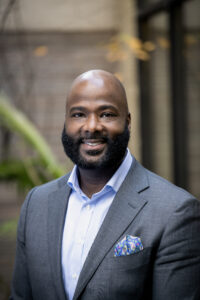
Frederick J. Riley
Executive Director
Weave: The Social Fabric Project
There is something good in every season, but spring invites us to grow. Flowers are blooming, the sun is warmer. Time to get energized and reflect on the perennial question: What is helping you grow?
Weavers are people who naturally lean into growth – both in their personal lives and their communities. But sometimes that commitment to growth doesn’t happen all at once.
Weaver and Chicago resident Asiaha Butler can tell you all about that. She lived for several years in the Englewood neighborhood on the South Side of the city. By 2008, things were going downhill fast. “We were terrified on our block,” Butler recalled. “We had vacant lots and abandonment around us, and criminal activity night and day.” She and her husband prepared to move out of state.
Then, one Sunday morning, Butler was having her coffee and looking out the window when she noticed a little girl wearing a dress and sitting in dirt. The girl was in a vacant lot strewn with glass and rocks.
“It shifted my whole life in a moment,” Butler said. “I could not witness this on my block and be OK with that. I told my husband, ‘We have to stay.’”
Butler started to introduce herself to neighbors that she hadn’t met. She began to organize. Her talent, she found, was to connect with others and show them that they were critical to the community. She began the nonprofit R.A.G.E., which stands for Resident Association of Greater Englewood. She and her neighbors went to Chicago’s city government and convinced the City Council to allow residents to buy up vacant lots for one dollar each and transform them. Neighbors created pocket parks, event spaces and community gardens. “They went from vacant to vibrant,” Butler smiled.
Now, years later, R.A.G.E is transforming dilapidated buildings, and even a former, now-closed school to create housing, a health care center and a community space. The streets are safer now. “It is brilliant here,” Butler said. “Outsiders think we are poor, uneducated and do not have the ability to lead. I can introduce you to people who are poised, professional and ready to lead.” And they have, Butler said.
But the question about growth that guided Butler in the beginning, when she first began to approach fellow residents, is relevant to all of us. “What is inside you that can uplift the community?” she asked. “The gift I discovered was that I could share my gifts, and other volunteers did, too.”
That act of agency didn’t just transform her neighborhood. It transformed her. It’s an ongoing process, she said. “The work is still changing me.”
At Weave: The Social Fabric Project, we are working to meet one of the defining challenges of our time: the erosion of trust in our communities. We do this by supporting weavers—everyday people who bring others together, build connection, and remind us what is possible when we choose relationship over division.
But this work is not just about those already stepping up. It is about calling forward those still waiting on the sidelines. Because the truth is, every one of us has something to offer.
We believe that relationships can heal what feels broken in our country. That when people come together, take responsibility for one another, and act with care, communities begin to grow—and so do we.
This is work we can all be part of. Come join us. Learn more at weavers.org.
Economic Opportunity is a Human Challenge, Even in the Age of AI
<strong><strong>In rural Missouri, a student-run coffee shop brews belonging across generations</strong></strong>

The Solutions Bringing Us Closer to a Whole-of-Ecosystem Response to Scams
Design of Business Takes on Radical Collaboration, Recorded Live in Aspen: A Guide to the DB|BD Season
What Are You Teaching Me Today?
Helping Afghan women gain freedom in Arkansas