
What Employee Ownership Means to Workers
Insights from Focus Groups with Employee Owners

Maxwell Johnson
Senior Research Associate

Matt Helmer
Director of Job Quality and Worker Well-Being
Follow Aspen EOP
Join our Mailing List
To receive occasional emails about our work — including new publications, commentary, events, fellowships, and more — join our mailing list.
EMPLOYEE OWNERSHIP HAS DEEP ROOTS in the United States. Working under President George Washington, Thomas Jefferson and Alexander Hamilton devised a profit-sharing system between ship owners and their crews in an effort to rebuild the economically vital cod fishing industry, which had been destroyed by the British during the American Revolution.1 Following the Civil War, formerly enslaved people organized into cooperative structures, including worker-owned businesses.2 Some companies, like Procter & Gamble, experimented with profit-sharing during industrialization at the turn of the twentieth century. In 1974, the establishment of the employee stock ownership plan (ESOP) formalized employee ownership in federal law. Employee ownership continues to grow today, as Americans seek a greater voice in their workplace and a means of sharing in the economy’s prosperity.
Employee-owned companies often offer better jobs than traditionally owned ones. Their workers often benefit from a say in the workplace, an opportunity to share in its financial rewards, and sometimes, the chance to build meaningful wealth beyond a wage. More than 80 percent of respondents to a 2025 Wall Street Journal/NORC poll reported concern about the availability of good jobs, as well as the pace of wage growth and unequal economic growth. Employee ownership is a promising tool to respond to the public’s concerns and create an economy where workers thrive.3
Employee ownership brings notable benefits to communities and business owners. It offers retiring business owners a succession plan and an opportunity to pass their legacy on to the workers that helped build the company. And employee ownership helps keep businesses anchored in their communities and increases business resiliency, protecting jobs, and mitigating the risk of firm closure.4
Support for employee ownership is growing. Employee ownership has bipartisan backing. Federal, state and local policymakers have introduced and passed legislation to expand employee ownership. Private investment is shifting to support this business model. But significant work remains to ensure the continued growth of employee ownership and the success of the businesses that adopt it.
There is a substantive body of quantitative research on the benefits that employee-owners experience, including well-established evidence on the effect of ESOPs on wealth-building and worker engagement. And there are some excellent qualitative studies of the experiences of employee-owners in ESOPs. Documenting the perspectives of employee-owners in ESOPs, a team led by Janet Boguslaw and Lisa Schur, of Rutgers University, found that low- and moderate-income workers report that the wealth generated through ESOP participation increased their financial and retirement security and allowed them to pass down wealth to the next generation. Employee-owners also reported receiving education and developing skills that positioned them for advancement and that employee ownership afforded them a better quality of life.5 However, qualitative research about variation in the experiences of employee-owners across different forms of employee ownership is less common.
A critical voice at this moment is that of employee-owners. After all, growing employee ownership requires more than boosting capital investment. It also requires focusing on the elements of workplace culture that are most salient for workers at employee-owned companies, then scaling them. Research shows strong links between low turnover at companies that combine employee ownership with employee participation in decision making and have greater information sharing and support.6 Examining such a culture from the perspective of employee-owners can help more companies build the workplace practices needed to thrive.
Furthermore, understanding how employee-owners characterize the outcomes of employee ownership can help companies ensure the business model delivers. Similarly, investors would benefit from worker perspectives when weighing the impact of their investments. And policymakers would benefit from such an understanding of employee-owners’ experiences and perspectives when crafting policy to support the growth of employee ownership.
To understand workers’ experiences across the range of employee ownership models, including ESOPs, employee ownership trusts (EOTs), worker-owned cooperatives, and broad-based equity compensation, the Aspen Institute Economic Opportunities Program convened focus groups with workers at 12 employee-owned firms across the country. We explored how employee ownership affects workers’ attitudes toward their jobs and their employers, the specific practices that help workers think and act like owners, and how they view the benefits of employee ownership, including their personal financial stake in the firm.
In this paper, we describe what we learned from our focus group discussions. After summarizing our methodology, we discuss what employee ownership means to workers. We then discuss the practices that employee-owners reported their companies use to encourage workers to think and act like owners, including the sharing of the company financials and implementation of practices that allow workers to help shape decisions. The next section explores the impacts that workers described as a result of employee ownership. These include increased financial security and nonfinancial benefits, like career advancement and personal development. We conclude the paper with observations about differences in employee-owners’ experiences across the range of employee ownership forms, and we highlight considerations for the employee ownership field as it continues to evolve.
Methodology
The findings in this report are drawn from semi-structured focus group conversations held with 85 workers across a dozen companies. Focus group participants were assured confidentiality, and their names are not included in this paper. When quoting focus group participants, we provide a job title, area of work, company, or length of tenure for context, when needed. Quotes have been lightly edited for clarity.
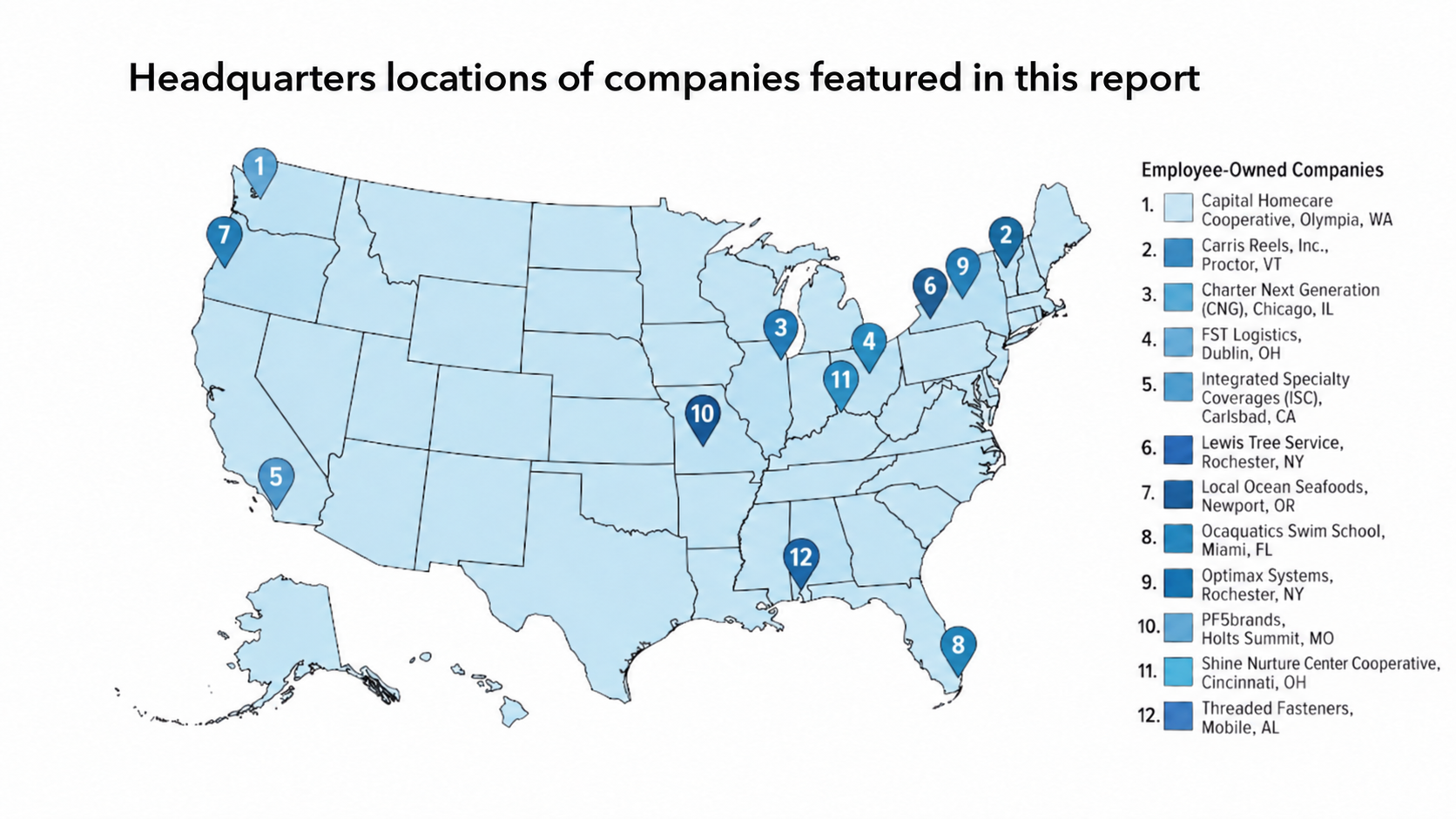
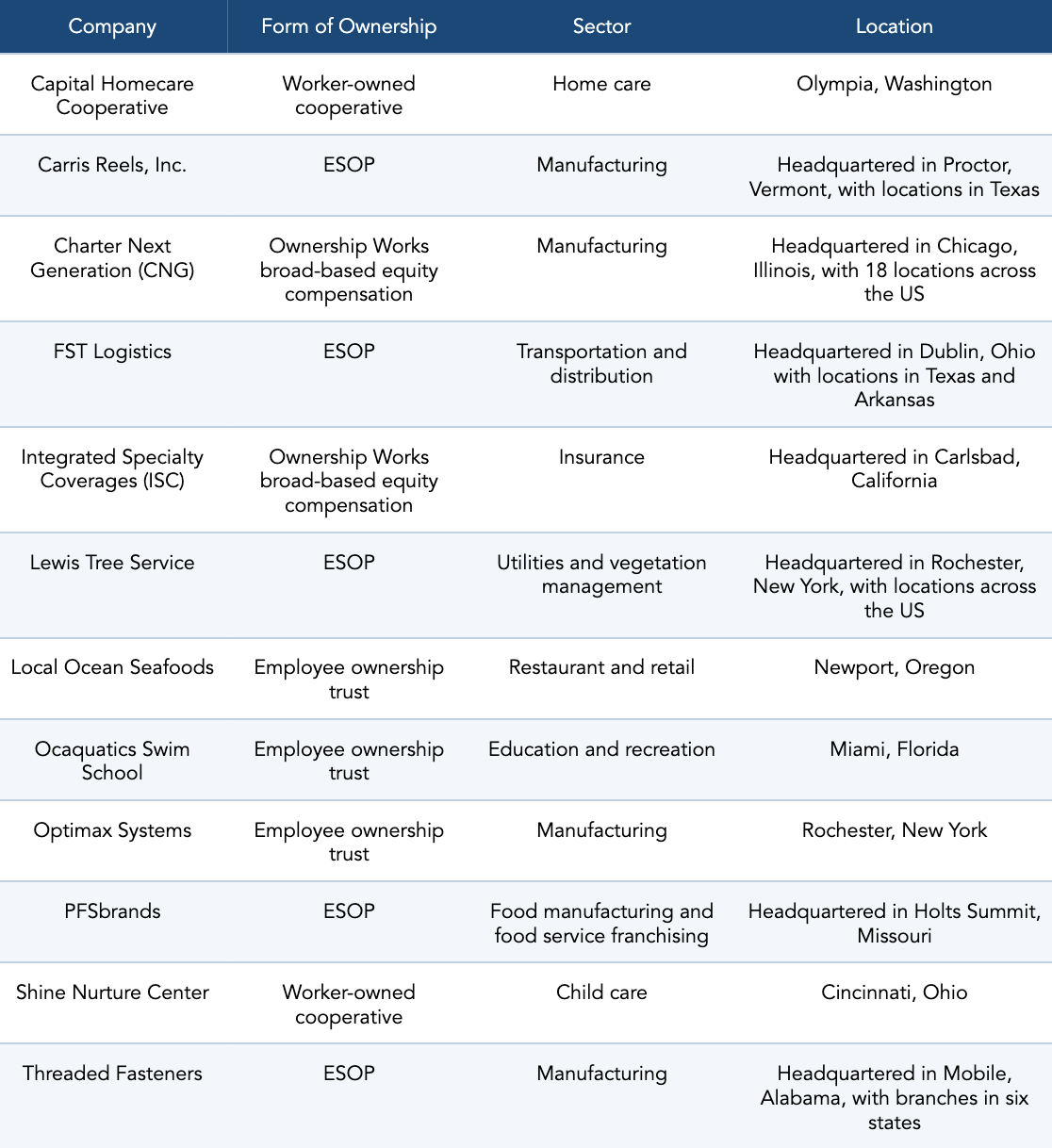
We selected companies based on our own network and referrals from employee ownership researchers and practitioners. Our goal was to include a mix of companies that represent the range of employee ownership forms across a diverse array of industries, communities, company sizes, and employee ownership histories. We also asked for referrals to companies that were perceived as having a strong ownership culture, or, in other words, those whose workers are thought to think and act like owners. That said, the companies included in this report are not a representative sample of all employee-owned companies. Half of the companies included are in the manufacturing and logistics industries. Others include a restaurant, home and child care providers, a vegetation management company, and an insurance firm. The workers interviewed hold a wide range of jobs. They are office staff and machine operators on the factory floor, teachers and truck drivers, cooks and engineers.
We held additional interviews with management representatives to understand their perspectives on employee ownership and how varied ownership models were operationalized. At some companies, the founding owners continue to serve in management roles following an employee ownership transition. In those cases, our conversations helped us understand their motivations for transitioning their companies to employee ownership.
We spoke to workers at five companies with employee stock ownership plans, three employee ownership trusts, two worker-owned cooperatives, and two companies within the Ownership Works portfolio of companies.
A qualified retirement plan that is federally regulated by the Employee Retirement Income Security Act of 1974 that holds company stock in a trust on behalf of employees. An ESOP owns all or part of a company, granting shares to employees that are cashed out upon leaving. ESOP beneficiaries have limited voting rights in major firm decisions, like a merger or the sale of assets.
Often perpetual purpose trusts adapted to the principles of employee ownership. The trust’s governing documents legally bind the firm to operate to benefit workers, often requiring profit sharing and continued firm independence. It is a flexible model that may be customized to fit a company’s needs and is rooted in state trust law, though it lacks a dedicated federal regulatory framework like ESOPs.
Enterprises that are owned and managed by their employees, who share in the profits. A worker typically must buy into the business to become a member of the cooperative. Worker cooperatives practice a form of workplace democracy that is based on a one-member, one-vote system, in which members vote on a range of governance matters defined by their bylaws.
A form of free equity participation provided to all employees at a company. At this stage in Ownership Works’ growth, it primarily supports private equity-backed companies to implement the model upon acquisition. A portion of equity is granted to employees, who receive payouts during a liquidity event, such as a dividend, an acquisition by another investor or company, or a public offering. Under the Ownership Works model, companies implement various practices designed to build an “ownership culture” and improve employee engagement, financial well-being, and business operations.
This report builds on the Aspen Institute Economic Opportunities Program’s (Aspen EOP) long-standing engagement in employee ownership. We have examined the potential for employee ownership to reduce racial and gender wealth gaps. We have also documented practices among state employee ownership centers and employee-owned companies. Aspen EOP regularly hosts experts and practitioners from across the field of employee ownership and convenes the annual Employee Ownership Ideas Forum, in partnership with the Institute for the Study of Employee Ownership and Profit-Sharing at Rutgers University.
What does employee ownership mean to workers?
The workers we interviewed hold diverse interpretations of employee ownership. These are strongly influenced by the form of ownership practiced and the manner of its implementation. A financial stake typically forms the central pillar onto which other meanings are scaffolded. The connection between workers’ efforts, firm profitability, and additional financial compensation gives workers the sense that a rising tide lifts all boats. A heightened degree of accountability to one’s colleagues is found in employee-owned workplaces, as the combined productivity of an employee-owned company’s workforce underpins its economic success and, consequently, the equity or profit-sharing that workers receive. Workers told us that employee-owned companies value their input, whether through formal or informal channels, and that their input can make a meaningful difference in company operations. Moreover, we heard workers describe a feeling of independence at their companies, with the power to shape their own work. Finally, for some workers, employee ownership codifies their company’s social mission.
A Financial Stake
A key element of employee ownership is sharing in the wealth the company creates. Workers told us that owning part of the company, or sharing in its profits, gives them a personal investment in its success. After all, there is a tangible connection between the fruits of one’s labor, a company’s success, and a payout down the line. For workers, the financial benefits of employee ownership can feel like they did for a caregiver at Capital Homecare Cooperative, who told us that it was “the first time in my working adult life that I [felt] like the amount of effort I put in was reflected back at me.”
“If you work for a boss, you feel like you’re making money for just him,” a longtime machine operator at Carris Reels explained. But under employee ownership, “you know you’re making money for your future and for yourself, not just somebody else.” It’s a perspective shared by others. “I’m investing in my own future through my work,” said an employee of nearly a decade at Ocaquatics Swim School. And for a recruiter at Lewis Tree, “a stake in the success of the company” means her contributions “can directly impact both the organization’s performance and [her] long-term future.”
That sense of working for one’s own financial benefit contrasted with past experiences at traditionally-owned companies. “It [was] just a job you wanted to get done with,” an office worker at CNG said of a previous employer, a family company that had been taken over by private equity. He felt that his hard work there benefitted senior executives’ paychecks, but not his own. “I think it’s good,” at CNG, “where now we have some skin in the game,” he told us. Employees received equity stakes as a condition of CNG’s partial acquisition by the private equity firm KKR.
Shared Goals and Mutual Accountability
Workers spoke positively of workplaces where employees shared a sense of purpose. “Your positive efforts have a direct correlation to your individual success and the company’s success,” an engineering manager at Carris Reels reflected. “We’re all kind of working together. We’re all kind of working towards that same goal.” Or as an Ocaquatics worker said, “Employee ownership to me is a huge responsibility that requires a tribe of people, whose focus is not on me, me, me — that focus is on us and we.”
A sense of shared goals fosters an expectation of mutual accountability. A dispatch manager at FST Logistics told us, “I feel that a lot more employees are being held accountable and they want to hold themselves accountable, as well.” The motivating factor? The “end goal” of the ESOP payout each employee receives upon retiring. “No matter how close you are to retirement, I think [that] is everyone’s end goal,” the dispatch manager added.
A senior quality control auditor laid out the culture of mutual accountability at Threaded Fasteners:
We are all in the driver’s seat for this company to succeed, regardless if you’re the president of the company or you’re just out there in the warehouse pulling orders. We are all in the driver’s seat and we all work together to make this company become more and more profitable and take care of our customers. The overall goal is customer satisfaction, because if they are satisfied, and we build our customer base, we’ll be more profitable.
There’s a sense of duty to one another at employee-owned companies that some workers even cast in familial terms. Take the words of an assembly supervisor at Carris Reels:
I feel like we know how to value that work ethic, that body of work. We also know how to value those people who understand why we’re doing this and why it means so much. And that’s that employee ownership. And that means a lot to me because I can go anywhere in the world and work hard. I can go back to the railroad, I can go back to GE and I can work my butt off. But to be recognized and for someone to see that work ethic and to know what that means, we are across all North America, but I mean, we are also a small family at the same time.
For a caregiver at Shine Nurture Center, that family feeling met the higher aspirations of what child care should be. “The difference between [experiences at other child care centers and working at Shine Nurture Center] is even when I wasn’t a worker-owner [at Shine Nurture Center], I’ve always had a say.” It’s in the nature of cooperatives, she said, explaining that Shine Nurture Center “runs a lot more smoothly.” And she got to participate in cooperative practices before being fully bought in. “So it’s very inviting, and that’s what childcare should be: It should be a family, a community of people that have like-minded goals.”
Voice and Agency in the Workplace
The workers we interviewed tended to associate employee ownership with workplaces that grant them agency and value their input. Employee-owned companies typically retain a management hierarchy while practicing a heightened degree of responsiveness to employee input, workers told us. In some cases, this formalized a culture that predated a transition to employee ownership. The respect, autonomy, and power to effect change extended to workers contributes to their investment in boosting productivity and improving the quality of companies’ output.
“Everyone in here can be heard,” a branch manager at Threaded Fasteners said. “And that starts from the top down.” It’s a sentiment repeated by numerous interviewees. “I do feel that here my voice is definitely heard more than previous employers that I have worked with,” said a dispatch manager at FST Logistics. “There’s no dumb idea — and if it is, they don’t belittle you for it. Something that you may present may not get passed through, but it definitely can stir up future conversations.”
Being a member of a cooperative “means having power in what you’re doing,” a worker-owner of Shine Nurture Center put it. “It empowers you to make decisions. It empowers you to benefit from your work in a way that is not just your salary. Instead of just being somebody who gets told what to do, you get to be part of the people who are making decisions. And I think it just empowers everybody to be on a similar level.” A colleague seconded her perspective. “It gives us a sense of autonomy over our jobs,” she emphasized. “We get to choose how we do the work that we do. We get to choose the people that we bring in to do that work with us. So the sense of power is there for sure. But it’s a shared power that I enjoy because I never wanted to be a daycare owner by myself.”
A co-owner of Capital Homecare Cooperative described how having control over her tasks plays out. “I can make accommodations as I need with each client that I have, because they get to know me and they respect my decision-making process,” she explained. “And I can make it more peaceful for me and so I don’t get burned out. And so I like that part. I’m in charge of how I work and where I work and when I work. And that’s really important to me in keeping employed.”
For some, greater agency comes with greater responsibility, we heard. “What I do isn’t micromanaged,” an experienced IT employee at Lewis Tree Service told us. She illustrated her understanding of the company’s ethos under employee ownership: “[Management is] going to empower [employees] to make these decisions. And if it’s the wrong one, then you learn why it was wrong or what you could do better.” The result is “a greater sense of responsibility than just walking in the door, punching a clock, and walking out — and not really having so much stake in your position.” A production manager at Carris Reels told us that it was “major” to feel able to take initiative, and that doing so comes with accountability. As another put it, “We kind of have that power to really drive changes, and that’s what makes me feel fulfilled.”
Commitment to a Social Mission
Some workers described a personal commitment to their company’s social mission. This was pronounced at cooperatives, which tend to adhere to a set of social principles, and at EOTs, where a social mission might be embedded in the stated purpose of the trust.
A worker with a decade of service at Ocaquatics, an EOT-owned swim school, saw the trust model as a way to “keep our culture,” explaining, “We get to stay a B Corp, we get to be a 1% for the Planet Partner. We get to have all these things that we had before. We get to maintain that throughout the many years to come, whether some of us are still here or not.”
For a service worker at Local Ocean Seafoods, the company offered a sense of purpose that was different from the industry norm, thanks to its environmental sustainability practices. “Restaurants don’t really have that kind of philanthropy or anything like that. It’s really just money-oriented,” she told us. “And so this is, like, we get to make an earning to live and also feel like we’re actually changing something.”
Building Ownership Culture
The emergence of a culture of ownership at employee-owned companies is typically the result of intentional effort. Employee ownership experts describe a culture of ownership — sometimes called an ownership mindset — as a sense of stewardship felt by workers towards the business. That culture plays an important role in the success of an employee-owned company, encouraging greater employee cooperation and retention, research shows.7
Researchers have developed similar frameworks for how ownership culture is created. A research team led by University of Massachusetts Boston management professor Edward Carberry found that such a culture emerges from the presence of a combination of factors:
- the regular sharing of business performance information,
- workers receiving training to understand business operations,
- workers having influence over day-to-day tasks and team decision, and
- an understanding among workers of how the ownership plan works.8
The National Center for Employee Ownership’s framework on ownership culture largely overlaps with that of Carberry and includes practices like sharing performance data, offering business literacy training, and developing employee involvement structures.9
One of our primary goals in this research was to build on existing research by better understanding from employee-owners’ perspective the practices that undergird ownership culture in different ownership structures. The practices that companies use vary according to their form of ownership and business context. But we heard themes that align with commonly accepted frameworks, including efforts to communicate shared values and goals, build employee-owners’ financial and ownership literacy, facilitate workers’ ideas and voices, and implement coaching, mentoring, and leadership development.
Communicating Shared Values and Goals
Through our conversations with employee-owners, it was evident that their companies articulate, communicate, and reinforce their stated values. Doing so creates a sense of shared purpose, both of which are important in establishing a feeling of ownership. In interviews, many employee- owners recited or explained their company’s values without prompting. These commonly included a commitment to quality work and customer service, continuous improvement, taking care of colleagues and the community, and, of course, acting like an owner.
The employee-owners we spoke with frequently discussed a culture of care within their companies, where colleagues feel like family. “There’s more reasonable accommodations for your personal and your family life than a much bigger corporation where this is the employee handbook and they’re super hardlined about whatever their rules are,” an employee-owner at Local Ocean Seafoods explained. “I feel like there is a little bit more about understanding the person and listening to the person and their circumstance than I’ve experienced in other workplaces,” she said. This practice of care is often extended to customers. “We want our people to feel cared for and listened to,” said a worker-owner at Capital Homecare. It’s a “human-centered value” that grants the cooperative’s worker-owners dignity, which translates into workers providing dignity to the people they care for, according to the worker-owner.
The dual frame of caring for each other and customers appeared in ESOPs too. “Our statement is to create value in the people we serve,” a branch manager at Threaded Fasteners explained. “So we want to be servant leaders. We want to make sure that not only [are we] serving our customers, we’re serving our family members — our team members, as we call them family or team.” The CEO summed up the culture with a catchphrase: “Hungry, humble, and aware are traits that we want to live by here. That’s how we want our employees to act.”
The value and financial performance of the company is a common north star at the companies whose workers we spoke with. For ESOP employee-owners, this is reflected in a goal to increase their share price. At Threaded Fasteners, staff meet with management at each location to develop goals. Companies deploying the Ownership Works model have shared goals around the value they hope the company will reach upon sale. Workers at EOTs and cooperatives also spoke about company goals related to financial performance. We often heard employee-owners express a commitment to quality work and customer service. A machine operator at Carris noted a strong dedication to a quality product to “make sure that it’s going out the door right.” Part of that commitment to customers is exercised through a focus on continuous improvement. Weekly safety meetings at Threaded Fasteners for example, always end with a discussion on what the team can do better, employee-owners at the ESOP said.
Employee-owned companies engaged in manufacturing and manual labor prioritize safety. An employer-owner who works in finishing at the manufacturer CNG remarked:
One thing that we do that I think really helps everybody feel like an owner is we have safety teams, and those are all operator-led. So our operators get to make those decisions to make the environment safer because they’re frontline, so they know a little bit better what will work and what won’t work because they’re around it every single day.
A division manager at Lewis Tree Service drew a parallel between the value of his ESOP account and that of workplace safety. “That stock represents more than just a number. It represents years of our hard work, safety, and commitment to doing things the right way,” he said.
Building Business and Ownership Literacy
An understanding of company finances and ownership structure is important for developing a shared ownership mindset among employee-owners. Nurturing that understanding often starts during onboarding, even when new hires may not qualify for ownership right away.
Ownership Education from Day One
“I think from even before people are hired here, we are already sharing information with them about what it means to be an employee-owner, that comes to them with their job offer,” a PFSbrands executive explained. “Their onboarding [on] day one includes some education around that. They also have training within their first two months typically — we call it Wow Week — but it includes education about ESOP from our chief financial officer.” Another colleague elaborated that “From the very beginning, even if they’re not eligible in the plan, we still refer to them as employee-owners. We also brand ourselves, so our attire, our clothes, our backpacks, the things that we’re wearing showcase employee ownership, and I think a couple of those things really do help, and even just from the very beginning.”
Similarly, Carris Reels also offers training on the basics of an ESOP and the company’s history to new employees. And Ocaquatics incorporates the concept of ownership mindset into employees’ orientation. An employee-owner at Ocaquatics explained, “From their first orientation, we talk about the ownership mindset, what it means, and really explain that to our newer team members, so that they have that feel, and they know from day one that no matter their role, they can be an owner of the company as well.”
Financial Education and Open-Book Management
Ownership training is an ongoing process, and open-book management is a common practice for engaging employee-owners on finances, we heard. Helping workers to understand business outcomes, financial statements, such as profit and loss statements, and how their performance affects the bottom line is fundamental to the practice.
As part of advancing open-book management, PFSbrands takes things a step further. The company both educates workers to build an understanding of the business’ finances and assigns to individual employees the ownership of lines in its general ledger. Employees report against and explain variances in performance targets, develop and implement plans for improvement, and, in some cases, re-forecast future performance. Metrics are shared in a weekly meeting on key performance indicators and a monthly huddle, and are displayed around campus on monitors. An employee-owner, who coaches peers, explained:
We teach the scores and how to win and what we’re aiming towards, which helps us understand what we call playing the game. You can’t win if you don’t know how to play the game. And so, for us, that’s a big part of understanding our own roles and how we are contributing to the bottom line or really making an impact. Sharing that visibility does help with that ownership mindset.
Or, as a quality technician at the company explained, “You literally feel like you’re on a sports team. It’s the only feeling I can say that’s close to it. And I like coming into work every day feeling that.”
The financial education gleaned through open-book management was transformational for an Ocaquatics employee-owner with more than a decade of experience. “I think that has been the greatest part of becoming an owner,” he said, speaking of the training. “You see where you’re succeeding and where you can grow. The financial literacy part of it has been awesome in helping us improve, and helping us want to achieve better numbers.” And an employee-owner at Integrated Specialty Coverages remarked that management walks them through financial statements and educates them on complex finance concepts. “They show us what’s under the hood,” motivating greater employee engagement.
Ongoing Communication on Business Performance
Sharing information on the company’s finances, strategic direction, and goals is common. Employee-owners at ESOPs and EOTs reported regular state-of-the-company meetings, to that end. Remarked an employee at Optimax on the value and transparency of the EOT’s monthly meetings, “We have pretty honest meetings each month, where, if it’s a good month, we’re seeing that. If it’s a bad month, we’re seeing it.”
Small team meetings, held more frequently than company-wide ones, facilitate information sharing. An assembly supervisor at Carris Reels described the company’s approach:
Each month, we stop production, we set up chairs, we set up a PowerPoint in the middle of the shop floor [and] we go over how we did last month financially, how we’re doing currently. We go over any project updates, we go over safety, our quality, and our delivery so people can really get a real time feeling of how our company’s doing, good, or bad.
Similarly, Threaded Fasteners has “total transparency,” according to an employee-owner at the manufacturer. “Anyone that wants to know our profit and loss in this location can walk in this office. They can see exactly what we spent money on for this location. So as an owner, you want to know where your money went and how profitable you are. It’s accessible to anybody.”
At Charter Next Generation, an Ownership Works partner, quarterly meetings on financial performance are complemented by “ownership boards.” The boards track “the past 24 hours for production, safety, engagement quality,” said an employee. Owners can see “how we’re performing in each facility day by day, which helps us know we’re winning or, [the] areas that we can improve upon.”
Addressing Challenges with Uncertain or Delayed Financial Rewards
For companies that offer regular profit sharing or dividends, such as cooperatives and EOTs, workers’ financial gains from ownership may ebb and flow. While some quarters or years may deliver a robust bonus, that is not always the case. Financial transparency and helping workers understand why the share of profits varies is therefore important.
ESOP beneficiaries, on the other hand, receive the value of their stake only upon leaving their employers. Employees of companies offering broad-based equity compensation receive the value of their shares once the company is sold. The delayed payout can make it difficult for employee ownership to feel real. As one interviewee put it, the financial stake can seem like “imaginary money.” That dynamic might be accentuated among younger and lower-tenured employee- owners at ESOP companies. An employee-owner explained the sentiment that he had witnessed from new hires: “‘Why am I waiting 30 years before I see this? Why does it matter to me right now?’” And for seasoned employee-owners, there is uncertainty about the payout. “Just like any stock, it’s not guaranteed,” one cautioned.
Employee-owners at ESOP companies told us that their employers often provide education and training to make employee ownership concrete. As previously noted, employee-owners may receive ESOP training from a financial or human resources officer, or through an online platform during onboarding and throughout their tenure. ESOP committees are common and can serve as touchpoints for employees with questions about ownership. And when employee-owners receive an annual ESOP statement showing growth in their account balance, a sense of ownership begins to take hold, we heard.
All employees at companies partnering with Ownership Works receive free equity grants through a company-wide pool or individual awards. Grants are awarded in the form of actual shares, such as restricted stock units, or through equity-linked instruments, such as stock appreciation rights. Grants are typically redeemed following a liquidity event such as a dividend or sale of the company, typically within five to seven years.10 As with other equity-based models, employees can experience uncertainty because their financial interests depend on whether the company’s value increases. Some companies have paid out dividends prior to sale to provide an additional financial benefit and help build trust in the ownership program. (According to Ownership Works, 41,600 workers at partnering companies have received over $234 million in dividends to date.)
The prospect of purchase by another company leads to questions about what the future holds..“There is a certain amount of anxiety that it’s given me, just because of the unknown,” a CNG employee told us. “I truly feel that we’re going to hit and probably exceed our goal,” but “that uncertainty of what happens next is where I feel the anxiety comes from.” That said, Ownership Works has deployed an app that allows employees to see what they would take home given a certain payout, an engineer at CNG said, explaining, “It lets everyone have a shared understanding.”
Promoting Worker Participation and Voice
Workers told us that employee ownership, to them, includes incorporating employee input into decision making. A range of formal and informal mechanisms encourage a participatory culture and operate at the individual, team, and firm-wide level. They range from employee-owners possessing the autonomy to determine their approach to their tasks, to collaborative process improvement, to management consulting with frontline workers on capital purchases.
At some firms, employee-owners hold formal positions in company leadership. Employee- owners hold a position on the board of directors for up to four consecutive, one-year terms at Carris Reels, an ESOP. One employee-owner reported that this practice allowed employee- owners to have a “direct impact on decision making.”
For worker cooperatives, workers serving on the board of directors is standard practice. Such is true of Shine Nurture Center and Capital Homecare Cooperative, where caregivers play a leading role in decision making. An employee-owner at Shine remarked, “I don’t do our finances, but I get to help make decisions that involve our finances. So we get to decide on raises and bonuses and things of that magnitude.” Worker-owners at both cooperatives described holding informal conversations, then votes, on relatively small issues. For major decisions, with long-term implication, such as those touching on wages or capital projects, a greater degree of formality, analysis, and deliberation accompanies decision making. A board member of Shine Nurture Center describe the cooperative’s approach:
Things that affect us long-term are going to be a formal discussion and vote in a meeting, but things that are short-term deals, like closing for snow day or moving the teacher around in the middle of the day, to compensate for someone else not being present, those are in-the-moment things that we can discuss really quick and decide on how to handle that.
At employee-owned companies with a traditional management structure, formal channels collect and transmit input from workers to managers. Optimax Systems set up an email system for employee feedback, a worker at the company told us, with “a separate email line specifically that goes to the executive team, [which] you can put in questions, comments, concerns at any point, and you will get a response from the executive team every time.” Employees can also submit tickets for process improvements.
Some firms have dedicated employee-owner committees. A steering committee at Carris Reels complements board representation as a link between management and shop-floor workers. A supervisor with the company explained, “We’re kind of like the front line dealing with the most local issues and being that voice between the floor and management,” and each supervisor completes a monthly check-in with each employee-owner once a month at their worksite. “We bring those check-ins to the management group to voice either questions, concerns, opinions — whatever it may be — so we can really feel a good vibe from our culture at each site,” he related. A maintenance worker with a decade of experience at Carris Reels found that “It’s a good opportunity to be that liaison between the other employee-owners and management.” The committee also promotes ownership culture “to get people passionate about being an employee- owner,” the maintenance work said.
Techniques to channel employee feedback into process improvement take a variety of forms. At FST Logistics, process improvement requests can be submitted by anyone. A long-haul dispatch manager with the company said that after an employee request is submitted and triaged to the appropriate person, it is followed up on in a conversation. It can be something as small as a warehouse doorbell, she emphasized. “There’s no limitation to what can be requested through that form.”
A process technician at Charter Next Generation described a similar platform that allows employees to submit feedback via a QR code. It’s a system that is part of an environment focused on employee success, we heard. The process technician stated, “There’s not another company I could possibly work for that gives me the flexibility and whatever we ask for,” he told us. “If it makes sense, we do it and it’s not even fighting.” Another colleague in finance remarked, “You’re not just a number. Your voice is heard. If you have a good idea, put it in and if it’s good, it’ll get picked up and implemented. So it seems like people do have more of a voice here than other companies I’ve worked at.” CNG employees reported that each plant receives a pool of money for workplace improvements. At ISC, another Ownership Works partner company, employees talked about similar structures for sharing ideas including through its Bright Ideas Committee and Working Conditions Committee, where “the whole purpose of those committees is just to make ISC a better place to work,” as an employee-owner remarked.
Informal, open-door workplace cultures are common. For a business analyst at FST Logistics, the company’s open-door policy “feels like it’s more of a two-way street of communication rather than just top-down.” Associate-level input is valued, he said, “[associates] might see an area for improvement that upper management — without being on the floor — may not get their eyes on.”
At PFSbrands, one employee-owner described a free-flowing exchange of ideas at their facilities:
It’s very much like it doesn’t matter what position you are, how new you are […] I know guys that have been there, it’s their first day, and they were like, ‘Hey, I was going through this process, I don’t know exactly how it works, but I figured this could be a great way to make it more efficient. It’s just an idea. I understand that I’m new.’ And we’ve implemented it […] if you’ve got a good idea, we’re going to listen.
Facilitating Coaching, Mentoring, and Leadership Development
Many employee-owners described workplaces that promote coaching, mentoring programs, and leadership development. There are learning moments, not mistakes, an Ocaquatics employee-owner remarked. “It happened, and we owned it, and then we moved on past it. I think that’s what our ownership mindset is mainly about.” Other interviewees similarly expressed a sense of empowerment to make decisions, knowing that mistakes were treated as opportunities for learning and improvement.
Several companies have made mentorship a formal practice. At Ocaquatics, every worker is assigned a mentor. Workers valued having someone to approach who was distinct from their direct supervisor, as this allows them to ask questions they may be hesitant to ask their manager. The practice emerges from a philosophy of servant leadership among management, an Ocaquatics supervisor explained. “Our leaders serve their team,” she said. “Our first customer we see as our team members. We need to do a good job serving our team members.”
Employee-owners at Optimax receive individual development plans that are created in collaboration with supervisors. A group leader with more than 20 years at the company said, “If you want to be trained on how to do something, we will actively try to do everything we can to provide that opportunity.”
PFSbrands approaches mentoring and coaching as a shared responsibility. A manager in sales and operations explained:
You have this obligation to help educate and teach your fellow employee-owners. And that takes away that mindset of I’m just the forklift driver or I’m just the guy that stacks the truck or I’m just the accountant. Everybody in an ESOP company makes an impact, whether it’s revenue coming in, cost savings, production, getting product out on time, whatever it might be. Everybody plays a role in the success of the company, and that education piece helps us all in the long run, and there’s that obligation to help teach and educate.
Instead of annual performance reviews, PFSbrands holds quarterly coaching sessions with each employee. While the sessions evaluate employee performance, they also help reinforce the company’s core values and help supervisors and employees develop personal and professional goals for the short and long term. Like Optimax, employee-owners at FST Logistics create individual development plans to guide their careers.
Employee-owners spoke frequently of companies dedicated to training future leaders. Threaded Fasteners, for one, provides employee-owners with deep dives into financial management, along with training of nontechnical qualities, like compassion in the workplace or at home. “They invest in us because they want to see us grow,” an employee-owner said. Another described her experience receiving encouragement to move beyond her comfort zone and participate in senior management meetings. As Threaded Fasteners CEO Billy Duren remarked, “We may be developing leaders for other companies, but we’re not going to stop developing leaders ever. That’s what we do.”
Impacts on Workers
We sought to understand how employee ownership and practices associated with the business model impact workers’ lives. The most significant impact for participants in ESOPs, though often not most immediate, is the added financial security it can provide, especially in retirement. But the workers we spoke with also describe employers that meaningfully invested in employees’ career development, offering opportunities for internal mobility that might not be as common at traditionally-owned firms. And workers saw employee ownership as rooting their employers in their communities, providing a sense of job security.
Financial Security
Additional Security in Retirement Through ESOP Shares
Workers told us time and again that employee ownership bolsters the prospects of a financially secure retirement, especially for ESOP beneficiaries. An ESOP account does not replace a diversified retirement portfolio or a pension. But it can provide extra cushioning on top of traditional retirement savings — a “bonus” is how one Carris Reels worker put it. And to a worker at PFSbrands, employee ownership resembles the old social contract between employer and employee. “I grew up in a family that worked for IBM for multiple generations and they all had pension plans,” he told us. “That really, by and large, doesn’t exist anymore in the private sector, and I think [an ESOP] is one of the closest things that you can get to that.” For a branch manager at Threaded Fasteners, the boost means, “When I retire, I can retire. I don’t have to go find another job to make ends meet. I can shut it down and live my life and I don’t have to worry about it again.” A longtime worker echoed the sentiment. “If you want to do something later on — you get bored — you’re doing it because you want it, not because you have to.”
Ownership stakes can make early retirement a possibility. Social Security typically cannot be claimed until a person is at least 62 years old, and federal retirement law requires a person to reach nearly 60 years of age before receiving distributions from a 401(k) plan, with limited exceptions. But workers at ESOP companies suggested that their account could provide a bridge.
“I keep telling myself, if my ESOP gets to a certain point, I’m retiring,” the IT worker at Lewis Tree Service emphasized. “Whether that’s 55 or 57, or maybe even earlier than that. I feel like that’s a real possibility to not have to work to New York State retirement age or federal retirement age to be able to retire.” What might that look like? A machine operator at Carris Reels told us his plan to retire at 60: “With my 401(k) and my ESOP, I’d be set.” His ESOP account is now worth more than $1 million. According to the National Center for Employee Ownership, ESOPs paid out $166 billion to employee-owners in 2023.11
Age can play a role in how workers view their ownership stake. A younger worker at Lewis Tree Service said that as a millennial, retirement can seem uncertain, but an ESOP “gives me that ability to dream.” A worker at Carris Reels related how his attitude toward the ESOP evolved over his time at the company. “I was only in my twenties and it’s like: ‘Okay, that’s good, but I want the paycheck now.’” But he explained that seeing his account grow over the years, “It’s nice to see that, knowing that that’s what I’ve worked so hard towards.” And it is money that provides “coverage” when he retires. Another Carris Reels worker echoed the sentiment. To him, the ESOP account is akin to a pension, a perspective shared by others at the company.
Carris Reels stands apart from others in its unique approach to ownership distribution. Many ESOPs allocate company shares based on an individual’s compensation, and, in some cases, a formula that also considers tenure. As a result, individuals with higher pay often receive more shares. Carris Reels’ formula considers compensation and tenure. But the compensation cap is set at around $60,000, so anyone earning $60,000 or more, with the same tenure, receives the same stock allocation. The practice dates to a company-wide vote.
Profit Distributions During Tenure at EOTs
Profit-sharing distributions to workers during their tenure, rather than cashing out their shares upon leaving, are common practice at cooperatives and EOTs. It’s extra income that workers we spoke with commonly describe as a bonus which they put toward their retirement savings, daily expenses, or emergency situations.
One analyst at the EOT Optimax Systems deposits the money into her retirement. “Me, personally, I don’t count on it arriving each month,” she explained. A longtime employee offered similar words of caution. “Bonus is awesome to have. It’s great. Do whatever you want with it, but don’t treat it as your paycheck.” Fully vested employees, from managers to machine operators, receive the same profit distribution. The company has recently begun financial education encouraging employees to devote at least some of their distributions to their 401(k) accounts.
At Ocaquatics, another EOT, half the annual profit-sharing distribution is deposited into workers’ retirement accounts. A worker found that the practice “makes you think about [how] you need to take care of your future, not only your present.”
Payouts from Broad-Based Equity Compensation Plans
Workers granted equity compensation at private equity-backed companies receive a payout upon the sale of the company. Staff at the insurer Integrated Specialty Coverages cashed in their shares in 2025. “It was almost like you’re the guy with the Publishers Clearing House check,” a senior employee told us. Workers related the stories of themselves and their colleagues: medical expenses paid off, the burden of homeownership eased, and kids’ college tuition covered.
Knowing that a payout is in the cards fosters an undercurrent of anticipation among workers at private equity-backed companies that haven’t yet sold. “I’ve thought about spending that money 20 different ways,” a manufacturing employee at Charter Next Generation said. Whether it’s investing in my kids, saving some money for them, redoing the house, paying off my mortgage,” or vacation with family, “it’s all possible once [the payout] comes.”
According to Ownership Works, employee-owners in the Ownership Works portfolio of companies have already received $2.2 billion in payouts as of mid-2026, with another $14.3 billion in awarded equity that is projected to be realized upon future liquidity events.
Cooperatives Boost Pay in Low-Wage Industries
Worker cooperatives center job quality in sectors, like child and home care, where doing so is uncommon. “I found that some agencies around here are charging as much as 75 dollars an hour, and paying caregivers 17 [dollars an hour],” a member of Capital Homecare Cooperative observed. The cooperative turned over nearly half its $72,000 patronage to its caregivers, in contrast. The distribution depends on the number of caregiving hours worked. One member received more than $6,000. Worker-owners at Shine Nurture Center also receive an annual dividend on their shares, which have multiplied in value since converting to a worker cooperative, an administrative worker told us. Not all workers have bought into the cooperative, but Shine devotes 70 percent of revenues to wages, more than double the industry average. “We’re trying to pay people — everyone — as a whole,” an administrative worker told us. “It’s about maximizing what everybody makes [at Shine], instead of just trying to put as much money in the worker-owners’ pockets” as possible.
It can be difficult for worker cooperatives to meet their job quality goals when competing in a marketplace of providers that take the low road — and when pay is influenced by government policy. The dual considerations of providing quality jobs and remaining competitive shapes the thinking of cooperative members when voting on proposed job quality improvements. “It comes to [the fact that] people would rather have more money in their paycheck than have [employer-sponsored] health insurance,” a cooperative member told us, regarding a discussion about offering medical benefits. There is flexibility, however. The cooperative extended a loan to purchase health insurance to a worker-owner who otherwise couldn’t afford a marketplace plan. In sum, “the challenges are the benefits,” as another worker-owner stated.
Job Security
Employee ownership responds to workers’ desire for secure employment. Too often, workers don’t reap the gains of improved productivity, fearing greater efficiency might come at the expense of their jobs. That’s different under employee ownership, said a maintenance worker at Carris Reels. “I don’t think anybody really fears for the fact that: ‘Oh. Because I made this process more efficient, I’m no longer needed.” Rather, “we all get to share in that improved efficiency,” thanks to the company’s ESOP.
In an era of seemingly constant mergers, acquisitions, and relocations, employee ownership can signal to workers that their employer will stay put in the community and its independence will be preserved. A maintenance manager at Carris Reels told us that his previous employer was owned by private equity, and “that risk of the company always selling — [I] never knew what the next year was going to bring — was very nerve-racking.” The ESOP was positioned for the long run, in comparison. On the other hand, an employee at ISC told us that purchase by a private equity firm granting equity compensation was a welcome outcome when his employer sold. “If we had been acquired by one of our competitors,” ISC would become “just a small cog in the big wheel.”
Workers at Optimax Systems recounted previous jobs at unstable employers. One had worked at a bank. It entered a cycle of mergers, and she saw her position become increasingly tenuous. Another previously worked at Motorola. The company was bought out, things looked ominous, and he left. A few months later, Motorola laid off thousands of workers.
“I actually came [to Optimax] because the company I worked for got sold,” another office worker said. He explained that the employment stability of working at a perpetual-trust-owned company makes it easier to plan life beyond work. “You make your life decisions based on your career, where you’re at, and where it’s going. So, I think that from a personal perspective, it relieves a lot of anxiety. And so when you don’t have a lot of that worry, you tend to perform better.” A colleague agreed. “I’m not coming in to a pink slip.”
“We want people to feel safe when they come to work, knowing they’re going to have a job tomorrow,” a Threaded Fasteners worker said of her employer’s contingency planning. Company leadership discusses contingency planning during “State of the Company” addresses. “If something goes awry — something happens with the economy, like in 2008 — we have a plan in place that we’re going to keep the employees working that we have.”
Civic-Mindedness
Most employee-owned companies whose workers we spoke with strive to contribute charitably in their communities. The workers typically have a say in the beneficiaries, we heard. “The company’s making a lot of money. You see a lot of companies make money,” a longtime Carris Reels assembly worker observed. The company sets aside a share of its profits for charity in each of its sites’ communities. Workers then choose the causes to support. “We’re giving back to the community,” the assembly worker explained. “It gives you pride to come to work knowing that, ‘Hey, my company’s giving to this.’” Similarly, an employee-led giving committee at ISC determines where the company will make charitable donations.
Ocaquatics is a member of 1% for the Planet, donating a percentage of gross annual revenues to environmental causes. Employee-owners at Ocaquatics took pride in that being a part of their mission. Other organizations we spoke to provided paid time off to employees to volunteer. FST Logistics added a benefit granting two paid days off for community service. “[Our volunteer work] has grown significantly since we’ve become an ESOP,” a worker told us.
Career Development
Workers told us that they appreciated opportunities to move laterally or upwards at their companies. The mobility was the product of informal workplace cultures and formalized engagement and development programs.
Take the story of a maintenance worker at Carris Reels. He’d started out in the warehouse and told us:
I spoke up about an interest in fixing the machine that was down, and in a couple of months, I was put into the maintenance team and working at plastics and getting to learn the machine there. Maybe about a couple of weeks after that, I had an off-the-cuff remark about wanting to go back to school to pursue something [in electrical or electronics] and the plant manager at the time approached me and was like, ‘Well, how do you feel about going into an electrical apprenticeship?’ And so I said, ‘Sure.’ So I jumped on that and Carris put me through trade school and now I’m a licensed electrician.
A senior dispatch worker at FST Logistics described her company’s formal approach.
FST also offers an IDP, which is an individual development plan. A lot of that is offered by managers to the fellow owners, their employees, but it is something that an employee can also request [from] their manager and set that up. I’ve taken an IDP, and it really just helped show me where I potentially wanted to go here within the company and the steps that I would need to take to get there and the resources and the people who I would need to reach out to as well to learn more.
The value placed on employees’ development encourages retention. A Lewis Tree Service IT employee began her career in fleet services. “I feel like I would not have gotten that opportunity elsewhere.” She explained that Lewis Tree Service gives workers the chance to retrain internally because they understand the company and its customers, regardless of their credentials on paper. Threaded Fasteners leadership recognizes the contributions of younger employees growing the worth of the ESOP and implemented a mentorship program. “Most people here probably went to some form of mentorship,” a worker told us. “There’s different programs that people are in. Some are voluntary [and] some we pick these people and say: ‘Hey, we have to invest in our future leaders because, ultimately, they’re the ones that are going to grow [the company] when we retire.’”
Personal Growth
Confidence built in the workplace carried over to workers’ personal lives. “I wanted to be seen and not heard,” an office worker at Threaded Fasteners said of her first years at the company. But company leaders pushed her to take leadership roles. The result? “Who I was back then is not who I am now,” and she became someone who “was willing to help extend a hand, or do something, instead of just walking through being seen and not heard.” An Ocaquatics worker said of the EOT that “It made me realize that I can be in a leadership position,” whether in her household or her activities outside of work. She joined the company nearly a decade ago, her first job. She is now a general manager.
Democracy practiced in the workplace at cooperative enterprises can make for workers who are more engaged in their communities. “Being a part of the co-op has put me into spaces I never imagined that I would be in. Mostly in a political sense,” said a Shine Nurture Center member. “It’s galvanized me to want to do more ground-level work, to get better pay and better things for childcare workers and teachers across the board.”
She told us that in her personal relationships, “It’s made me a little bit more understanding, a little bit more patient, with my four children and my husband.” Why might that be? “Because you have to listen to other people’s opinions,” as another co-op member explained. “You have to respect what other people are saying to you because you’ve brought them into this circle and you’ve empowered them. And so it makes you slow down a little bit and think a little bit harder about other people’s opinions and views and where they’re coming from before you jump to decisions.”
Takeaways
Firms differ in how equity or profit is allocated, how long the ownership structure is intended to last, and how workers participate in governance and the workplace, all of which affect how workers experience ownership.
A primary difference between forms of employee ownership is the manner in which financial stakes are allocated, which influences the impact on employee-owners’ pocketbooks and the implementation of a culture of ownership. Each EOT in the report structures profit-sharing differently. One ESOP differed from the others in its allocation of shares. And broad-based equity compensation plans are customized to the implementing company and can also vary.
The time frame of employee ownership differs across forms. Worker cooperatives, EOTs, and ESOPs are designed to be held by workers for the long term. EOTs are designed to be held by a trust in perpetuity and protected from acquisition. As a result, some employee-owners in these companies voiced an ethic of stewardship for the company and future workers. Broad-based equity compensation plans, operated in partnership with Ownership Works, on the other hand, are designed for workers to hold partial ownership for relatively short periods of time in comparison.
Governance and employee participation in decision making also varies. Worker cooperatives are worker-managed and consequently provide worker-owners more influence over firm-level decisions. The participatory strategies implemented in ESOPs can also vary. In one instance, a seat of the board was reserved for a worker representative, demonstrating that implementation — not just model — matters.
Employee-owners also have common experiences regardless of the form of ownership.
Despite differences in practice, the models of employee ownership represented in this report shared several important similarities. Each company takes steps to engage employee-owners in financial and ownership education. Frontline worker input in operations is commonplace, even if authority differs. And we often heard workers express that they felt a greater sense of voice and control under employee ownership than at previous employers, as well as a sense of family. Community engagement, whether through volunteering or charitable giving, was also common.
Employee ownership positively impacts business and worker outcomes.
Employee ownership improves business performance and workers’ professional and personal lives, we heard. Workers told us that employee ownership supports employee retention, continuous improvement, and innovation. In addition, workers reported experiencing higher job quality, including increased financial security, greater career and personal development opportunities, a sense of dignity, and an understanding that their voice and contributions matter. Employee-owners expressed an investment in delivering a quality product and in continual improvement to drive greater productivity.
The financial stake drives a sense of ownership. It takes careful and deliberate implementation to ensure that workers find their stake meaningful.
It takes careful and deliberate implementation to ensure that workers find their stake meaningful. For many employee- owners, the financial stake is what comes to mind first and foremost when asked about what ownership means to them. And that stake was impactful for many of the employee-owners we spoke with, particularly for ESOP beneficiaries, who reported a sense of increased retirement security, and for those in broad-based equity plans, who saw the prospect of large lump sum payouts.
Each form of employee ownership comes with unique challenges, requiring attention when designing the structure of ownership, so as to make future payouts feel real for employee-owners. Some ESOP beneficiaries do not perceive their financial stake as concrete. For participants in broad-based equity plans, there can be uncertainty about the timing and value of payouts, as well as a lack of clarity about the continuation of employee ownership following a company’s acquisition. Workers at EOT firms and worker cooperatives described sometimes unpredictable variation in the amount of profit-sharing money they received. In one instance, we heard frustrations about irregular profit-sharing, which had been paused while a company paid off debt from its conversion to employee ownership, lessening some workers’ sense of ownership.
Challenges can occur even in companies with robust ownership and business finance education efforts, revealing that workers’ financial needs and lives are not the same, nor are they static. Workers experience ebbs and flows in their financial security throughout their careers and often periods of uncertainty. Those designing and implementing ownership structures should be mindful of how their ownership plan aligns with workers’ needs and goals and be open to new approaches that may help meet the varied needs of workers.
Ownership culture matters.
A financial stake doesn’t foster a sense of ownership by itself, we heard. Employee-owned companies strive to implement practices that engage workers in shaping their work, incorporate them into decision making, and connect their efforts to the company’s bottom line and the value of their financial stakes. These practices drive a sense of ownership and, consequently, an ethic of commitment and continuous improvement. In some cases, practices associated with ownership culture were already in place before transitioning to employee ownership.
Looking Forward
Employee ownership continues to evolve, and our conversations with employee-owners surfaced several considerations from practitioners, investors, researchers, and policymakers:
- The mechanisms that allow workers at employee-owned companies to participate in governance vary. One company in this report reserved a board seat for a worker, while cooperatives are run often by board drawn from membership, and others, including ESOPs and EOTs, had a variety of worker participation committees. They offer case studies to explore — and innovate on — the governance structures which are most effective for employee satisfaction and business performance
- Some companies implemented highly equitable forms of profit-sharing and equity allocation. These practices also offer an opportunity to critically examine the distribution of ownership between frontline workers, executives, and investors — and suggest avenues for innovation.
- Workers’ financial lives are complex and financial security can ebb and flow. Can ownership models where payouts to workers are in the distant future develop mechanisms for earlier access to some proportion of their equity or profit distributions?
- The length of employee ownership depends on the form implemented. Additional research is needed to understand the tradeoffs and impact on businesses, workers, and communities when employee ownership is designed for the short-term versus the long-term.
- Workplace culture matters, as employee-owners made clear, offering a lesson for all businesses, employee-owned or otherwise. Any company can choose to increase its transparency with workers, practice open-book management, implement mentoring programs, and establish shared goals and mutual accountability. How else might we encourage these practices to grow?
Finally, as the field continues to attract needed capital to grow, we must continue to invest in business advising and training supports that ensure ownership is a culture, not just a fringe benefit. We already have the resources and institutions to draw on that support entrepreneurs and small businesses in succeeding through agencies such as the Small Business Administration, Department of Labor, and Department of Commerce. Equipping and resourcing those systems to promote employee ownership is crucial if we are to bring about an ownership economy in which all workers share fairly in the value that they create.
References
- Joseph Blasi, “George Washington, Thomas Jefferson, and Alexander Hamilton and an Early Case of Shared Capitalism in American History: The Cod Fishery,” April 2012. https://smlr.rutgers.edu/sites/default/files/Documents/Centers/Institute_Employee_Ownership/Blasi_Joseph_Shared%20Capitalism_Cod%20Fishery.pdf.
↩︎ - Jessica Gordon Nembhard. Collective Courage: A History of African American Cooperative Economic Thought and Practice. University Park, PA: Pennsylvania State University Press, 2014. ↩︎
- The Wall Street Journal and NORC at the University of Chicago. “WSJ/NORC Poll July 2025,” July 2025. https://prod-i.a.dj.com/public/resources/documents/WSJNORCJuly2025.pdf. ↩︎
- Joseph Blasi and Douglas Kruse, “Employee Ownership and ESOPs: What We Know from Recent Research,” The Aspen Institute, May 2026, https://www.aspeninstitute.org/wp-content/uploads/2026/05/employee ownership-and-ESOPs-What-We-Know-from-Recent-Research.pdf. ↩︎
- Janet Boguslaw and Lisa Schur, “Building the Assets of Low and Moderate Income Workers and their Families: The Role of Employee Ownership,” Institute for the Study of Employee Ownership and Profit Sharing, Ruters University, March 2019. https://smlr.rutgers.edu/sites/default/files/Documents/Centers/Institute_Employee_Ownership/rutgerskelloggreport_april2019.pdf. ↩︎
- Blasi and Kruse, 2016. ↩︎
- Blasi and Kruse, 2026. ↩︎
- Carberry, Edward J., Jung Ook Kim, et al. “Feeling like Owners: The Impact of High-Performance Work Practices and Psychological Ownership on Employee Outcomes in Employee-Owned Companies,” International Review of Applied Economics 39, 4–5 (2025): 595–616. doi:10.1080/02692171.2024.2404882. ↩︎
- National Center for Employee Ownership. “Ownership Culture,” National Center for Employee Ownership, accessed 19 Aug. 2026. https://www.nceo.org/ownership-culture/. ↩︎
- Edlich, Alexander, Chris Llewellyn, et al. “Private equity: Clearer view, tougher terrain,” McKinsey & Company, 10 February 2026. https://www.mckinsey.com/industries/private-capital/our-insights/global-private-markets-report/private-equity/. ↩︎
- National Center for Employee Ownership. “Employee Ownership by the Numbers,” National Center for Employee Ownership, accessed 11 Sept. 2026. https://www.nceo.org/research/employee ownership-by-the-numbers.
↩︎
Acknowledgements
The authors would like to thank the many people whose work and contributions made this report possible. First and foremost, we’d like to express our deep gratitude to the employee-owned companies that participated in their research. We are deeply appreciative for the time and insights of all the employee owners who participated in the focus groups. Their experiences and perspectives form the basis of this report and we learned so much from talking to them. Many individuals at each company helped organize the focus groups and provided valuable information about their companies including their histories and operations. Many organizations also helped identify participating companies and we are thankful for their assistance in making this research possible.
This research was made possible through the generous support and partnership of the Sorenson Impact Foundation. We are very thankful to the Foundation for its collaboration and ongoing leadership in helping grow employee ownership in the United States.
Finally, we’d like to thank our team at the Aspen Institute Economic Opportunities Program including Maureen Conway for her leadership on this issue and critical contributions to this report. Thank you to Merrit Stüven for her invaluable insights that identified the need for this research and her work to help launch the project. We’d like to express deep appreciation for our communications and grant management teams including Tony Mastria, Frances Almodovar, Nora Heffernan, Colleen Cunningham, and Sinin Young for all of the work they did to make this work possible.
Licensing
Creative Commons
The Aspen Institute Economic Opportunities Program owns this work and is proud to release it under a Creative Commons license (CC BY-NC-ND 4.0) so that other organizations can use and share it to inform and support their work. Note that the use and redistribution of this
publication must include an attribution, and this license does not permit use for commercial purposes or modification of the source material. If your use of this publication is not covered by this license, please email us at [email protected] for written permission. We encourage you to contact us to share your feedback and let us know how you’ve used this publication in your work.
Suggested Citation
Johnson, Maxwell, and Matt Helmer. “What Employee Ownership Means to Workers.” The Aspen Institute Economic Opportunities Program. October 2026.
https://www.aspeninstitute.org/our-work/publications/what-employee-ownership-means-to-workers.

What Employee Ownership Means to Workers

Employer-Friendly Practices: A Guide for Higher Education
MillerKnoll: Developing Operations Leaders from Within and Beyond — A Case Study in Structured Talent Development

A Typology of State-Supported Work-Connected Learning Programs



Work and the Social Contract in the Age of AI: How did we get here?
About the Economic Opportunities Program
The Aspen Institute Economic Opportunities Program advances strategies, policies, and ideas to help low- and moderate-income people thrive in a changing economy.
