From Rural Education to the Civil Rights Movement: How Benjamin E. Mays Shaped Martin Luther King Jr. and the Future of Civil Rights Leaders
Subscribe to CRG’s Newsletter
Stay connected! Sign up for CRG’s newsletter for the latest updates, events, opportunities, and stories led by young people shaping what’s next.
Tay Moore
Associate
There’s a story we don’t tell on MLK Day. I only grasped it myself over the holiday break while reading the autobiography of a man called, Dr. Benjamin E. Mays: Born to Rebel. Lingering through the pages, I was captivated by his recount, particularly the early chapters on his childhood. His trailblazing journey began in the Epworth community—a small rural town on the outskirts of Ninety Six, South Carolina — where all he had was his family, church, and a one-room rural schoolhouse.
Born in 1894 to former slaves, Benjamin E. Mays’ earliest memory was of racial violence. Mays travelled seven miles roundtrip each day to attend that one-room schoolhouse for four months per year (the maximum term for Black children at that time). Forced to work the cotton fields for the remaining months, Mays dreamed of furthering his intellectual capacity, much to the dismay of his sharecropping father. Despite these drawbacks caused by Jim Crow, that “Brickhouse School” lit a spark that grew into “an insatiable desire to get an education.”
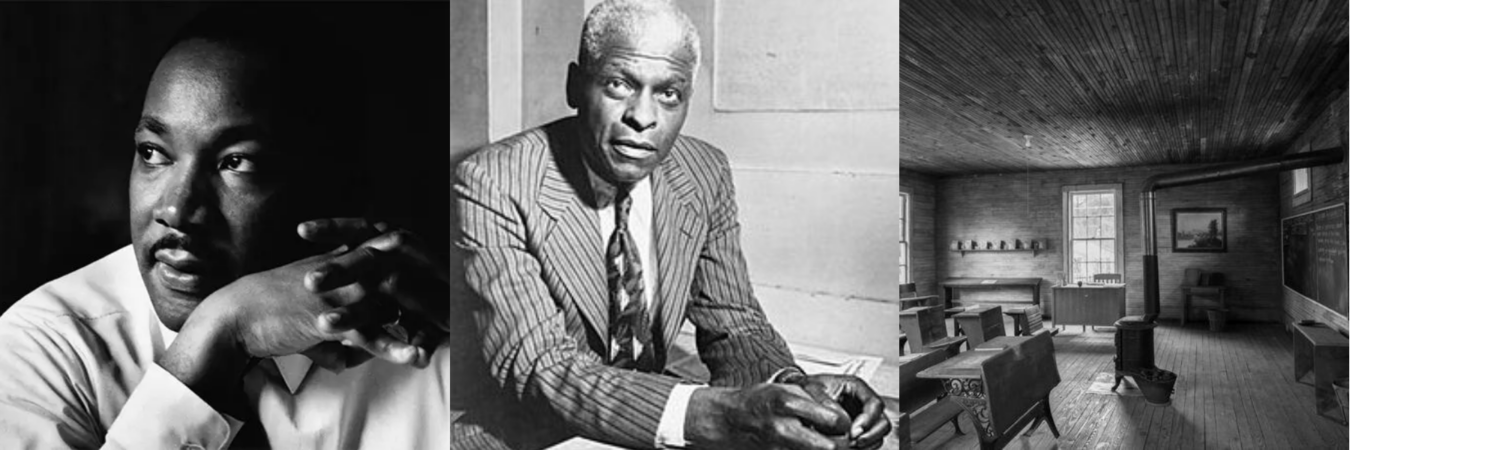
After learning everything his teachers could impart, Mays began attending a small Baptist Association School twenty-four miles away at age 15. He’d later finish his high school career at South Carolina State College, graduating as valedictorian at age 22. Completing a brief stint at Virginia Union University, he transferred to Bates College in Maine, an experience that allowed him to “emancipate” himself. There, he maintained a rigorous academic schedule including debate and Greek, and with much diligence excelled as a respected student and campus leader. Mays then pursued graduate studies at the University of Chicago where he later earned his PhD after working as a pullman porter, teacher, pastor, Tampa Urban League director, and YMCA national student secretary. Reaching the pinnacle of academic achievement, he became the dean of Howard University’s School of Religion, and thereafter became the president of Morehouse University. And it would be during that monumental tenure that he’d become a role model for the young Martin Luther King Jr.
Here’s a man that experienced blatant racism, yet bestowed discipline, morality, and dignity into generations of “Morehouse Men”. A man who earned a PhD in 1935 from one of the best universities in the world but was not given the right to vote until 10 years later. The man who, alongside Howard Thurman, met with Gandhi in India in 1936 for over an hour about the philosophy of nonviolent resistance – a concept they would later introduce to King. Dr. Mays was a driving force behind King’s decision to stay in Montgomery. The man who travelled the world as a leader of global faith organizations. The man who oversaw Atlanta’s peaceful desegregation as the first black president of the Atlanta Board of Education.
Truthfully, Mays was only one of the many influences on King’s moral imagination and nonviolent conviction. However, King himself considered Mays his “spiritual and intellectual father”, and historians such as Lerone Bennett Jr. and Dr. Randal Jelks hail him as the “schoolmaster of the Civil Rights Movement”.
Dr. King may not have reached his mountaintop of societal change and moral courage without the immeasurable influence of Dr. Mays. Unquestionably, Dr. Mays could not have forged such a distinguished career amid Jim Crow segregation without the affirmation and early academic exposure he received at that one-room rural schoolhouse in Ninety Six, South Carolina.
Having grown up myself in a one-building K-12 school in Ringgold, Louisiana, I know that, complementing family and church, schools are the foundation, epicenter, and pipeline of community and economic development in rural areas.
Tay Moore
Rural education was a foundational pillar for Mays. Mays profoundly shaped King, and King changed the world.
Could it be then that the impact of the Civil Rights movement and ongoing progress towards Beloved Community stands on the shoulders of untold schools and communities in the Black rural South who shed blood, sweat, and tears in paving the way for a brighter day? From dirt roads and church benches to cotton fields and front porches emerged trailblazers who compelled this nation to make good on its promises. Today, rural schools serve one in five American students—nearly 10 million children. Yet they are largely overlooked, receiving only 17 percent of state education funds despite comprising a quarter of all schools. And while rural residents make up nearly 20 percent of the U.S. population, only 7 percent of private philanthropic giving goes to rural communities.
Having grown up myself in a one-building K-12 school in Ringgold, Louisiana, I know that, complementing family and church, schools are the foundation, epicenter, and pipeline of community and economic development in rural areas. My great-great-great-grandmother donated the land to establish the first school for Black children near my hometown. Separately, one of my great-great-great grandfathers was a farmer and pastor in Lincoln Parish, where members of the North Louisiana Colored Agriculture Relief Association wrote to Booker T. Washington requesting assistance from Tuskegee to start a college. That school, founded in 1901 and reorganized in 1936 to focus on rural teacher education, is now more widely known as Grambling State University – home of the “World Famed Tiger Marching Band” and a gateway to opportunity for generations.
So this month, as we commemorate our nation’s most notable Civil Rights leader and one of the world’s greatest nonviolent advocates, let us not forget the rural-born educator who helped him climb that mountaintop. May we never dismiss the Black rural South that, in spite of its systemic disenfranchisement, cultivated the minds of John Lewis, Ella Baker, Fannie Lou Hamer, Robert J. Jones, Zora Neale Hurston, Vivian Pinn, Percy Hunter Jones, Bennie Thompson, B.B. King, Billy Ray Ballard, Lee Arthur Smith, Juliette B. Bell, Charles Blow, and many of the world’s finest artists, scholars, and civic leaders. And may our country commit to better honoring and investing in the countless rural educators and public schools nurturing the next generation of young people who will redeem the soul of our nation.
“His Name Was Martin” was composed by jazz pianist and educator Billy Taylor as part of his Peaceful Warrior suite, commissioned by the Atlanta Symphony in honor of Dr. Martin Luther King Jr. This performance features Tay’s original arrangement of the work, created in collaboration with Dr. Willis Delony, LSU Boyd Professor of Piano and Jazz Studies. The introduction references “Precious Lord, Take My Hand,” Dr. King’s favorite and last requested hymn, and the piece concludes with “We Shall Overcome.”
Design of Business Takes on Radical Collaboration, Recorded Live in Aspen: A Guide to the DB|BD Season
What Are You Teaching Me Today?
Helping Afghan women gain freedom in Arkansas
Know a Courageous Leader Taking On a Critical Issue? Nominate Them for the McNulty Prize & Catalyst Fund
Mapping the Religion & Media Space

Aspen Business & Society Dispatches from Climate Week