
Moving Beyond a “Marriage” to Education

Chelsea Miller
Associate Director
Last week, our second cohort of the Education and Career Mobility Fellowship gathered in Indianapolis for their third and final seminar. Over three days of discussion and collaboration, a clear theme emerged: the growth our fellows experienced was fueled by the power of their collective. Whether they were expanding their risk tolerance, navigating imposter syndrome, or articulating the business case for their work, the fellows were stronger as a unit than as individuals.
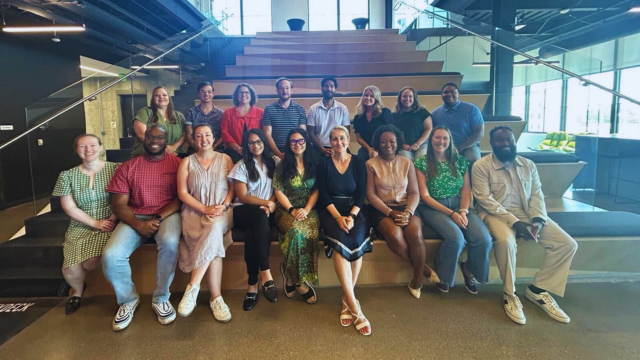
ABOVE: Second cohort of the UpSkill America/Guild Education and Mobility Fellowship
This collective strength was on full display during a design session where fellows applied their knowledge to a fictional case study. The design session allowed for individuals to leverage their own skills while learning from others. This hands-on, collaborative learning approach yielded innovative solutions to the problem, showcasing the group’s ability to tackle complex challenges together.
Beyond the invaluable time for collaboration, the seminar provided a platform for our fellows to learn from influential leaders. We were joined by both national experts and key figures from within Indiana, offering a diversity of perspectives and deep expertise.
A highlight of the seminar was a session with Chike Aguh, who led a crucial conversation on navigating disruption. His insights provided fellows with actionable frameworks to respond to today’s rapidly evolving landscape. As Chike said, “America treats education as a marriage. You choose a four-year institution until death do us part.” The idea that we expect people to select a career path and an education program early in life and stick with it forever is simply unrealistic in a modern economy. This quote became a recurring theme throughout the rest of the seminar.
The fellows also gained invaluable perspectives from Ruth Watkins of the Strada Education Foundation and Molly Doge from Ivy Tech Community College. Their discussion highlighted how colleges and universities are actively innovating to meet the evolving demands of the modern workforce. This segment underscored the vital link between education and workforce development, emphasizing adaptive strategies for success.
As the fellowship came to a close, fellows took time for personal reflection, identifying their own “superpower,” exploring potential career paths, and setting commitments for themselves. This space allowed individuals to reflect on all they learned during the fellowship and share with their colleagues for accountability. In their reflections, the cohort emphasized that all learning is valuable, regardless of where it’s obtained.In continued partnership with Guild, we are proud to announce that applications for Cohort 3 are now open! Together, we’re creating meaningful impact for mid-career professionals.
About UpSkill America
UpSkill America, an initiative of the Economic Opportunities Program, supports employers and workforce organizations to expand and improve high-quality educational and career advancement opportunities for America’s front-line workers.
About the Economic Opportunities Program
The Aspen Institute Economic Opportunities Program advances strategies, policies, and ideas to help low- and moderate-income people thrive in a changing economy.
Join Our Mailing List
To receive occasional emails about our work — including new publications, commentary, events, fellowships, and more — join our mailing list.
Connect on Social Media
For news and updates every day, connect with us on the social media platform of your choice.

A Typology of State-Supported Work-Connected Learning Programs

The Workforce of the Future Starts with Adult Basic Education

Foundational Skills: Early Insights from Employers and Providers
How Tax Policy Can Help Employers Expand Access to Learning

Adult Working Learners Vote With Their Feet: What Employers Are Learning About Foundational Skills

The Impact of Foundational Skills on Workforce Success

Making Skills-First Work for Small Businesses

AI Decisions are Workforce Decisions
About This Post
Authors
Series
Topics
Impact Areas
Categories
