The Workforce of the Future Starts with Adult Basic Education

Haley Glover
Senior Director
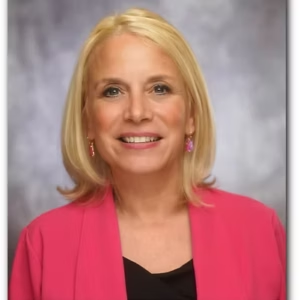
Sharon Bonney
Executive Director, COABE
As employers, educators, and workforce leaders prepare for a rapidly changing economy, conversations increasingly center on artificial intelligence, skills-based hiring, talent development, and economic mobility. Yet underneath each of these priorities lies something even more fundamental: people need the foundational skills that allow them to participate, adapt, and advance.
Literacy, numeracy, digital fluency, English language proficiency, and the ability to continually learn are not simply educational outcomes. They are workforce infrastructure.
During National Adult Education and Family Literacy Week, UpSkill America and the Coalition on Adult Basic Education (COABE) are joining together to highlight an important opportunity: connecting employer-led talent strategies more intentionally with the adult education system that helps millions of Americans build the skills they need to succeed.
Foundational Skills Are Workforce Skills
UpSkill America’s recent work has elevated an issue employers across the country recognize: foundational skill gaps can limit both employee advancement and business performance. As workplaces become more technologically sophisticated, these skills become more—not less—important.
An employee may need English language skills to communicate effectively with a supervisor, math skills to move into a higher-skilled technical role, digital fluency to navigate a new workplace platform, or stronger reading skills to complete training and earn an industry-recognized credential.
These are precisely the areas in which adult education excels.
Across the country, adult education programs serve adults seeking high school equivalency, English language instruction, digital skills, workforce preparation, integrated education and training, and pathways into postsecondary education and careers. Through COABE, this field is connected by a national network representing more than 100,000 members and 2,384 local programs serving approximately 3.2 million adult learners.
That makes adult education an extraordinary—and too often unknown and underutilized—part of America’s talent-development infrastructure.
Putting People at the Center
UpSkill America has also challenged workforce leaders to think beyond individual programs and ask a larger question: How do we build workforce systems that truly serve people?
That question resonates deeply with adult education.
A learner entering an adult education classroom is rarely pursuing education simply for education’s sake. That individual may be seeking a better job, trying to learn English, preparing for college or occupational training, earning a credential, supporting a family, or building the confidence and skills necessary to take the next step.
Effective workforce systems begin with those aspirations rather than asking individuals to navigate a collection of disconnected institutions.
This is where stronger partnerships among employers, adult education providers, workforce agencies, community colleges, training organizations, and community-based organizations can make an enormous difference. Instead of asking learners to find their way through the system, we can design systems that create clear pathways around them.
Adult education can serve as a critical on-ramp to those pathways, enabling working learners to gain the skills they need to perform in their current roles, connect to further education, and advance their careers.
AI Raises the Stakes
Artificial intelligence makes this work even more urgent.
AI is changing jobs, but it is also changing the skills workers need within existing jobs. Employees at every level will increasingly need the ability to interact with technology, evaluate information, solve problems, communicate effectively, and continuously acquire new skills.
That means the AI conversation cannot be limited to technology leaders.
AI decisions are workforce decisions, and workforce decisions must include the workers whose jobs and opportunities will be affected.
They must also include the educators and workforce professionals helping adults develop the capabilities needed to navigate those changes.
COABE has been working to ensure that adult education is part of this transformation. Through national professional development, AI-focused learning opportunities, industry partnerships, digital credentials, research, and leadership development, COABE is helping adult educators understand emerging technologies and translate them into practical opportunities for adult learners.
But AI also presents a larger challenge. If workers who already face foundational skill gaps are excluded from AI training and digital upskilling, technology could widen existing opportunity gaps. If we intentionally build foundational learning into workforce and AI strategies, however, these technologies can become powerful tools for mobility.
The difference will depend on the choices we make now.
From Programs to an Ecosystem
For employers, one of those choices is recognizing that they do not have to solve foundational skill challenges alone.
Adult education programs already exist in communities across America. They understand adult learners. They know how to teach literacy, numeracy, English language acquisition, digital skills, and workforce preparation. Increasingly, they are contextualizing instruction around industries and occupations so that adults can learn foundational and technical skills together.
The opportunity is to connect this capacity more directly to employer talent strategies.
Imagine employers routinely partnering with local adult education programs to identify skill needs, develop contextualized instruction, create advancement pathways for incumbent workers, and connect adults to credentials and careers. Imagine workforce systems in which an adult’s entry point—whether an employer, adult education classroom, workforce center, community college, or community organization—leads to a connected pathway rather than another referral. Imagine an ecosystem where ever-improving outcomes lead to deep trust between employers and education providers, and where working learners are centered in how training and education approaches are designed and delivered.
That is the kind of ecosystem our changing economy demands.
A Call to Action During Adult Education and Family Literacy Week
National Adult Education and Family Literacy Week is an opportunity to celebrate the millions of adults who are investing in themselves, their families, their workplaces, and their communities. It is also an opportunity to rethink the role adult education can play in America’s workforce strategy.
For employers, the invitation is simple: get to know your local adult education program. You can find your local program at our award winning Move Ahead with Adult Ed website. Bring adult educators into conversations about talent development, incumbent-worker advancement, skills-based hiring, digital transformation, and AI.
For workforce and education leaders, the challenge is to ensure adult education is embedded within career pathways rather than positioned alongside them.
And for all of us, the goal should extend beyond helping someone obtain the next available job. We should be building systems that give people the foundational skills, trusted pathways, and opportunities they need to continue learning and advancing throughout their careers.
The workforce of the future will require new technologies, new credentials, and new ways of working. But ultimately, its success will depend upon people.
If we want to strengthen America’s workforce, one of the most powerful places to begin is by strengthening the foundational skills of America’s workers—and adult education is ready to help lead the way.
About UpSkill America
UpSkill America, an initiative of the Economic Opportunities Program, supports employers and workforce organizations to expand and improve high-quality educational and career advancement opportunities for America’s front-line workers.
About the Economic Opportunities Program
The Aspen Institute Economic Opportunities Program advances strategies, policies, and ideas to help low- and moderate-income people thrive in a changing economy.
Join Our Mailing List
To receive occasional emails about our work — including new publications, commentary, events, fellowships, and more — join our mailing list.
Connect on Social Media
For news and updates every day, connect with us on the social media platform of your choice.

The Workforce of the Future Starts with Adult Basic Education

Foundational Skills: Early Insights from Employers and Providers
How Tax Policy Can Help Employers Expand Access to Learning

Adult Working Learners Vote With Their Feet: What Employers Are Learning About Foundational Skills

The Impact of Foundational Skills on Workforce Success

Making Skills-First Work for Small Businesses

AI Decisions are Workforce Decisions