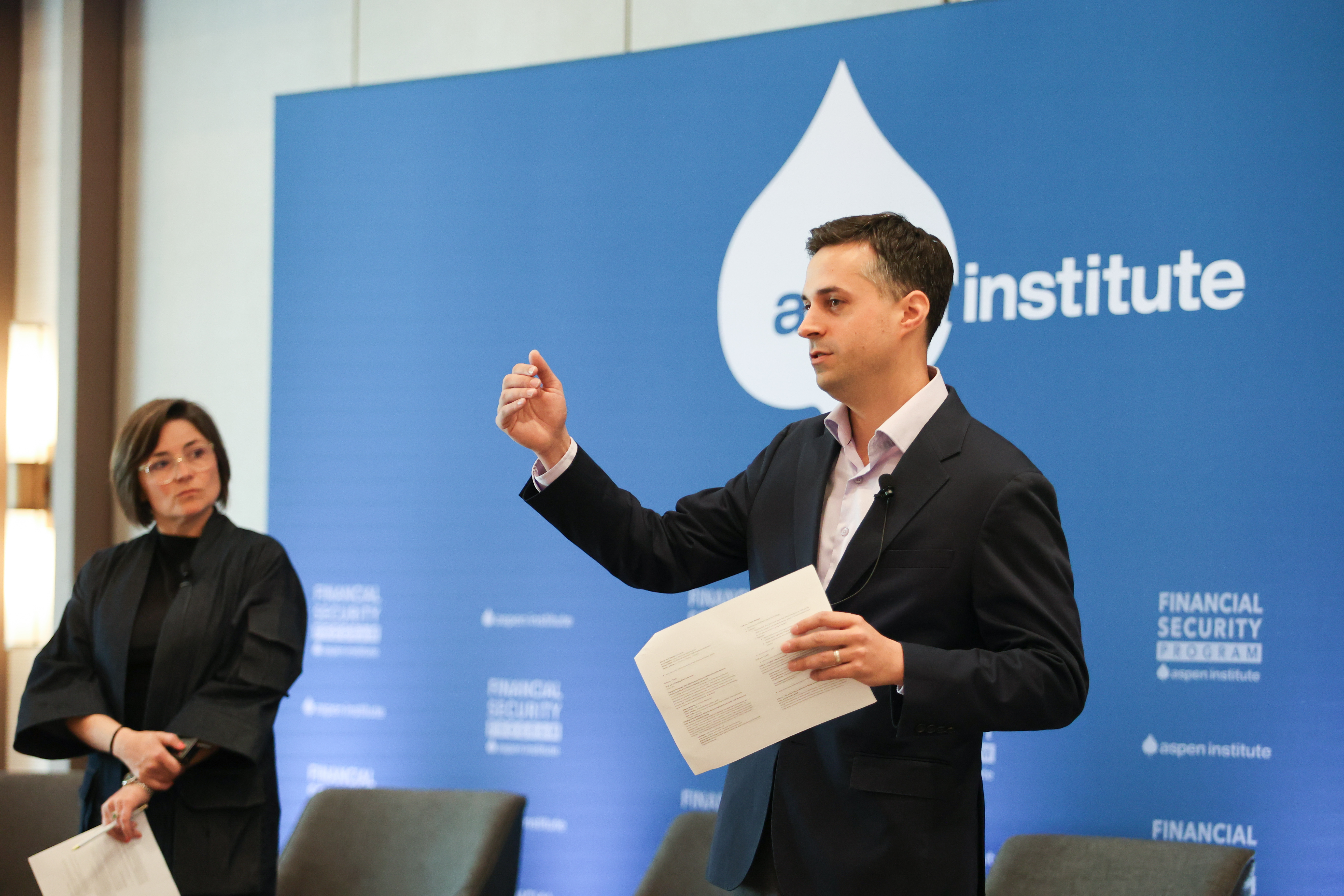
How would America be different if we made real estate ownership more affordable and accessible to millions of Americans through innovation in asset acquisition and financing?
While real estate ownership is the largest contributor to wealth for the majority of households in America, this asset class remains inaccessible to millions. Fortunately, an emerging cohort of innovators and investors are reimagining equitable real estate ownership as the foundation of an inclusive future of wealth. In this discussion, meet the forward-thinking leaders on the cutting edge of widespread, equitable real estate ownership—and learn how we can get there faster.
Speakers

Talib Graves-Manns, Managing Partner, Partners in Equity
Talib Graves-Manns (MBA, Wake Forest University / MS, Hampton University). Co-Founder of Partners in Equity N.C., an investment fund focused on supporting owner-occupied commercial real estate for Black- -owned businesses. An urban innovator and social impact entrepreneur, Talib draws on his vast expertise in technology, finance and real estate to build vehicles that launch, fund and help support Black entrepreneurial enterprises across the U.S.

Tracy Hadden Loh, Fellow, The Brookings Institution
Tracy Hadden Loh is a Fellow with the Anne T. and Robert M. Bass Center for Transformative Placemaking at Brookings Metro, where she integrates her interests in commercial real estate, infrastructure, racial justice, and governance. She serves on the boards of the Washington Metropolitan Area Transit Authority and Greater Greater Washington. Her most recent writing includes two co-authored chapters in Hyperlocal: Place Governance in a Fragmented World and a series on the future of downtowns, including what to do about public safety and adaptive reuse. She also previously served two years on the city council of Mount Rainier, a small town in Prince George’s County, Maryland.

John W. Haines, Executive Director, Community Investment Trust, Mercy Corps
Founder and Executive Director of the Community Investment Trust. Previously, he was Executive Director of Mercy Corps Northwest—the domestic arm of Mercy Corps, where he incubated a range of innovative loan and asset development programs including a refugee farming program, programs in women’s prisons in Oregon and Washington, and a nationally recognized felon-led Reentry Transition Center from 2002-2018. He helped start and was VP/Lender for ShoreBank Pacific, the first U.S. commercial bank with a commitment to environmentally sustainable community development from 1997-2002. He worked for Chemonics in Prague, CZ as Senior Finance Advisor to the Czech National Environmental Fund, where he created a loan guarantee mechanism to leverage $1 billion in environmental remediation and clean energy conversions in 1997-98. He is a graduate of the University of Wyoming. His first book, Never Leaving Laramie: Travels in a Restless World, was published in 2020 by Oregon State University Press.

Erika Wright, Vice President Global Philanthropy, Learning and Insights, JPMorgan Chase & Co.
Erika Wright is a dedicated social and economic justice professional with over 20 years of experience working across the nonprofit, public, and private sectors. Erika recently joined the Learning and Insights team at JPMorgan Chase where she works alongside corporate responsibility colleagues, grantees, and public sector partners to elevate best and promising practices to advance economic inclusion in our most vulnerable communities. Prior to joining Learning and Insights, Erika served as a Program Officer for the Foundation, executing a $20 million plus portfolio of philanthropic investments across Louisiana, Tennessee, and Missouri. As a Program Officer, Erika engaged economic development, nonprofit, educational, and research partners dedicated to increasing economic opportunity through a combination of workforce, small business, community development, and financial capability initiatives. Prior to joining JPMorgan Chase, Erika served as the Program Lead for Violence Prevention in the New Orleans Health Department, where she convened nonprofit partners around the development of a continuum of services for Boys and Men of Color (BMOC), informed violence reduction initiatives across the department, and worked with school partners to integrate trauma informed practices.
Erika received her undergraduate degree from Morgan State University in Baltimore, MD and served as an English teacher in the U.S. Peace Corps prior to completing her Masters in Social Work from Washington University in St. Louis, where she specialized in systems change and collective impact. Erika is a former Board Member of Jane Place Neighborhood Sustainability Initiative (JPNSI) and Abeona House early childhood education center, and currently serves on the Board of the Louisiana Children’s Museum.

Ida Rademacher, Vice President, Aspen Institute and Co-Executive Director, Aspen Institute Financial Security Program
Ida is Vice President at the Aspen Institute and Co- Executive Director of the Aspen Institute Financial Security Program, a leading national voice on Americans’ financial health. Ida combines her expertise in economic inclusion research and policy with her reputation as a collaborative and creative thinker to raise up a national conversation and solutions set around financial inequality and financial instability. Ida and her team are building a cross-disciplinary community of leaders and change agents who, together, are deeply probing critical financial challenges facing US households and shaping market and policy innovations that can improve the financial security and wellbeing of all Americans.
Prior to leading the Aspen Institute Financial Security Program, Ida was Chief Program Officer at Prosperity Now (formerly CFED), where she created the multi-institutional team that led the CFPB’s Consumer Financial Well-Being Metrics Project, and also led the creation of Upside Down, a program examining ways the US income tax code generates disparate wealth-building opportunities and contributes to growing levels of wealth inequality. Earlier in her career Ida led research and evaluation projects at the Aspen Economic Opportunities Program and the Center for Behavioral and Evaluation Research at the Academy for Educational Development.

Joanna Smith-Ramani, Co-Executive Director, Aspen Institute Financial Security Program
Joanna Smith-Ramani is Co-Executive Director of the Aspen Institute Financial Security Program, a leading national voice on Americans’ financial security. Working with the team, she is building a diverse cross-sector community of leaders (Joanna calls her “quirky Thanksgiving table”) who, together, are using their shared accumulated wisdom and humanity to deeply investigate and solve the most critical financial challenges facing U.S. households.
Joanna has more than 20 years of experience across community, personal finance, and asset development. Prior to joining Aspen FSP as the Director of its Expanding Prosperity Impact Collaborative (EPIC), Joanna served as Senior Innovation Director at Commonwealth.
Joanna holds a Master of Public Policy degree from the Harvard Kennedy School and a B.A. in Urban Studies from Barnard College, Columbia University. She serves on the Board of the CASH Campaign of Maryland and A Wider Circle, and was selected to the 2017-2018 class of Leadership Montgomery.