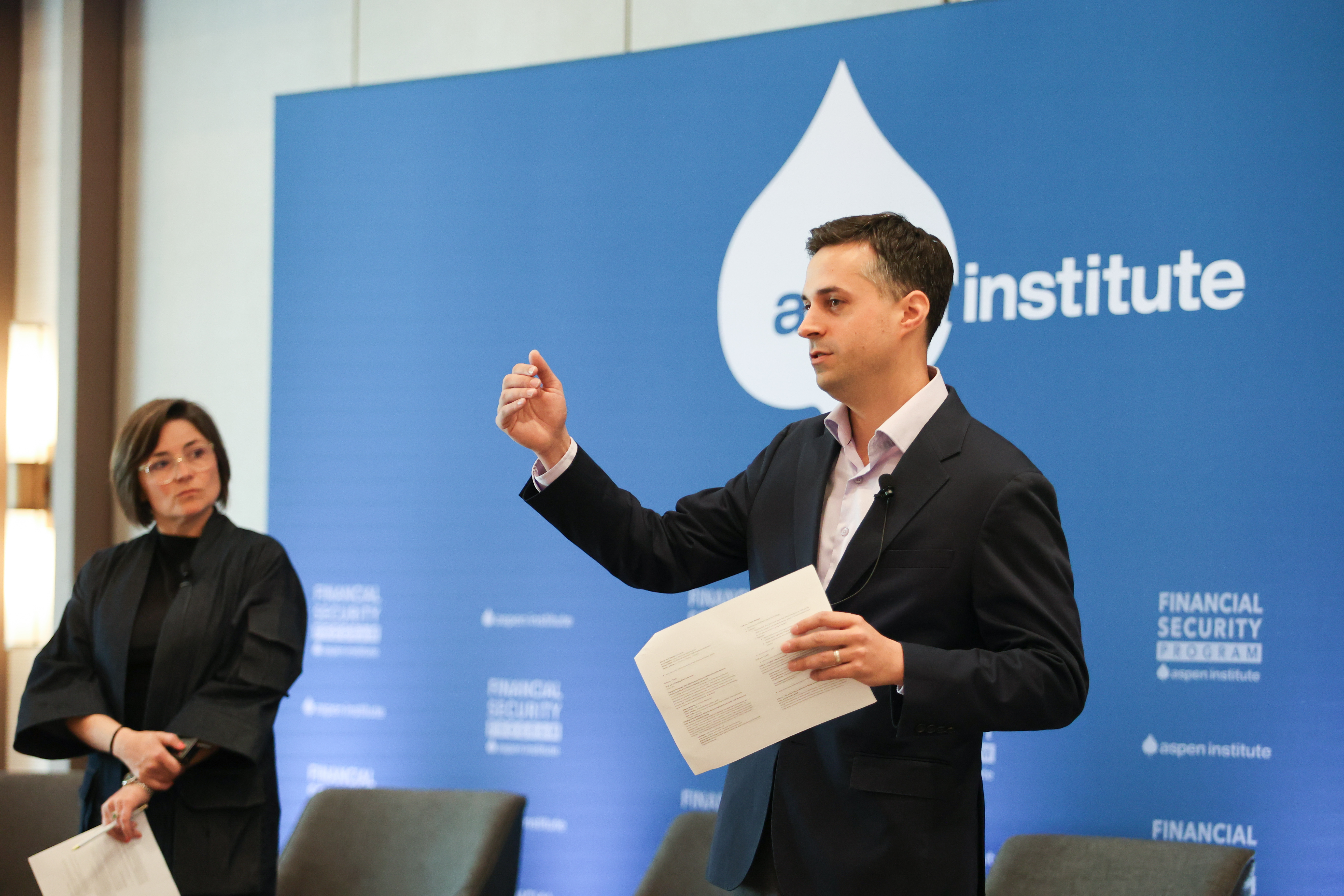
One of the most common ways we measure and talk about dealing with unexpected expenses is to ask people how they would react to a hypothetical emergency. But is $400 enough–both as an amount and as a measure? The Aspen Institute Financial Security Program hosted a panel discussion on September 9, 2024 to dig into new data and explore innovative approaches that grapple with how real people react to real financial emergencies, because by better understanding financial shocks–what kinds, how much, how frequent, how destabilizing–we can develop more inclusive financial systems and solutions that increase financial well-being. Hear expert perspectives and discover how cross-sector leadership is changing the ways we consider the human cost of financial shocks.
Speakers

Steven Brown, Director of Insights and Evidence, Aspen Institute Financial Security Program
Steven Brown is the Director of Insights and Evidence for the Aspen Institute Financial Security Program. The Insights and Evidence team drives FSP’s efforts to promote data and research-informed strategies that advance household financial prosperity.
His professional work has focused on understanding the structural factors that impact wealth-building and inclusive economic opportunity. Prior to Aspen, he was a director at the Washington Center for Equitable Growth and served on assignment to the U.S. Department of the Treasury, where he supported their equitable research and policy implementation efforts. He also spent several years at the Urban Institute, where he helped stand up the Office of Race and Equity Research and authored numerous briefs and reports on racial wealth gaps, disparities in employment opportunities, economic mobility metrics, and advancing equity through data. His research and perspective have been cited in The Washington Post, CNN, Marketplace, NPR, and Vox.
He holds a bachelor’s degree from Princeton University and a master’s degree in sociology from Harvard University, where he was also an inequality and social policy doctoral fellow at Harvard Kennedy School.

Scott Fulford, Senior Economist, Consumer Financial Protection Bureau
Scott Fulford is a senior economist at the Consumer Financial Protection Bureau where he leads the Making Ends Meet survey. His academic and policy research examines the economic problems individuals and households face and how they use financial products to help deal with them. He is the author of The Pandemic Paradox: How the COVID Crisis Made Americans More Financially Secure. Fulford taught economics and international studies at Boston College before joining the CFPB. He holds a PhD in economics from Princeton University.

Kate Griffin, Director of Programs, Aspen Institute Financial Security Program
Kate Griffin serves as Director of Programs at the Aspen Institute Financial Security Program. She works on initiative strategies, ensuring FSP’s work across benefits, savings, investing, wealth building, and financial inclusion catalyzes leaders toward systemic change that results in financial security for all people in America. She also serves as senior strategic advisor to FSP’s work supporting the launch of a proposed National Financial Inclusion Commission in the U.S. to create a national financial inclusion strategy that moves from focusing on account and information access to measurable financial security outcomes for households.
Kate has spent two decades making financial services work better for low-income and marginalized people, both here in the US and in developing countries. In various leadership roles, she has led a social enterprise providing financial wellness benefits to workers, and was on the founding executive team of a start-up fintech, tasked with bringing the voice of underserved consumers into product design and delivery. She also led programming for savings, financial capability, higher education, and housing at Prosperity Now. She started her career in international microfinance working with CGAP and the Grameen Foundation.
Kate holds degrees in international development from Kenyon College and American University and lives in suburban Washington, DC with her family.

Samer Hassan, Storytelling and Engagement Manager, Young Invincibles
Samer Hassan is a formerly undocumented immigrant from Venezuela, part of the Palestinian diaspora; he is acutely aware of the realities marginalized communities face. After noticing rampant inequalities among the segregated neighborhoods of Chicago, he began a mentorship pipeline from Chicago’s underrepresented communities to the Community Colleges of Chicago to provide children with marketable skills and self-growth. After gaining the Student Government President position at Harold Washington College, he advocated for fellow students, who worked in tandem to push administrators toward tuition reform and accept student voices in their decision-making processes. Samer transferred to Columbia University NY, where he gained his BA in political science and went on to complete his MAPP at The University of Chicago Harris School of Public Policy. Samer is the National Storytelling and Engagement Manager at Young Invincibles, where he teaches institutions and advocates nationwide how to tell their stories using an asset-framed approach.

Jeff Larrimore, Chief, Consumer and Community Research Section, the Federal Reserve Board
Jeff Larrimore is the chief of the Consumer and Community Research Section at the Federal Reserve Board, where he oversees the Survey of Household Economics and Decisionmaking. This survey monitors the financial circumstances of U.S. families, with an emphasis on how low- and middle-income individuals are faring. Much of Jeff’s research focuses on income inequality, income mobility, and the implications of taxes and public transfers on the distribution of economic resources. His recent research uses IRS tax data to explore income trends in the United States during the COVID recession. Jeff previously worked as a senior economist for the Council of Economic Advisers focusing on employment policies and as an economist for the Joint Committee on Taxation estimating the impacts of tax legislation on federal tax revenues. He also has taught as an adjunct professor at Georgetown University and the University of Maryland. He received his Ph.D. in economics from Cornell University and his B.A. in economics and political science from Davidson College.

Chris Wheat, Managing Director, JPMorgan Chase & Co., President, JPMorgan Chase Institute
Chris Wheat is a managing director at JPMorgan Chase & Co. and President of the JPMorgan Chase Institute, where he leads and develops the research agenda on small business, local economic development, and inclusive banking. His recent work has focused on racial gaps in financial outcomes for households and small businesses, the impact of the Payroll Protection Program on small business activity, and the role of online retail in shaping outcomes in and across cities. His work has been cited by federal and local policymakers.
In addition to leading research, Wheat is invested in work on diversity, equity, and inclusion at both the institute and JPMorgan Chase, serving as a mentor, leader, and adviser to young Black professionals across the firm. He serves on the board of the Association for Enterprise Opportunity, and regularly joins industry leaders and other experts in joint advisory work on small business economic policy.
Previously, Wheat served as the director of analytics at a financial technology startup, where he led the development of advanced analytics algorithms. He previously was an assistant professor at the MIT Sloan School of Management and at the Center for Urban Entrepreneurship & Economic Development at Rutgers Business School. As a faculty member, he taught and researched topics in strategy, entrepreneurship, global microfinance, economic sociology, and social network analysis. He earned a B.S.E. in mechanical and aerospace engineering from Princeton University, an M.S. in computer science from Stanford University, an M.A. in sociology from Harvard University, and a Ph.D. in organizational behavior from Harvard University.
Our ability to identify, engage, and support leaders to advance this work is only possible due to the generous support of a growing group of partners. We are grateful for the support and partnership of all of the investors on our Inclusive Financial System work: Edward Jones, Equifax, H&R Block, JPMorganChase, Mastercard Center for Inclusive Growth, Plaid, U.S. Bank, Walmart, and Wells Fargo.