Work and the Social Contract in the Age of AI: How did we get here?
Transcript
[music]
[00:00:10] Liba Wenig Rubenstein: Good afternoon and morning to some, everyone. I’m Liba Wenig Rubenstein, Director of the Aspen Institute’s Future of Work Initiative, and I’m delighted to welcome you to this very timely conversation. As you are probably all painfully aware, most conversations these days about what we call artificial intelligence start in one of two places: wonder at what it might build or fear of what it might destroy. I am not going to start quite in either place today. Instead, I want to start with something narrower, but hopefully still useful: a phrase.
When the people actually building this technology try to describe what is at stake, a surprising number of them have been reaching for the same phrase. I’m not talking about existential risk, or even race with China. I’m talking about the social contract. I find that interesting because technology companies are more likely to reach for vintage sci-fi references than Enlightenment political philosophy. This is a concept that winds through Hobbes and Locke and Rousseau. It’s the idea that political and social order does not come from force or from tradition, but from an agreement, spoken or not, about what we owe each other.
OpenAI has said explicitly that every technological revolution has forced societies to renegotiate their social contract, and that the intelligence age will require us to do the same. Its policy chief has argued that AI may require a new set of rights, which, to me, has echoes of FDR’s call for economic rights. Elected officials from Senator Bernie Sanders to Representative Ro Khanna have also reached for social contracts, albeit toward somewhat different ends than OpenAI. At its simplest, the social contract is an argument about legitimacy. What do people owe one another? What do institutions owe people in return? What makes this arrangement valid?
In America, a huge part of that implicit contract has been organized around work. Our bargain was never quite as simple or as inclusive as the mythology might suggest, but the basic promise, which we know of as the American dream, was pretty powerful. If you work hard, you should have a reasonable chance to build a secure and dignified life and even exceed the material circumstances of your parents. Work was not just a way to earn a paycheck. It became a pathway to economic security, social mobility, homeownership, family formation, community, and civic identity. Today, that bargain is increasingly difficult to recognize.
In a survey this summer, the AP found that only about a third of Americans say the American dream still holds true. Half of them said it once did, but no longer does. Among Americans 18 to 29, just 22% said it still holds true compared with 46% of people 60 and older. When you ask them about the concrete building blocks of that bargain, the numbers are also very striking. Pew found this year that 87% of Americans believe it is harder for young adults today to buy a home than it was for their parents’ generation. 64% say it’s harder to find a job. Among young adults themselves, three-quarters say finding a job is harder than it was for their parents.
This isn’t just a feeling. 40 years ago, the basket of costs that define a middle-class life took about 40 weeks of a typical worker’s pay to cover. By 2022, it would take 62 weeks. Yes, that is more than a year. Among workers under 35, only about one in four can now meet the two-plus years of stable employment that most mortgage lenders require. That’s down from two-thirds just a decade ago. This is not simply a jobs policy problem. It is a question of whether the terms of belonging in American life still hold true.
Fears about AI are not actually causing a crisis of confidence in the existing social contract. They are arising in the middle of that crisis. That may be what makes this moment so consequential because AI could make some of these problems better. It could dramatically increase productivity, create new forms of abundance, give people new tools to learn and create, and potentially make work more accessible and fulfilling, or it could make an already fragile bargain even harder to sustain, particularly if the gains from AI accrue primarily to the people who own the technology while the risks are borne by everyone else.
News from the last few weeks and months has asked us all to imagine a future in which AI becomes powerful enough to raise questions about the survival of humanity. I told you I was not going to start there. I’m not going to end there either because there is an enormous amount of space between here and there. That space is where most of us are actually going to live and work and raise our families. What happens in that space will shape the society that meets whatever comes next in this uncertain future.
Even if the most extreme AI scenarios are on the table, the social contract remains a question of existential importance at a more immediate human scale. The question before us is not simply what will AI do to work? It is what was the bargain that made work central to American life in the first place? Who was that bargain really for? Why and how did it erode? If AI is now forcing us to renegotiate it, who gets to write the new one and what should it promise? That is what we will start to explore today and continue in part two soon.
Super quickly, a review of our technology. All attendees are muted. There’s a Q&A button at the bottom of your screen to submit and upvote questions. The chat is for sharing your perspective and ideas and resources, but not for questions. If you have any technical issues during the webinar, please message us in the chat or email us at [email protected]. The event is being recorded and will be shared with you via email and posted on our website and YouTube. Closed captions are available. You can click the CC button at the bottom of your screen to activate them.
Now, it’s my pleasure to quickly introduce our amazing panel. In the interest of time, I will just match names to faces, and you can read more about them on our event page. I’m pleased to welcome Joseph Blasi, who’s the director emeritus of the Institute for the Study of Employee Ownership and Profit Sharing at the School of Management and Labor Relations at Rutgers University. Chris Hyams is the former CEO of Indeed and now a visiting lecturer at Huston-Tillotson University and recently a founding board member of the Guardrails Alliance.
Erica Smiley is the executive director of Jobs With Justice. It’s also my pleasure to turn it over to our moderator, Marshall Kosloff. If you have not heard his podcast, The Realignment, I highly recommend it. I’m a big fan. He’s a senior fellow and director of special projects at the Niskanen Center where, among other things, he helps produce the annual Abundance Conference. He’s also a senior fellow at UT Austin’s Strauss Center for International Security and Law. We are fortunate to get to collaborate on a conference together each year called Going to Work. Thanks for being here, Marshall, and I will turn it over to you.
[00:07:53] Marshall Kosloff: Really excited to be here. Thanks to the panelists for participating and all of the people who are tuning in. Let’s just start by interrogating the actual title. To what extent was there ever actually a social contract in America? We could just throw it open to the panelists. Whoever’s particularly excited for answering that question first can take it.
[00:08:19] Erica Smiley: Well, I certainly don’t mind jumping in. I think that the idea that there have long been social contracts in the United States is real. I think the challenge to that is less about whether or not it existed and more about what defined the social, what defined the landscape of who got to be a part of that. At the root of those decisions, whether we’re talking about the Great Reconstruction, the New Deal, or even some of the agreements that came during the Civil Rights Movement, who were those agreements with? The core question we have to ask today is who got to be at the table and who was most directly impacted, either from benefiting or negatively impacted?[1]
Those are the questions that we have to face today as we try to rebuild that. I think the only other thing that I would add as we open up this discussion is that I think that the idea of a social contract in the United States almost always has historically benefited a set of priority stakeholders, which have either been shareholders or investors or whatever, and not actually looking at the social, the general population, or the implications. If the investors are doing well, the assumption is that everyone is doing well. I think that’s part of the paradigm that we need to shift in this moment and that AI gives us an opportunity to really look at.
[00:09:44] Joseph Blasi: I’d like to go back a lot further on this question. I spent time in my book, The Citizen’s Share, looking at the ideal of this social contract among many of America’s founders. While they did not do a good job, they did, in fact, in many cases, an evil job of including everybody from the beginning. The ideal articulated really commonly by President George Washington, by John Adams, by Jefferson, by James Madison, even with the agreement of Alexander Hamilton, who supported the role of finance in America, was that you needed broad-based property ownership for a republic to exist.
It was that people would be free if they had economic liberty, and the government could not control them, or no other force could control them from an economic point of view, and thus, the thought was, control their vote. It was a clear connection between having an economic freedom, share of property, and the ability of a republic to exist.
Originally, they thought of doing that with land. There are a lot of problems with that because there were other people on the land, but then there was a notion that shares of corporations were unlimited, and you could use shares of corporations, profit-sharing, employee share ownership, for example. This was articulated by Abraham Lincoln’s Speaker of the House of Representatives.
Just a brief introduction on that early view of this question of the social contract: broad-based property ownership.
[00:11:37] Erica: Then even getting back to that, Marshall, as we get into the discussion more, again, in this question of who gets to decide and who benefits, the question of what constitutes property is going to be of big interest here, both in terms of the technological evolution, and of course, certainly historically, where you could have a Goldman Sachs or someone putting up their enslaved workforce as property or collateral for an insurance loan. I think the question in this period is what actually constitutes property to be owned, and who gets to actually have some say over how that’s used.
[00:12:14] Chris Hyams: Maybe just to add really briefly, I think the concept of the social contract to many people implies a contract between the government and the people. In the US, we’ve taken an approach of essentially privatizing that, and that we made decisions early on to tie employment not just to livelihood, but also to healthcare and retirement and other things. It has created an environment where things like part-time work or gig work essentially exclude people from that contract, especially unemployment benefits.[2]
This system, this privatization of the contract, really is a benefit only to employers. People essentially get trapped in needing to work or relying on it. This, when we talk about AI, I think becomes one of the most important factors in the discussion about– you hear a lot of people talk about UBI as a solution. I will argue that UBI is just a lie, but even if it wasn’t a lie, I don’t think it’s what anyone actually wants. There’s a whole belief that work is not just a source of livelihood, but it’s actually a basic human dignity. It’s where we find meaning and purpose, and being useful to others is foundational.
I think when we’re having this conversation and whether we need to negotiate a new contract, I think that the current contract doesn’t work, but I think it’s important as a society for us to ask these questions about what is basic human dignity and what is the meaning and the nature of work, and how do we preserve that under any circumstances.
[00:13:51] Marshall: I actually want to pick up there, Chris. When you say the current contract doesn’t work, can I get from every single panelist your definition of that contract and define why you think it is or is not working? Because there’s a world where not working doesn’t mean it’s not valid. We have an entirely valid contract; it’s just not being fulfilled, so the task is different. I’d love to get each panelist’s perspective on the current and whether it works or not.
[00:14:22] Joseph: I think the definition of the current contract has to do with wage income. Certainly, since World War II, it’s had to do with wage income and some retirement savings or program connected to that. That doesn’t work for several reasons. First of all, it doesn’t work because that doesn’t go to the original concept of everybody being a property owner.
The founding generation talked about wage slavery. It’s not the same as the evil of true slavery, but they conceived of the wage-income relationship as not a good thing for a democratic republic. Another aspect of this is that now we see that the families doing well are families that have capital ownership, ownership of the stock market, capital income, dividends, bonds, and such. That all leaves wage earners behind.
[00:15:23] Marshall: How about you, Chris?
[00:15:28] Chris: I don’t have the same scholarly background as some of the other folks here. Just to bring it to AI, so I’ve read a bunch of summaries and decided I needed to actually sit down and read Magnifica Humanitas, which is the pope’s encyclical on AI, which is extraordinary. I’ve been reading a lot about the social doctrine of the Catholic Church, which I think has some relation to the social contract.
One of the things that he talks about in going through the history of what the social doctrine has meant for the Catholic Church there’s really fundamental ideas about fair wages– the phrase is, “The fair wages are the test of the whole system.” Is the worker treated as a person or just as a cost of production? That work is not a problem to manage, but is a fundamental human good. Then, in particular, that job security, automation, and things like that need to be judged specifically by human dignity, not by efficiency.
I think that by those measures, and again, that’s not maybe the historical definition of the social contract. I think by those measures, all of the conversation that we’re having around AI, and then especially looking at the US economy since the ’70s, which is when, essentially, productivity and wages started on their K-shaped divergence, that a definition of the social contract to me would be that productivity and success of the system is something that is distributed to everyone as opposed to unevenly distributed just at the top. I don’t think we need a long conversation to argue that that’s not the case today.
[00:17:23] Erica: Well, I know you want to hear from me next, Marshall, and I’ll try to be brief. I also wanted to say, first of all, I didn’t realize how much I was in love with Chris Hyams and his orientation in the world. I want to put that out there. He’s my new best friend, even though he doesn’t know it yet.
The second point that I want to make, building on what Joseph said, is this question of the commons, and where is the commons? Where is the social? I think both Chris and Joseph alluded to the fact that in the United States, that was mostly privatized, as opposed to an agreement or a deal between government and its people is actually more of an agreement between a set of workers and their employers, and even that in this economy is more and more loosely defined than I think we would like it to be.
Now, the only addition I would add to what both Joseph and Chris already said is that I do think that one of my co-authors, Sarita Gupta, always agitates me that it’s not simply about wages. When we talk about wages and when we talk about the dignity of work, what we’re ultimately saying when we ask the question, “So what? What is the actual measure of the social contract?” We’re talking about really basic things like joy, the ability to go to that soccer game or to that terrible saxophone recital where your fourth-grader is going to rip up that poor woodwind instrument, the ability to work to live as opposed to live to work.
That, to me, has to be the measure of the wage itself. Is the wage providing that? Is the retirement income providing that? I think, to Joseph’s earlier point, the idea that families that are doing better in this moment have some form of capital investment, capital ownership, is largely because that capital ownership is allowing them to do those things without the precarity or the fear of losing a job or losing a wage or not being able to pick up that extra shift. I do think keeping it to that fundamental human need as the measure, as opposed to having a metric that is the stock market. I’ll give one other example.
When we talk about the metrics of unionization, most people define the metrics of unionization in the United States context as the wage that you get, of course, and your access to health care, or what is our current social contract. For all the reasons that Chris has identified, that’s broken. That doesn’t work for the overwhelming majority of people for a lot of reasons that we could spend a whole other webinar talking about.
At the same time, though, when we talk about the metrics of unionization, there are metrics that often go unnamed. There’s the metric that Adam Dean wrote about at American University that, in the peak of the pandemic, that in an assisted living facility, where there was a union president, where regular everyday workers, nurses, medical staff had the ability to weigh in on the systems that were going to be in place, there were 30% less COVID deaths in that facility. It’s not something that you often hear as a measure of the social contract, but that’s actually a measure of our current contract when it works, of our current social contract when it works.
Likewise, when we look in corrections facilities, and a lot of the corrections facilities where there is some form of labor management consultation, because that’s basically what democracy is, is being able to confer on the standards, a union contract, just a policy for a workplace that’s democratically made, then what they found was that there were actually less incidents of domestic violence in the homes of those corrections officers when they actually had that ability to make decisions.
As we’re beginning to think about, one, where our current social contract is working and where it isn’t, as a way of looking at how we’re going to rebuild or build a different social contract for the future, because my ancestors were long excluded from the current one, but how do we actually envision and imagine a new social contract? I think that we have to actually think about the metrics, certainly, fundamentally, at their economic state, but also in the so what of what those metrics are then translating to in a civilized society.
[00:21:32] Marshall: Oh, please.
[00:21:34] Joseph: I think the problem that we have is that there’s really no way to rescue the crisis of AI with the wage system. We should just even just give up on trying to figure that out because there is no way to do that. Even investors, not just wage laborers, investors are going to be at a huge disadvantage because AI is and will be owned under the current patterns by a very small group of very rich people and very rich organizations.[3]
We have to go back to this notion that many of the founders had that the American experiment is against feudalism. It’s against a few people owning the substantive resource. The substantive resource is no longer land. It’s no longer corporate shares. The substantive resource is AI, robots, software, all of that stuff. We have no broad-based ownership model for that for American citizens.
[00:22:54] Marshall: I think, Joseph, that gets us into the difficult squaring we have to do between the ownership question, the way you’re framing it correctly, and the work and the importance of work in a society question because I could see a world– well, it’s difficult to get to this world, but let’s just say there’s a world where, in the 2040s, we do have public ownership of these companies. You don’t have the problem you’re describing.
A large part of my UBI skepticism comes from the idea that I don’t think a world where we didn’t work and we just received UBI payments would be a healthy one. I don’t think a world where we sports gamble on the side, and you get your monthly UBI check, is a particularly attractive world. I think there’s actually a broad agreement on that. How do you see the public ownership question extending to, let’s say, a hopeful point?
[00:23:49] Joseph: Since that was directed at me a little bit, I’ll–
[00:23:52] Marshall: We can expand out as well, too, to the group afterwards.
[00:23:55] Joseph: I do not agree that public ownership is the solution to the concentrated AI ownership. You said that I don’t agree with that. We’ve seen public ownership be tried by communist and socialist, and democratic socialist, and social democratic regimes hasn’t had a good impact, maybe except for how the railroads work in some European countries.
What I’m thinking of is something very different. I’m also not thinking of UBI. I agree that that’s a problem. I think we need some form of a citizen dividend combined with national service. I mean required national service, not UBI, not public ownership, and not feudalistic ownership by a few AI companies of all of these new software and robotic resources.
[00:24:59] Erica: This might be where I actually veer a little bit from Joseph. I’m not opposed to public ownership. I think the problem comes in ensuring that that ownership is democratically transmitted, that in making the plans for markets and the engagement of these companies, like ensuring that everyday people, including the workers in those sectors, have influence over setting the policies of how that rolls out.
I’m also not opposed to UBI. I just think the difference is not wanting to let the richest of them, who currently own AI, off the hook from providing those fees. I think this notion that UBI or basic income for most people is just like a thing that happens from our tax dollars and is provided out and there’s no work. I think that’s a very generalized view of thinking about it. I actually think part of what we want to imagine is a system where, if new technology actually does advance and make more efficient productivity of a certain set of things or a certain set of sectors, that the benefit is shared.[4]
I think this speaks a little bit to what Joseph was saying in terms of shared dividend: that the benefit of that is shared and that the continued evolution of that and the innovation of that is incentivized. That tends to be led through the commons and through a group of people that’s able to democratically consult, confer, and weigh in on what the needs are such that we can decide if we want to generate a new turbine engine to make more jet planes for wealthy people or more ventilators for hospitals.
I think that to that degree, again, getting back to the heart of how AI is going to implicate the social contract is that it’s going to be incredibly important for us to define the commons and then define the governance of that commons to then navigate how AI is then governed through that process.
[00:27:01] Chris: Let me start by just saying that if I have any ideas that Smiley appreciates, I got many of them from their book, The Future We Need, which is awesome and highly recommend to everyone. I think the first thing to establish, and this is something that, as someone who spent 30 years in the industry and spent the last 15 at Indeed thinking deeply about work and the meaning of work and the impact of variety of forces in society and how they impact work, the first thing that I want to assert is that the purpose of the frontier companies right now, who are building these models, we talk about AI as if it’s this big thing, they say that AI is going to solve all the world’s problems, that it’s going to cure cancer, that it’s going to fix climate change.
AI solves problems that huge amounts of capital and compute power are pointed towards, and the primary focus of the frontier companies right now is replacing human labor. They say it’s a whole bunch of other stuff, but that is the purpose. That’s where the multi-trillion-dollar valuations come from. If you look at their revenue, the vast majority of revenue comes from the enterprise and what they are selling to enterprise companies, and what enterprise companies are buying is replacement for human labor.
All the other stuff, and I can say just because I spent a lot of time in this industry, there’s a big difference between what companies say and what the actual financial incentives that are driving their work is. It’s impossible to have this conversation without saying what is the meaning of work and what is the responsibility. First of all, do we really want to be developing something that is fundamentally there to replace human labor?
Just to make it clear, I don’t know how many people have actually read OpenAI’s mission statement. It’s on their website. You go to openai.com/charter, and it says, “Our mission is to ensure that AGI—by which we mean highly autonomous systems that outperform humans at most economically valuable work—benefits all of humanity.”
First of all, there’s this mental gymnastics for how does that benefit humanity, but they explicitly define the holy grail of the AI industry, which is artificial general intelligence. The definition is highly autonomous systems that outperform humans at most economically valuable work. I think it’s impossible to look at this in any other way. Again, UBI or just taxation or nationalization or things that we then hope we’re going to support other people. If the goal is that we want people who want to work to be able to work, then we actually need an incentive system that is a combination of carrots and sticks. I know from inside a company that carrots are actually a much bigger deal than the stick.
There’s all these ideas about things like a token tax or a GPU tax or some form of nationalized ownership. I think that needs to be combined with, if we want to preserve work and the dignity of work, a repeal over time of the payroll tax and incentives actually that pay companies to employ people. It should cost something to use AI, and there should be a benefit to people. If truly what everyone is saying is the story is that they’re building these things to augment humans, not to replace them, then there’s no additional cost. Actually, if this leads to a massive disincentive to actually hire humans, then it should cost something, and there should be a way to preserve those incentives.
[00:30:42] Joseph: I think we should learn about what happened with the internet, because that was one of the most recent technologies. First of all, in terms of somebody’s notion of the commons, we know that the internet used a lot of the commons for free. The electricity networks, the communication networks, all of this kind of stuff, it was basically quickly taken, quickly deregulated. States provided all kinds of tax benefits to these companies. It’s almost like that’s the ceiling now. We don’t even see it. We’ve already made a terrible error of having the commons be privatized by the internet companies.
I’m just going to give one factoid and then stop on this issue. I did a study in 2000 of the 100 companies whose technologies, ideas, and software, and sales plans developed the internet. What I found was that those companies at the time, in the year 2000, had 200,000 employees. Those 200,000 employees captured most of the hundreds of billions of dollars. Those 200,000 workers, a very small group, captured most of the hundreds of billions of dollars that workers were to capture from the value of the internet. The rest, who was it captured by? The venture capital firms that are still listed. If you go into the SEC and these internet companies, still listed as major investors.
We already did it wrong. We already privatized the commons. Even if you use the concept of broad-based employee share ownership, the 100 companies that built the internet, basically in 2000, helped 200,000 employees become employee share owners. We need a completely different point of view to solve this problem with the AI companies.
[00:32:52] Chris: That’s a great point. The total number of people employed in the Frontier Labs is a tiny fraction of that. The dollar amounts are dramatically larger. I’ll just say, from someone who has not been able to drag both feet out of that world, if you listen to the venture capitalists today and the thing that they salivate over, the thing that everyone talks about, the thing that is the holy grail that people are looking for as the big proof point of what AI can do, they are all obsessed with what will be the first single-employee unicorn.
A unicorn is worth a billion dollars. They all believe that the most amazing thing that could ever happen is a billion-dollar company that has a single employee. I think that tells you a whole lot about what the goal actually looks like here.
[00:33:41] Joseph: I think we just have to stipulate it. I’m happy to stand up and stipulate that when I read the ideas and the speeches of many of the founders of the AI companies and the software companies, and even the more established companies like Amazon and Microsoft that we tend to have more trust for because they’ve been around very long, they don’t understand the history of the American Republic. They don’t understand the founders’ view that we are against having feudalism; that that doesn’t make a republic work. They don’t understand that they basically took control of the commons and aren’t sharing the value with the rest of the population. They don’t understand any of these issues.
On the other hand, we can’t force them to understand. We know what happens with planned economies and government ownership and all of this stuff. We have to get, as it were, the political parties and social movements behind the original vision.
[00:34:39] Erica: The original vision only went so far. Just as a Southerner and a Black Southerner, the original vision was deeply flawed. I think that part of what we’re experiencing now are populations, and not just my ancestors and my communities, but many communities across various demographics that are essentially backlashing against the fact that the social contract never fully worked for us. If it’s not going to work, then let’s just throw a Molotov cocktail at the whole thing and blow it up, and Lord help us, this is where we’re at.
I do think that it can’t just be going back to an old social contract or the vision of Thomas Jefferson. Actually, more needs to be about building the social contract and the democracy for us, for what we need now, for what America is today. I also think that this idea of the commons, when I talk about it, because I think Joseph makes a really valid point about the internet and the privatizing of the commons, I think that there is still some hunger and interest for the actual commons, the public space, the space where things are collectively understood and collectively owned, or at least decisions about them are made in some form of our community and society.
I think that that’s part of what we really need to think about when we discuss new technology. This last point is that I’m a math nerd, and I love that Chris Hyams referred to all of us as scholars. I think Joseph might be the only one. I graduated, as my dad said, thank you, Lottie, from college. I was a math nerd. I think that at its heart, when we’re thinking about new technological developments, new technological developments and new technology is not inherently bad. The devil’s in the details.[5]
Chris, when you gave the– I hadn’t read that line in OpenAI’s mission, but when you were saying it, it reminded me very much about if you read the preface of the National Labor Relations Act, where you learn that the one thing that technically is supposed to gird all labor law in the United States, that the purpose of it, the formal purpose, is to keep commerce moving. The formal purpose is labor peace. It’s not the right of people to control their labor. It’s not the right to live with dignity. It’s the purpose of commerce.
If that is at the root, and I know, Joseph, you said a couple times about, and I think we probably just disagree on the public ownership and what it means to have state-run and this, that, and the other. I think we do agree that the fundamental assumption, whether it’s written formally in the law, or it’s just the assumption that companies are having as they’re developing new technology, including right now AI, if the fundamental assumption is that the purpose is to develop that unicorn and to make profit for a whole bunch of folks while everyone else is– we don’t have to deal with that labor issue, we don’t have to deal with that person who’s hungry or that person who is calling for discrimination.
If that’s the fundamental purpose, then we’re screwed, no matter whether we’re talking about AI or anything else. I do think this re-imagining of the social contract and getting back to the actual commons is at the root of the discussion and what we need to rebuild in this moment.
[00:38:02] Marshall: Smiley, can I push you on something?
[00:38:07] Erica: Please.
[00:38:07] Marshall: Insert all of the statements about founding father hypocrisy, racism. You say feudalism is bad, but you literally are impregnating your slaves. That’s all taken, obviously. I think when Joseph was speaking and quoting Jefferson’s words about feudalism being a fundamental violation of the American ideal, I just think that given the power of these companies, given the lack of unionization, it just seems to me important that if you’re having this debate and coming to the table, the ability just to say that your vision of how you see people working, how you see citizenship, this is me speaking to a company founder or a CEO, is just fundamentally un-American because it’s feudalistic.
That is just so powerful that I worry that coming up with better language than that, which definitely exists, it will be free of hypocrisy, just seems to be another huge project on one of the shortest timelines imaginable. I’d just be curious how you think about that dynamic.
[00:39:09] Erica: I appreciate the pushback. Joseph, you should come right after. I appreciate the pushback, but here’s what I’ll just add to that. One of my mentors always reminds me: “We’re not going to narrative our way out of this.” Even the words that, I think Chris alluded to this earlier, the words that corporations will use to say this is good are completely different than what’s actually happening in practice. What you’re saying, that this is un-American and feudal, is true. That is 100% true, but so long as it’s lining the pockets of a select few, that may not matter, which goes back to something that Joseph, you said earlier.
I agree, it’s not actually about convincing them that this is wrong. I don’t think we are convincing some of these company owners that this is un-American because it’s feudalistic. I’m not sure they care. At that point, the question becomes, what is the actual point? What is the intervention that we make in order to build a social safety net, a social contract that actually makes sense to us, that is not feudal, that rings true to that original vision, even if it wasn’t practiced. Part of our problem with the social contract at the root of this is that we’ve had these 200 years, 400 years of supposed vision for what America is supposed to be, but the underlying assumptions and daily practices of industry, of companies, of how businesses run, have been the exact opposite. We’re like a gas-lit nation, if you will. [laughs]
What we need to do is actually fix that, regardless of whether we’re talking about AI or anything else. I don’t know that it’s actually about finding the right words, although I do agree it’s powerful and we want to bring people to it, but actually propose the interventions that will make sure that what is actually stated on paper—that AI is good for humanity—is actually something that’s practiced and enforceable based on the governance of it. At the current rate and given the current actors, I agree with Joseph, that’s not possible. It has to be completely different.
[00:40:59] Joseph: Let me respond on this point of hypocrisy. We have to distinguish between the model and the philosophy that many in the founding generation were talking about. By the way, I was not quoting Jefferson; I was quoting John Adams. I was quoting Abraham Lincoln, who were the non-slave owners of this group, by the way. It is also true that the entire founding population of core founders, is what I call them in my book, they agreed with this general notion that you needed broad-based property ownership and economic liberty by citizens for a democratic public to exist. Where did they get that from?
There was a whole scholarship of looking at the republics in world history that had come before. They all needed that broad-based property ownership. It was imperfect, but we have to distinguish between the hypocrisy of individuals and the model itself, and parts of that model, sorry, did work. Small business ownership, family business ownership, home ownership has worked very well in the American experiment. We have 20% of all adult workers having some form of stock ownership in the company where they work. We have 50% of all American workers have some form of profit sharing or stock ownership in the company where they work.
There is a lot of example of broad-based ownership. What we have now is something very different. We have an industry where, as Chris has now confirmed for me, taking forward my studies of the internet, where a very small group of owners, a very small group of board members, a very small group of employees are going to own the whole thing with maybe some big institutional investors. That just flies in the face and destroys this whole model that the American dream is based on. It completely obliterates it, and you never hear them talk about it. The political parties can’t go back to this dream because they, too, are living in an absence-of-history mentality.
[00:43:30] Marshall: One quick question for Chris, then final closing question, and we will do Q&A. Chris, insert statement, the ’50s, lots of mythology. I do think that when the CEO of GM said what’s good for GM is good for America, I think the CEO actually believed that, whether or not that was true. I think that was a statement that was their perspective. I think one of the problems when it comes to doing a social contract, though, is it requires trust. I just do not wager that similar CEOs have a similar nation-centric, country-centric, citizen-centric understanding of their role as a CEO. Am I too cynical? What’s your perspective on that?
[00:44:14] Chris: I think I’m more cynical than you might be when it comes to this, having been on the inside of it. I think GM is a super interesting example because, at the time of the height of their power, the Treaty of Detroit, they impacted a pretty meaningful percentage of the total economy, of the total GDP, and the number of workers that were represented by that. When they struck a deal, it had an impact on the relationship between capital and labor that impacted the economy as a whole.
The AI firms, as we just talked about today, have as big or maybe a bigger impact in terms of percentage of GDP, but employ so few people that there’s no Treaty of Detroit to sign right now because all the people who are being affected by this don’t actually work for these companies. How can a new deal be negotiated? It’s not going to happen in the workplace. My argument is that it has to happen through policy.
I think it does have to, just coming back to the beginning of the conversation, but also just what we were talking about, I think it’s important to recognize and call out hypocrisy, but also to say that I think the power of the American experiment, the American dream, whatever we want to call it, is that there were extremely high ideals that were set forth that are really powerful, that have captivated people for 250 years, and the people who articulated that did not believe 100% of what they said. They can’t take back the thing that they said in terms of what it has meant over 250 years.
We do have this constant renegotiation of how to form a more perfect union. Sometimes that’s in small steps. It seems now that there needs to be a much bigger step to take the words at face value to recognize that it was not at all that all men are created equal, specifically meant white landed men and men only. The idea is really, really powerful. It’s a problem to say someone is deeply flawed, and therefore everything they said we should throw out. I want to keep the ideals and then say, what does that mean today?
I think that’s, again, just another plug for Pope Leo. One of the things that he lays out in this encyclical is like, this is the history of what the church has done is there’s a set of ideals, and how do we adapt those to changes in society, to industrialization, to people moving into cities, to technology, and right now to AI. I think it’s critical for us to say, what are those things?
In the same way that a lot of my writing and teaching is, well, let’s take at face value the stuff that these AI founders and investors say about what AI can do. I don’t believe they believe it. I don’t believe they even want those things, but let’s take it at face value and say, what would it actually mean to eliminate poverty, to eliminate disease, and to do those in a way that’s not just something that is marketing fluff for them to pump up their valuations, but how do we actually ask those questions? I think there does need to be a significant renegotiation, and it’s not going to happen. Companies are not going to do this on their own. It’s going to need to be enforced.
[00:47:46] Marshall: We need to get to Q&A, but I want to get a five-second answer from Joseph and Smiley. Chris said policy is the mechanism. What would Joseph and then Smiley say the mechanism for a new social contract be?
[silence]
[00:48:07] Erica: I didn’t know if you wanted to start, Joseph. He said you first.
[00:48:09] Joseph: You first.
[00:48:10] Erica: Yes, go ahead.
[00:48:11] Joseph: You go.
[00:48:12] Marshall: 10 seconds.
[00:48:13] Erica: All right, 10 seconds. I was worried that I was finally finding my first disagreement with Chris, but he brought it back together at the end.
[00:48:21] Chris: [laughs]
[00:48:23] Erica: I will say that if we’re thinking about policy through the lens of just government, that’s not going to work. Policy is something that has to be designed across industries, across markets, and across civil society. Right now, policy and government is pseudo-democratic, given the pushbacks on voting. It’s becoming less and less so. The policy that’s being designed for markets and industry has rarely been democratic, except for when there have been big pushes, like with the United Auto Workers and GM, in creating the Treaty of Detroit.
I think, and part of this fundamentally is what Jobs With Justice is about, is really expanding the scope of where those policies are democratized. Instead of just, as Chris Hughes lays out in his book Marketcrafters, instead of just having a bunch of technocrats and corporate investors designing the policy for a particular market or for a particular industry, actually democratizing that to ensure that those who are directly impacted, including those who are either directly or tangentially working within that industry, are part of designing those policies as well. I don’t completely disagree, but I think the scope of how those policies are set up has to be broadened beyond civil society.
[00:49:35] Joseph: I agree with that. I would say that if you read the speeches and listen to the heads of these AI companies, underneath all of this is their notion that they could have concentrated ownership of this new, most important asset in America, and that they and their shareholders can control it, but that it’s still going to benefit everyone. That is a complete violation of the philosophy of the American dream and total violation. What we need is we need for political parties and for Congress and for other organizations and voices in America to directly challenge them on this idea. That’s the idea that it’s the source of all the mistakes that will be made on this issue in terms of ownership and political power.
[00:50:29] Marshall: Something I’m really curious about, reflected in questions we have here, is what have been your takeaways from the company response to the broad AI backlash over the past six months? Personally, when I saw a lot of folks retreat into messaging is our problem, that was concerning because that just turns it into a marketing question rather than, no, actually, people don’t like this thing.
It just seems to me the messaging is like a way of trying to say we could get 100% of what we want if we use different words, when the actual lesson is, well, maybe you only get 70%. That’s my takeaway take. I’d be curious what your takeaway from the backlash discourse, at a minimum, has been. Anyone could jump in.[6]
[00:51:19] Erica: Do you mean from the perspective of the owners of AI, or you mean just from the perspective of policymakers?
[00:51:26] Marshall: It could be either, but I think in this case, another question that we have here is just like, what should we actually do about AI in the social contract? It seems like one of those obvious things is that a public backlash via voting against data centers or doing this, this, this, or that could serve as a check, but the check is just being translated into messaging discourse. Answer it however you’d like to.
[00:51:53] Chris: One of the things that has happened, obviously, there’s been quite an acceleration just in the last three weeks of the discussion here. A big thing that happened, probably starting about six months ago, is that the question of data centers started to bring together people who sat on very different sides of the political aisle. That was not true. Data centers have been around for a long time, and other debates around things that impact climate have not. What you’ve seen now in these local areas is people in MAGA caps and tree huggers carrying placards and standing in front of the same lake.
What’s interesting is all the polling shows is that the negative sentiment about data centers, if you put the word AI in front of it, it goes up like 20 points. People are more mad about AI data centers than they are about data centers. All of this news, and especially there’s a bunch of areas that are more partisan. Not everyone cares about exploitation of labor in the Global South. Not everyone cares about creative theft. Everyone agrees on kids. Everyone, I think, agrees now more than ever on jobs.
Then when it comes to the data center thing, it’s one thing to say, “I don’t want my electricity bill to go up. I don’t want to have water impacted. It’s another thing if this thing going in here is also then going to corrupt my kids, drive mental health down, and potentially put me out of work.” It’s bringing together a whole bunch of people that, for a long time, have had a set of shared interests but have been effectively divided and conquered politically and is now actually creating what seems like a pretty significant groundswell.
In particular, one of the things that I think is likely to happen over time with this is that the decline that we’ve seen over the last 60 years in both participation and power of labor unions is likely, this is my great hope, to turn around entirely because of AI, and that the power that individuals have, like the right to vote, is insufficient because of Citizens United and how much my vote counts differently than someone else’s vote. If you think about the possibility of the workers of the world actually uniting, there is real potential here if it’s done in the next few years before that’s too late.
[00:54:42] Erica: Look, from your lips to God’s ears, man. [laughs]
[00:54:42] Marshall: Actually, that was an excellent answer by Chris, and we will treat it as the word for this panel to have one last question.[7]
[00:54:50] Erica: Hey, there it is.
[00:54:51] Marshall: That was a great answer. The final real question here is, at least as a moderator, I’ve been unfair to the AI companies because it should be noted, we started this conversation off by talking about how, since the ’70s, we’ve had stagnating wage growth. A lot of the economic issues we are describing have actually nothing to do with AI. They were present in the 2000s, 2010s, et cetera.
For the closing question, this last minute and a half, what do we need to do to change or push the American economy in a better direction, social contract-wise, even if we wake up tomorrow and AI is just all hype, and none of it really matters, et cetera, et cetera, et cetera? Because there’s something deeper going on here, obviously.
[00:55:35] Joseph: I would say that what we have to do is, with the employed workforce, and we still have a very significant employee workforce, make sure that we have broad-based share ownership in companies and profit sharing, and that we encourage broad small business and family ownership and homeownership. All that still exists. It’s very, very important. We cannot let the tech bros, talking about your earlier question, reduce this whole thing to, “Oh, the kill switch, a review board, and some smart people to make sure things don’t go wrong.” No, this is all about who will own it, who will control us, and where the capital streams will go. It’s not about a kill switch.
[00:56:27] Erica: Yes, I do agree with that. I also think part of the question is about what are we incentivizing? If OpenAI is mostly being funded and getting their revenue from corporations that are trying to develop the unicorn employee, then that’s what they’re going to do. I think part of the question for us is where can we have civil society influencing it differently, or where can there be even a cost on corporations based on how many employees they have or don’t have that are humans?[8]
How many human employees are dependent on public subsidies versus actually can sustain a way of life? How many of their employees have retirement benefits or access to capital ownership? If these become the metrics for how we define a successful business in addition to what shareholders are getting, at that root, that’s how we begin the process of reshaping the idea of who benefits and who decides.
I’m not mad at the math nerds. I was a math nerd myself who developed the AI for art, or AI for doing really complicated problems. If the places where your resources are coming from are actually asking you to develop that unicorn, that’s what you’re going to develop. This is where I do think I agree with Chris in terms of what civil society can do. It’s also I agree with Joseph in terms of thinking about the employees as a container, as a set of commons in themselves, and that it may not be the employees of OpenAI or of any one company, but thinking about working people in general as decision makers and setting the terms of how this technology is developed and innovated.
[silence]
[00:58:19] Liba: Thank you. I’m just so grateful to all of you for being part of this conversation. Obviously, there’s a lot more to talk about and so many questions coming in at the last minute. I’m going to assure you all this is not the end of the conversation. We will have a follow-up that looks ahead a bit more about, given the challenges and the opportunity that we just identified, what do we do about it, and what do we want this AI moment to deliver for us and for our social contracts?
I have just been thinking a lot about Peter Drucker’s famous line that a healthy business cannot exist in a sick society and that the concept of the social contract understands this interconnectedness. We need to remain focused on what we think keeps a society healthy if we want business and democracy to continue to exist in it. Thank you all. Marshall, wonderful moderator. Thanks to our team at the Economic Opportunities Program, Merrit, Tony, Frances, Nora, and the AV team and Architex, and our fearless leader, Maureen Conway, and to you, our audience, for taking this hour out of your busy day to join us.
There’s a survey that will open up shortly in your browser. Please do fill it out and come back for our next event, which will be Building Economic Security, a book talk with our Arindrajit Dube and Carrie Joy Grimes on October 7th. We’ll see you there. Thank you.
[00:59:55] [END OF AUDIO]
Resources
Books
- Blasi, Joseph R., et al. “The Citizen’s Share: Reducing Inequality in the 21st Century.” Yale University Press. June 24, 2014.
- Locke, John. “Second Treatise Of Government.” The Project Gutenberg eBook. April 22, 2003.
- Rousseau, Jean-Jacques. “The Social Contract Or Principles Of Political Right.”1762.
- Smiley, Erica, and Sarita Gupta. “The Future We Need: Organizing for a Better Democracy in the Twenty-First Century.” Cornell University Press. April 15, 2022.
- Carnegie, Andrew. “The Gospel of Wealth.” Excerpts from the American Nation, Longman.
Blogs, Commentary, and Research
- Brady, Diane. “Indeed ex-CEO Chris Hyams: AI’s risk comes from those ‘responsible for driving it.” Fortune. March 13, 2026.
- Braga, Dana. “Majorities Of Americans Say Key Financial Milestones Are Harder For Today’s Young Adults To Reach.”Pew Research Center. July 17, 2026.
- Fields, Gary, et al. “Fewer Americans See Country As Exceptional: New Poll.” AP News. June 8, 2026.
- Robert, Carle. “The Unravelling of The American Employment Compact.” Public Discourse. September 8, 2026.
- Rubenstein, Liba Wenig. “The Power to Shape What Comes Next: Writing the Future of Work Together.” Aspen Institute. December 16, 2025.
- Smiley, Erica. “Reflections on Democracy By The People.” Ford Foundation.
Websites
Events and Recordings
- Abundance Conference DC 2026
- Disposable Workers: A Book Talk with MIT Sloan Professor Paul Osterman (webinar recording)
- Marketcrafters: The 100-Year Struggle To Shape the American Economy — A Book Talk with Chris Hughes (webinar recording)
Additional Resources
About this event
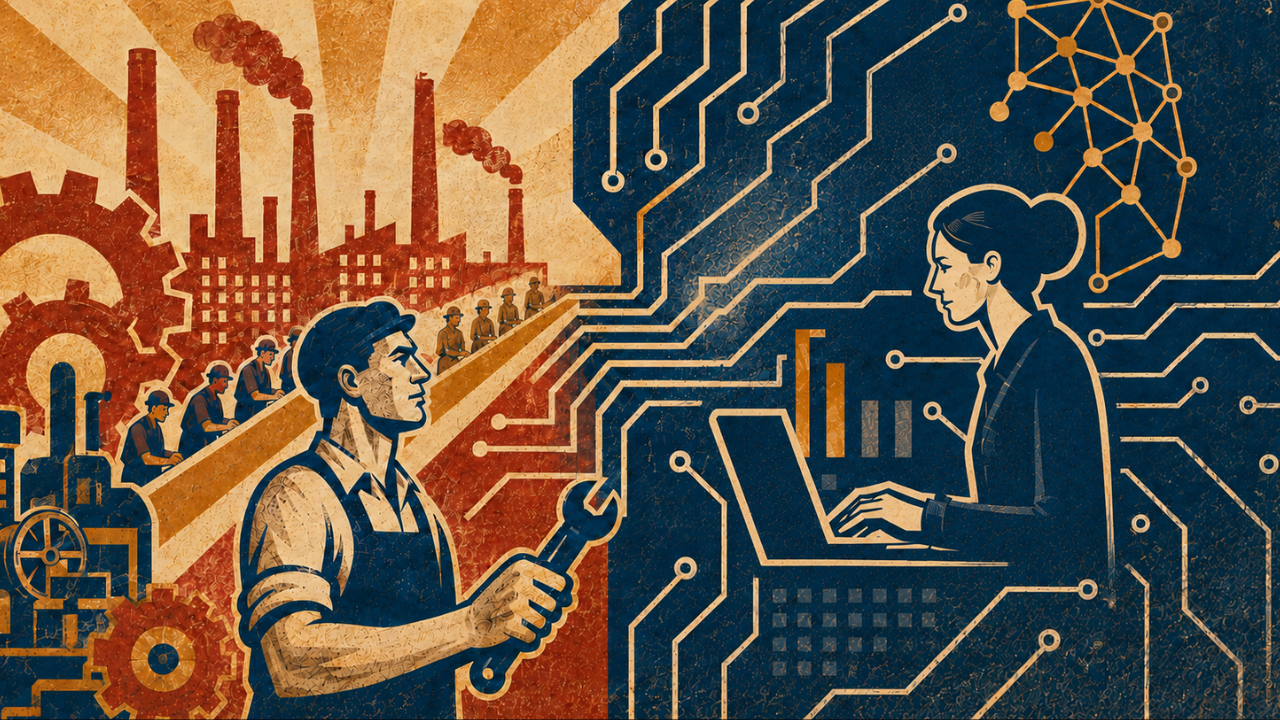
“Social contract” has quickly become one of the most-used, least-defined phrases in the AI policy conversation. This first event in a two-part series will trace the origin and history of the American social contract, examining how work became the anchor of economic security, mobility, and civic identity in the United States.
From an economy whose foundations were built on forced and unpaid labor, through the rise of industrialization, the New Deal, a postwar economic boom, financialization, and then globalization, the relationship between workers, employers, and the state has been redefined repeatedly. Panelists will discuss these inflection points, focusing on who was (and was not) party to these agreements — from organized labor and industrial barons to policymakers and grassroots movements — and under what circumstances their compromises established the baseline expectations of a middle-class life.
Speakers explore the evolving role of labor and how structural shifts over the 20th century laid the groundwork for today’s economic landscape — including the extent to which AI is a novel force reshaping our society. The discussion provides essential context for today’s leaders to understand their respective roles in forging a new social contract for the 21st century — a discussion that will continue in the second installment of the series: Work and the Social Contract in the Age of AI: Where do we go from here?
This conversation was hosted by the Future of Work Initiative, an initiative of the Aspen Institute’s Economic Opportunities Program on September 23, 2026 — explores what drove this transformation, who bears its costs, and what it would take to reverse it.
Our speakers include Joseph Blasi (Rutgers University), Chris Hyams (former CEO of Indeed), Marshall Kosloff (Niskanen Center), Liba Wenig Rubenstein (Future of Work Initiative, The Aspen Institute), and Erica Smiley (Jobs with Justice).
For highlights from this discussion, subscribe to our YouTube channel. Or subscribe to our podcast to listen on the go.
This event is part of our Opportunity in America series.
About the Future of Work Initiative
The Aspen Institute’s Future of Work Initiative, part of the Economic Opportunities Program, empowers and equips leaders to innovate workplace structures, policies, and practices that renew rather than erode America’s social contract.
About the Economic Opportunities Program
The Aspen Institute Economic Opportunities Program advances strategies, policies, and ideas to help low- and moderate-income people thrive in a changing economy.
Join Our Mailing List
To receive occasional emails about our work — including new publications, commentary, events, fellowships, and more — join our mailing list.
Connect on Social Media
For news and updates every day, connect with us on the social media platform of your choice.
Work and the Social Contract in the Age of AI: How did we get here?

Back to the Future of Work: Revisiting the Past and Shaping the Future

The Power to Shape What Comes Next: Writing the Future of Work Together
Power At Work Blogcast #107:
Worker Power & Agency

Worker Power in the Age of AI Monopolies: Why We Need Structural Solutions Now
Reflections on the Future of Work from Aspen Ideas Festival 2025