Rethinking Learning and Opportunity: Insights from the Century Summit VI

Chelsea Miller
Associate Director
Last month, I had the privilege of joining fellow subject matter experts on longevity and the workforce for Century Summit VI, an annual gathering hosted by the Stanford Center for Longevity. This year’s theme was “Longevity, Learning, and the Future of Work.”
Throughout the exchange between employers, academic providers, and ecosystem advocates, a clear divergence in philosophy emerged. For many in academia, the focus remains on instruction—the formal transfer of knowledge within a classroom. For employers and skills advocates, however, the focus is learning—a fluid, lifelong activity that must happen anywhere and everywhere. As the rate of innovation accelerates, longevity experts are increasingly focused on the generational impacts on our economy, yet regardless of the vantage point, one truth was universal: the collision of technological innovation and demographic shifts is fundamentally rewriting how we learn and earn.
From a skills development and talent planning perspective, this moment is unprecedented. For the first time, five generations — from the Silent Generation (born before 1946) to Gen Z (born after 1996) — are participating in the workforce at the same time, creating new complexity that’s compounded by the project-based nature of modern work. Addressing the diverse learning styles and talent needs of this cohort requires a level of stakeholder collaboration we haven’t yet mastered. As one executive leader noted during the convening, “There are so many conversations that need to be turned on their head. We are fighting decades of assumptions because we’ve only ever had one way of doing things.”
During the panel “Rethinking Learning and Opportunity,” my fellow panelists and I shared data highlighting the populations currently stranded by traditional pathways, including research UpSkill America has done about employer needs relating to validated skills. I shared a staggering statistic: as of the 2025-26 academic year, 70% of undergraduates are working while enrolled—and 80% of those working students are clocking more than 20 hours per week. This sparked a visible reaction in the room, and for good reason. Traditional academic settings are simply not designed for this reality. While institutions often aim to produce “productive members of society,” they frequently treat the work done inside their walls as the only work that matters. They rarely prioritize economic mobility as the first step—the very thing that allows a student the stability to focus on their studies in the first place.
We also explored the technology enabling us to rethink how people contribute and find value. Work is no longer a simple transaction for a paycheck; both employers and employees expect more from the relationship. However, technology alone isn’t a silver bullet. While many turn to “YouTube University” for bite-sized performance support, it often lacks the depth of comprehensive education. As one professor pointed out, “YouTube is performance support, not democratized education. It is the weakest way for individuals to learn.”
As this work continues to evolve, we must move beyond polite conversation and into systemic redesign. We cannot solve the problems that lie ahead using the maps of the past. We challenge employers, educators, and policymakers to stop viewing the working learner as an outlier or a non-traditional student to be accommodated. When 70% of students are working, the working learner is the new normal. Creating economic mobility isn’t about asking workers to fit into education; it’s about building learning pathways that fit into their lives. It is time to stop trying to fix the learner and start fixing the system—by integrating work and learning, prioritizing economic stability as a prerequisite for success, and building an infrastructure that truly serves the modern workforce.
About UpSkill America
UpSkill America, an initiative of the Economic Opportunities Program, supports employers and workforce organizations to expand and improve high-quality educational and career advancement opportunities for America’s front-line workers.
About the Economic Opportunities Program
The Aspen Institute Economic Opportunities Program advances strategies, policies, and ideas to help low- and moderate-income people thrive in a changing economy.
Join Our Mailing List
To receive occasional emails about our work — including new publications, commentary, events, fellowships, and more — join our mailing list.
Connect on Social Media
For news and updates every day, connect with us on the social media platform of your choice.

People at the Center – How We Think About Designing Systems Change for Impact

How to Navigate Systems to Create Impact

Rethinking Learning and Opportunity: Insights from the Century Summit VI
Seeing the Grass, Solving for the Weeds

UpSkill America & Guild Announce Third Cohort of Education and Career Mobility Fellowship
Moving Beyond a “Marriage” to Education


Announcing the 2024 Class of Education and Career Mobility Fellows
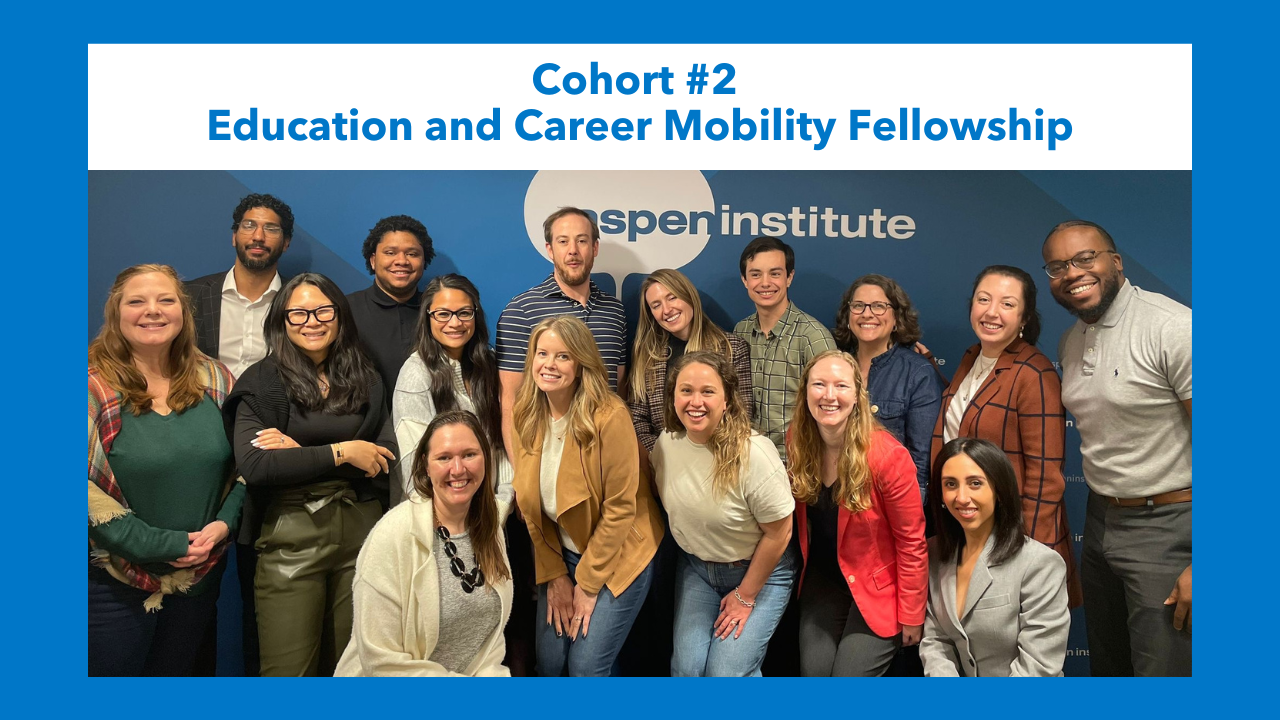
UpSkill America & Guild Announce Second Cohort of Education and Career Mobility Fellowship