
The White House Acts on Scams: What Comes Next

Nick Bourke
Senior Policy Advisor, Inclusive Financial System

Kate Griffin
Director, Inclusive Financial System
A new White House Executive Order (March 6, 2026) is an important milestone in America’s fight against transnational criminal organizations that steal tens of billions of dollars from Americans each year. It directs the Attorney General and the Secretaries of State, Treasury, War, and Homeland Security to assess current authorities and identify gaps in federal capabilities to prevent cybercrime, financial fraud, and online scams. And importantly, it requires these agencies to deliver an action plan to the President within 120 days, working in conjunction with a senior White House advisor and the Office of the National Cyber Director. In doing so, the EO appears to elevate scam prevention from a fragmented set of enforcement and regulatory activities to a whole-of-government priority.
The EO appears to elevate scam prevention from a fragmented set of enforcement and regulatory activities to a whole-of-government priority.
That shift is significant. For years, federal agencies, companies, and consumer advocates have worked on different parts of the scam problem, but without the benefit of unified approaches or coordinated strategies. The EO creates an opportunity to align efforts of federal and state governments with those of the private sector. This could greatly improve the country’s ability to combat scams, which the Executive Order rightly characterizes as “predatory schemes [that] are draining American families of their life savings, stealing the benefits of years of work, and destroying the lives of our youth.”
The White House ordered an anti-scam action plan by summer 2026. What should it say?
As agencies begin work on their plan, policymakers can draw on recommendations from the Aspen Institute Financial Security Program (Aspen FSP) report, United We Stand: A National Strategy to Prevent Scams. The report outlines a coordinated public-private approach across the full lifecycle of scam activity, from prevention to disruption and victim recovery. It reflects ideas and recommendations from an Aspen FSP-led task force of over 80 public and private sector organizations that worked together between 2024 and 2025 to identify the most urgently needed policies and practices to combat scams.
Below are several priorities that could help shape a strong federal action plan.
Priorities for the Federal Action Plan
Establish clear federal leadership and coordination
The action plan should designate clear ongoing leadership for the federal government’s anti-scam strategy and create mechanisms for sustained coordination across agencies, including not just law enforcement and national security bodies but also regulators of key industries (e.g., financial, digital platforms, and communications). The strategy should seek a meaningful reduction in scam activity. If the agencies identify the need for legislative reforms, they should prioritize them and communicate them to congressional leadership.
Improve information sharing across sectors
Financial institutions, digital and social media platforms, telecommunications providers, and law enforcement all detect different pieces of scam activity. The federal government should empower more effective private sector information sharing through legal safe harbors, interoperable data systems, and cross-sector intelligence exchanges.
Strengthen defenses against inauthentic communications
Many scams begin with impersonation, spoofed calls, or fraudulent online advertisements. The action plan should encourage companies, their regulators, and consumer-facing government agencies alike to extend “know your customer” principles to users of systems accessed by advertisers, merchants, and other businesses that seek to interact with customers on a given platform. Similarly, credentialing and (re)certification programs should be refreshed regularly for high-risk situations, which may include the FCC’s Robo Call Mitigation Database, licensed advertiser registries, or any similar whitelist maintained by companies or government agencies.
Enable faster disruption of scams in progress
Policies that empower companies and government agencies to disable fraudulent accounts, domains, and advertisements and intervene in suspicious transactions can significantly reduce consumer losses. The new EO and the recently established Scams Center Strike Force represent how law enforcement agencies can be more proactive in preventing and disrupting scams, and these efforts should be paired with renewed private sector efforts.
Modernize government crime reporting and analytical tools
Companies at the front lines of the scam epidemic have valuable information from their technological systems and customer feedback (most victims never report their losses directly to law enforcement, but they do report it to their financial institution, for example). Law enforcement has an opportunity to improve how they consolidate that information into powerful intelligence that helps companies and government agencies alike become better at preventing scams.
The United States relies heavily on law enforcement reporting channels—including the FBI’s IC3, FTC’s Sentinel, and FinCEN’s SARS systems—that were not designed for the fast-paced epidemic of online fraud and scams. Federal agencies are hampered by outdated technology, which limits their ability to create useful intelligence from consumer and private sector reports. Many critical government reporting systems still rely on PDFs or database technologies from decades ago. What’s needed now are clear and technologically advanced ways for companies and the public to report information to law enforcement, and better tools for analyzing that information.
As explained in Aspen FSP’s report, a plan to correct this shortcoming may include developing a single user interface for companies and the public to submit information to law enforcement databases, including through bulk delivery or real-time automation. It should also give law enforcement access to analytical capabilities that can uncover the most prolific sources of scams and bundle information to support successful prosecutions. This would have the added benefit of allowing federal agencies to publish trends and insights that help companies become better at preventing and detecting future scams.
Improve metrics and transparency
To date, federal data collection about scam activity is fragmented, which hinders effective prevention and response. Better measurement is essential to demonstrating what interventions are working and driving smart public and private sector investments that bring scam costs down. Federal agencies should implement GAO recommendations to create consistent metrics and methodologies for estimating scam activity and tracking the progress of interventions.
Recover stolen proceeds and restore funds to victims
The EO contemplates a new Victim Restoration Program funded by forfeited or seized assets obtained from the perpetrators of cyber-fraud. Complementary measures should help consumers restore accounts that have been compromised or falsely flagged as fraudulent. Further, government agencies should promote increased access to victim recovery services, because evidence shows that they help substantially reduce the (otherwise high) rate of re-victimization associated with scam crimes.
The United We Stand: A National Strategy to Prevent Scams report includes dozens of specific examples and practical ideas related to these recommendations. If implemented, they would undermine the scams business model by making it harder and less lucrative to prey on American consumers.
A role for public-private collaboration
The EO rightly focuses on federal government action. But scams operate across a digital ecosystem that includes social media platforms, telecommunications networks, financial institutions, payment providers, and other consumer-facing industries. Effective solutions will therefore require close collaboration among public and private entities across several industry sectors.
Many of America’s largest companies and public interest groups have already joined the call for a multi-faceted national strategy to stop fraud and scams. In the coming months, Aspen FSP will convene a forum of executives from companies across the digital ecosystem to advance practical solutions, pilot collaborative initiatives, and support implementation of a national anti-scam response. Aspen FSP intends these private-sector convenings to complement the federal government’s efforts and improve scam prevention capabilities across industries.
Congress needs a coordinated strategy, too
This EO launches an important federal agency strategy. But some vital actions for combating scams will require legislative reforms. Congressional leaders should establish a strategy to modernize the legal framework that supports scam prevention, in a coordinated way, across congressional committees and the industries they oversee. As documented in Aspen FSP’s report, these legislative reforms should:
- Enhance law enforcement’s powers to seize or achieve forfeiture of criminals’ digital assets and restore funds to victims;
- Clarify and harmonize the duties that companies have to protect customers from online scams and provide for sufficient legal safe harbors to empower them to pursue those duties (including sharing actionable scam intelligence with each other and relevant government agencies and acting on that information); and
- Commit resources to make key federal criminal reporting and analysis systems fit-for-purpose.
Such a coordinated congressional strategy would complement the White House action plan and empower the increasingly collaborative scam prevention efforts of private sector firms.
Turning strategy into results
The EO marks an important step toward a coordinated national response to scams. Its success will depend on the strength of the forthcoming federal action plan, sustained collaboration between the government and private sector, and well-coordinated congressional legislative reforms. With the right mix of leadership, data, and cross-sector cooperation, the United States can meaningfully reduce the scale and impact of scams on American households.
More from Aspen FSP on Fraud and Scam Prevention:
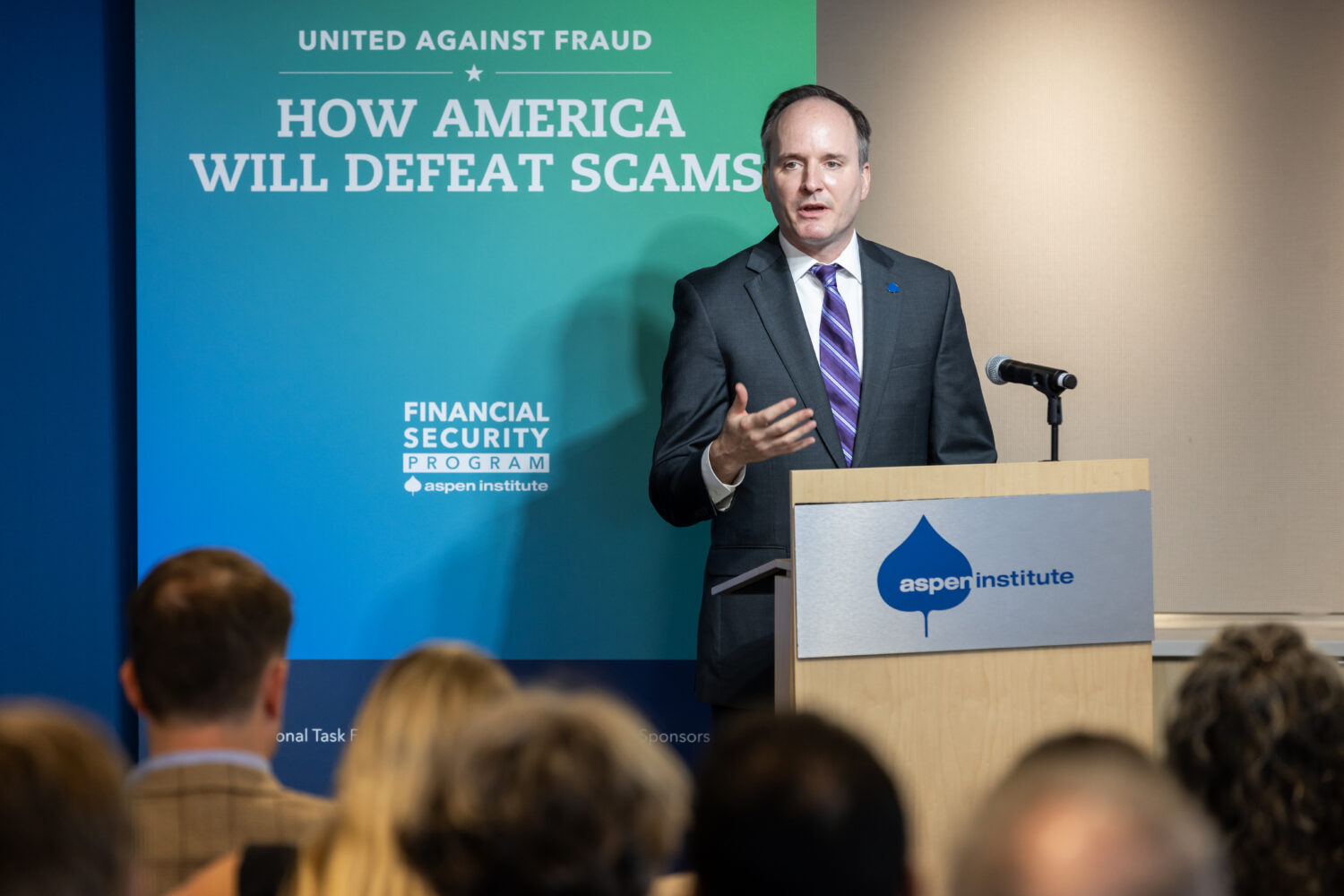
Turning America’s Anti-Scam Strategy Into Action

More Choices, More Questions: Is the Financial Marketplace Truly Delivering Resilience?

Moving from Consensus to Consequence in Global Fraud and Scam Prevention
A Blueprint for Action: Lessons from the National Strategy to Prevent Scams with Nick Bourke

A Pervasive Threat: Analyzing Recent Survey Data on Fraud and Scams

United We Stand: A National Strategy to Prevent Scams

Five Forces of Change Shaping the Next Decade of Inclusive Finance

How the National Strategy for Financial Inclusion Can Help Households Build Wealth

Aspen FSP Launches National Task Force for Fraud & Scam Prevention

10 Real Ways that Blockchain and Crypto Could Drive Financial Inclusion and Help Households Build Wealth
Stay Connected
Join our work to build financial security for all.
Subscribe to Our Newsletter
Stay up to date with our latest news and events.
