Disposable Workers: A Book Talk with MIT Sloan Professor Paul Osterman
Transcript
[00:00:07] Maureen Conway:
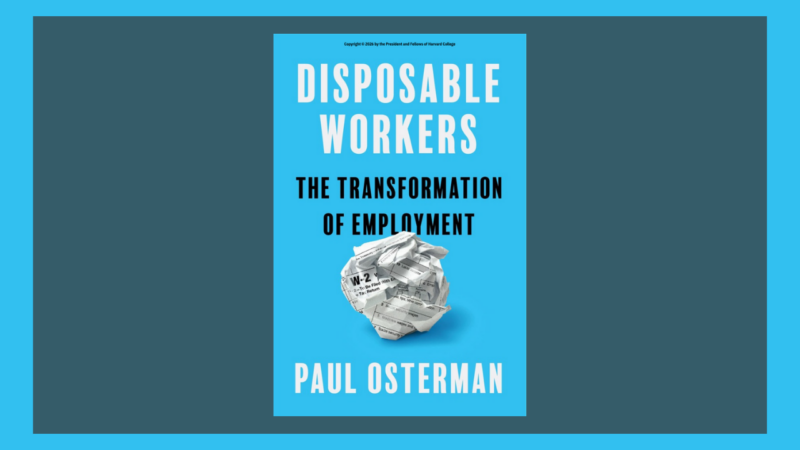
Good afternoon and welcome, everyone. My name is Maureen Conway. I’m a vice president at the Aspen Institute and executive director of the Economic Opportunities Program. I am thrilled to welcome you to today’s book talk with Paul Osterman on his book “Disposable Workers: The Transformation of Employment.” This conversation is part of the Economic Opportunities Program Opportunity in America series, in which we discuss the changing economic landscape and bring a variety of leaders, and innovators, and experts to a conversation on how to build an economy that works for everyone. Before we start, a quick review of today’s technology. All attendees are muted. Please do use the Q&A button at the bottom of your screen to submit and upvote questions. Please share your perspectives, ideas. I know we have a great audience with a lot of experience on the topics we’re discussing today, so please do share your ideas, examples, resources, and any materials related to today’s topic in the chat. We encourage you to post about this conversation on the social media platform of your choice. Our hashtag is #TalkOpportunity. If you have any technical issues during the event, please message us in the chat or email [email protected]. This event is being recorded, and it will be shared via email and posted on our website after the event. Closed captions are available for this discussion. Please click the CC button at the bottom of your screen to activate them. Now to today’s event. I am so pleased to have Paul Osterman here to discuss his book. This is actually not our first book talk with Paul. He also joined us in 2017 when his book, “Who Will Care for Us? Long-Term Care and the Long-Term Workforce,” came out. Paul has a long publication list of books and scholarly articles on work, job quality, workplace practices, and ideas to improve work for working people. He’s a longtime friend and advisor to the Economic Opportunities Program, and we’re so thrilled to welcome him back today. He’s written a really important book. It illuminates an important way in which job quality is changing. In the US context, having a good job is often essential for people to feel that they have a measure of control over their lives and can be an important way in which people feel included and connected in our society. In work that the Economic Opportunities Program did a few years ago in collaboration with the Families and Workers Fund, we spent a lot of time looking at a variety of resources, research, frameworks, et cetera, on what characterizes a good job. Across them, we basically found that three broad areas were consistent. A good job provides economic stability. It provides the basics for your daily life. It provides opportunities for learning, growth, and economic mobility, and it’s got a context of dignity and respect for the work that is done. “Disposable Workers” documents the rise of marginal and disposable workers, and discusses the business incentives that lead to this rise. Stealing a little bit of Paul’s thunder, he finds more than a third of US jobs are designed for disposable workers. What does this mean in terms of good jobs? Well, first, when workers are marginal to the firm, they, by definition, are disconnected from opportunity within that firm. They’re not connected to internal career ladders, and get limited investment in them in terms of their skills and abilities. In terms of their economic stability, these are labor cost minimization strategies, so they tend to not be paid that well, although some are. Some of them may provide economic stability, but on balance, it seems that most don’t. Just the idea that they’re disposable indicates there’s not a lot of respect for the work or the contributions to the success of the enterprise. They don’t seem that good. Good jobs are important. We care about good jobs because work plays such an important role in our lives. It’s how the vast majority of us support ourselves and our family. It’s what occupies the best part of our waking hours for the most part. We also care about good jobs from a societal level because we want people to be able to support themselves and their families, and to lead lives of dignity, and feel like full members of society, and that a growing number of jobs do not allow for this causes more and more people to believe the system is rigged, that the American dream is dying or dead or a lie. It just contributes to the declining trust in social divisions that we see today in our society. I wrote recently over Labor Day that we need to make making work better a focus of our policy, and it should also be a focus of our practices, but in order to do that, it’s important to understand the trends that are influencing job quality and why work today is structured to be so unrewarding for so very many. “Disposable Workers” is an important contribution to building that understanding, and I’m really thrilled to have Paul with us here today to discuss it. What we’re going to do today, I’m going to hand it over to Paul in just a minute. He’s going to do a presentation for about 15 minutes. I’ll pose a few questions to him about ideas for action. We really do want to get to your questions, so please, as I mentioned, do put your questions in the Q&A, and we will get to as many of them as we can today. Paul, let me now hand it over to you.
[00:06:15] Paul Osterman:
Thank you, Maureen, for that lovely introduction. Let me just say that for many, many years, decades, I’ve admired Maureen and her work. The Economic Opportunities Program is really a beacon of thinking around job quality. It’s by far the best in the country on that topic. I’m very happy to be here. I’m going to talk for about 15-ish minutes, and I’m going talk fast. Let me begin with a paragraph the way the book opens. “When I walk out of my condo every morning, I say good morning to the concierge who works for a contracting company that provides staff to the building. When I conduct an interview at a downtown office building, the people who clean that building at night are contractors. If I need help with the index for this book, that person will be a freelancer. “When my best intentions are for naught and I gorge on Doritos, I remember that the tasters hired by PepsiCo to ensure that the Doritos are sufficiently addictive are contractors. If I have an accident and go to the ER, I may be cared for by a travel nurse. If I sue Boston for the pothole that led me to the hospital, the law firm, they use a staff attorney for discovery; and when I buy a sandwich at the local sandwich store, the person behind the counter will be a high turnover part-time worker who got no training.” Those are all examples of different flavors of disposable workers. There are contractors who work for a staffing firm, but at the location where they work, the company has no obligation to them. They’re freelancers. Now, I’m going to brag about my data in a second, but I am only interested in organizational freelancers, people who work for organizations. I’m not interested in the person who walks your dog or cleans your gutter. My data, which I’ll describe, enabled me to make that distinction. Freelance journalists are a category of freelancers. Uber drivers and food delivery drivers are categories of freelancers. Then there’s a new category in the book, which is new to the discussion, which I call marginal workers. These are W-2s. Unlike the freelancers and the contractors, the W-2s at the organization for whom they work, but they are no way attached to any kind of career ladder in that organization. Examples are adjunct faculty who will never be considered for tenure and are on short-term contracts. Staff attorneys who are on short-term contracts do the scut work in big law firms. Many part-time workers are marginal. They’re high turnover, and the organization uses them expressly with the desire to get the high turnover out of them. I give examples in the book of big-box stores that more or less explicitly said, “We’re moving to part-time work because these people are high turnover and will save on benefits,” and then low-wage service jobs. The headline, as Maureen said, is that about 35% of the workforce are disposable. This number comes from a survey I did two years ago of 6,000 people that very, very carefully defined these categories and asked very, very detailed questions about what the work was like. Hence, I can talk about organizational freelancers instead of the dog walkers. The book offers a unified treatment of these categories. It explains this marginal idea. It has much better data than has been out there, including the contingent worker survey of the census. It documents carefully the consequences. It has a long discussion about policy, and I should say, it does recognize heterogeneity. Some people do prefer to be freelancers, for example. You’ll see when I show you the slide on consequences that that’s the case. Why is this happening? Think about contractors. I’m a firm, and I want to get people to be my security guards, or I want them to clean the building at night, or a similar job. I go to a staffing company, and I say, “Hey, give me your bid for this work,” and they do. Six months later, I go to the staffing company and say, “I’m putting it out for bid to these other two companies. Compete.” How can they compete? Only way they can compete is on lower wages. That’s the only margin, so there’s a wage consequence. There’s a benefit consequence. After the Affordable Care Act was passed, the rate of jobs being part-time increased higher than trend because firms wanted to avoid the health care insurance requirements. Medicare: so Medicare says if you’re a firm and your employee turns 65, who can put them on Medicare, and who has to keep them on the firm’s health insurance policy? Then there’s a size cut. If you’re small, you can move them to Medicare; if you’re large, you got to keep them on your own policy. Guess what? In large firms who were forced to maintain their insurance policy, the rate of reclassification into freelance status went up after that requirement went in. One of my favorite descriptions and motivation comes from a report by McKinsey; you all know about McKinsey. It’s the exemplar of mainstream business in America. McKinsey issued a report on the state of organizations in 2023 that said, “Our research shows that 95% of a firm’s value is produced by 5% of its employees.” Think about that for a minute. Think about what cultural attitudes are embedded in that quote finding. Those other 95% who aren’t producing the value, they’re either disposable or we have no respect for them. There’s a cultural issue in addition to cost savings and flexibility. I do find 35% of the workforce falls into one of my categories. To break that out, 5% of the workforce are organizational freelancers, 13% are contractors, and 17% are what I call marginal workers. The way I operationalize the definition of marginal workers is either you’re on a short-term contract, a fixed term with no guarantee of renewal, or you’re neither a freelancer nor a contractor, and you receive no training from the firm and no pension from the firm. That all adds up to 35%. The demographics of this are a little surprising. Along gender lines, there’s no difference across these categories compared to standard work. The same percentage of each category, including standard work, are women. People of color and people with no college degree are more likely to be contractors and marginal workers, but there’s heterogeneity. Among contractors, 31% have a college degree, and 41% of marginal workers have a college degree. There’s heterogeneity, and I’m going to come back to heterogeneity because I think that has important political implications. Just to give you an example, I interviewed freelance journalists. Some of them said, “I really like freelancing. It’s work-family. I can spend time with my kids and so on, and I can work on topics only I care about.” Many of them said, “I was pushed out of the newsroom. I have to be a freelancer, and I’m competing with every writer in the world, on the planet.” They’re unhappy. There’s heterogeneity. Look at the outcomes for this. Now I’m going to share a couple of slides to show you something about the outcomes for this. [silence] Preferences, who would rather be a standard worker? Sixty-nine percent of contractors would like to be a standard worker. Only 14% of organizational freelancers. That is heterogeneity. You’ll see in a second, freelancers are happy campers. Job satisfaction. Now, job satisfaction is a great measure because it incorporates earnings, but also incorporates whether you’re respected on the work, on your job, whether you have some control, whether you’re treated well. You’ll see here that contractors and marginal workers are noticeably less satisfied than our standard employees or freelancers. Freelancers continue to be happy campers. Earnings, same story. Contractors and marginal workers earn noticeably less than do standard workers. Freelancers do too, but that’s because they work fewer hours. They work fewer hours by choice. Organizational citizenship. Do they care about their work? Two questions: how much they’re committed to the success of the organization, and how willing are they to put in extra effort for their employer? Again, contractors and marginal workers are much, much less happy campers. What do we do about all this? Maureen’s going to come back and ask me about this. Here’s the categories in which I’d like to think about it. For freelancers, the issue is defining employee status. As an Uber driver, an employee, or a freelancer, Amazon is pushing its drivers into freelance status. Walmart is pushing its drivers into freelance status. How do we define this? For marginal workers and contractors, they are W-2s. The issue there is how do you raise job quality? We’ll talk about a number of ways to do that. We can make one more effort to convince employers that there’s a better way. Now, I have to tell you, all the evidence is that employers are not going to follow that advice. The so-called high road, high-commitment Toyota system has not diffused. It has not diffused. At the same time, employers, say three years ago after George Floyd, made strong statements about equity and diversity are central to our values. Today, no one mentions DEI [diversity, equity, and inclusion] under any circumstances. All employers care about is maximizing profits, which is not a bad thing. Not a bad thing at all. Employers create jobs. Employers innovate on products. You’re not going to convince them, I don’t think, to follow a path that leads them to treating disposable workers better. Now, the one qualification on that comment is that there is evidence that if you use a disposable worker, the quality of your product declines; not just effort and commitment, but the actual quality of your product. The best example of that is in hospitals, hospitals that use contractors as cleaners. Those hospitals have higher infection rates than hospitals that have contractors on staff because of communication issues and commitment. There is a cost to employers, and the question is, can you sell that? Improving mobility options; giving people an opportunity, and the training and the labor exchange to get out from under the status. Finally, and we’ll talk about this, making this politically salient. A topic that’s politically salient is essential. It’s broad-based. It’s people with college degrees, people with only high school degrees. It’s men, it’s women, it’s Blacks, it’s whites, it’s Hispanics. There should be a political base around this, but it has to be taken up in order to talk about policy. That’s a brief look at the book, and I think we’ll turn to questions that Maureen has. I’ll stop my share.
[00:19:20] Maureen:
Great. Thank you, Paul. That was terrific. One thing I did want to clarify, I think, a little bit before we jump into what to do about all this is, I think one of the things that you describe well in the book is the way we think about preferences for part-time work, and is it employer design, is it because people want to work part-time, how we talk about it versus what you observe happening. I was wondering if you could just talk about that a little bit.
[00:19:54] Paul:
Sure. The way the census classifies part-time work is a little deceptive from my point of view. They distinguish between voluntary and involuntary, where involuntary means that you’re looking for a full-time job, and you can’t find it. About 80% of all part-time workers are voluntary. That carries with it the notion that, no problem, it’s voluntary. What I observe, and I should say other people have observed this too, this is not new to me; employers create part-time work because they know it’s high turnover. They build in high turnover. As we saw, they don’t have to connect part-time workers to career ladders. They don’t have to pay them benefits. They have to give them relatively little training. Now, clearly, there are some examples when that’s not true. I cite, for example, a brilliant law school graduate who cares a lot about work-family issues, and he or she goes to a big law firm and says, “I want to work for you, but I only want to work for you part-time.” The law firm says, “Gee, we really wish you were full-time, but you can be part-time for a while, and we hope we can convince you.” That’s fine. No problem. A great deal of part-time work is created by employers because of the benefits to the employer. As I said, you can see that in big-box firms, Walmart and Home Depot are the examples I use in the book, who are embarrassingly explicit about why they use part-time. The United Parcel Service has had strike after strike, driven by its desire to have more and more part-time workers and the union’s desire to oppose that. That’s what’s going on here. I’m not negating the voluntary/involuntary distinction. That carries meaning, but I’m saying there’s another way of framing it.
[00:21:50] Maureen:
No, that’s really helpful. I guess I wanted to ask you one more question that’s not something I [unintelligible 00:22:00] for you, but my colleague, Bryn Morgan, wrote a piece about difficult nonprofit jobs over for Labor Day weekend. I’m wondering the degree to which you see not just this happening in the private sector but also nonprofits and government agencies emulating these employer practices?
[00:22:27] Paul:
Government and nonprofits, I think, are distinct. We need to talk about them separately, not lump them together. A lot of nonprofits are value-driven. In that stance, they’re more likely to be concerned about these issues as something to consider. On the other hand, although they’re called nonprofits, nonprofits, as you well know, Maureen, need to have a gap between cost and revenue. It has to be a positive number; revenue is higher than cost. To the extent of having a regular, standard worker involves costs, benefits, training, and so on, they’re going to be challenged. Yes, the tendency would be to maybe feel bad about it, to try to avoid it. I would say you’re still going to see plenty of part-time people and plenty of use of contractors in nonprofits. Government is more complicated because many Government jobs are unionized. We’ll talk about unions because unions are a part of a potential solution for all these. I don’t think you can talk about the public sector in the same way that you talk about other nonprofits or for-profit firms.
[00:23:40] Maureen:
Okay. Great. I’ll have a longer conversation with you about some of that later. It seems like we’ve covered what marginal or disposable workers are, how the strategy has grown, and maybe can you say a little bit more about change over time in this strategy, how it’s become more common, perhaps?
[00:24:04] Paul:
Yes, it has, but I’m very proud of my survey; you won’t be surprised to hear, but it’s cross-sectional. It adds very textured questions in order to enable me to make the distinctions I’m making, but there is no other survey like it that was done five years ago or 10 years ago. The Current Population Survey, the census, does not ask textured questions. There’s nothing out there. You have to basically rely on snatches of evidence. The temporary help industry has grown. That’s pretty clear. That is a subset of contracting. It’s not all there is in contracting, but it’s a subset, and there are data on the growth of the temporary help industry over time. If you look in specific industries and you get on websites that are industry-based, kind of informational websites, you see that building contracting has increased over time. There’s absolutely no question that universities are using adjunct faculty at a far higher rate than they used to. It’s gone from 30% adjunct and 70% tenure-track to exactly the reverse over time. You can identify bits and pieces of evidence that give you a sense of time trend, but there’s nothing like my survey that— I can’t say, “Oh, a similar survey five years ago showed such and such.”
[00:25:34] Maureen:
Great. Thank you. Let’s get into some of the strategies about what to do about it a little bit more. You’ve talked about a little bit this self-help strategy. I’m also looking at some of these questions that we have coming in in the Q&A box. One of them has to do with adjunct faculty. You may build in how you’ve looked at adjunct faculty at some point. You describe self-help strategies and workers band together. Let’s talk about these together. What is the self-help strategy? Then why this approach is not enough? Then unions, which are also workers banding together. You describe the impact you see from that. Why don’t you talk about both of those?
[00:26:30] Paul:
I want to distinguish.
[00:26:31] Maureen:
Right, distinguish.
[00:26:31] Paul:
In the book, when I talk about self-help strategy, I really talk about community organizing of one kind or another. Visible examples of that are the drivers in New York City; the food and delivery drivers and rideshare drivers in New York, similar in Massachusetts, similar in Illinois, similar in California, in which they organize into basically nonunion organizations to push city councils or state legislatures to enact basic standards for their jobs. Now, I think that’s great, and it’s been effective in the examples that I just gave you, but guess what? Those examples are heavily blue states. They tend to be on the coast. The other problem with those organizations is that, unlike unions, they don’t really have a stable funding base. I give an example in the book of a contracting organization along those lines, WashTech, out west in the state of Washington, that had some effect for a while and then just fell apart because there was no base. I’m not critical of these groups at all. They’ve accomplished something, but at the scale of the United States of America [chuckles] with 50 states, so far only 50 states, it’s hard to imagine these self-help groups having an impact at scale. Not critical. They’ve done a good job where they’ve worked, but it’s hard to imagine. The evidence on unions is very strong. Take building cleaners. Where building cleaners are unionized, the pay rates are much higher, they receive benefits, and they’re just in much better shape than nonunion building cleaners. That’s true for the people who make your bed in hotels. That’s true across the board for these jobs. The challenge is the rate of the density of unions in the private sector is about 6%, and it’s not budging upwards. In United Parcel Service, the unions have managed to control the use of part-time work to some degree, but that 6% number is challenging.
[00:28:50] Maureen:
We have a question asking if you would agree that essentially the problem of disposable workers is because of federal legislation that severely weakened labor unions. What would you say is at least the role of federal legislation in weakening labor unions?
[00:29:09] Paul:
I think that what we have seen, basically, since the mid-1970s is a sustained effort by employers to get on top of the workforce and to diminish the role of unions. We’ve seen it a number of ways. Auto plants moved south because in the South the unions are weak. Ronald Reagan fired the air traffic controllers, which was a signal to the employer community. This use of disposable workers, the breaking down of what we called internal labor markets, that is to say, once you’re in an organization, strong preference is given to incumbents for promotions and moving up the ladder. Now organizations are much more willing to hire directly from the outside and force you to compete with the whole market, not just with people in the organization. We’ve seen a number of changes in how work is organized over time, of which this, I think, is a piece. That’s the way I would frame it.
[00:30:12] Maureen:
Great. I want to go to another one that you’ve already touched on a little bit, but you call these carrots, I think, [chuckles] in your book, appealing to employers’ self-interest, somehow persuading them to adopt better employment strategies, and this being inadequate. Can you say just a little bit more about how you feel— what have been the tactic to try to persuade employers to adopt these strategies?
[00:30:48] Paul:
The tactics have been basically jaw-boning, conferences that show evidence, or business roundtables in which people like me make presentations. The issue is, there is clear evidence that a set of practices, which you could call high-road practices, pay off on some dimensions. If you pay people better and you treat them better, turnover goes down. Theft goes down. There’s good evidence that theft goes down; pilfering goes down. I just showed you evidence that people who are not disposable are more willing to work hard for the organization, more willing to put in effort. The challenge is that all of those are true. You would think they would improve outcomes for the employer, but there’s a cost associated with all of those, or at least the chief financial officer thinks that there’s a cost associated with all of these. Now, there may be long-run benefits, and the firm, in the long run, may be better off pursuing so-called high-road strategies. We have not — we, but I talk about the advocacy community who advocate for these high-road strategies — have not made the case that in the short and medium term, profitability rises. That’s the challenge. Now, this example I gave you of infections in hospitals, and there’s another example: industrial accidents increase when you use contractors. Those are not always visible to management. You can either try and persuade the chief financial officer that he or she is overlooking something, or you could find a way to get around him or her organizationally. It’s going to be hard. It’s going to be hard, but it’s worth continuing the conversation.
[00:32:41] Maureen:
Particularly when we’re talking about large firms, I think that is true. I think also, because I’ve been doing a lot of work with organizations that work with small firms, I think these are more complicated management strategies. I think that there’s not widespread understanding of them, and not just only among small firms or small/medium firms, but also among extension services responsible for providing technical assistance. They don’t really have a lot of knowledge of this, and that can also, I think, be a barrier for this strategy. I don’t know if you have any thoughts on that.
[00:33:21] Paul:
The problem with small firms is, as you know better than I do, they’re stretched thin on management. There’s a million things happening to them every day. On some of these issues, they’re going to take the path of least resistance. That’s why, again, this is something you know a lot about: management extension services of one kind or another that provide technical assistance to firms. Those have historically been very oriented towards production processes, just-in-time, and all that, and less to human resource policies, but you can imagine making an effort. Now, I hate to say it, but to make this effort requires resources, [chuckles] governmental resources to finance this kind of thing.
[00:34:07] Maureen:
Right, yes. No, I can more than imagine it. I’ve seen it done, and I’ve seen it done where it does actually benefit the firm and the workers. You’re right, it requires resources. We invest in resources on advising already, so why we can’t do that is a little beyond me. We’ll get into that political will problem later. We’ve had a few pre-submitted questions, and I see some questions coming up. I did want to ask you about employee ownership, which is what a couple of people asked ahead of time, and whether incentives, awareness, education efforts that yielded more employee-owned business strategies, if that could be useful towards addressing this issue of disposable workers, because they own the business, so they’re less disposable. What do you think [crosstalk]
[00:34:57] Paul:
Right. I’m not an expert on employee ownership, but I did think about it because I knew you were going to ask me this question. What I would say is the following. I think the evidence is that the “owners,” the employees who are owners, are better off in an employee-owned business. They’re less likely to be treated disposable. Those employee-owned businesses still face up and downs and product markets and business cycles. How do they avoid the layoffs? My intuition — and this is intuition; I didn’t study this in any depth — is that they’re more likely to surround themselves with a buffer of disposable workers so that they don’t have to lay off their employee owners; they can use that buffer to protect the core workforce. Now that’s speculation on my part. It’s not based on research, but it is plausible to me.
[00:35:57] Maureen:
I don’t know. I haven’t seen it. What would that buffer look like? I’m just trying to think about it.
[00:36:02] Paul:
It would look, I’m a manufacturing company, and so I’m employee-owned, but 20% of my workforce is going to be contractors. When no one wants to buy my widget, instead of laying off my employee owners, I just cancel the contractors. That’s what I’m talking about.
[00:36:20] Maureen:
I don’t know this systematically, like anecdotally of stories. I think they’ve done more of some of the things like unions do, with everybody taking a cut.
[00:36:34] Paul:
Yes, that’s also possible.
[00:36:34] Maureen:
Work and see [crosstalk] something like that.
[00:36:37] Paul:
As we professors say, “Maureen, that’s a really good topic for research.”
[00:36:44] Maureen:
[laughs] All right. We will look into that.
[00:36:47] Paul:
Come back to me with a memo.
[00:36:49] Maureen:
[laughs] You do have a lot of policy options, and you started talking about some of them in terms of raising job quality standards for some and performing employment classification. What’s the one you’re most optimistic about that you think would make the biggest difference?
[00:37:13] Paul:
Let me just say, being optimistic requires that this is [crosstalk]
[00:37:17] Maureen:
Is not really your thing, right? [chuckles]
[00:37:20] Paul:
[chuckles] No, no. That’s what my wife says too. No, no. The political environment has to change. I really do believe that this is a broad-based issue. It’s not narrow. It’s not like, “Oh, we should care about poor people.” It’s not that. It’s, “Hey, you’ve got a college degree, and you’re disposable. You have a college degree, and your employer is misclassifying you.” I met a freelance writer who worked full time for an organization, but they said, “One day a month, you have to go work for somebody else, and we’re going to call you an independent contractor or freelancer.” It’s broad-based. Let’s assume for a minute that there’s sufficient political interest in this question. It catches on as something for politicians to deal with. With respect to classification of freelancers as employees, there’s a relatively simple solution, which is the so-called ABC law, which about 33— right now, it’s bounced back and forth. Obama does this, Trump does that. Biden does this, Trump does that. There’s no federal consistency. About over 30 states have this ABC rule about who’s an employee for state purposes. It’s very straightforward. Adopting that at the federal level would make a huge difference with respect to employee status. We could talk about what that rule is, but it exists. I also think that pressure on companies can make a difference. I give some examples in the book of senators holding hearings, and suddenly companies that are coming up for antitrust review, reclassify their freelancers and contractors as regular employees. I use the sweatshop example on what happened with Nike. It’s been possible for customers to put pressure on firms with respect to how they treat their workforce. There’s a variety of things you can think about if it becomes a salient political issue.
[00:39:28] Maureen:
Great. We do have a question about the role of AI and the role of AI in eliminating lower-tier jobs in particular. How does that interact with all of that?
[00:39:38] Paul:
Thank you for asking. I’m now going to share a slide to give you my fulminations about AI. Let me— You can see this. This is the slide before. Let me go down to some AI. And AI. Here’s two headlines. Wall Street Journal : “Tens of Thousands of White-Collar Jobs are Disappearing.” Wall Street Journal : “Big Companies Are Starting to Hire Again, Defying—” My point is that we simply do not know what’s going to happen with AI. Let me give you some evidence. In 1964, IBM introduced the System/360 into offices. That’s the mainframe computer, followed by minicomputers, and followed by personal computers. Office work was revolutionized. Millions of clerks who you thought were filing this and keeping track of that, now there’s a computer to do their work. This was dramatic. This was radical. Let’s see what happened. Here’s a list of clerical jobs. I won’t read this all out loud, but telephone operators, file clerks, insurance clerks, mail clerks, shipping and receiving clerks. I can track how many of these there are over time from 1960 to today. I can do it using definitions that are harmonized across all of those decades. If it was going to be a disaster, you would expect that, in 1964, these computers come in, and by 1970, these people are just out of work. Let’s see what happened. Office clerical work, those occupations as a percentage of total employment. In 1960, it was a bit over 10%. In 1970, it was 12%. In 1980, it was a bit under 12%, and then it starts to go down. It goes down in 1990 to 10%, the same percentage as in 1960. The world did not end for clerical workers. Yes, there was a decline. It took four decades. I want to claim, based on just this kind of evidence, that we should calm down a little bit about AI. Certainly, some occupations are going to be impacted, but look at this. I would argue to you that the introduction of these computers in the office was as big a deal as AI is today. Now, what will this do to disposable workers? I will say this: there is uncertainty. Go back to that previous slide, the different views. In the face of uncertainty, if you’re a firm, do you want to hire regular employees, or do you find it safer bet to use more disposable workers to deal with the uncertainty? I don’t know what kind of staffing I’m going to need. I don’t know what skills I’m going to need. Let me use contractors and freelancers because then I can adjust more easily. I think it’s a reasonable bet that I emphasize the word bet here that AI will increase the incentive to use disposable workers. I think it’s also a reasonable bet that the world is not going to end in the next couple of decades based on that clerical evidence. That’s my answer about AI.
[00:43:20] Maureen:
Great. You and I have both spent a fair bit of time with the workforce development system and the people who work on helping people get skills and connect to work. There’s a question in the chat about what can the workforce development system do to address this challenge of disposable workers?
[00:43:41] Paul:
Absolutely. Let me be clear — and you know this better than I do — the rap against job training, “Nothing works, it’s a waste of money.” It’s just flat-out wrong. Well-designed job training programs improve outcomes for their participants. There’s a lot of RCT, random controlled data, as well as observational data, on just that point. The issue is scaling it up. We come back, brings us back to money, money, money. Training programs, when they’re there, good quality ones, work. A lot of these marginal jobs, people are low-wage, part-time jobs, low-wage service sector jobs, or a lot of contractors who are stuck being building cleaners or security guards. If they were in training programs and if there was a good labor exchange to match people to jobs, they could find their way out of disposability status. It’s not the only answer to this challenge, but it is an answer. We need to get past the nothing works rhetoric. We also need to understand that it requires scale, and scale, again — I sound like a broken record — requires money.
[00:44:56] Maureen:
I have a question for you about that because you find 35% are in this disposable worker status. That’s a lot of jobs.
[00:45:07] Paul:
Yes, it is a lot of jobs.
[00:45:09] Maureen:
I agree with you, there’s absolutely— I get very frustrated with the training doesn’t work rhetoric as well, but at the same time, I think there’s always this challenge of, “Am I moving somebody out of this job into a better job, but then somebody else who is very similar to them ends up in that crummy job? When I step back, my labor market is still not really meeting the needs of the people who live in my community.”
[00:45:39] Paul:
That’s an economics jargon that’s a general equilibrium concern, but I’ll spare you most economics jargon. That’s why improving things on the supply side, which is what job training is, is only part of the answer. I just want to make the point that it’s part of the answer. The other part of the answer is creating restrictions and barriers to reduce the perimeter of disposable work. That requires laws, regulations, incentives to firms, and so on, what we’ve talked about. Job training alone is not going to “solve the problem,” but it’s part of the solution.
[00:46:22] Maureen:
No, I actually really like that framing because I think that is how we need to start thinking about our solutions, is that there’s different ones that are part of the solution. We’re not going to solve the whole thing with a regulatory approach, but it’s certainly part of the solution, in my view. We have another question here. To what extent do you feel Peter Drucker’s advice to do what you do best and outsource the rest is the origin of the corporate embrace of subcontracting and outsourcing?
[00:46:56] Paul:
Right. Another version of that in business jargon is core competencies. The problem with that is it’s very hard to distinguish the rhetoric from the reality, but if you look at the firms that aggress—and this is a study that actually, although I dumped on McKinsey earlier, McKinsey did do this other study that I’m about to describe. If you look at firms that adopted the reengineering, the corporation core competency, and you track those firms over time, they did no better than any other company. You couldn’t say a CEO who argued for core competency, that firm did better than a comparable firm in the same industry. I view those kind of business school slogans as rationalizations. The underlying reason is profit maximization, getting more flexibility, this cultural attitude towards the workforce. That’s what’s driving it. Business slogans, I think, are ephemeral, and I say that as somebody who teaches in a business school where many of my colleagues sell business slogans, but still.
[00:48:20] Maureen:
Great. Another question: “If stable full-time employment ceases to be the principal means by which millions of Americans receive income, health care, retirement security, professional formation, and social identity, what new social compact should replace it? What responsibilities should employers, government, labor organizations, and technology companies each bear in building that transition?” A lot in that question. Basically, who should be responsible for what here?
[00:48:50] Paul:
Look, in the best of all possible— First, it’s easy to articulate, not easy to implement, pieces of a solution. Health care for all, public-payer health care, would solve a piece of this, because it would shift the burden of health insurance, and health insurance is a driver for much of this. Other forms of portable benefits would also help. Those are legislative solutions which could happen. They’re true in other countries, so they’re not like pie in the sky, but we all know how difficult it is. Beyond that, that question implies: can we arrive at a new social compact, a stakeholder perspective on the labor market and on the economy? That would be nice, but I think all the evidence about firm incentives is profit maximization, and Wall Street enforces that. There’s a first-mover problem: which firm is going to be willing to say, “I’m giving up on profit maximization; I’ll take 10% fewer profits in order to treat my workforce better”? “Oh, look, the up firm, my competitors aren’t doing it, and they’re underpricing me.” I am skeptical about a new social compact outside of legislative action.
[00:50:24] Maureen:
We have an executive comp question. Is there a relationship between companies cutting labor costs and companies raising executive comp or the compensation of top executives?
[00:50:38] Paul:
Will it make you think less of me if I said I don’t know?
[00:50:43] Maureen:
[laughs] No, I respect that as an answer very much. You told me you would make things up, but I think “I don’t know” is a better answer if you don’t know.
[00:50:52] Paul:
I don’t know. It’s a good question, though. Executive comp is out of control for everyone across the board. Would a CEO who’s making $100 million behave differently than a CEO who’s making $55 million? I don’t know, but think about it.
[00:51:15] Maureen:
Are there tax policies that you think could push employers to invest more in labor or employees?
[00:51:23] Paul:
Yes, the classic discussion around that is around how firms account for training investments. Now, the tax system treats it as a pure cost. If you treated it as an investment in the same way you treat an investment in a piece of machinery as an investment that you can depreciate over time, it would lessen the cost of firms investing in training their workforce. This isn’t something that I’ve just thought of. That’s been a complaint among people in our field for a long time about the tax treatment of training.
[00:52:01] Maureen:
Absolutely. Another question, curious whether you delve into issues for opportunity youth and other people breaking into the labor market. To what degree can contract or other work serve as a proverbial stepping stone into something more solid or permanent?
[00:52:26] Paul:
The temp help industry will say, “We are exactly that. We’re an entry point for people.” The research evidence, and there was a random control trial done on this, is that that’s just not the case. That people who get these temporary jobs — sure, some go what’s called temp-to-perm — but on average they don’t benefit from being in the temp jobs compared to comparable people who enter the labor market directly into a “standard job.” I wouldn’t argue with this; you could say, “Look, someone has a life crisis. I’ve suddenly become a single parent, and I need to take care of my kids, but I need to earn a little money on the side, and a temp job will help me get through that.” Sure. I’m not talking here, nor are you, but I’m not talking about eliminating all flexibility in the labor market, eliminating firms’ ability to have some flexibility, making people have to have a standard job even if they need something different. I’m not arguing against that, but 35% is too much. Thirty-five percent of the workforce is being disposable. That’s just too big a number.
[00:53:41] Maureen:
No, and also, I will just say on that opportunity youth point, we did some work a few years ago on what are what we call good-fit jobs for opportunity youth. I think some of the entry-level jobs, the way you describe disposable workers is people who aren’t being invested in or mentored or felt to be part of the firm. I think for some opportunity youth, they really do need to have a little bit more mentoring and feeling of being part of the team to improve their labor force attachment. That was just a more qualitative look at what some organizations were doing for that to see. I’m just saying that in case one of my colleagues wants to drop that in the chat [chuckles] and leave that as a resource for folks. Could the government require employers to pay disposable workers an extra amount above pay for benefits that the employer is not providing? Why don’t you just comment on what you think about minimum wage and other kinds of policies like that at this point?
[00:54:56] Paul:
What I’m interested in, and one of the solutions, specifically for contractors and marginal workers is raising the floor in the labor market, right? The evidence on minimum wages, contrary to what economic theory held, is that, within a reasonable range, you can increase the minimum wage without leading to job loss, and people are better off. Again, the federal minimum wage is a joke. It’s $7.25 an hour. I don’t remember the number exactly, but let’s say 30-plus states have higher minimum wages. That’s certainly an issue. That certainly increases job quality, raises the floor. Keep in mind that a lot of these disposable workers are outside the minimum wage range. Raising the minimum wage to $20 an hour is not going to help the former journalist who suddenly is a freelancer and is getting treated pretty poorly by the industry. It’s not going to help the building cleaner. Again, we need a range of tools here. There’s no single kind of magic tool. We have to have a concerted strategy, and the minimum wage is a reasonable concerted strategy. On the more narrow question, that’s what the Affordable Care Act does. You either provide your employee with health insurance, or you pay a penalty to the government, and that person then can get on the exchange. That’s the strategy around the Affordable Care Act, but what firms do, of course, is that they try and keep as many people as possible part-time so that they’re not eligible for that.
[00:56:44] Maureen:
Yes. Just to follow up on that one, there was a question about whether you see — sorry, now I’m skipping around a little bit — retail outfits turning 20- to 25-hour part-time positions into 8- to 12-hour jobs, reserving the 20- to 25-hour work weeks for holiday and other busy periods. Basically, does it never exceed that?
[00:57:10] Paul:
Right. The advantage for a retail operation of having a part-time job below 30 hours is that you can then raise their hours to above 40 hours for some period of time, and they’re still treated by the law as part-time because they don’t reach an aggregate number of hours over the year. Yes, I hire you, Maureen, to be a clerk in my retail operation, and I have you at 10 hours, but come Thanksgiving or Christmas, I raise you to 50 hours, but you’re still legally part-time because I drop you back down when Christmas is over, and your aggregate hours keep you as part-time. There’s that additional motivation for using part-time work at relatively low hour rates.
[00:57:59] Maureen:
I see we are getting close to time here. In the conclusion of the book, you write, “The goal of this book has been to clarify just what is happening and to contribute to the discussion of what should be done.” I think the book accomplishes this goal. I’m wondering if you have any just final thoughts that you want to share or emphasize about what people should understand and where they can take action.
[00:58:24] Paul:
It’s been a great and challenging discussion. I really, really appreciate it. The book has got much more rich texture data about jobs and job quality than is typically out there. I think it does identify a problem that cuts across education levels, that cuts across occupation levels, that cuts across industry levels, race levels, gender levels. There’s a challenge. A lot of people are uncomfortable by their status. I just hope that, over time, this gets picked up as a public policy issue.
[00:59:04] Maureen:
Resources
Featured Book
- Osterman, Paul. “Disposable Workers: The Transformation of Employment.” Harvard University Press. 2026.
Articles, blogs, and publications
- Conway, Maureen. “The forgotten goal of labor policy: Make work better.” Federal News Network. September 7, 2026.
- Jain, Ranita, and Amy Blair. “Promoting Equity and Inclusion and Connection to Good Fit Jobs for Young Adults.” Aspen Institute. June 2021.
- Morgan, Bryn. “Nonprofits Need Better Jobs.” Aspen Institute. September 2, 2026.
About this event
This event is part of our Opportunity in America series.
For decades, economists and policymakers have debated how to help workers get better jobs. But what if the more fundamental problem is that employers have systematically redesigned work itself to make a third of the workforce expendable? In his forthcoming book, “Disposable Workers: The Transformation of Employment,” MIT Sloan Professor Emeritus Paul Osterman examines this idea and what it would take to reverse it.
Osterman documents the rise of contract workers, freelancers, and what he calls “marginal workers” — W-2 employees who are cut off from training, advancement, and any real stake in the organizations they work for. Together, these three groups now make up more than a third of the American workforce. Osterman argues that this trend is neither an accident nor an inevitable byproduct of technological change. It is the result of deliberate choices employers have made about how to structure work and manage labor costs. Osterman traces both the logic behind those choices and their consequences for worker well-being, economic mobility, and the broader social contract.
This conversation — hosted by the Aspen Institute Economic Opportunities Program on September 9, 2026 — explores what drove this transformation, who bears its costs, and what it would take to reverse it.
Our speakers include Osterman and moderator Maureen Conway, a vice president at the Aspen Institute and executive director of the Economic Opportunities Program.
Highlights
For highlights from this discussion, subscribe to our YouTube channel or subscribe to our podcast to listen on the go. Check out our playlist or click below to watch.
For decades, economists and policymakers have debated how to help workers get better jobs. But what if the more fundamental problem is that employers have systematically redesigned work itself to make a third of the workforce expendable? In his forthcoming book, “Disposable Workers: The Transformation of Employment,” MIT Sloan Professor Emeritus Paul Osterman examines this idea and what it would take to reverse it.
Osterman documents the rise of contract workers, freelancers, and what he calls “marginal workers” — W-2 employees who are cut off from training, advancement, and any real stake in the organizations they work for. Together, these three groups now make up more than a third of the American workforce. Osterman argues that this trend is neither an accident nor an inevitable byproduct of technological change. It is the result of deliberate choices employers have made about how to structure work and manage labor costs. Osterman traces both the logic behind those choices and their consequences for worker well-being, economic mobility, and the broader social contract.
This conversation — hosted by the Aspen Institute Economic Opportunities Program on September 9, 2026, explores what drove this transformation, who bears its costs, and what it would take to reverse it. Our speakers include Osterman and moderator Maureen Conway, a vice president at the Aspen Institute and executive director of the Economic Opportunities Program.
This event is part of our Opportunity in America series.
About Opportunity in America
Opportunity in America, an event series hosted by the Economic Opportunities Program, considers the changing landscape of economic opportunity in the US and implications for individuals, families, and communities across the country.
About the Economic Opportunities Program
The Aspen Institute Economic Opportunities Program advances strategies, policies, and ideas to help low- and moderate-income people thrive in a changing economy.
Join Our Mailing List
To receive occasional emails about our work — including new publications, commentary, events, fellowships, and more — join our mailing list.
Connect on Social Media
For news and updates every day, connect with us on the social media platform of your choice.
More Events by the Economic Opportunities Program

What Employee Ownership Means to Workers
View Event