A Few Cool Hardware Stores’ Gina Schaefer Keynotes the 2026 Employee Ownership Ideas Forum
Description
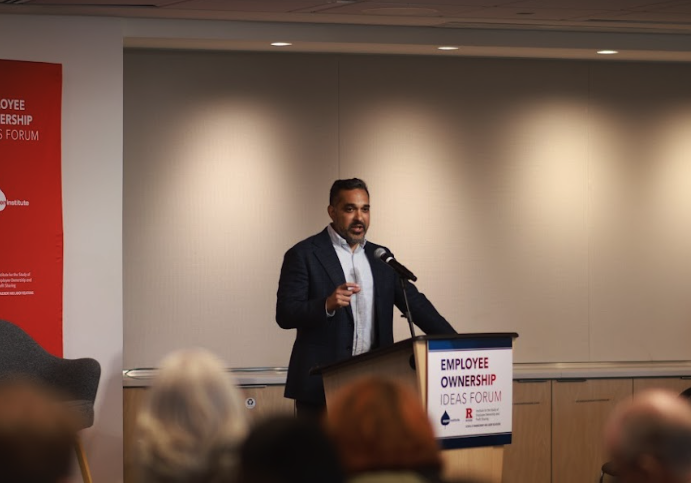
In this video, Gina Schaefer — founder and co-owner of A Few Cool Hardware Stores — speaks at the 2026 Employee Ownership Ideas Forum, which took place on June 2-3, 2026, in Washington DC and online.
This video comes from the 2026 Employee Ownership Ideas Forum, which took place on June 2-3, 2026, in Washington DC and online.
For more videos from the Forum, visit our event page or subscribe to our YouTube channel.
And subscribe to our podcast to listen on the go.
Resources
- Book: Recovery Hardware: A Nuts and Bolts Story About Building a Business, Restoring a Community, and Renovating Lives
- Website: A Few Cool Hardware Stores — About Us
[00:00:05] Maureen Conway: All right. Our next speaker is someone who has spent more than two decades proving that you can build a successful business by investing in people and community. Nearly 22 years ago, Gina Schaefer opened her first hardware store in Washington, D.C., in a neighborhood that at the time, many people would have questioned the choice. Gina saw potential where others saw risk.
Over the years, she grew that first store into a thriving business with 13 locations across D.C., Maryland, and Virginia, employing more than 300 people. Along the way, she never lost sight of the fact that businesses are about more than products and profits, they are about people. Gina understood the important role a good job can play in someone’s life and the important role a local business can play in strengthening a community. She built a company culture grounded in opportunity, belonging, and second chances, a story she shares in her book Recovery Hardware. It’s a great book. I recommend it.
Many business owners who care deeply about their employees and their communities struggle when it’s time for them to think about what do I do next? When it comes time to step back, selling to an outsider can mean losing the culture, the values, the relationships, and worrying about what happens to your employees. Gina chose a different path. She sold her company to her employees through an ESOP, creating more than 130 employee owners and ensuring that the people who helped build the business would share in its future. It’s a powerful example of employee ownership in action, and what it can mean for workers, businesses, and communities alike. Please join me in welcoming Gina Schaefer.
[applause]
[00:01:52] Gina Schaefer: Good morning. I’m so excited to be in the room with all of you. I have to get all of the nerves out. I moved to a community in Washington, D.C. called Logan Circle in 1997. I’m not always in a room with people who know where Logan Circle is. I think it’s that way, if I’m not misoriented in the building. Logan Circle helped create the full circle moment that I had creating my ESOP. You all know the end of the story, the end where we are right now. I think it started in a really beautiful way, or is rooted in a full circle moment that I want to share with you today.
Logan Circle was one of the communities in the United States that was destroyed by the riots when Martin Luther King was assassinated. Those riots started on U Street, just north of where my office is today, and spread south down 14th Street, leaving a wake of destruction in their path. By the time the riots were over, over 300 businesses had been burned, looted, and abandoned. Over 1,000 people were injured, or arrested, or both, and this once beautiful, diverse, vibrant neighborhood fell apart.
Fast forward to the late ’80s, early ’90s, people started moving east in Washington in search of cheaper housing, and they were running smack dab into this community with all of these boarded up houses in this long, abandoned commercial corridor just screaming with potential. I was one of those people. I decided for whatever reason that before I got married, I was going to buy my own house or condo, and my boyfriend was getting fidgety. He always says, “I was not.”
Anyway, I decided I was going to buy a place, and I started working with this really great real estate agent who took me all over Washington. Linda was like 7 feet tall, and I am not, and so she would bend down so she could look me right in the eyes. One day she did that, and she said, “I figured it out. The only place you can afford is Logan Circle.” We have an unofficial motto at our business, and that is there are no tears in hardware. We’re expected to be beefy, and tough, and sell tools.
You better believe when Linda told me that day that I should probably buy a place in Logan Hardware, I cried. The streets were strewn with trash, my friends wouldn’t visit because they thought it was too sketchy. Every other block had boarded up buildings. There was no place to transact commerce, but I believed in Linda. I bought a condo. My boyfriend got jealous. He bought a condo around the corner. Together we got actively involved in community, which was a really great lesson to us about the power of community.
We would go to the association meetings, and everybody would joke that we lived in the dark, our pictures were on the ground, and our toilets were always running because the closest hardware store was way too far away. We wanted to walk, and shop, and dine, and recreate right outside of our front doors. I got laid off from my job about a year later. I was working in the tech industry, and I called myself the tech reject. My third layoff in four years. I drove home from work that day, and I was like, “That’s it. I’m done. I’m not going to work outside of my community. I’m going to open the hardware store that this neighborhood needs.”
My husband pipes in on this story in so many great ways, but he didn’t say a word. I think he was stunned. He’s like, “No, you’re not. What do you know about hardware? What do you know about retail?” I was like, “Nothing, but I know about community, and this is what this neighborhood needs, and I need a job, and I love the idea, and let’s do it.” A lot of you might not know this, maybe this is the group that does, but there are no hardware franchises in the United States. You either buy from a wholesaler or you join a co-op.
I joined the Ace Hardware Cooperative. They sent a guy named Richard Mann to vet me. Richard’s job was to make sure I had money in the bank, business experience, and I had picked the perfect location to fly the Ace banner. I won’t bore you with all of the details from that story, but I ended up getting approved to join the cooperative, and I opened my very first location in Logan Circle.
About three months later, my husband came home from his job. He’s like, “You’re having way too much fun. Can I join you?” He’s been our CFO ever since. Thank goodness, because when I almost did put us out of business, it’s a topic for another day, he was there to pick up the pieces. People have asked me for years, “Hey, how do you compete in a male-dominated industry?” Most of the hardware store owners are men. What I always want them to ask is why, not how. Why became the teammates that we hired to work with us.
My first teammate had been in prison for 17 years. I didn’t ask. I didn’t think it was any of my business. My second teammate was clean from a crystal meth addiction for six weeks when he asked for a job. If you know anything about addiction, you know that that’s so young, and so fragile, and so precarious of a position to be in, but I hired him. He brought somebody, and he brought somebody, and he brought somebody. All of a sudden, we had this amazing group of people helping us build this culture that was going to be the underpinning of this business that continued to grow.
I didn’t say this a second ago, but fast forward, it’ll be 23 years. Logan Hardware turned 23 years old this year. We opened our most recent location about eight weeks ago in Rockville, Maryland. Maureen, there’s 14 of us now, about 300 teammates.
[applause]
[00:06:56] Gina Schaefer: Thank you. We just continued to grow and grow and grow. My why became those teammates, the people that we were hiring. Some of you have heard this story, but I love to tell the story of my teammate Mike. Mike was sitting in the break room one day with one of our other employees, and he was talking about how he had run a 10K race that weekend. Normally, I have a picture of Mike on the screen. Mike just doesn’t look like much of a runner. He likes to say that he’s more tortoise than hare. His words, not mine.
He went on to tell David, the younger guy, that he had run 25 5Ks, 15 10Ks, and he was training for a half marathon. I was like, “You are not a runner.” I kept listening, eavesdropping, and eventually, the young guy went back out to finish his shift. I walked over to Mike and I said, “Dude, that’s a really great resume. Have you been running your whole life?” He said, “No, I started running three years ago.” Now, three years prior to this conversation, Mike had been 59. 59 is not old. Some of you will back me up on this. I know 59-year-olds that climb mountains and jump out of airplanes. I just didn’t see Mike as much of a runner.
I asked him why, at the ripe old age of 59, he became a runner. He said, “I was homeless, Gina. I was living on a park bench for nine years in the middle of Washington, D.C.” I remember thinking, “Wow, what a life Mike has lived. What things do I not know about these incredible people working with me?” A man came to him one day from a nonprofit agency, and he said, “If you come to a meeting, we’ll give you a pair of shoes.” Mike said, “I needed those shoes,” so he went.
In the next meeting, they offered him a pair of pants. In the next meeting, they said, “Hey, do you want to go for a walk with us?” Mike said, “Before I knew it, I was walking, and jogging, and running my way all over Washington, D.C.” I was amazed by this story. I went back to my office that day, and I started reflecting on what Mike had told me, and what I had learned, and why I continue to build community, and build these stores. It was to give folks like Mike, people I like to think of as my non-traditional teachers, a job.
Mike didn’t just run himself all over Washington. He ran himself to a boss that loved him, a 401k, a profit-sharing program, a healthcare, an apartment, he doesn’t live in a park bench. On and on and on and on, all because of a pair of shoes. The full circle moment that came, I don’t know, 15 years after that conversation with Mike was when the protests started in Washington, D.C.
I gave you a little bit of a taste of the visuals of what happened when the riots went through Logan Circle, but the protests in 2021 started at the exact same spot on U Street, and they spread south down 14th Street, right in front of our offices. My team would joke that I was going to fall out of the window because we had cowbells, and we were making signs, and we were so excited to be part of what was going on, but we kept thinking, “We’re just a little local business. What can we do?”
One day, my husband said, “Hey, do you want to go for a walk?” We went around the store, and we asked all of our customers and all of our team that day if they wanted to go march with us and the protesters. Every single person said yes. We locked the door and we went on a walk. Now, I do joke we were probably only gone for 20 minutes because we didn’t want to make customers mad, and we didn’t want to lose many sales, but that 20 minutes was life-changing.
We realized the protesters wanted things like generational wealth building, and gender equity, and racial equity, and all the things that maybe in some little microcosm we were doing in the plumbing aisle, and in the paint department, and with the flower pots. We came back to the store that day and we realized that we could sell the business to the people who had helped us build it, and we could create an ESOP, and we could put a team together to help us do that, and our legacy could be continuing to grow community-based local hardware stores with the people who had helped us create the first one.
I love being able to tell Mike’s story and the story of so many other of my teammates because Mike didn’t just walk, and then jog, and then run his way to a job, and a 401k, and a healthcare plan. Mike retired as an owner in my business. He retired as an owner in his business. Thank you.
[applause]
[00:11:16] [END OF AUDIO]
About the Employee Ownership Ideas Forum
The Employee Ownership Ideas Forum brings together leading policymakers, practitioners, experts, and the media for a robust discussion on how we can grow employee ownership for the shared benefit of American workers and businesses. It is hosted by the Aspen Institute Economic Opportunities Program and Rutgers Institute for the Study of Employee Ownership and Profit Sharing.
About the Rutgers Institute for the Study of Employee Ownership and Profit Sharing
The purpose of the Institute for the Study of Employee Ownership and Profit Sharing is to study the various models that have emerged and will emerge of employee ownership shares and profit shares in the corporation and society of the United States and around the world.
About the Economic Opportunities Program
The Aspen Institute Economic Opportunities Program advances strategies, policies, and ideas to help low- and moderate-income people thrive in a changing economy.
Join Our Mailing List
To receive occasional emails about our work — including new publications, commentary, events, fellowships, and more — join our mailing list.
Connect on Social Media
For news and updates every day, connect with us on the social media platform of your choice.