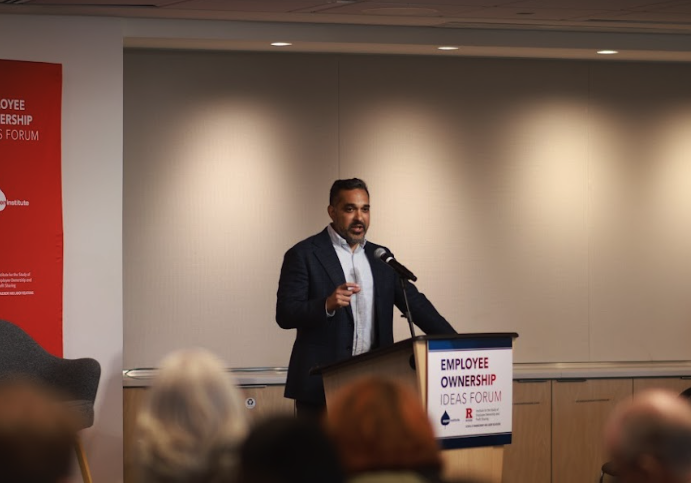
Fmr. NEC Deputy Director Bharat Ramamurti Keynotes the 2026 Employee Ownership Ideas Forum
Description
In this video, Bharat Ramamurti — former deputy director of the National Economic Council of the United States — speaks at the 2026 Employee Ownership Ideas Forum, which took place on June 2-3, 2026, in Washington DC and online.
For more videos from the Forum, visit our event page or subscribe to our YouTube channel.
And subscribe to our podcast to listen on the go.
[silence]
[00:00:05] Speaker 1: I have the pleasure of introducing our next featured speaker, who I think has just joined us in the back, Bharat Ramamurti. Bharat Ramamurti served as deputy director of the National Economic Council in the Biden-Harris Administration from 2021 through 2023. In that role, he worked with Congress to secure the enactment of several landmark pieces of economic legislation and helped lead the administration’s efforts on student debt, competition policy, small business, broadband, housing, technology and social media platforms, financial regulation, and more. He regularly appeared on television at the White House press briefing to discuss the administration’s economic policies.
Before joining the administration, he was appointed as a member of the Congressional Oversight Commission for the CARES Act by Senate Majority Leader Chuck Schumer, where he helped oversee half a trillion dollars in government spending. He previously served as the top banking and economic policy advisor for Senator Elizabeth Warren, including during her 2020 presidential campaign. He is a graduate of Harvard College and Yale Law School and is also a Massachusetts guy, which means he’s always welcome. I’d love to welcome Bharat to the stage.
[applause]
[silence]
[00:01:25] Bharat Ramamurti: Thanks very much for that intro and for having me. I have exactly five minutes to do these remarks, which in my mind is the exact perfect length of time to do remarks like this, so I will adhere to that. As you heard, I spent about 15 or 20 years working in policy in the Senate, on the presidential campaign, and then ultimately in the White House for several years. I would always say to people that it’s very rare in politics to find a win-win. Almost any policy is going to have trade-offs and winners and losers, and the entire question is, how do you weigh those trade-offs against one another and make a decision?
In my experience, in my time, facilitating employee ownership is one of the very rare win-win policies. It’s a win for employees who have an opportunity to not just preserve their jobs but build wealth. It’s a win for owners who now have more exit options and a chance to see their legacy, their business that they built grow over time.
It’s a win for consumers who are going to have more options in the communities that they live in if these businesses are preserved rather than closing down. Frankly, it’s a win for the entire American economy because these types of small businesses are the foundation of our manufacturing sector, of our healthcare sector in many ways, of our industrial policy in the United States. We would see a real harm to the economic competitiveness and, frankly, even national security of the United States if we were to see a big deterioration in this area.
We’re at this key crossroads right now where all of the businesses that were started by the baby boomer generation are potentially going to close or be sold. 3 million businesses that are baby boomer-owned, and the vast majority of baby boomers report that they want to figure out a way of disposing of their business. They want to retire basically within the next 10 years. What’s going to happen to those 3 million businesses that collectively employ about 32 million Americans?
McKinsey did a study in 2022, and what they found was that of the businesses in this category that transferred ownership or that were disposed of in some way, only 5% were actually sold. 3% were sold to new owners, 2% were sold to employees, and the remaining 95% shut down in some fashion. It’s a huge problem, and this wave is only going to grow bigger and bigger and bigger over time.
As I said, there’s a real regional concentration to this issue, too. These types of businesses are overrepresented in rural communities, and there also is a industry concentration. They tend to be focused on construction, for example, manufacturing, home healthcare services, healthcare in general. If you put all of those facts together, what could you see over the next 5 or 10 years without some kind of policy intervention? You could see waves of business closing, particularly in rural areas, losses for the employees, the millions of employees that work at these firms, but then huge rippling losses for all the people who live in these areas.
What happens to the housing market if some of the main construction firms in these smaller communities shut down? What happens to the quality of healthcare service in the United States if the main company in your community that provides home healthcare services shuts down, or the company that provides nurse staffing services to hospitals shuts down? There’s a real concern about the sort of concentration in the economy, and by that, I don’t just mean the biggest businesses growing bigger but the availability of basic services to people who don’t happen to live in one of the 10 biggest metropolitan areas in the United States.
What does the data show about employee ownership? Not only is it a great transfer of wealth to workers, but these businesses tend to overperform non-employee-owned businesses. We in the government keep track of performance on contracts very carefully. What we see on the government context is that when the government contractor is an employee-owned firm, they get much higher ratings for quality than non-employee-owned firms. There’s a quality difference. You see, obviously, wealth generation for employees who, frankly, don’t have that many pathways to homeownership.
One of the stats that I always remind people is there’s all this fixation on the stock market. 50% of households in the United States don’t own any stocks. About 60% of households are homeowners. What about that remaining 35% who can’t build wealth through the home that they own, who don’t have stocks? What’s their pathway to wealth creation and passing something along to their kids? This is one way of doing it.
What can we actually do right now? Three things in my mind. Number one, there is a financing gap that I’m sure others have talked about before. Even if the employees of a company want to buy, it’s hard for them to stack up with potentially competing offers from a private equity firm with deep pockets. There’s already bipartisan proposals in Congress to create some kind of financial support via the federal government. Maybe that’s a revolving loan fund where you provide a low-cost loan so the employees can finish the transaction, and it’s self-sustaining because these new companies will then pay back the loan, and that money goes out the door again to the next generation of potential owners.
Number two, even if you have the money and you have the will, these are really complicated transactions. A group of employees may say, “I really want to buy this firm, but I don’t have the faintest idea how to put together the paperwork. I don’t have access to the kinds of fancy lawyers and accountants that some of the other deep-pocketed firms have. What can the government do to solve that? Maybe part of it is technical assistance, part of it may be trying to simplify the regulatory environment so there aren’t quite as many hurdles to employee ownership.
The third thing, frankly, is tax treatment. If an owner is looking to sell and they have one option that provides a certain type of tax treatment, why can’t we make it more of a tax-advantaged sale to sell it to employees relative to somebody else? One thing that the government can do relatively easily is change the tax treatment of certain types of transactions. If we put a bit of a thumb on the scale from the federal government for a tax-advantaged sale to employee owners, maybe that can move the needle.
I’ll close with this. There aren’t an awful lot of issues right now in Washington that command bipartisan support. This is one of them. A lot of the bills and a lot of the ideas that I just talked about, there’s already good bipartisan proposals for them at the federal level, and there’s a lot of progress happening at the state level across party lines as well.
A tiny bit of optimism to end here. I do think that we’re at this key crossroads moment. I’m worried that if we don’t do something in the next few years, we’re going to let a massive opportunity go by, but the good news is that we do have bipartisan momentum to try to solve this problem. My hope is that events like this and spreading it beyond here to the networks that you’re operating in can create a bit of momentum to actually see the types of reforms that we need. Thanks.
[applause]
About the Employee Ownership Ideas Forum
The Employee Ownership Ideas Forum brings together leading policymakers, practitioners, experts, and the media for a robust discussion on how we can grow employee ownership for the shared benefit of American workers and businesses. It is hosted by the Aspen Institute Economic Opportunities Program and Rutgers Institute for the Study of Employee Ownership and Profit Sharing.
About the Rutgers Institute for the Study of Employee Ownership and Profit Sharing
The purpose of the Institute for the Study of Employee Ownership and Profit Sharing is to study the various models that have emerged and will emerge of employee ownership shares and profit shares in the corporation and society of the United States and around the world.
About the Economic Opportunities Program
The Aspen Institute Economic Opportunities Program advances strategies, policies, and ideas to help low- and moderate-income people thrive in a changing economy.
Join Our Mailing List
To receive occasional emails about our work — including new publications, commentary, events, fellowships, and more — join our mailing list.
Connect on Social Media
For news and updates every day, connect with us on the social media platform of your choice.