Made Here, Owned Here: Employee Ownership in Manufacturing
Description
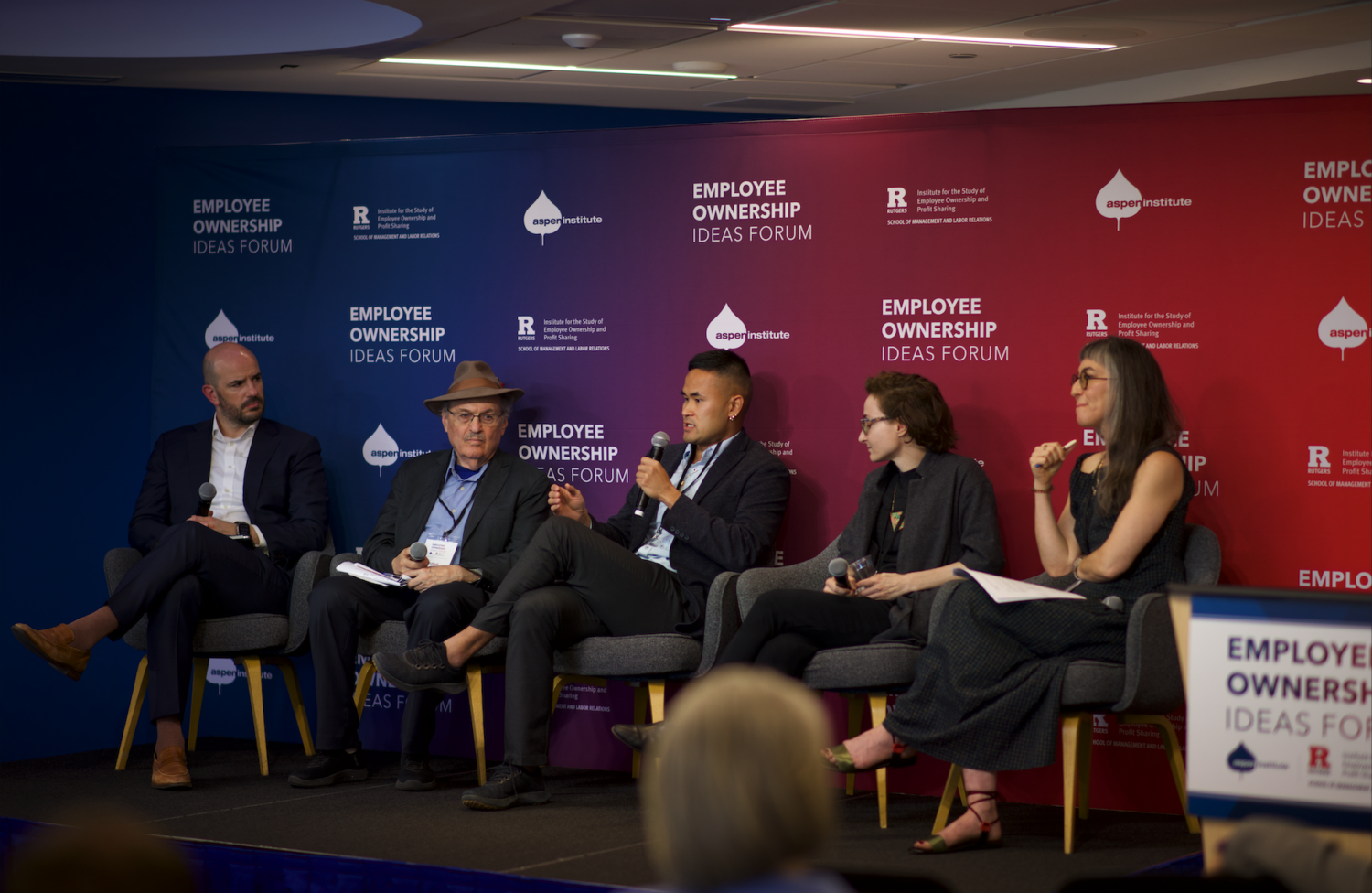
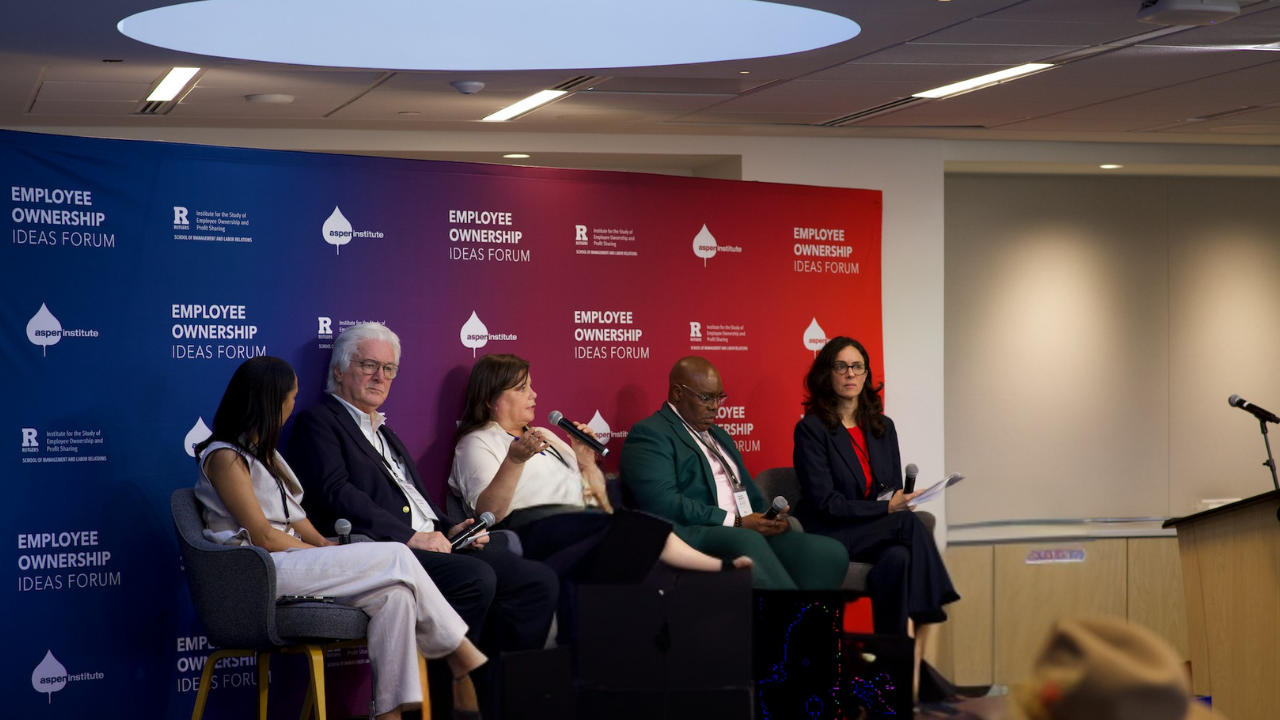
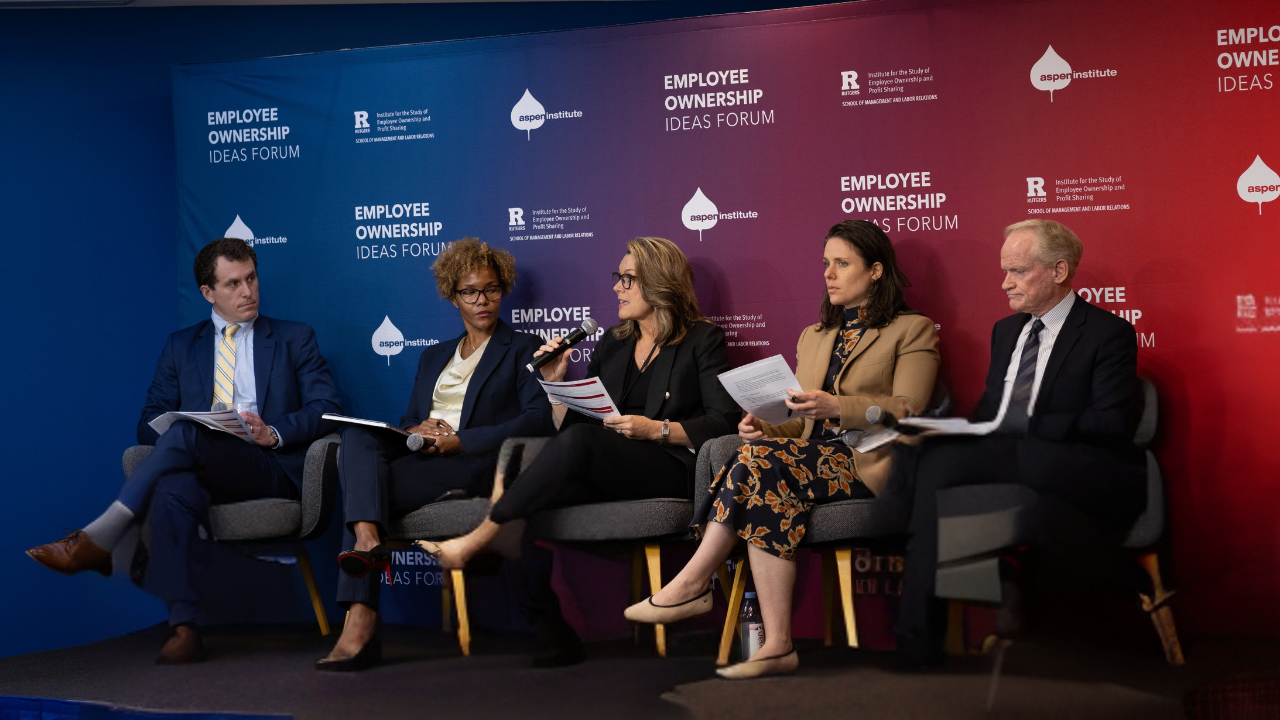
American manufacturing continues to face an uncertain future, with decades of offshoring and consolidation hollowing out communities and leaving workers behind. This session explores how employee ownership models can help sustain existing manufacturers, support the rebuilding of domestic production capacity, advance our national competitiveness, and ensure that the workers who make things in America have a real stake in the businesses they power.
This video comes from the 2026 Employee Ownership Ideas Forum, which took place on June 2-3, 2026, in Washington DC and online.
For more videos from the Forum, visit our event page or subscribe to our YouTube channel.
And subscribe to our podcast to listen on the go.
Speakers
- Douglas Kruse (opening remarks), Research Director, Institute for the Study of Employee Ownership and Profit Sharing
- Rich Cammarano, President and CEO, Tech Etch Inc
- Veda Clark, Chair of the Board of Directors, Lampin Corporation
- Elisabeth Reynolds, Professor of the Practice, Department of Urban Studies and Planning, MIT
- Jack Moriarty (moderator), Executive Director, Lafayette Square Institute
Resources
- Website: Tech Etch — Employee-Ownership
- Report: Employee Ownership and ESOPs: What We Know from Recent Research
- Website: Lampin — About Us
- Website: MIT Work of the Future
[00:00:05] Matt Helmer: Thanks to Senator Kaine for joining us. We’re going to move along into our next panel on employee ownership and manufacturing. From Rutgers University, we have Doug Kruse, who’s going to provide some opening remarks before that panel starts. Thanks, Doug.
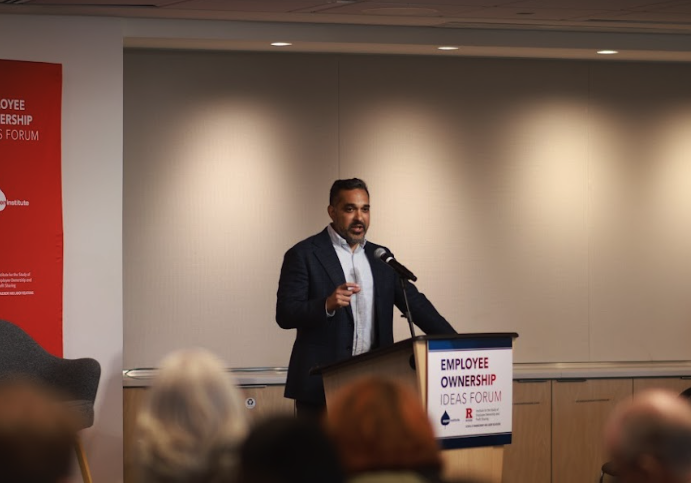
[00:00:19] Douglas Kruse: Thank you. I hope everyone can see me. I remember a psychological experiment done some years ago, where some listeners could see a speaker and others could not. The ones who could not see the speaker ended up getting more distracted and remembering less. I always try to make sure my students can see me. At any rate, I’m very glad to be here. I’m going to give just a few quick notes before we hear from the panelists on the next session.
I was asked to provide an update on employee ownership research. We continue to learn a lot. One exciting new study in particular I’ll mention in a bit. First, just for some context, the most studied issue, employee ownership has been studied a lot, hundreds of studies. The most studied issue is how it affects company performance. There’s two broad conclusions from that.
Over 100 studies clearly show employee ownership is linked to better performance on average. True across a range of samples, big and small firms, US and non-US methods, pre-post studies using statistical corrections. The second broad conclusion is that there’s a lot of dispersion around those average good outcomes. Some companies do really well and some don’t. Employee ownership is not a magic pill that automatically improves performance.
One of the most important research areas is to try to explain that dispersion. We know in general that outcomes are better when employee ownership is accompanied by policies that help to increase a sense of ownership, such as by providing workers, say, more information, training, job security. Again, there’s no magic pill or formula. Engaged in a big study right now with ESOP Association to survey workers and try to find out what are the critical success factors, what explains that dispersion.
Apart from company performance, research studies also tend to find positive effects of employee ownership on outcomes, such as income, wealth, job security, workplace safety. Studies on employment stability showing lower layoffs among employee ownership firms are especially interesting from a policy perspective since they indicate that employee ownership may have favorable effects on communities and the overall economy by helping decrease unemployment and improving a range of community outcomes.
Going back to firm performance, the study I mentioned, we just have an exciting new study that was released on company productivity. While past studies find an overall positive performance effect, those studies tend to be focused on publicly-traded companies where we have good performance data. The public companies tend to have low levels of employee ownership, 2% to 3%, and we happen to have strong evidence on performance effects in closely held companies where employees are much more likely to own the majority of the company. Those are the companies that we’re studying right now with the ESOP Association, 100% ESOP companies.
Two of our colleagues, Eric Hoyt of University of Rhode Island, Fidan Kurtulus of UMass Amherst, were able to arrange access to confidential census data in a research data center where they could match administrative data on ESOPs from the Department of Labor’s Form 5500 to performance data from manufacturing establishments collected by the Census Bureau.
It provides a much larger, more representative sample, in particular by fully including closely held companies. One great aspect of these census data is we can not only do cross-sectional comparisons of ESOP and non-ESOP firms, we can also see how productivity changes when manufacturing companies adopt ESOPs. The bottom line result confirms the past positive findings.
Manufacturing companies that adopted ESOPs between 2010 and 2015 had between a 6% to 7% greater productivity increase than otherwise similar companies that did not adopt ESOPs. Now, it might be that that simply reflects companies simultaneously adopting other good management practices, but these data allowed controlling for a wide variety of management practices and the ESOP results were on top of those.
Of course, ESOPs are associated with a number of good characteristics on their own to help improve employee identification and governance. One other noteworthy result is the best effects came when combining ESOP adoption with broad-based profit sharing or group performance pay, showing an effect of almost 13% when those were adopted together.
That’s a big advance in our research knowledge. Just one other quick note on a related topic. We know from past research that employees in employee ownership firms are more likely to report a favorable climate for innovation, but we haven’t known whether that leads to more innovation.
A new study looks at this, just forthcoming, finds that not only do firms with broad-based employee ownership produce more patents in a year, but patents actually increase as firms move from no employee ownership to broad-based employee ownership. That’s very consistent with employee ownership having a causal role in increasing more innovation.
I’m glad to talk with anyone about research in this field, but now I look forward to learning from the panelists in the next session on the role that employee ownership may play in outcomes for companies, workers, communities, and the broader economy. Thank you.
[applause]
[00:05:52] Jack Moriarty: Give another round of applause for Doug and all the exciting research that Rutgers has led on. I’ll invite the panel to come on up with me. While we do that, I’m going to switch out here. Excellent. While the panelists are coming up, once again, Jack Moriarty, great to be with you this afternoon.
This next panel is about, I think, trying to bridge two very important topics in our world. The first, of course, is employee ownership, but the second is, what’s going on with the American manufacturing sector? I think many of us are aware, over the last 10 years or so, there’s been a real sort of Renaissance and thinking on both sides of the aisle. What does it mean to actually produce here domestically? How should we be thinking about the configuration of our supply chains, our domestic productive capacity? Our job quality, certainly.
I think we’ve realized, certainly, the consequences of offshoring. There’s a bipartisan political appetite to re-industrialize. I think many of us, and I’m certainly biased here, think that employee ownership has a very important role to play in that conversation. It’s my pleasure to introduce our panelists. We have Veda Clark, who is a board member of Lampin Corporation, an ESOP company, and former CEO of Litecontrol, which was also an ESOP.
We have Elisabeth Reynolds. Liz is a professor of practice at MIT, where she’s focused on systems of innovation, manufacturing, and industrial competitiveness, particularly in the context of regional and national economic development. She’s also just put out a new volume called Priority Technologies, which I recommend as a member of the pre-order club.
Then we’ve got Rich Cammarano, who is a CEO of Tech-Etch, which is a 100% ESOP company based in my beloved home, Commonwealth of Massachusetts. We give a quick round of applause for our panelists.
[applause]
Thank you. We’re going to go a little bit out of order here. Actually, Liz, I’d love to start with you as somebody that has an empirical background, a policy background, focused on American manufacturing. If you could give us a broad overview, what’s going on in the manufacturing sector right now? What are the forces that we should be considering to help ground the conversation?
[00:08:06] Elisabeth Reynolds: Great. Thank you. It’s a real pleasure to be here. I am someone who I’m relatively new to the ESOP topic, but I come to it through the lens of manufacturing. It’s hard to say if there’s ever been such an exciting time for US manufacturing right now. I think that what we’re seeing is a number of forces that have provided a lot of tailwinds for manufacturing.
First and foremost, I would say the COVID experience for the country exposed the vulnerabilities. Whether it was low value-added PPE or high-end semiconductors, the country’s manufacturing capabilities have really been deteriorating, as we knew, over decades. That has led to, I think, a real focus and, I’d say, collective agreement that we need to rebuild and reinvest to regain our competitiveness, not just in our industrial base today, but also to build toward the industries and the technologies of the future.
If we look at quantum, if we look at bio-manufacturing, critical minerals, semiconductors, by the way, all of those covered as chapters in my book, this is what we’re building toward for the future. I think the motivation, in part, I see at least four motivations for this shift. One, of course, has been the geopolitical challenge.
If we look at China and its lead, both in manufacturing capabilities, but also in terms of technological leadership, we used to be leading 20 years ago, and the majority of leading technologies, they have now taken that lead. It’s been flipped. Secondly, I think, when we look at supply chain resilience, we now understand resilience is as important as efficiency, and we need to invest in it. What does that look like? Part of that response to that is a domestic supply chain. Not all of it, but part of it.
Third, climate change. Despite what you hear in the headlines or see in the headlines, this country has made major investments in moving toward renewable energy, in trying to make investments in our grid and in a transition there that we will have to continue, and that’s got a strong manufacturing base. Then the fourth one for me, and we’ve talked about it I think today, is inequality and the growing concerns for inequality and how it affects our communities, our workers, but our social cohesion.
I think for all of those reasons we saw in the Biden administration, I was a special assistant to the president, for President Biden in 2021, 2022, this major focus that started certainly earlier. President Obama also made major investments, but it has continued in the Trump administration, a doubling down in a lot of the same areas, an expansion of the tools one might use that we can discuss.
On the whole, we’re at a place where the tailwinds are very strong for reinvestment and for building, not just reshoring, but for building anew. We have some headwinds. They’re called tariffs. They’re not, I think, helping our small and medium-sized manufacturers, but we can talk about that later.
[00:11:09] Jack: Well, thank you, Liz. Rich, you’re doing it. You’re leading a manufacturing company, 100% ESOP, but there’s been a couple of different points on that employee ownership journey. If you could introduce the business and then a little bit about the background, how it became employee-owned, and those couple of stages along the way.
[00:11:28] Rich Cammarano: Sure. First things first, I am not pimping a book.
[laughter]
I’m just a manufacturing guy. I have the privilege of leading a company that’s been in the manufacturing business for 62 years. We have about 600 employee owners in three locations, two in Massachusetts, one in Minnesota. I’m going to oversimplify the business. We provide manufacturing services in two forms, one precision metal fabrication and flexible circuit fabrication and assembly, and then we have a business unit, which is a product business model that also provides components to the electronics industry.
We have been an ESOP for about 26 years. Maybe we can go into the ESOP crossover a quick second, though, too. Although we’ve been an ESOP for 26 years, 30%, in 2018 we went 100%, we really didn’t understand what it meant to be employee-owned. We had the financial gain. We didn’t have the cultural impact. That not only made an impact in how we conducted our business, it also made a huge impact in how we looked at manufacturing.
I think one of the forces in manufacturing, which employee ownership can be an accelerator to, is that, back to the point that I don’t have a book, manufacturing isn’t necessarily seen as an exciting industry or historically hasn’t been seen as an exciting industry. With technology and advances in robotics and automation, the adoption of AI in our business, not just the front office but on the manufacturing floor, there is a renewed excitement.
I’m also affiliated with National Association of Manufacturers, and there is a lot of momentum with recognizing that it’s not just the trades, as we traditionally think of trades, electricians, plumbers, but there is a career opportunity in manufacturing. Then you couple that with employee ownership.
Now we have folks that maybe don’t have the college degree that are looking for that career. They see it in manufacturing, but at first glance, it’s an hourly paycheck. What employee ownership does, it provides for net worth. It provides for an accelerator to their financial position.
[00:14:03] Jack: Rich, thank you for bringing up the technology adoption, including AI. I think we’ll come back to that, apropos of Jim’s comments earlier. Veda, you’ve got a very unique background insofar as you’ve been an operator. You’re on a board of an ESOP company, but you also have some economic development experience of your own at the state level. I would love to hear from you how you’ve approached these issues and the intersection between employee ownership and domestic manufacturing.
[00:14:29] Veda Clark: Thank you. Also, it’s great to be here. I haven’t been at an ESOP conference in quite a while, and it’s great to see so many familiar faces and companies really trying to understand and promote the differences in employee ownership and how to propel it.
I do come at this from several different levels. I was CEO of a manufacturing, imagine a woman in manufacturing, when she was 35, way back then, only 10 years ago. I became CEO because the owner decided to retire. With him, we created this idea. He had always valued his employees, and he and I came up with the idea of an ESOP.
We completed the purchase. We had about 300 people at the time. We completed the purchase of the ESOP. Half the time, we had planned, in seven years, a $25-million purchase. I’m here to tell you about the, a little bit, negative sides of being in ESOP also. We had done a lot of investing. We had bought a new plant. We had started a joint venture with three European companies. Then 2008, 2009 happened.
We were highly leveraged from completing the purchase, buying a building. We had two buildings now, two locations, a national presence and a presence also in Europe, and our bank became not so happy. The board, even though we did, we found some mezzanine financing, which is very difficult for ESOPs to find, but there is Mass Capital Resources in Massachusetts, which does understand ESOPs and provide some mezzanine financing.
In any case, the board got nervous, the bank got nervous, and so we sold to conglomerates, who sold to another conglomerate, another. That company is no longer in existence. Then I did a few other things, but the Commonwealth reached out to me because I had extensive experience running several manufacturing companies after that, and they asked me to become, for the Commonwealth in mass development, helping to promote manufacturing throughout the state, because it has been noted that manufacturing at the time, even 10 years ago, was not such an attractive place to work.
We had to figure out how to help young people understand that they had a future there, how it could be an exciting future. Technology was just coming into play, and so we were doing a lot of work with schools and universities throughout Massachusetts and trying to help them understand how good a future they could have.
When you added to that being an ESOP and teaching people how to learn how they could create their own financial future, I think all of those things really connected at an important time for me. It made it a lot of fun to be visiting with manufacturers across Massachusetts.
[00:17:46] Jack: Well, I do want to come back to the access to capital challenges because I know, Rich, we talked about that on our call, and we’ll have a conversation tomorrow as well that digs into that even further. I want to first reflect on a couple of my observations from the employee-owner panel this morning. I think, Veda, you alluded to this, but we heard a couple of things.
We heard that employee ownership, it was a mindset first before it was a financial event. We also heard that this is about retention. We’re not doing this just because it’s pro-worker, although it’s certainly that, and we certainly are, but there’s a real competitiveness, outperformance, retention, opportunity.
Then, of course, we heard from Doug that, as many of us that are familiar with the literature know, it’s not just. It’s necessary to have employee ownership, but it’s not sufficient. We need to have high-performance work practices. We need to create culture that actually takes that ownership and turns it into a competitive advantage.
Rich, I’d love to hear. I had the opportunity at the ESOP Association National Conference to participate with some of your colleagues, employee owners up on the Hill, and it was very powerful, a culture that you’ve created. I would love to hear how you approach that.
[00:19:02] Rich: As I stated, we’ve been an ESOP for 26 years, 30% until 2018, then 100%. The culture, Jack, that you’re referencing really was a laggard. I’ll say it this way. We understood that an ESOP was another retirement thing, and it landed at thing. As I joined the organization, I’ve only been with the organization eight years. That tells you a little bit about how long some of our employees have been with us.
When I joined the organization, it was a thing. Some employees understood it, but not many. We didn’t have some of the infrastructure. We didn’t have the employee ownership committees. We didn’t really have the conversation. Then the little thing happened called COVID that distracted us for a little bit. Then after COVID, and I would say even during COVID, short story, we had more than 500 employee owners, but we weren’t really a big company. We got squeezed because we didn’t qualify for PPP. Don’t get me started on that because then it got forgiven. A lot of companies really benefited back to the capital.
We didn’t quite get that, but guess what? We had people to be concerned about. We had people who got COVID. We had people who were scared. We pulled out of our own profits to take care of our people. That might have been a seed that then changed our trajectory on really embracing what it meant to be employee owners because we were caring for one another.
As a leadership team, we made a pretty hard decision. As employee owners, all in, there was an appreciation for when someone gets sick or needs to take– that was happening. That just has propelled into the more recent years where, as Jack just alluded, when we hit the Hill, sure, I’ve been part of those advocacy days with the ESOP Association, but we now send purposely employee owners throughout the organization to share our story.
It’s our employee owners that are actually embracing our story and have built up a real understanding of what it means to be employee owners, to respect one another, to be great teamworks, to live up to commitments, even just the protocol of showing up on time for meetings. Then that also reinforces our productivity on the manufacturing floor and one stat for us. If you were to come on our manufacturing floor, it’s noisy. There’s a lot of machines. There’s dangerous chemicals. Safety is a big thing for us.
Sure, I can stand up front and talk about our safety rates, but when our employee owners stand up front in all company meetings and really command the audience to talk about how important safety is, that’s when you see real growth starting to take place.
[00:22:06] Jack: Well, speaking of growth, Liz, you’ve studied the manufacturing sector from inside out. What are its capital constraints? What’s driving retention? What’s driving performance? If you could share maybe more of a bird’s eye view on, and maybe start the conversation on the capital issues that you’re seeing.
We know that there’s a silver tsunami, and my team’s done some research on this, that we have substantial numbers of manufacturers that are going to be selling sooner rather than later. What does that mean for our industrial base if we don’t have the conditions created to facilitate those sales, ideally, to employee owners where appropriate? There’s also growth capital and the need to think about competitiveness and acquisition and so forth. Liz, if you could share your thinking and research on those topics, that would be great.
[00:22:55] Elisabeth: Yes. Well, I think that’s actually, in part, what brought me into this topic was a recent survey by the New America Industrial Alliance and Sustainment showed a survey of, I think it was about 100 SME owners, who said that 50% of them were expecting a transition in the next five years.
You multiply that by the number of small and medium-sized firms we have in the country, and you ask yourself, if it doesn’t go well, what are the implications for this country when you are trying to rebuild in such a strategic way and at scale? In many ways, my focus has been on that small and medium-sized manufacturer and what we need to do because they are the backbone of our supply chains, right? 250,000 in the country.
I always say, if we just wanted 20% of those companies to be at the frontier of technology, the frontier of high manufacturing productivity, it’s 50,000 firms. Everyone here who works in manufacturing understands, like, what mechanisms do we have in this country to help support 50,000 small and medium-sized manufacturers? Not many.
I think I would say, despite my book, I would say that the issue is not innovation. The issue is adoption, technology adoption. The research we’ve been doing at MIT and elsewhere is to ask ourselves, what are the barriers to this adoption? I led MIT’s Task Force on the Work of the Future in 2018 to 2021. At the time, it was, the robots are coming. They’re going to take everybody’s jobs. We’re all going to be with a universal basic income. It’s just a terrible outcome.
The fact is, here we are. If we had had more robots, we would have saved more lives during COVID. Actually, robotics is a pathway, along with AI, along with the automation, for US competitiveness and for the strength and the growth of US manufacturing. We are short, as people know here. Currently, 500,000 jobs openings. Estimates of 2 million.
Even with AI, and I would say even for all of the sky is falling with AI, actually in operations, more so. White-collar jobs is another story. I always say, I’m not too worried about the lawyers, but there are other people to worry about. In operations, it’s a real game-changer.
This focus on how do we get technology into the hands of our small and medium-sized firms, and frankly, into the hands of frontline workers? AI has that democratizing opportunity. My first part on the research side is this technology adoption. The second one is the capital stack. Part of my research at MIT has been about how do we scale new technologies in manufacturing?
Our whole capital stack and risk capital has been oriented largely not toward the hardware company, toward the software company. Higher returns, all of that. We’re missing what we call the middle growth capital in the country. I would say there’s been a recognition of that now, in many ways. We’ve seen the private sector start to venture and others saying, okay, these industrials are interesting. What might we do there?
Then on the public sector side, we started, in the Biden administration, the Office of Strategic Capital in the Department of Defense. We brought in a Make More in America through the EXIM Bank. We’re looking for ways for public capital to de-risk technology and help make it more accessible.
On the capital front, we’re not there yet. Of course, it’s night and day compared to what China does on that front. At least, I think we have a recognition, and we’re looking at both public and private vehicles, if you will, to try and address that gap.
[00:27:06] Rich: Yes, just to chase the access to capital. We’ve got 600 folks, been in business for a little bit. We’ve got marquee customers. We have a decent balance sheet. My competitive landscape is primarily against firms that are private equity held. PE has a war chest. As part of our growth strategy, as you would expect, we have an inorganic growth strategy, along with needing to reinvest into our factories and our equipment and continually upgrade.
That access is one of our bigger challenges right now. We’ve got the reputation. We’ve got great technology. We have great partners. We’ve got a great culture. We’ve got all this greatness. Yet, there is a fuel to growth, and that is often capital. It is a very real challenge for small and medium-sized manufacturers.
Then to boot, the small and medium-sized manufacturers that’s employee-owned also has that other disadvantage. Opening up those avenues, being creative, it’s necessary for us to continue to grow. Otherwise, we’re going to stagnate. Then we’ll be forced with other exits. Such as what Veda shared earlier.
[00:28:31] Veda: I’ll go back to that in a minute, but I wanted to touch on a point that Liz brought up. With Mass Development, one of our key goals was to connect upcoming entrepreneurs who are beginning to start manufacturing companies with other manufacturers in the state so that they could get their prototypes and things made in Massachusetts rather than jumping over to China or wherever else they might get them made.
We really had two purposes in that. We wanted to keep manufacturing in Massachusetts, but we also wanted to introduce these small to mid-sized manufacturers who are making the prototypes with ideas and thoughts about how to approach automation because that’s what many of these entrepreneurs were trying to do, get automation into manufacturing.
We were trying to help these manufacturers who we can be a little old-fashioned in our ways. Not only do you have to find the money to do it, which is very difficult, then you also have to train the employees. Although employees are very excited about using new technology and it’s a great way to get young employees, it’s not such a great way if you have a workforce that’s in their 50s and 60s. They don’t want to hear, I have to use a different piece of equipment. There are a lot of challenges involved in bringing automation into manufacturers when you have a long-term workforce, which is what many ESOPs also have. There are some issues there.
The access to capital issue– I had a state business card, so I’d be walking around saying I wanted to meet with these manufacturing CEOs, and they would say, can you help me find some money? My answer was, I can connect you to other manufacturers. I can try to help you find workers.
The purpose of the fund we have is not to fund manufacturers. That was a little difficult to deliver, shall we say, but we could help them find some resources. Those resources, oh, there’s the SBA. Things do exist, but they really aren’t that helpful. Access to capital, growth capital, the capital you need to keep growing your business when all of your capital is tied up in your inventory, your factory, all the things that banks look at and say, oh, that’s where all your cash is, as well as the repurchase liability, access to capital is very difficult and risky for financial institutions. They look at a manufacturer who’s an ESOP and say, no way, no way. We just can’t do it.
[00:31:36] Jack: I think that’s, first of all, an unfortunate anecdote, but I think an apt one. I’ll just share some of my personal observations over the years in the policy field. There have been attempts, as many of us in this room know or have been part of, to try to integrate employee ownership into existing programs. You mentioned SBA and the 7(a) program. That work remains ongoing, but we’re not there yet. Treasury efforts, state small business credit initiative during the Biden administration.
I think there’s been progress made to move employee ownership into the mental model of what it means to do industrial policy, what it means to do development finance on a bipartisan basis. My observation has been that we don’t tend to do all that well when it’s not dedicated infrastructure. When employee ownership and ESOPs in particular are one use case of a much broader array of use cases that are much more familiar that creates friction for us.
From a policy design standpoint, I think one lesson at least that I’ve taken away is we really need to create institutions and structures that are designed for employee-owned businesses. We’ll talk more tomorrow about the American Ownership and Resilience Act, which is one effort that we’re certainly part of to help support both new formations, but also to the conversation today focused on mature ESOP companies, employee-owned businesses, worker cooperatives to help sustain them, grow them, recapitalize them over time.
Before we get to policy, though, and actually, I want to hear from Liz on that front, I did want to make sure that we really leaned into Doug’s empirical finding around the productivity premium. I think we should be shouting that from the rooftops, certainly in this town, but also in state houses as well.
Again, as we’re having a national conversation about what does it mean to have superior manufacturing and productive capacity in geopolitical competition, the idea that not only is this powerful for workers and retirement security, but, oh, by the way, we can actually outperform by integrating employee ownership strategies, that’s a huge deal.
The findings that Rutgers and Doug and others have put out is, you heard the 67% premium, but that productivity effect goes up as wealth and account balances go up, which is even more powerful. I’d love to hear from Rich and maybe then Veda, how did you see that data manifesting on the shop floor, and what should that mean for how we approach re-industrialization more generally?
[00:34:15] Rich: Sure. Maybe I’ll share a story on the floor, but then also in the back office. Again, very industrial manufacturing environment, so if you close your eyes and envision that. There was a longstanding employee owner. His name is Dog. That’s what he goes by. He’s a crusty guy. He’s been on the manufacturing floor for 25-plus years.
We have a quarterly all-company meeting, like many manufacturings do. Everyone is off the manufacturing floor. We talk about our business. It’s very open dialogue. Then we have open mic towards the end. He approached the mic and shared that he had an idea on his particular work area. He was frustrated that the engineers didn’t necessarily listen to him. This was probably five or six years ago.
Why I share this story is he felt safe enough in a room with twice as many people, lots of his peers, and the reputation of being Dog, to come forward and say, I’ve got an idea that’s going to improve my manufacturing experience, my workspace, improve productivity. I just don’t have a voice. It was hard to hear that in an all-company meeting. It gives you a flavor of what we talk about in our all-company meetings, anything and everything.
Thankfully, we heard him. Then that began a conversation on who’s best to know where are the opportunities for efficiencies, for increased productivity, for increased safety, lies? It is with the workers, as we say. In my case, with the folks on the manufacturing floor. That’s one example. I do want to flip it. I know you just asked about the manufacturing floor, but I’m going to take some liberties.
I think employee ownership also shows up when investing back into our business and buying capital equipment, which is often the responsibility at Tech-Etch of an engineer. We, like all companies, have capital expense request forms that have our NPV, IRR. You’ve got to do the math, and you have to have the business case.
What’s super cool is the engineers often feel more compelled to build a stronger business case so that, when it actually hits the committee, it flies through. With that, there’s a stewardship that, if we are going to ask for $100,000, $200,000, that they see the value themselves. They workshop. They do the math themselves and realize, okay, I’m going to get a good investment as an employee owner. I think it takes place across an organization if you allow those voices to come forward.
[00:37:04] Veda: That’s a great story. I have a couple stories to share. We were a lighting fixture manufacturer, commercial lighting. We had a big Cape Verdean population. About half of our workers were from Cape Verde. We had monthly meetings. I would present all of the financial data and all the information that we needed to share.
At one of the meetings, one of the fellows came up to me and, he was from Cape Verde, he said, half the people can’t understand the slides and then what you’re saying. My language skills aren’t very good, so I couldn’t handle it. Monthly, he would have the task of coming and sitting in my office and translating all the slides so we could communicate a little bit more effectively.
Then he would also help ask questions from the folks on the floor and answer them. That was a way we dealt with the communication issue. On a more empirical basis, we had, when we started our ESOP, 300 employees. We introduced continuous improvement into the organization. I have a couple stories here, but I’ll try to shorten it. We introduced continuous improvement to the organization.
As we grew from 25 million to 45 million, we were able to reduce our workforce solely through attrition from about 300 people to 200 people. That was not just on the plant floor. That was throughout the organization because we were very active.
Continuous improvement, as most of you may know, is very connected to employee ownership in that you have a voice. You have to have a voice. It was really a tool, continuous improvement, along with the employee ownership that helped us grow the organization into understanding what employee ownership is all about.
[00:39:07] Elisabeth: If I could just add, I think this issue of increasing productivity in US manufacturing is one of the central challenges for the country. We’ve had essentially flat productivity for 15 years, more or less, since post-2010. Figuring out how exactly we’re going to change that model and change that trajectory to a higher productivity, higher resilience, higher sustainability, actually, I think is a major challenge right now for the country.
Technology adoption is one path that we know to be important, but the other is employee ownership, broadly defined, and how we draw that in. Again, as I said, I see AI as a potential tool to support that because it is a tool, and it’s a tool that we use that we need to use to improve the lives and the work of our workers. If you take that lens and you see, okay, let’s put it in the hands of everybody, given this tool, what would you change differently about your work? It can be pretty powerful.
[00:40:18] Jack: I think we’re having a conversation as a country about what does it mean for workers to integrate AI and to adopt AI solutions. My team and I had a conversation earlier this week that, if you subscribe to the idea that Thomas Piketty said R is greater than G, the rate of return on capital ownership is likely to exceed the G, the growth rate of the economy, proxy for wages, then that creates inequality.
I think there’s been a lot of conversation about, and understandably and appropriately, how do you do better on G so that we don’t have these yawning inequalities? I don’t think we’ve had nearly enough time spent on, well, how do you get everybody to participate in capital ownership, so that when we do adopt productivity enhancements through AI or other solutions, perhaps there’d be more willingness to do so, number one?
There’s been interesting early research on that at employee-owned firms. Also, when we do have productivity gains, valuation increases, that’s broadly distributed and broadly participated in and shared. Liz, maybe sticking with you, what do we do next? You’ve been in the policy seat. You also mentioned correctly that the Trump administration has really doubled down on manufacturing, certainly industrial policy tools.
You mentioned the Office of Strategic Capital. That’s been significantly expanded in terms of its firepower financially. Where do we go from here? There’s been conversations about what are the obligations of industrial policy? Employee ownership has historically not been on that menu. How might we change that?
[00:41:56] Elisabeth: Yes. No surprise here. I’m going to point to some successes, I think, of the last few years in terms of industrial policy.
[00:42:06] Rich: Are they in the book?
[00:42:08] Elisabeth: I think they are. This whole idea that we’ve gotten actually now as a country understood that leaving things to the markets may be good for individuals, may be good for individual companies, but is not delivering what we need as a country. I think we now have real consensus that that model has failed in many ways.
Figuring out where the state should step in so that we can build in areas of both technology and industries that matter, I think, is a very exciting and interesting time that requires a lot of hands-on. There’s smart industrial policy, and there’s dumb industrial policy. We’d like to stay on the smart side. It’s not something that you put into place, and it’s done.
If you look at the CHIPS Act, which was rebuilding semiconductor capabilities in the country, we’ve actually really seen in a very short period of time an ability now in the States to build at the frontier of semiconductor chips, which is remarkable. Now, how we got there, it matters in industrial policy. It matters how we get there, not just the end game, which is we want it from both defense and economic security point of view. We want advanced chips in the States.
When you look at what the CHIPS Act did, it was very focused on a number of things that we care about. It was focused on creating quality jobs, and that was measured by wages. It was focused on education and training and making sure that we had community colleges and universities engaged in training the next generation. It talked about windfill profits, and if there were any that we needed to look at sharing those with the public.
It had a whole host of– it had daycare provisions in there as well, which got a lot of flack, but actually, it turns out everybody was okay taking the money. I think that, from a policy point of view, I would say we’re in a new environment in which we are really aggressively seeing our government take stands, take investments in companies. We’re watching these equity stakes across the board.
Again, we could have a debate about that. I think the part that we haven’t really cracked the nut on is the definition of quality jobs to include employee ownership. Somehow, it’s the tried-and-true thing to focus on wages, and I think we need to really expand that understanding. Then the other piece we can do better as a country on is supporting the small and medium-sized firm.
It is very easy to write tax subsidies. We do a lot with tax, and it’s worked. Incentives. In both CHIPS and with the Inflation Reduction Act and Clean Energy, we crowded in billions of private sector dollars for investment in these areas. These are success stories, despite what you might see in the headlines, but it doesn’t necessarily play to the small and medium-sized firms. It just doesn’t. Whatever the vision is, a trickle-down or something, it’s not tailored enough.
I feel like that’s the area, and I feel like the employee ownership agenda is one that says, let’s really dig in. What does quality job mean? How can we expand that? In the Inflation Reduction Act, if you invested in a distressed community, you got an extra 10% tax credit. If you provided an apprenticeship, you got an extra 10% tax credit. If you did prevailing wages, you got an extra 10%.
It was a whole carrots model because the sticks was not going to work. I asked myself, well, why wasn’t there, if you have employee ownership, you get an extra 10%? I feel like we have to now take this agenda. We’re now in it. We’re in the industrial policy game. Let’s figure out what it means for employee ownership and for small and medium-sized firms.
[00:46:27] Jack: Thanks, Liz. No, please, Rich.
[00:46:29] Rich: Just adding to outside of the employee ownership structure within small and medium-sized manufacturers, it’s often a single person. If you’ve got a 50-person machine shop, usually it’s one person who owns it. What I’ve seen over the last, we’ll go post-COVID, is that it’s almost an inverse event that’s happening.
That is that there is a culture being built under a different ownership structure that values people, shocker, that listens to their people, that is in pursuit of productivity, that has a willingness to lean in to caring for their people. The decisions made, the financial decisions are still made by that sole proprietor who is going to look at, well, here’s my– I’ll get the tax benefit if I do X.
I’m telling you, if we were to weave in, here’s your tax benefit for employee ownership, there is a thirst among, I’ll go smaller manufacturers, maybe not medium-sized, but smaller manufacturers who are owned by people who care about their people and are really passionate about what they’re doing, including in their communities. I think, if you were to even just spark that, you’d get a tremendous response from the smaller and medium-sized manufacturers.
[00:47:58] Elisabeth: I agree. Really makes sense.
[00:47:59] Jack: Veda, I’ll give you the last word.
[00:48:02] Veda: Last word on what topic? [laughs]
[00:48:04] Jack: Dealer’s choice.
[00:48:09] Veda: I’m going to say something that I’ve heard. I didn’t know quite where to go with the last topic, but I haven’t been at an employee ownership conference in a long time. I was ecstatic to hear the conversation about the wide division of wealth in this country now that is only getting worse. Employee ownership is an answer for that.
The people creating the value, sharing the value, there is so much power in that that can transform manufacturing as well as other companies in the US. I think we’re all agreed, we need to be excited about going to work every day, and we need to be excited about life at this point in time in our geopolitical situation. I think employee ownership can bring a lot of joy to many, many, many companies as well as helping solve that wealth problem.
[00:49:13] Jack: Can’t beat that. Thanks so much, everybody.
[applause]
[00:49:23] [END OF AUDIO]
About the Employee Ownership Ideas Forum
The Employee Ownership Ideas Forum brings together leading policymakers, practitioners, experts, and the media for a robust discussion on how we can grow employee ownership for the shared benefit of American workers and businesses. It is hosted by the Aspen Institute Economic Opportunities Program and Rutgers Institute for the Study of Employee Ownership and Profit Sharing.
About the Rutgers Institute for the Study of Employee Ownership and Profit Sharing
The purpose of the Institute for the Study of Employee Ownership and Profit Sharing is to study the various models that have emerged and will emerge of employee ownership shares and profit shares in the corporation and society of the United States and around the world.
About the Economic Opportunities Program
The Aspen Institute Economic Opportunities Program advances strategies, policies, and ideas to help low- and moderate-income people thrive in a changing economy.
Join Our Mailing List
To receive occasional emails about our work — including new publications, commentary, events, fellowships, and more — join our mailing list.
Connect on Social Media
For news and updates every day, connect with us on the social media platform of your choice.