What Ownership Means: Employee Owners in Their Own Words
Description
Employee ownership looks compelling on paper, but what does it actually mean to have a stake in the place where you work? This session puts employee owners at the center, sharing firsthand accounts of how ownership has changed their relationship to their work, their workplace, and their futures, offering an unfiltered look at the promises and realities of building an economy where more workers have a real share in what they create.
This video comes from the 2026 Employee Ownership Ideas Forum, which took place on June 2-3, 2026, in Washington DC and online.
For more videos from the Forum, visit our event page or subscribe to our YouTube channel.
And subscribe to our podcast to listen on the go.
Speakers
- Charlie Arrindell, Division Manager, Lewis Tree Services
- Krystal Thompson, Senior Software Solutions Advisor, Advisors for Change
- Nicole Vitello, Vice President, Equal Exchange
- Matt Helmer (moderator), Director of Job Quality and Worker Well-Being, Economic Opportunities Program, The Aspen Institute
Resources
- Article: Equal Exchange — Our Worker-Owned Cooperative
- Article: Lewis is First 100% Employee-Owned Company to Receive National Certification as Minority-Owned
- Op-Ed: Millions of business owners are about to retire. They should sell to their employees
- Website: Advisors for Change
- Website: Parksite, Inc.
[00:00:05] Matt Helmer: Good morning, everybody. I’m Matt Helmer. I’m the Director of Job Quality and Worker Wellbeing at the Aspen Institute. When we were thinking of opening speakers for this year’s forum, Gina was the first name that came to mind, and you can see why. I’ve heard her story many times, and I think it’s always wonderful.
[applause]
Another perfect way to start this forum, I think, is to hear from employee owners themselves about their experience, their perspective, how employee ownership has benefited them, and that’s really what the essence of this panel is about: what ownership means. I’ll say that Senator Johnson is scheduled to stop by around 10:30, so we’re going to try to get as far in the conversation as we can, and if we have some time afterwards, we’ll come back up on stage, but once he gets here, we’ll take a brief pause, and he’ll get some remarks.
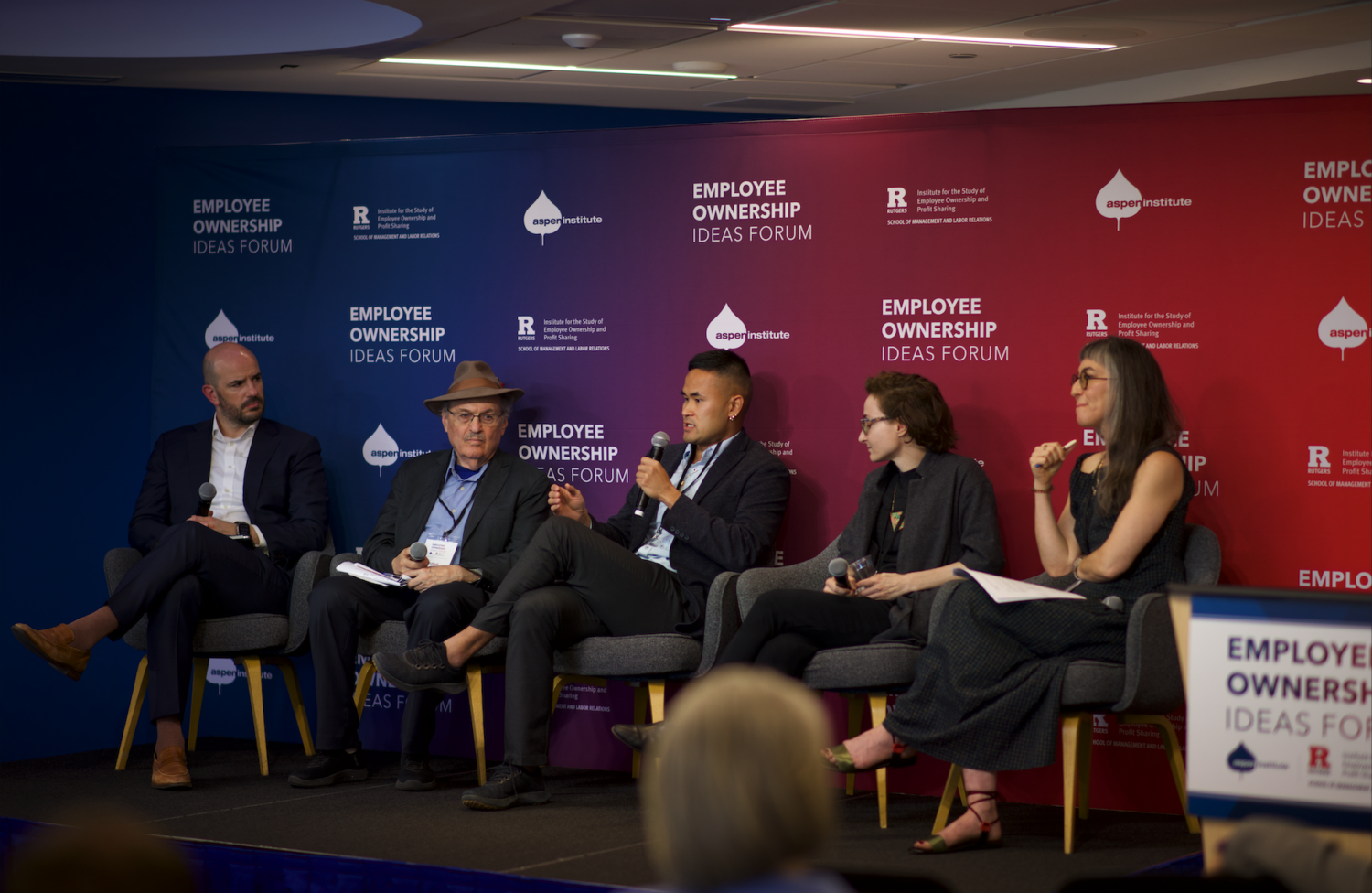
Let me introduce our panel here. Next to me is Charlie Arrindell, Division Manager of Lewis Tree Services. Next to him is Nicole Vitello, Vice President of Equal Exchange, an absolutely iconic coffee brand for the coffee snobs in the room. We have Krystal Thompson, Senior Software Solutions Advisor at Advisors for Change. To get started, I want to get to these folks as quickly as possible just because of time constraints, but I wanted to share a quote that I think many of you are probably pretty familiar with. I came across it in college reading Working by Studs Terkel.
I was in college back in the 1990s. My kids refer to it as the 1900s recently, and it’s really upsetting to me, but the quote is, Work is about a search for daily meaning as well as daily bread, for recognition as well as cash, for astonishment rather than torpor, in short, for a sort of life rather than a Monday through Friday sort of dying. When I think of employee ownership and when I’ve talked to employee owners around the country and when I’ve seen it done really well, it really lives out that quote, I think, in a just perfect way. It’s this daily bread and daily meaning that really comes to life.
I think that’s part of what we’re going to unpack in this conversation today. You’ll notice on your agenda that we had a fourth panelist lined up, Jill Ferdinand from Atlantic Plywood. She unfortunately got sick at the last moment and couldn’t make the trip down, but we’ll still have a wonderful conversation here. Let’s just get started with some basic intros. Please tell us a bit about yourself, your organization, and, given that we’re a little bit short on time, let’s not bury the lead too much. Tell us about what ownership means to you and what it’s meant for your life. We’ll start on the far left with Krystal.
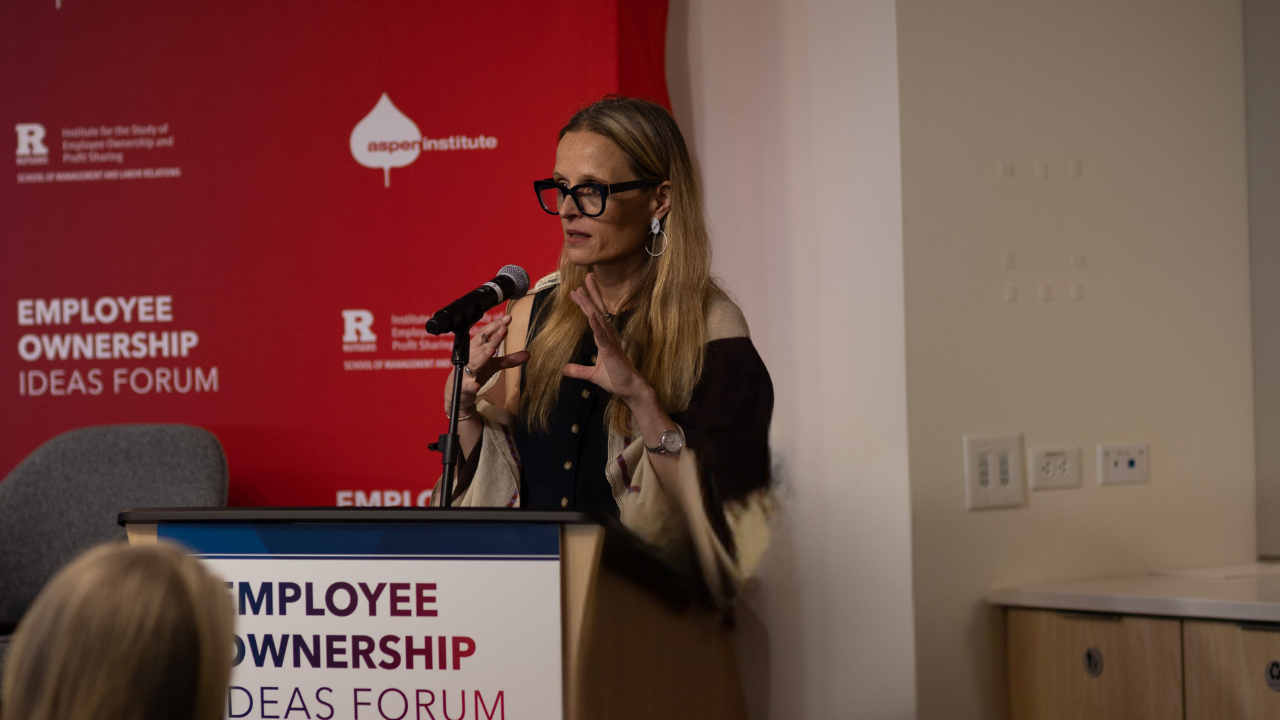
[00:02:43] Krystal Thompson: Thanks, Matt. Hi, everyone. Good morning. My name is Krystal Thompson. I’m a worker-owner at Advisors for Change, where we help nonprofits transform their financial management systems and eventually be able to have autonomy and own them for themselves. I think that normally people associate ownership with equity. Who doesn’t like that? I’d say that it’s equity in another space as well. It’s not just changed my mindset, but also– I’m sorry, it changed my mindset well before it changed my financials.
I’ve been in the opportunity to be able to be involved in our transition from the feasibility studies to serving on our transition team, helping create the sale agreement, our bylaws. I served as our inaugural vice president for our board of directors, and also I now lead our membership committee. If anything, employee ownership has just expanded what I felt possible for myself. It really gave me visibility into how decisions are made within organizations and how I can see myself really fit into a space where my voice matters and giving more direction into the space. I really think that it gives more than just the stakes and the outcome, but more so a voice in the process.
That’s what employee ownership really is for me.
[00:04:04] Matt: I love that. Thanks, Krystal. Nicole, let’s go to you next.
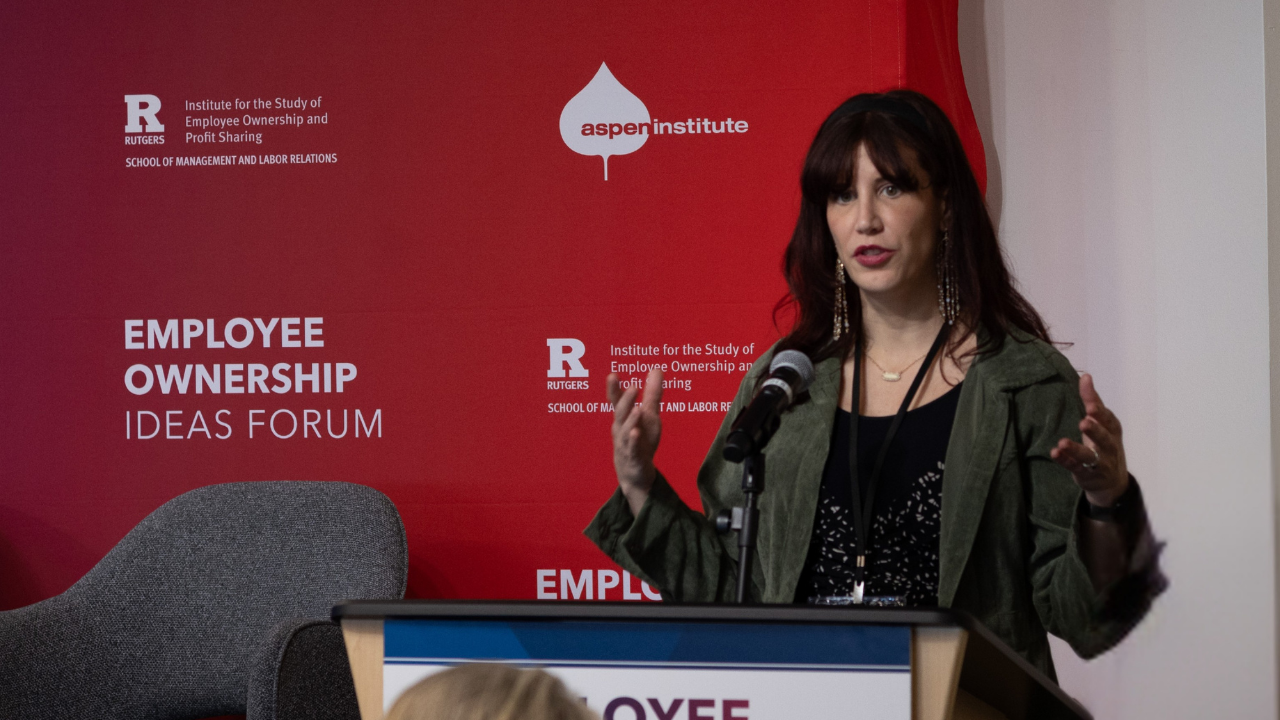
[00:04:07] Nicole Vitello: Good morning. My name’s Nicole, and I’m from Equal Exchange. Equal Exchange is a worker-owned co-op. I believe we’re one of the biggest worker-owned co-ops in the country. We’re about 120 worker-owners. We’re actually celebrating our 40th anniversary this year, which is very exciting.
[applause]
Yes. I think what I believe about Equal Exchange is it really is a model for what worker-owned co-ops can be. Was started as a worker-owned co-op. It has an alternative capital agenda in terms of investors and expectations. It’s a global company at this point. We’re about $80 million. We manufacture coffee. We have people that are worker owners from the production line, roasting, packaging coffee, warehouse workers. We’re nationally distributed. What that means to me is that we have worker ownership from an entry-level warehouse worker all the way up to the president and founder of the company. It’s a one member, one vote.
We serve on our board of directors. We own the company. Our investments, our decisions, the risk that we take, we take that collectively. There is democracy within our structure. We also have a management structure. Not everything is decided by a co-op. That would be impossible. What worker ownership means to me is– I was an organic farmer for 10 years in my home state of Rhode Island. I could not continue with that business because of equity, capital, land, and a whole bunch of other factors that my business was successful, but I had no equity, and I couldn’t move forward.
When I came to Equal Exchange, I started as a sales rep. Now I’ve worked my way to being a vice president, which still feels like being a sales rep, being up here and selling the idea of Equal Exchange. When I came to Equal Exchange, I thought I ran my own business. I can’t just go work for some other company. I had never really heard of worker-owned co-ops. I certainly didn’t know that there would be manufacturing co-ops and co-ops doing the work that we’re doing internationally with small farmers and with other types of independent businesses.
I think that through line between your whole supply chain and also how you can take this concept of ownership and investment and some of the things Krystal was also talking about in terms of equity, retirement, healthcare, the fact that you can take those as a through line from the farmer that grew the coffee all the way to the person that’s drinking the coffee is a really powerful model. I’m proud to represent Equal Exchange here, and I’m proud to represent worker ownership in the co-op sector and really demystify that concept and actually say that it can be a profitable business model and that it can share equity from farmer to coffee drinker and that that’s something people should and can replicate.
I hope to see that happen more and more. Thank you.
[00:07:35] Matt: Thanks, Nicole.
[applause]
For those of you who joined us last year, you may recall that Leslie Kass from Lewis Tree Services was one of our speakers. For those of you who joined us last year, you probably saw the line across the street, right? If you’ve been with us the first three years, it’s been a little bit of a coach experience, and we like to think of this year as coming up to the first-class experience. People can reach out and stretch at least this year. We’re really thankful to our supporters for making this venue happen. That’s an aside. My point was that now we have another member of Lewis Tree Services joining us this year, Charlie Arrindell. Charlie, tell us a little bit about yourself, Lewis Tree, and what ownership has meant to you.
[00:08:20] Charlie Arrindell: Thank you. My name is Charlie Arrindell. I’m the vision manager for our Connecticut region. Lewis Tree Services, we’re one of the largest vegetation management companies in the country. Basically, what that means is we keep the power on. We trim near power lines to ensure that all communities have a reliable energy grid. Lewis has been an ESOP for over 26 years. Way before I started, and again, I’ve been with the company for 14 years. I started with the company in between careers. I did not know much about the line utility trimming business.
I had a friend who said, you should come to Lewis. Again, I’d never heard of Lewis. He kept touting the culture, the people, and definitely the ESOP. Right now, we have over 4,000 employees throughout the country. What I will say is, similar to my colleague here, we have a breadth of talent from entry level all the way up to CEO level. What we do know about profit sharing is our contribution helps not just ourselves and the company, but also all of them around us. We know that our success will ultimately lead to their success as well.
[00:09:33] Matt: Could you say a word about just what ownership has meant to you personally and in your life a little bit?
[00:09:39] Charlie: Ownership to me just means that I’ve been able to basically live the American dream, provide for my family, develop others, succeed in business, and ultimately just help the community.
[00:09:53] Matt: Thanks, Charlie. I think most of you in the room know that part of the secret sauce or the magic potion to employee ownership isn’t just the sharing of profit, the sharing of equity. It really is the culture, as Charlie started to note, and it’s that combination of culture and equity sharing that really drives the productivity, drives the innovation, drives the job satisfaction for a lot of people. I want to take a little bit of a deep dive and some time to unpack what the culture of each of your workplaces looks like. Nicole, maybe take us behind the scenes of Equal Exchange a little bit and talk about what the culture is, what it feels like day-to-day, and just give people a sense that maybe haven’t been to Equal Exchange.
[00:10:35] Nicole: Yes. Equal Exchange is based in Massachusetts, and that’s where we manufacture. We roast and package our coffee there. What happens when you start as a– When you’re hired at Equal Exchange, you basically are on a worker-owner track for the first year. You go through a co-op curriculum, you have a mentor, and the whole idea is that you’re becoming a fellow owner of an $80 million business. You need to be able to read a balance sheet, understand our financials, understand what it means to be part of a co-op, what worker-owner votes are, what serving on the board of directors are, because we’re our own board. We’re the owners of our company.
We manage the organizational director, which is quite a challenge. Imagine you’re the founder of the co-op, and here you are as the president of the company, and your board might be full of 25-year-olds who have been elected by their peers and are now your board, which is an interesting, humbling, and sometimes challenging experience. We really want to make sure that worker-owners are up to the task of co-owning a company. That worker-owner curriculum, we do take it seriously. In that period of time, worker-owners are part of our worker-owner meetings. You’re observing. You’re there with your mentor. You’re observing board meetings. Everything is transparent.
Our financials are transparent. They’re discussed. The business decisions and risks we’re taking are transparent, and they’re discussed. Yet there is, as I said, a management structure. Each team obviously has their own culture. What’s really great is we’re all together. We’re there. We have a communal kitchen, and here we are. We have folks that work on the production line from Cape Verde and live in the local community. We have people from the sales department that are there. We have the founders of the company. We have new workers that have– Some of us have been. I’ve been at Equal Exchange almost 20 years now.
My job has changed over time from being a salesperson to running our produce company and importing fresh bananas from Ecuador. Now I’m on the leadership team. I think that culture allows us to change. It’s not necessarily a linear progression. You start in the warehouse, and you wind up as a vice president. You can move in a linear fashion or laterally through the company and experience different jobs in different places. Some people might move across the country to our Portland office or in Minnesota or one of our other divisions, and yet you continue to grow and develop through leadership on the board, through different committees we might have, through a mentorship program.
There’s plenty of ways to engage in the business and the co-op. Also, collectively take risk and support other cooperative businesses that have now merged within our ecosystem to keep people changing and growing. I think that’s part of the innovative part of Equal Exchange, is we just keep moving forward and taking risk. We can do that because we own our business and because we control our capital. That’s a really powerful, I think, force also for innovation and risk-taking.
Maybe sometimes people think co-ops are conservative because you have so many people there, it’s really hard to make a decision, but I would say that I think it actually brings ideas to the forefront and forces us to keep growing and changing.
[00:14:21] Matt: That’s great. Thanks, Nicole, for sharing that. Let’s stay on the co-op side for a second, Krystal. Advisors for Change, I think, is a relatively new cooperative, right? Still early on in the worker ownership journey. I wonder if you could talk a little bit about where the culture is at now, maybe where it was before the conversion, and how it’s evolving.
[00:14:42] Krystal: Yes, of course. Advisors for Change has been a worker co-op for two years now, so we are very new in the worker-owner space. However, I would say that the difference is not overnight. You just wake up, and everybody on the team is present and ready to participate, and knows everything. As my colleague said here, that it takes time to develop that team. It started before we even actually transitioned. The transparency is a big part. Preparing people to become worker-owners is not just a title. It’s a process. It’s an emotional journey. It’s a financial journey in trying to get everyone acquainted to how to run a business.
I think that you see yourself more than just completing tasks once you’ve transitioned. It becomes more about being invested in long-term decisions and understanding the role that you play. I’m someone with a sports background, so I really like to equate it as you developing an even stronger team. You have a coach who knows. We all know the goal is to win, right? We want success and whatever that means to your organization. You have a coach who helps lay that game plan. Then you have your players, your worker owners, who then have to know their role and envision themselves in that game plan that you have and understand what they need to do to be able to drive that success.
I think that becoming a worker-owner really challenged our team to be more communicative about gaps that they have in understanding, giving opportunities for people to speak up and really level the playing field of what it means to exercise their voice and practice. I think that was really one of the best things, that it gave us more confidence. You start to see the people who just showed up to meetings and were there to do what they had to do now speaking up and giving ideas, and that actually get put into action and not just lay by the wayside. I think that empowerment is really one of the biggest changes that you see almost instantly.
[00:16:46] Matt: Thanks, Krystal. Charlie, back to you and an ESOP perspective. Charlie and I have chatted a couple of times and there’s a few things that have stuck out to me about those conversations, Charlie. I’ve heard you say that I is rarely used at Lewis Tree and it’s more we and us. I’ve also heard you say that this idea of continuous improvement is a core value and that there’s a real open-door policy at Lewis Tree despite its size. To make sure that this continuous improvement process and ideas play out. Tell us a little bit more about the culture at a big employee-owned company where workers are spread across the country and how that’s supported and maintained.
[00:17:31] Charlie: Yes, sure. As you said, we usually often use I and we, very few times I mean, we and us, very few times I, but also very few times we use the word they. When I say they, there’s no they, there’s no corporate structure that’s basically reaping the benefits of the hard work that’s done in the field. All the labor, all the benefits are going back to the field, invested back into the people that are working. Also, let me add in there, not only are we an ESOP, we’re also a minority-owned company, which means our ESOP is helping serve a community that’s usually underserved.
We rely heavily on manual labor and as you know, those in the manual labor trade often try to keep every penny and spend it locally and spend it in the moment, not really thinking about 10, 20, 30 years from now. By offering ESOP, we’re able to offer them a future without having them have to set aside extra that they may not have in the moment. With that being said, since we are spread across over 30 states, one of our operating principles is improvement mindedness and we’re always thinking about how can we improve not only our local operation, but also the process for the entire corporation. Because we understand that every improvement, even 1%, ultimately is reinvested in their retirement.
What was the second part of that question?
[00:19:07] Matt: It was just what the culture looks like at a big company that’s spread across the country and how you come together as a company on a periodic basis, maybe as a whole company of 3,000 employees to make sure everyone’s on the same page. I think you guys have what’s called state-of-the-company meetings. I wonder if you could talk a little bit about that.
[00:19:25] Charlie: Yes. Similar to Jill, we do have state-of-the-company meetings. This is often in our corporate office in Rochester, either for the leadership team or through teams calls or local visits from our leadership team to many of the states. Again, similar to Jill, we share our balance sheets, our P&L. Again, the reason being is that we know that everything that’s on the balance sheet is important. It’s ultimately funding our retirement. We’re very transparent, and we’re all pulling on the same rope for the same ultimate goal.
[00:20:03] Matt: Perfect. Thank you, Charlie. When we had our prep call for this meeting, it was short, but it was super powerful, and these panelists just have a ton of ideas about where this field can go and where their own individual businesses can grow along with their communities and customers. I want to create some space and time to have you all hear some of what we talked about on that call. Nicole, I wonder if you could talk a little bit about how Equal Exchange and you are thinking about not just employee ownership within the context of one firm, but really employee ownership and its principles within the context of a supply chain and how you’re approaching that strategically.
[00:20:50] Nicole: I spoke about my experience as a small farmer, and part of what drew me to Equal Exchange. Equal Exchange, we import coffee, tea, cocoa, sugar, bananas, avocados, a whole host of products pretty much globally. All of the products that we source come from small farmer cooperatives. That means basically hundreds of thousands of small farmers that own their own land are organized themselves into co-ops. That co-op is the exporter of the product. It also might be quality control, a whole bunch of other certifications, accounting.
What that’s basically doing is it’s creating ownership in communities of a business. You own your farm business, but you’re also part of a cooperative business. Often, it’s really hard to keep, we keep hearing, it’s hard to keep kids in farming. It’s hard to excite the next generation sometimes in some of these communities. Now you’ve basically created a place where people can go off to technical training, accountants, certification people elsewhere, and a second tier of jobs basically that you’re creating in that community. Who knows better that business than kids of farmers or otherwise to navigate some of the challenges of global supply chains, commodity pricing, fair trade premiums?
It’s a complicated business. Why should that be exported to some other company that’s coming in from outside to do that? You’re creating jobs in the community. You’re creating business models in the community. The cooperative structure allows small farmers who may not have enough products themselves in volume to export access to the export community. You’re also cutting out the middleman, which is how Equal Exchange can afford to be a profitable company, not by forcing farmers or other people to take less, but by actually being as efficient as we possibly can with the supply chain.
When there’s ownership at source, Equal Exchange is the importer of those products. We have ownership in the import and manufacturing process and in the sales process. Then we’re often selling to independent, family-owned, or a lot of times consumer-owned food co-ops. Now you have a co-op to co-op to co-op supply chain, which is a pretty powerful thing because we’re all now operating on the same business practices. We’re not selling to a major food corporation that’s pushing down on margins for their shareholders that then we have to push down on margins to the farmers that are producing those products.
I think consumers are pretty savvy, especially about food prices these days and groceries and how much they cost. Being able to say, hey, here’s the transparency that’s going all the way back to our farmer partners and their businesses and the members that own the co-op are community-owned. Those are community-owned businesses. I think the more and more we look at where our spending practices are going and where our money is going and what we’re supporting, to Gina’s example, we have businesses all around us that can reflect our values.
I think it’s important to think about the supply chain in general and try to have an answer and a response to that and create these linkages that we can have between global cooperative entities and not make that so much more difficult or expensive or otherwise. It just makes sense.
[00:24:27] Matt: I love that vision. I think that’s the next frontier of where we can take this work, really. Krystal, talk a little bit about what employee ownership has meant at Advisors for Change for the customers you serve and how that’s maybe improved service and performance on your end.
[00:24:46] Krystal: I think this is a great question because AFC is a little bit different than what you would normally see in your ESOPs and worker-owned cooperatives. We’re a group of now hiring one, so 20, and we’re fully remote, so we work all across the country. Really trying to create a unified vision between 20 people in different parts of the world can be challenging. One of our niches is that we don’t hold our partners in perpetuity. We help build them sustainably from within and help create capacity and build systems that actually function for them.
I think our transition to worker ownership really helped with that accountability on our end. It forced us into not only talking the talk but walking the walk and all the things that we preach to our partners and now the things that we have to do ourselves. Created an environment where people feel more invested in helping others. We serve nonprofit communities all throughout the world, honestly. I think that the more that we are able to help sustain our company and teach other nonprofits how to do that as well, it eventually reaches their entire communities for their missions as well.
It brings together different types of communities. It’s not just, as I mentioned, I’m in accounting. You have agriculture. You have technical services. Truly, the outreach and expansion of capabilities of worker ownership transcend what I think I even knew was possible when I first started. Now, being a part of more of these conversations, I’m seeing that it’s becoming more and more of a common conversation. I’m very excited about that because it just really shows that the more that we, as the employee cooperative community, come together, the more that we’re able to share that insight and those possibilities with others.
[00:26:45] Matt: Thanks, Krystal. I think all three of you exemplify what I think is pretty common in employee ownership, which is a grow-your-own strategy. I think people at worker-owned companies are really invested in terms of training and development and promotion. I think the ESOP Association actually has some research out there backing up that employee-owned companies, ESOPs in particular, train their workers at a much higher rate than normal companies do.
Charlie, I want to ask you that question in particular is, how does Lewis Tree think about the professional development of its people and retaining and growing them? What systems and processes have you put in place to do that? Is that part of the culture?
[00:27:29] Charlie: Having an ESOP is really a huge factor in retaining talent. Again, this type of industry, manual labor, people are often quick to jump to the next competitor who gets a contract or who may be paying a few cents more, whatever it may be. The ESOP allows us to retain this talent. Our individuals want to stay with the company. Because we know that, we’re able to feel confident to be able to put out the expenditures to train them. Many of our individuals have been with our company for a very, very long time. Like I said, I’ve been with the company over 14 years. We have some people that work underneath me that I’ve worked for 30-plus years for the same company.
Again, our vision is to grow from within, to utilize the experience and then the talent. Then to obviously mold that to be able to help them grow past some of the maybe horizons they didn’t think they could reach. Again, people coming from the field never thought they would be in management, never thought they’d be up at the corporate office. Because of our training, we’ve allowed that to happen.
[00:28:43] Matt: Great. Thanks, Charlie. I think another thing we’ve noticed in talking to employee owners around the country is that there’s a real sense of being embedded in a place and being embedded in a community. When it’s your business and you’re sharing in the profits, you care about the image that your company portrays to the community. You care about investing in that community. I wonder if the three of you could, like in our conversations with employee owners, we hear a lot about volunteering in employee-owned companies in the community, a lot of giving back, a lot of philanthropy.
I wonder if the three of you could maybe say a word about how your company thinks about the place you’re located in and what it means to be attached to the community in a different way that if you’re just a corporation may not happen.
[00:29:31] Krystal: Yes, absolutely. I think that with AFC, again, being 100% remote, it’s difficult to create an image that we’re all under the same idea and unified in the same spaces. I think that AFC does a great job at not only providing opportunities for professional development on topics that you’re interested in, not just topics that are relevant to the job that you do. What that does is it really provides people with the confidence to move out into the community and talk about the work that we do, talk about what it means to be an employee owner.
I think that the best thing that we can do for employee ownership is help expose it more. We’re having those conversations with nonprofit organizations who are impacting millions of people on scale. Those people are now seeing that whether it’s just a single owner of a 19-person company looking for a session plan or someone whose organization is 30,000-plus, there’s opportunities to be able to see yourself in this space. I think having those conversations is what made it possible for us to even be here and also help promote the process for other people. Who doesn’t want to have a little bit more control in their life at work?
[00:30:52] Matt: For sure. Nicole?
[00:30:57] Nicole: We’re a national company, and so we have different chapters. As I said, Minnesota, Portland, Oregon, and Massachusetts. We’re members of some national co-op organizations. I see Esteban here from the United Federation of Worker Co-ops. We’re Equal Exchange. We’re a member of the National Organic Coalition, which is a grassroots organization fighting for organic policy. We also, we’ve developed some policies ourselves that really came from ideas from worker owners. During COVID, we developed some COVID hours so that people could basically be with their family or friends or help other people that might need extra support.
We’ve carried that over right now into something that we actually just developed called, sort of calling it civic engagement hours. It’s some amount of hours that are there meant to be like engage in your community. These are trying times. People are somewhat isolated and divided. The idea was, we’re not telling you what to do with those hours. We’re saying, check in with your supervisor and talk about them. However, maybe that’s taking someone to the polls. Maybe that’s volunteering at your church or your congregation. Maybe that’s volunteering in your community or at a food bank or something like that that will get you out engaging with your friends and family and neighbors in your community.
Maybe during that time, you’ll talk about what it means to be part of a co-op and what it means to engage with local businesses. Maybe you’ll bring ideas back to us about what we should continue to do with that. Creating space for people in your day-to-day job and also realizing that we have people that are DSD drivers, warehouse workers. It’s not always easy to attend all of the meetings that we have. We really try. We have a division in the UK. We have a division in Canada now. How do we even have meetings that can bring everybody together?
You have to think about the timing, the acknowledgement of who’s going to cover your route. Can you safely pull over and do this meeting from your car? We’re trying to create culture in different ways where we’re all aware of maybe some of the privileges that people have in being remote workers and working from home versus somebody that’s on the production line. How can we all be pulling in the same direction and creating policies that actually work for everyone? I think part of that community engagement comes from also listening to what people are looking for and creating some space for experimentation and then see where your policies go from there.
[00:33:39] Matt: Great. Well, I see one of our special guests, Senator Johnson, has arrived. I’m going to ask our panelists to pause here and take a break with me offstage and bring him up for some remarks. All right. Almost to our first break of the day. Exciting morning. Let’s end this panel on a little bit of an uplifting note here maybe. I’d like to hear from each of you. A few years ago, we had this speaker join us from SBA. He talked about what he imagined our country would look like if we had more employee ownership in the United States.
Obviously, no matter where you sit on the political spectrum these days, the country’s in a difficult spot. I’d love just to hear a final reflection from you all when you think about your experiences as an employee owner, when you think about your company. What would it mean for our country to have more of that right now? Maybe we’ll start with you, Charlie, since I cut you off last time.
[00:34:33] Charlie: Okay. Not a problem. There’s a few things. First of all, employee ownership allows for more vested leadership, a bigger stake in what the company does. What that does, it ultimately leads to a better experience, better decision-making, and just a better experience for the public when dealing with any company. The decisions that are being made are well thought out, and there’s not the chance or the thought of, I’m going to be leaving or I’m going to be chasing a dollar somewhere else. On top of that, there’s also the fact that– Let me gather my thoughts here. I’ll pass right now.
[00:35:19] Matt: Okay. If you have any, we’ll come back here. Nicole, go ahead.
[00:35:22] Nicole: I think really we’re all also really looking for community. A lot of the corporations that have just been discussed that are private equity and M&A and this consolidation of industries, it’s pretty hard to go to Home Depot and ask them to support your local little league team. What used to be small businesses and family-owned businesses, we’re about to go through another sea change of this as people retire and don’t really have great plans for a business transition. A, because we’ve made the cost of capital and expectations so high.
As we think about what if there could be more models for some of those businesses to stay in a community, to stay more small and medium-sized businesses, but also have some economies of scale to the people that are involved in them. I think employee-owned and cooperatively-owned businesses are just by nature rooted in their community. As Charlie’s saying, if you can afford to buy your home, take over your local landscaping business or plumbing business or HVAC business or all these things. I think about being a kid and having our softball team. They were all local businesses that were invested in us and in our community.
We have to rethink what that looks like now. The barriers are higher to starting businesses. Yet, if we can Equal Exchange, we’re trying to use our capital to also help other businesses that are in our network continue to survive and get some economies of scale themselves from our structure and from our capital that we’ve built over 40 years. Maybe also thinking about what other businesses are in your network that we can band together with and maybe rethink some community efforts. I think being rooted in the place that you are and supporting the businesses that are there, not all the things that you can buy from businesses that you’re not invested in that are maybe not invested in you, it’s an important lesson for all of us.
My grandmother used to say, put your money where your mouth is. I think that still stands.
[00:37:37] Matt: I love that. The surgeon general put out the report a couple of years ago that we’re in the midst of this loneliness pandemic. I think when you hear about employee-owned companies, the first thing that often comes to mind when employee owners talk about their experiences is that they say it feels like I’m a part of a family. Krystal, I’m going to give you the last word.
[00:37:56] Krystal: Thank you, Matt. I think that is a great segue into what I think that employee ownership can really provide is rebuilding connection and feeling meaning in the work that we do. People want more than just a paycheck. People want to feel that they have a voice, that they have flexibility, that they have autonomy in not only the work that they do, but the impact that they have on other people. When you feel more connected to the work, people show up differently. People are present. People ask questions. They engage, and they empower you to engage with other people, especially in your communities.
I’m from Buffalo, New York, where a lot of what independence looks like is either work for yourself or pro sports. I think that employee ownership really offers a different path. It offers you an idea that you can still work for someone else and share in that vision because it’s hard to step into a place and see a future in someone else’s vision. Employee ownership gives you a voice in that, in the future that you’re building and you build together. I think that it also doesn’t just build strong businesses. It builds strong community, a strong workforce. I think that employee ownership gives us hope for the future of connection.
[00:39:17] Matt: Thanks, Krystal. Charlie, did your thought come back?
[00:39:19] Charlie: Yes, it did. I’m going to segue off of what the senator said. I know it’s a taboo of Social Security possibly running out. We have a lot of retirees who are currently working because they were not set up for success when they had the opportunity to. Having an ESOP will allow them to retire, get out of the job market, and then ultimately be self-sustaining even if, God forbid, Social Security is not there for them.
[00:39:49] Matt: Thanks, Charlie. Join me in thanking Krystal, Nicole, and Charlie. They’re going to be around if you have questions.
[applause]
[00:40:02] [END OF AUDIO]
About the Employee Ownership Ideas Forum
The Employee Ownership Ideas Forum brings together leading policymakers, practitioners, experts, and the media for a robust discussion on how we can grow employee ownership for the shared benefit of American workers and businesses. It is hosted by the Aspen Institute Economic Opportunities Program and Rutgers Institute for the Study of Employee Ownership and Profit Sharing.
About the Rutgers Institute for the Study of Employee Ownership and Profit Sharing
The purpose of the Institute for the Study of Employee Ownership and Profit Sharing is to study the various models that have emerged and will emerge of employee ownership shares and profit shares in the corporation and society of the United States and around the world.
About the Economic Opportunities Program
The Aspen Institute Economic Opportunities Program advances strategies, policies, and ideas to help low- and moderate-income people thrive in a changing economy.
Join Our Mailing List
To receive occasional emails about our work — including new publications, commentary, events, fellowships, and more — join our mailing list.
Connect on Social Media
For news and updates every day, connect with us on the social media platform of your choice.