Employee Ownership and Profit Sharing in Public Companies
Description
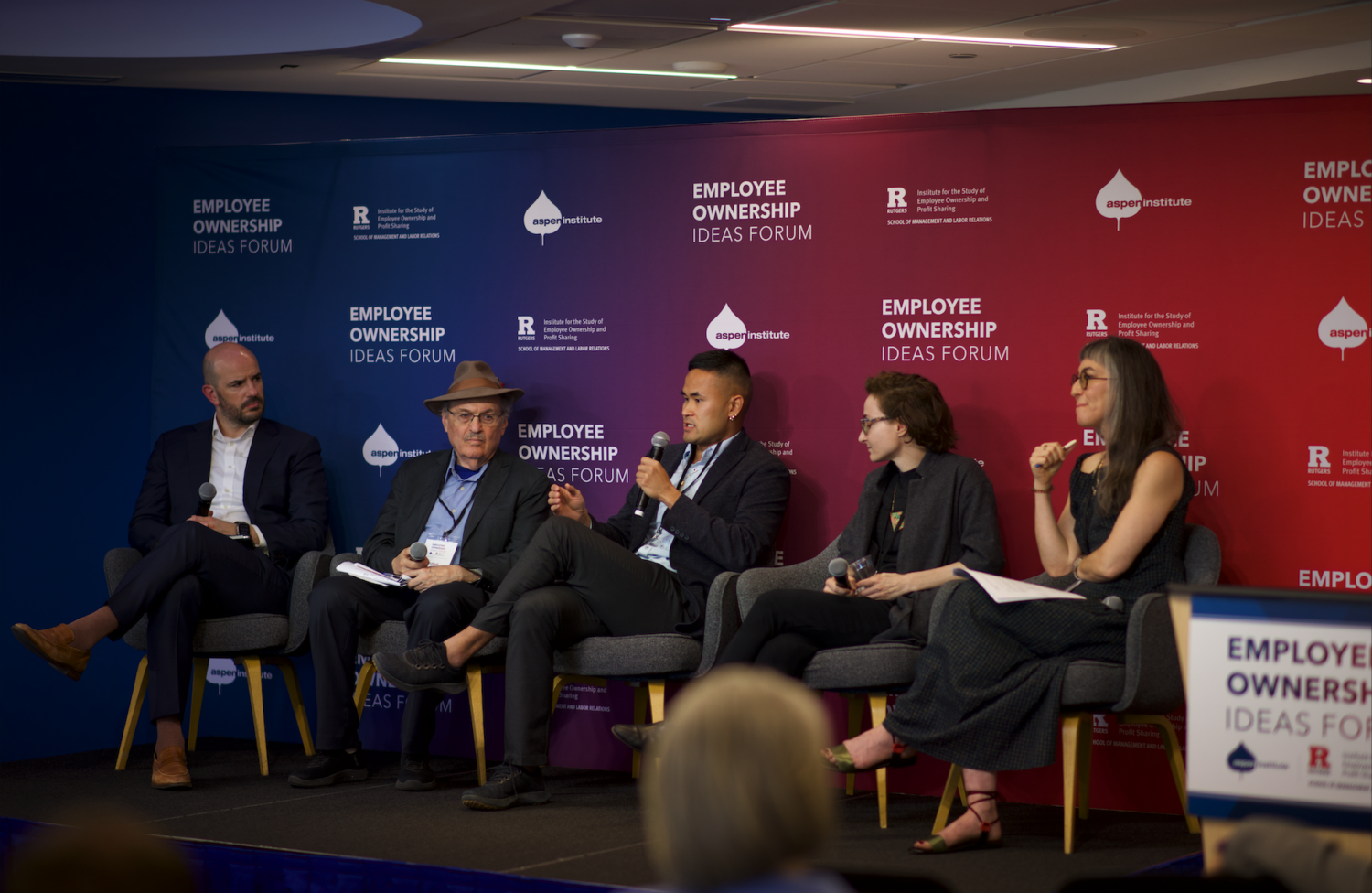
Public companies employ the majority of America’s workforce, yet broad-based employee ownership remains and profit sharing the exception rather than the rule. This session explores the current landscape of employee ownership in this sector, examines the opportunities and challenges for broader adoption, and discusses how we can realize the enormous untapped potential for expanding ownership culture across America’s largest employers.
This video comes from the 2026 Employee Ownership Ideas Forum, which took place on June 2-3, 2026, in Washington DC and online.
For more videos from the Forum, visit our event page or subscribe to our YouTube channel.
And subscribe to our podcast to listen on the go.
Speakers
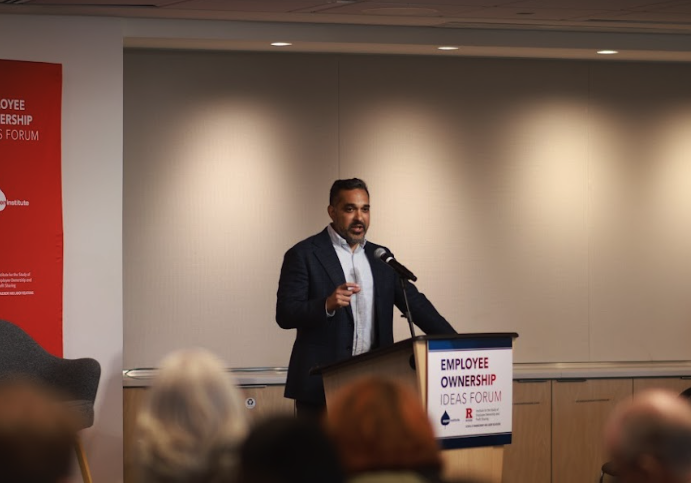
- Dr. William Castellano (opening remarks), Director, Institute for the Study of Employee Ownership and Profit Sharing, Executive Director, NJ/NY Center for Employee Ownership
- Jason Kelly, Co-founder and CEO, Ginkgo Bioworks
- Ethan Rouen, Associate Professor of Business Administration in the Accounting and Management Unit at Harvard Business School, Faculty Co-chair of The Ownership Project
- Mary Josephs (moderator), Founder and CEO, Verit Advisors, Contributor at Forbes Magazine
Resources
- Website: Expanding ESOPs
- Website: Ginkgo Bioworks
- Website: Harvard Business School — The Ownership Project
[00:00:05] Bill Castellano: Good afternoon again. I’m Bill Castellano. I’m the director of the Institute at Rutgers for the Study of Employee Ownership and Profit Sharing. We do a lot of work in publicly traded firms, equity. We have a Shares lab. I often hear, “Well, Bill, there’s big differences between when we think about equity for publicly traded firms and private firms.” My typical response is, “No kidding.” [chuckles] You’re dealing with a firm with less than 20 employees establishing a worker cooperative, 200-employee firm establishing an ESOP compared to a 20,000-employee firm sharing equity broadly.
Of course, those are very different kinds of forms of employee ownership. We do research in all of those areas, and we do see differences. I think the overall context is overwhelmingly broadly sharing equity is one way of dealing with this growing inequality. A big part of the growing inequality is a concentration of equity ownership. 10% wealthiest households own 90% of equity. The bottom 50%, just about 1%. That’s not sustainable dealing with the income and wealth inequality.
We also know universally across all different size firms that having an ownership culture does have a tremendous positive benefit on employees, their engagement, their commitment, innovative behaviors on strategic outcomes, customer satisfaction, productivity, and of course financial outcomes. We see differences, not surprisingly. When we think about an ownership culture, we’re talking about sharing information, investing in training, empowering employees to be more involved in decision making. Overwhelmingly, that’s the case in ESOPs, in worker cooperatives.
Clearly, ESOPs and worker cooperatives are probably the only employee ownership model that truly is broad. If you’re working for an ESOP, everybody is participating. Working for a worker cooperative, everybody participates. That’s the big difference. When you start looking at publicly traded firms, you don’t see that broad distribution. A lot of the benefits that we see with ownership cultures and sharing equity broadly, of course, will vary between those different models. Nonetheless, we do really focus on trying to expand broad-based equity type programs within the public sector because they’re huge.
Looking at some of these fun facts that I just pulled up just for you, we have a workforce of 135 million employees. 30 million are in publicly traded firms. 105 million are in private. I don’t know who wrote that paragraph for this, but there are more people working for private firms than public firms. Interestingly, 98% of the private sector are firms with 20 or less employees. There is a tremendous opportunity to encourage more broad-based equity within that 30 million that are working for publicly traded firms. It does make economic sense.
When we look at the market value of private firms, you’re looking at between $7 trillion and $10 trillion. The market value of public firms exceeds $76 trillion. Talking about dealing with wealth inequality, there’s a tremendous benefit for sharing equity more broadly within these publicly traded firms. One of the challenges that we face is it’s hard getting data. We’re lucky that we have 5,500 reports where we can really slice and dice what’s really going on in the ESOP world. Very, very challenging getting data, trying to get a sense of how broadly is equity being distributed in the public sector.
We’re thankful we have access to the General Social Survey. We just got funding to get the 2026 data, but it’s hard to distinguish the different forms of ownership. What that data tells us is that there is approximately 18% of the workforce participating in some form of employee ownership. About 8% of that are in ESOPs. Again, there’s a tremendous opportunity. The other opportunity that I think is beyond distributing equity more broadly in publicly traded firms is to address even the inequality in what we see. It’s highly skewed towards higher income employees.
When we do look at the GSS data, one way for us to slice and dice is to look at the very large firms, acknowledging that the vast majority of those firms are publicly traded. What we see there is only about 30%, 35% of employers are participating. Overwhelmingly, they’re in the high income category. There’s a lot of opportunity there. Then another way of slicing and dicing the data, we do see some challenges from a gender and a race perspective to make it more equitable.
I’m really excited to hear about some of these challenges and what other companies are doing in this space. It’s my pleasure to introduce the next panel. We have Jason Kelly, co-founder and CEO of Ginkgo BioWorks. We have Ethan Rouen, the Associate Professor of Business Administration in the Accounting and Management Unit at Harvard School of Business, also, a faculty co-chair of the Ownership Project. Of course, we have our very own Mary Josephs, the founder and CEO of Verit Advisors and Contributor at Forbes Magazine. Thank you.
[00:06:47] Mary Josephs: Thank you. Thank you so much. I’m going to start here. Phil, I couldn’t agree with you more. Having been in this space for four decades, working tirelessly to realize the dream of more employee ownership for more workers, it is a demand problem. Thank you, Lauren, for your inspiring comments. Thank you to the Aspen Institute and to Rutgers for just another incredible day of inspiration and learning.
You advancing the conversation of one big tent, many ways that employee ownership can be realized in different types of bespoke companies, as was mentioned earlier today, is such an important conversation to have. While I hearken from the ESOP world, I get excited when I learn how it’s happening with Apis & Heritage, with co-ops, with EOTs and so many other ways.
I am thrilled to go big right now, having spent most my career with private companies, because that’s where, as Bill just shared, so much of employee ownership is. Wow, that’s a lot of employees in public companies. That’s a lot of employees. When Bank of America bought LaSalle Bank, I became an executive at Bank of America. When I was negotiating my employment contract, my boss told me that I was going to get half my bonus in Bank of America stock. I’m like, “I can’t pay for my kids’ college with Bank of America stock.” That was really true because it was 2007 at the time.
[laughter]
[00:08:27] Mary: Through work that Rutgers has done and Joseph Blasi, there are billions of dollars of wealth in public company stock ownership plans. I just haven’t paid attention to it or been aware of it. Imagine if owners of public company or workers at public companies that employ so much of America weren’t just an employee ID number, and they had access to ownership, and their jobs could matter. I am thrilled with this panel, and I’ll let you introduce yourself, because they are so enthusiastic about what they’ve done to start moving the needle on employee ownership with public companies and where the opportunities are. You want to go first?
[00:09:12] Jason Kelly: I’m Jason Kelly. I’m one of the co-founders and the CEO at Ginkgo BioWorks. Did you want me to give comments? How do you want to run the panel? I had a little bit of a thing I wanted to say.
[00:09:22] Mary: Do your thing?
[00:09:23] Jason: Are you sure?
[00:09:23] Mary: Yes. [inaudible 00:09:24]
[00:09:24] Jason: All right. Can I get up there?
[00:09:26] Mary: Oh, sure.
[00:09:27] Jason: All right. Amazing. Sorry. Hi, I’m Jason. I was just going to try to use this very tactically to explain what we’ve done at Ginkgo. It’s been really heartening to– I share a lot of the views that are present in this room around wealth creation and things like that that follow for workers. I believe firmly that the people that build the value in companies are the people that work there. That alignment makes a lot of sense to me. The only other facet I would add to it– Ginkgo’s a technology company or public company. I’m going to get to that in a second.
Our technology is really around designing DNA, so doing biotechnology work. Some of that’s in pharmaceuticals and other industries. We consider it a very powerful technology. I think the other thing to keep in mind as we build these powerful companies, and a lot of our public companies are our most powerful companies, is who controls them. We’re seeing this powerful technology. This is very apparent when it comes to AI today.
It’s like, who’s controlling the technology? We have a few possible roads. There’s like, “The government should control it.” If you follow what’s happening in China, that’s an example. That approach. There’s the founder controls it. This is like the Elon or the Zuckerberg model of control of companies, or there’s like the ghost of Milton Friedman controls it. It’s like the capital markets will control it through their power over the public companies, and they’ll get funneled through ISS or Glass Lewis and how they vote on things. Those are the three models we have.
I would propose there’s another one, which is the workers control it. They control it through their control of the corporation. I want to just add to worker ownership and control. That’s what I want to talk about today, a little bit, and how we’ve done that. All right. How do you do that? I’m just going to very tactically talk about our story at Ginkgo so you see how we did it, because I think we are an example of how to do it. I grew up in Florida. I went to MIT for undergrad and grad school as a chemical engineer. Then I did a PhD in bioengineering. Then we started the company right out of grad school.
It was me and four other students, and then a professor at MIT. We couldn’t raise money. We were a bunch of kids, which is common in the tech industry, but biotech doesn’t like it so much. We actually did SBIRs. NSF SBIRs were a big part of our funding, like translational government money. The first $2 million or $3 million, $4 million into the company came in from those types of government grants. Then we built up a little bit of a service business. Then summer 2014, we went out to Silicon Valley and did an incubator called Y Combinator.
I’m going to give you a little bit of background on how did tech startups get going, because I think there’s this weird divide. A lot of the conversation here, okay, we’ve got cooperatives, we’ve got the Mondragons, all these things. If you spend a little time with the tech startup ecosystem, you’ll find that these companies are very much worker owned. Everybody in these companies has equity in the company. I think it’s an interesting model to take a look at. We were based in Boston, but I was introduced to it through Y Combinator. Ironically, it was because Sam Altman, now Mr. Famous, had taken over as the president of YC in 2014.
He thought the Silicon Valley model could apply outside of software and tech companies. Maybe it could apply to nuclear fusion companies. Maybe it could apply to biotech and materials. We were the first biotech to join YC and do that. We did that. Then we got treated like a tech company. Over the next six, seven years, we raised $900 million privately. Then we took the company public in 2021, peak COVID, biotech was rallying, and we raised $1.6 billion at the IPO. Total of $2.5 billion of capital in. After the IPO, worker-controlled company.
Let me explain, because I think one of the things that people think is if you tap risk capital, you can’t have worker control and ownership. That I do not believe is true. This is one of my favorite books. This is a fellow, David Ellerman. I don’t know if people know him. He’s a professor in Slovenia these days. You guys probably know him here. I’ll quote a thing from one of his essays that I quite like. I don’t like his approach to what to do about the problem, but I think his diagnosis of the problem is very acute, which is that we’re all living in a capitalist system designed for the rules of capital. There’s a lot of myths that people just believe that aren’t actually true.
I want to dispel those again through the evidence of what we did. He talks about this idea that who controls a firm? Who is renting who? Is it that capital is paying to rent labor? You can also invert that, and labor can pay to rent capital. He talks about taking out a loan. The interest on a loan is you renting capital. I’m going to add to that because you can’t build a technology company on loans. I’m going to talk about how maybe you could rent out your equity instead. Let me talk about that. In other words, who controls? I’ll just quote.
The basic capitalist myth that capital owns the firm, owns the future production profits, and holds the production management rights are all accepted by the public in general. This is true, by the way. Everyone thinks this, and by organized labor in particular. Even unions think this. Labor believes not only that capital will always win the hiring conflict, by which he means who’s hiring who, but that capital must, must always win by law. Labor leaders thus believe that, “The purpose of organized labor is not to hire in capital and to engage in the production, but to hire out labor on the best possible terms.
Labor leaders tend to be like generals who, for some reason, believe the other side’s propaganda that the other side must, by law, win the conflict. Hence, they sincerely believe that the purpose of leading the troops into battle is only to try to obtain the best possible terms of surrender. Since labor accepts the capitalist myth that the capitalists must, by law, be the firm, because they own the firm, the only battle actually fought out between capital and labor is the customary conflict over the terms of the labor hiring contract. It is this ideological hegemony of the capitalist mythology and the resultant pacification of the labor movement that’s capital’s most valuable asset.”
Correct. That is a very correct assessment of the situation. It is the case that everybody assumes that there is no way for these big companies to be anything but controlled by capital. Let me talk about how you do it. How do you have a worker-controlled company? When we did Y Combinator afterwards, we started to raise venture capital. As you raise venture capital, you’re still a private company, but every time you raise a round, you have an argument. When we started, we had five founders. All five of us were on the board. That’s five votes.
We went out and raised $40 million of venture capital. The venture capitalist added a seat to the board. He actually forced us, instead of five of us, to have two of us, but he was nice. Actually, he’s a good guy, a good friend of mine, Brian. He let us keep five votes, so we were five to one. By the way, in a private company, board, hires and fires the CEO. CEO, hires and fires everyone else. That’s the flow of power. Whoever controls the board controls management, controls the company. It’s five to one. Workers, we all work there. One capital.
Then we raised three more rounds, and it went ding, ding, ding, ding. By the time we went public, it was like five to four. We were still worker-controlled through going public. That’s how you play the game when you’re– By the way, every Silicon Valley entrepreneur knows this. As part of their raising capital, one negotiation is what’s the valuation of your company because you’re going to sell some of it. The other big negotiation is how many board seats you’re going to take because it’s not lost on Mark Zuckerberg. It’s not lost on all these people since they fired Steve Jobs.
It’s not lost that it is not a aligned relationship necessarily between capital and management, especially when it’s a founder management. Now, this is another one of the myths that capital and management are necessarily aligned. It’s certainly not the case when you’re a Silicon Valley founder. You go into that relationship with mutual respect, but also a little bit of distrust. Next, public. That’s the important part because this is where we are unique. There’s one other public company like us in the market today, UPS. The way that you do it when you go public now. How does a public C corp work?
Most of our powerful companies in the United States, our C corp public corporations, the way it works is you have shares in the company, and those shares have votes, and those votes allow you to elect the board. Your charter as a company has some rate at which you turn the board over, and the board members go up for election, and the shareholder, they have a vote, and management recommends who they think should be the next person on the board. The shareholders, you get either a packet, or you go log into a website, and you pick who you want. You’re like, yes, no, yes, no, from the slate.
When an activist comes in, all those types of things, they’re using their newfound power of the shares they just bought to vote no on somebody they don’t like on the board. That’s the flow of power. It shifts now. The board doesn’t have the power, the shareholders have the power. Then they elect the board, and then it’s the same as a private company. Board hires and fires CEO, CEO hires and fires everybody else. Does that make sense? Okay. All right. How did we solve this problem? We instituted a thing that we stole from the Zuckerbergs of the world and the Elons, which is called super voting shares.
You have dual class structure. We have two types of shares in the corporation. In our case, it’s an A and a B share. The A share votes one. The B share, each share gets to vote 10. The way the math works out is if you have 9.1% of the company in B shares, you out-vote the other 90.9. If you have 9.1% of B shares, you out-vote the A shares. Who did we give the B shares to? At Facebook, the B shares go to Mark Zuckerberg. That’s how, even though his ownership in Facebook is down at 10% or 15% these days, he still out-votes the remainder of the company, which means he doesn’t get fired when he does the metaverse or whatever.
It’s important, actually. That’s why he gets to take those risks, interestingly. It is a worker-controlled company. It’s just asterisked worker equals Mark Zuckerberg. It’s not controlled by Milton Fridsman’s ghost. We kept the B share idea, the 10x voting, but we gave it to all the employees. Then, very importantly, we made it so that it would go to employees in the future. If there’s a new employee that gets hired, and they get a share, so long as they’re working at the company, it’s a B share. By the way, if you quit, it becomes an A share, including me. This is the transition plan.
This is the means by which we go from a founder-controlled company, which we still are today, founders of Ginkgo own 10% or 12%, something like that, and the employees own something like 4% or 5%. We give out 4% of the company every year, by the way, so we can up people’s ownership. The way we do that transition is when I retire, I go to 1X, and the employees who are still at the company, they’re at 10X. As long as they own over 9.1%, at that point, if they vote as a block, can hire and fire the board. If you hire and fire the board, well, the board hires and fires the CEO.
Again, I’m not restructuring management. I’m not saying we should run the company differently. I’m not trying to come up with a new management philosophy. I’m saying the way C corps work is you have a certain type of management philosophy, and it’s just, who does the CEO have to listen to? It’s the board. Who does the board have to listen to? It’s the shareholders. I’m wrapping that back around and making the shareholders the workers. Does that make sense? That works, I think. We’ll find out.
[laughter]
[00:21:17] Jason: It’s been tried. There’s a company you’re probably also familiar with that I studied a lot, which was SAIC. SAIC, because they were a strong worker ownership company when they were private, when they went public, created super-voting shares. Then promptly, three years later, the employees voted away the super-voting shares. Interesting story we can talk about in the panel. UPS does still have them. It’s us and UPS. We’re the only two that have 10x voting that’s going to more than just the senior leadership or founders. The last point I will make is you might notice Anthrofix filing for an IPO right now.
That company is going to be worth a trillion dollars. This is a company that did not exist seven years ago. If we went down this road, and we started to lock in this concept among the new tech companies that they’re part of the family, that they are worker owned and controlled, it turns over a lot who the public companies are in the Fortune 500. A lot of them are new. I think in 25-ish years, you could start to have the majority of the public companies be worker controlled. That’s it. Thank you for your time.
[applause]
[00:22:25] Mary: All right. We’re going ad hoc here. Thank you so much. We’ll come back with Q&A. I’m going to invite you to come and give your background because it’s equally interesting. This is the best panel, by the way. I’m just going to say–
[00:22:38] Ethan: I can do it from–
[00:22:40] Mary: Okay, cool.
[00:22:41] Ethan: I can’t believe I have to follow a founder’s story with– My name’s Ethan, and I’m an accounting professor.
[laughter]
[applause]
[00:22:52] Ethan: Thanks. I took a securities route to the accounting racket. I was a librarian in a maximum security prison. Then I was a crime reporter for the New York Daily News. What tied all of this together, at least what I tell myself tied it all together, was two things. One, it’s storytelling. Journalism, thank you. You really warmed up the room well. Thanks. Journalism, accounting.
The goal is to tell as truthful a story as you can. We just use different tools. The other thing that really ties my career together is the realization that resources are inequitably distributed and done so randomly by group. That leads to optimization problems. Milton Friedman would say, one of the fundamental tenants of free market capitalism is equality of opportunity, which does not exist. I strongly believe that measurement is a vital tool to address that. That’s the end of my story.
[laughter]
[00:23:59] Mary: Can you share how you got into employee ownership?
[00:24:02] Ethan: Oh, yes. Employee ownership seemed like a natural place. I came into this studying human capital. I did my dissertation at a time when the CEO pay ratio was just about to be disclosed for public companies. I thought this was an interesting way to think about inequality. My conclusion was that it wasn’t all that interesting a way to do it. There’s just too much noise in measuring the CEO to the average employee.
I developed other ways to think about how inequality exists in an organization, when it can be good, when it can be bad. I’ve continued to think about the measurement and management of human capital. Another conclusion is that on the measurement side, we get to a limit. One other way to address this alignment of shareholders with the firm itself is through employee ownership, aligning the incentives of the workforce as a whole with the outside shareholders.
[00:24:53] Mary: You’ve done a lot of really interesting work around the tensions between stakeholders. In public companies, what are some strategies that you think can better align it?
[00:25:03] Ethan: Yes. There are lots of tensions. I’ll draw on Ingersoll Rand, which is a publicly traded company manufacturing that does broad-based employee ownership. This was a company that was bought by KKR. Pete Stavros led the deal, gave equity to the employees. It went public in, I believe, 2017. All the employees got equity. To this day, they still give restricted stock to every employee on their one-year anniversary. One of the tensions that I think is under-appreciated is the stakeholder tension between leadership and itself.
I’m going to use Pete as an example here because someone like Pete Stavros became successful in the model that has worked for decades. We say private equity, it doesn’t have a reputation for being very worker-friendly. The explicit incentives that he has always had have been two. They’re easy to measure. They’re easy to obtain if you follow this model. The challenge is that to do it differently, first of all, bucks against that contradicts what has always worked for the people who make these decisions.
It also relies really heavily on hard-to-measure implicit incentives, such as wanting to do well for the world, wanting to look your children in the face and say, “I’m doing good for the people who depend on me.” I think that’s one really big tension that tends to be under-explored. The other stakeholder tensions that Ingersoll Rand has dealt with is obviously the large asset managers, the institutional investors who see employee ownership as just a way to dilute their shares, and then dealing with employees themselves and trying to address the free rider problem, trying to address the agency problem, the fact that this is an organization with 20,000 employees.
I think at a tech company, Ginkgo BioWorks, it’s an easy sell to give broad-based employee ownership, in part because the agency problem is very clear. It’s very hard to measure a researcher’s daily productivity or a software engineer’s daily productivity. It’s a lot easier for a manufacturing worker, so maybe we don’t need to align incentives as much. How I’ve seen Vicente Reynal, he’s the CEO of that company, the investors want a causal story. They want to say, “I am giving X million dollars to my employees. We are getting X times $2 million in returns.” There’s never going to be sufficient evidence to make that causal story.
That’s where storytelling comes in. You see it really well with someone like Vicente. You ask Vicente what the weather is today, and he goes, “I’m so happy you asked that question because it gives me an opportunity to talk about how employee ownership creates value for this organization.” Every single day, I believe this guy wakes up and says, “Who am I going to evangelize to today?” That’s the way that you address this when data fails. It’s through telling the stories that make sense, that tell this long-tail story, and you see it in the output measures, the stock returns, profitability, but it’s really hard to identify in those input and process measures, such as the distribution of equity.
[00:28:08] Mary: Thank you. Another issue with public companies and ESOPs in particular, since you’ve got an accounting background, [chuckles] has been the negative pressure with ESOPs on EPS. Have you looked into that?
[00:28:22] Ethan: Yes.
[00:28:23] Mary: Can you change that rule?
[00:28:24] Ethan: Can I change that rule? This guy runs a billion-dollar company. He could change that rule. [laughs] It’s hard to look into. It’s hard to study, in part because ESOPs are so rare in public companies. There are these clear frictions. First of all, there’s the liquidity friction. In private markets, the ESOP is such a compelling story. It’s such a beautiful thing. This community comes together to engineer a market for shares that didn’t exist before.
The only people who can participate in that market are members of this community. It builds this ownership culture on its own almost, whereas with public companies, you have an ESOP, but you’re competing with the most liquid market in the world. It makes it really hard to get the Ron Johnsons of the world to care about these rules when it really is like a drop in the bucket of the broader capital market.
[00:29:22] Mary: I’m going to come back to you here. Raising capital and that fight for board seats, can you give us an inside scoop story on some of those conversations as you’re trying to raise capital and say, “Yes, but you’re not going to get control?”
[00:29:41] Jason: Yes. It’s interesting. I would say the culture in Silicon Valley among the investors has co-evolved with the culture of the entrepreneurs. If you were an entrepreneur, and you walked into a venture capitalist and weren’t fighting for control, they’d say, “Well, you don’t really seem like a Zuckerberg to me.” You’d be less likely to get investment. There’s a little bit of a difference because the companies are so new, and it’s so outrageous that someone’s coming in claiming they’re going to make the next Google or something, that you’re betting on a founder with a attitude.
Part of that attitude that has pattern matched for them has been they want the control. Now, to be fair, the VCs have also gigantic egos, and they also want the control, but they expect the fight. It isn’t like, “Oh, you should roll over.” That’s just not the cultural attitude. Anyway. I guess that’s my point again. At that stage, it’s surprisingly favorable to worker control and worker ownership, at least the investors accept it, among the founders. It wouldn’t really extend to the control being held by the employees at that stage, but I think it doesn’t really matter much. The big win is at the public stage.
[00:31:01] Mary: Continuing on that theme, how do your employees feel about it? Do they care?
[00:31:08] Jason: It’s a good question. I think this is still a thing to work out. I describe it like, because the founders still have enough ownership to control, if we vote together, those five of us. I think of it like we’re like an egg shell, and there’s this incubating zygote in there of worker ownership. We have some time. I’m not that old, 45. We can work on that when you hand out– For example, in order to really wield the power of the worker ownership votes, they need to vote in a semi-coordinated way, because they’re going to need to stack up their votes. Sometimes it might be obvious, sometimes not. How the heck do you do that? Nobody knows.
I think the other thing that is a little tricky is, this is my beef with Ellermann, I’m not talking about workplace democracy here. I’m sure some people in this room think that’s a fine idea. That’s fine. In the public markets, that, to date, has not been a winning arrangement for a management strategy. You’ll notice any company that’s a public company can switch its management strategy. It’s free. It’s a competition, viciously, about what the best management strategy is, and what we’ve all landed on so far is roughly like the arms. It’s like command and control.
I’m not actually talking about changing how management is done. People in the company, it’s not like by giving you shares, you get to vote on what market we should enter next, or something about our product features. What you get to vote on is the board. That’s your power. By the way, that’s the exact power of all the capital markets. Why do the companies act the way they do? Why do they cut and say all their decisions are under the pressure of the capital markets voting on the board? That is, to me, the root power line. That’s a new thing.
You’re a little bit, feels far away, but it’s like when we tell kids, “Hey, it’s still important to vote, but I’m only one vote. There’s 300 million people.” You’re like, “Listen, if you don’t vote, you and the people like you will not get representation.” Even though you’re only one vote, it matters. Same idea. People are going to need to learn that the board worries about what the shareholders think. If they’re the shareholders, they should exert that power. That’s a whole thing to build. I think we have some time to build it, but it’s there. The groundwork is there to figure that out. Does that make sense?
[00:33:31] Mary: Yes.
[00:33:31] Jason: I don’t know the answer, to be honest. I’d like if there were more people messing around with this to figure it out.
[00:33:36] Mary: We’re going to work on this together, as Lauren said. This is going to be great. Ethan, why in public companies are– Do you think– I think it’s because it’s easier to write the contract, but why are there so many short-term incentives, like restricted stock units and phantom stock and things of that nature, as compared to maybe something more broad-based?
[00:34:03] Ethan: Oh, you mean short-term for–
[00:34:05] Mary: Equity-based incentives, profits.
[00:34:07] Ethan: Oh. One reason is that the regulation changed in the mid-2000s. It used to be they did long-dated options, and those were rampant because companies only had to expense them when they were paid out. It was basically free employment, or they were punting the employee expense down the road. Once they changed that, they switched to restricted stock. We still see restricted stock over multiple years.
The real debate is, can profit sharing capture the same goals that equity can without the regulatory headache of issuing equity to a broad base of employees? We’ve seen this in places like Nucor, which wound up buying C.H.I. Overhead Doors, which was part of the KKR employee-owned business. They have very, very aggressive profit sharing, and advertisers, to some extent, as ownership culture, Delta gets a lot of attention for this as well. The risk there is that you’re always worried that employees are going to leave once they become instantly unhappy.
We don’t have the golden handcuff aspect of long-dated restricted stock. Why we don’t have long-dated restricted stock, one is obviously just the challenge of issuing equity, the dealing with shareholders or being diluted. Another reason that we don’t have long-dated restricted stock is because lots of these employees are cash-constrained. I like to think about it as your personal discount rate. They don’t have a high value for the future because they need money today. You could issue them a lot of money in equity, which has a clear market price, but they’re going to discount that significantly because they can’t access that capital when they need it, which is today.
[00:36:01] Mary: So true. Would you like to comment on that?
[00:36:03] Jason: The only thing I’d add, this is why I like the model of it’s just normal equity. I also looked a lot at Mondragon and all that stuff. It’s like, you can’t quit, and you can’t lose everything. I’m not trying to lock people up. That’s not worker empowering either, in my opinion. What I like about the model with equity ownership in a public company is absolutely you have– By the way, when you’re private, everyone’s stuck. There’s not a very liquid market while you’re a startup. That’s why all these people end up making so much money is because they couldn’t sell anything along the way, or else they probably would have sold a bunch.
In any case, in a public company, you can sell all the time. You can do things like vesting. I can say, “Hey, I’m going to give you some stock,” very common. “I’ll give you some stock, and it’s going to vest over the next four years.” That’s a form of golden haircut. It’s not like I’m saying you’re going to lose everything. You’ll have some in the future that you could get if you stick around longer. That’s one way you could do it. Also, I like that if you hold more, you get more votes. Maybe you are a person who just like, “Listen, I just like to work every day. I take my jet ski on the weekend, and I don’t really care about where I work.”
Great. Sell your stock. I don’t want you contributing that much to the direction of the company anyway. You’re not that into it. The people who are into it, they don’t sell, and they accumulate more power. They have more votes. If there’s a contentious vote that could go either way between the employees, they’re going to be the ones who swing it. What’s wrong with that? Again, Ellerman wouldn’t agree with me, but [unintelligible 00:37:42] a democracy. I like that model. I think that actually helps make it feel more like what the capital would be critical of, which is, “Well, these people, they’re not incented to make good decisions about the business.” I’m like, “Oh, I disagree completely.”
They actually own a bunch of the business. They’re highly incented to make good decisions about the business. They don’t want to crater the stock. They have a lot of their wealth in the stock. I think that should actually correlate with how much vote they have because the ones who have more ownership then are better tied to the company and make more wise choices about the future of the business because they’re long the business. Anyway, I don’t know. That’s a theory. Again, we’re pioneering this here. That’s at least how I thought about it when we made the choice.
[00:38:29] Mary: Ethan, when you were thinking through this, did you compare, contrast, and I get this a lot with employee ownership, is it a gift? It sounds like your employees are getting stock annually, or do you buy it? It’s skin in the game. That’s a philosophical difference.
[00:38:46] Jason: Yes. By the way, again, I would say, a myth to be careful with here, again, this is another reason I think the public company is great, is it’s liquid. I give it to them as part of their salary. It’s like partially what I’m giving you is cash, and partially what I’m giving you is liquid equity in the New York Stock Exchange. You can sell it if you want some money. Why is that different than the other money I’m giving you? It’s not a gift. It’s part of your compensation package. Again, you can choose to sell it or hold it if you want to accumulate power in the company, but it’s definitely not a gift.
[00:39:20] Mary: What about buy it? Skin in the game.
[00:39:22] Jason: Yes, they can call the New York Stock Exchange, buy some. They want. They could take some other money they have if they’re independently wealthy or something and want to build a position. They could do that. If they’re at the company, I do believe they could convert those to B shares. We do an optional, you can convert an A to a B once a year or something. If they bought it on the open market, I’d have to double-check with our lawyers, but I think they could even convert it to a B as long as they’re working there.
[00:39:45] Mary: That’s really cool. I’m going to come back to you here. Why do we not see, in public companies, more broad-based worker ownership?
[00:39:57] Ethan: Most of it is structural. One question is, why don’t policymakers change that structure? When Ron Johnson was up here speaking, the phrase that weirdly popped in my mind was benign neglect. Politicians as a whole, they like these ideas, but it seems like it’s not divisive enough to get them to actually invest in changing the rules. There is the S corp. For ESOP’s private companies, the rules are great. The tax advantage is there, not so much for public companies. Where we see it most common is employee stock purchase programs, which about half of public traded companies offer these 15% discount, as usually how it works.
You can buy a set amount of shares every year. Actually, the UPS model, they’ve been a little innovative there because you’re not just buying shares, you’re buying shares with 10 to 1 voting rights. That 15% sounds like a great deal, but there’s no real tax of it. The tax burden of that purchase is consequential. In addition, it assumes that the employees have the money to buy those shares. When you’re talking about distribution and redistribution, doesn’t necessarily cure that. Then securities regulation. Again, there is an onerous amount of disclosure around all of these different programs.
Anytime the SEC proposes a new rule, the first thing company push back about is the cost of that. Back to my Pete Stavros example, business as usual works really well for the people who are making these decisions. Why take on that extra burden? Why take on that extra risk? You need those intrinsic motivations. You need to think, I have an obligation to my employees, and this is one way I can meet that obligation. It is a high hurdle, and it requires a tremendous amount of effort.
[00:41:59] Mary: I’m surprised it hasn’t gained more conversation in light of the heightened human capital and employee engagement observations that are out there. I think Gallup came out recently, and the whole silent quitting or employee engagement just continues to–
[00:42:16] Ethan: Just to put some numbers on that. In the US, we have no idea how much public companies spend on their employees because they don’t have to disclose this. In Europe, they do. In the last 30 years, as a percentage of revenue, about $0.10 of every dollar has consistently gone to property planning equipment, maintaining equipment, buying new equipment. In 1990, $0.30 of every dollar was going to employees. It’s now about $0.55 of every dollar. We’ve seen a 70% increase in the investments in people, and yet our pay policies, our disclosure policies have remained that 1990 manufacturing world view of how we treat employees, how we incentivize employees.
There’s a reason this room is full. We all know this is a problem. We all know this needs to be addressed. Many of the tools that capital markets have tended to rely on, such as disclosure, are not going to solve this problem or are unlikely to solve this problem. Instead of thinking about it that way, we can think about it from an institutional perspective. We as investors, or not me as investors, but they as investors, instead of saying we need more information about how companies treat employees, they can say we want to better align the objectives of employees with our objectives.
[00:43:37] Mary: I think one dream, I was an economics major, so forgive me, is demand pull. As we increasingly have market observations about the superior performance of companies that have high employee engagement and employee ownership, that the investors, the capital, will start demanding that.
[00:43:55] Ethan: Nicholas Bloom has a paper, I think it’s called Superstar Firms. Basically, what he shows is that obviously everyone knows inequality has increased dramatically in the United States. The interesting finding in that paper is that part of that is that executives are getting paid more than lower-level employees. A significant portion is also that the better performing firms are also paying better than the others. Some of it is that the CEO of Google is getting paid more than the janitor at Google, but it’s also that the janitor at Google is getting paid so much more than the janitor at Yahoo, for example.
[00:44:37] Mary: [inaudible 00:44:37]
[00:44:39] Jason: No.
[00:44:42] Mary: I just got my little wave from Matt. You asked this question early, and everyone at my table turned around and said, “Who asked that question early?”
[00:44:57] Ethan: Me?
[00:44:57] Mary: I think it was our first panel of speakers. I appreciated it. Do you have a hypothesis or answer to your own question about what needs to happen in the public policy perspective?
[00:45:11] Ethan: Oh.
[00:45:12] Mary: Sorry.
[00:45:13] Ethan: No, it’s okay. There’s many reasons why I wouldn’t run for office, including competency, but making policy recommendations is definitely one of them. I’m an accountant. I’ve pooh-poohed disclosure, but I think disclosure is an important tool. If investors start demanding better disclosure around this, thinking about requiring firms not just to disclose how much equity is given to employees, but who gets that equity, that will be really eye-opening.
There is evidence that naming and shaming is an effective way to change corporate behavior. We’ve seen this. Japan has done this incredibly effectively. If we see that the executives and the top software engineers at a company are getting all of the equity, and no one at the lower levels is, that’s one way to start changing behavior. Tax incentives are a clear way to address this. It works for ESOPs. It can work for public companies. It just needs to be well designed.
I think for people in this room, it’s also technical assistance and education. I’m so shocked when people– Was it you, Bill, were saying that people are just unaware of employee ownership as an option, both in the private markets and in the public markets. It’s teaching people that, A, this is a real and viable solution, and, B, when it’s done well, it can be really effective for everyone involved and see that there is a developing playbook on how to do it well.
[00:46:45] Jason: On the policy side, anything that would favor people owning equity in their own companies would be an interesting policy to consider. The other thing you’ll face is, well, people are going to want to diversify or whatever, right? If you had some way where you’re like, oh, it’s tax advantage or something for you to own stock in the company you’ve worked at, something like that would be really powerful.
This is the magic, right? Again, I think the root of this whole thing, it’s like if labor wants to rent capital, then you’re on for the ride. I think the little bit of this element is like you can’t have your cake and eat it, too. It’s like which road do you want to be on. If you are an employee, and you want to build a lot of wealth, you’ve got to keep the stock. If you sell all the stock, then the company could be worth a ton, but you didn’t get it, right?
It is a real cultural choice to say, we want to rent capital and take the risk. That is very much the culture of founders in Silicon Valley. That’s why that’s our first worker-controlled segment of the economy. By the way, it happens to be a really powerful one, which is pretty cool. That’s because they are long, yes, I want to be paid what I earned. By the way, if it doesn’t go well, that means I don’t make that much. If you want really worker-controlled economy, that’s the culture.
[00:48:24] Mary: Matt, I think we have time for one or two questions. All right, Bill. He hosting us today. He gets [unintelligible 00:48:33]
[00:48:35] Participant 1: Jason, really, thank you for your presentation. One challenge we hear a lot is recommendations and strategies. [inaudible 00:48:44] What’s your thinking about that problem and how do you assess it?
[00:48:54] Mary: It’s a great question. Dilution. Again, it’s not [unintelligible 00:48:57] voting. Number one there is a question of why to pick 10. [unintelligible 00:49:01] 100 to 1, and then you’d only need to own 0.9% of the company to control it. By the way, some companies are like that. Ideologically, Palantir is weird like that. Peter Thiel is like a million X the vote or something crazy. In general, the reason I didn’t pick 100 to 1 would have probably been a bigger fight with capital. The other reason was I was like, “That’s not enough ownership in the company to get to decide about this place.
I’m not going to trust you to have the interest of the company in heart if you only own 0.9%. I’ll trust you if you own 9%.” 9% feels about right. That feels like you’ll have a big fight. You’ll be like, “Hey guys, my kid’s college depends on this. We’ve got to make this choice. We’ve got to do these layoffs.” You would make hard choices at 9% ownership that you wouldn’t make at 0.9%.
The number does matter. That’s point number one. Then dilution happens when we raise equity capital. We can sell our shares, been doing it recently, you can sell shares, and you can get money in the door. What that does is if I sold shares in the company, and I currently own 10%, I would go down to owning 9%. I would own 10% less, but we’d have a big check in the bank at Ginkgo, so that’s the thing to watch. Now, buybacks, boogity, boogity. No one likes buybacks. You know who buybacks are good for? Worker ownership.
I actually think buybacks are freaking awesome. If, for whatever reason, capital markets start to not like my company, and I have enough cash, I can buy back the stock, and it goes the other direction. I go from owning 9% to 10% without me spending $1. The company spends money buying out capital, and that balance is totally fine. The answer, from my perspective, is you would want decisions about basically buybacks and equity issuances, and you would be paying pretty close attention to where you are relative to 9.1%. Does that make sense? Yes.
[00:50:49] Mary: I think we have time, Matt, for one more question. We got it? All right. There you go.
[00:50:55] Participant 2: Jason, [inaudible 00:50:56]
[00:51:05] Jason: Yes, this is a great question. The other reason I was able to get this, by the way, why don’t a lot of companies do this? By the way, even the founder, it’s infrequent that even like the Zuckerberg thing where it’s just the founder that gets the 10X, even that is hard to get. It’s very much a function of at the moment of listing, how frenetic are the public markets?
If it’s like a hot market, and they want IPOs, you can set your terms, and basically no discount. If it’s not a hot market, then your terms are going to get set for you. This is a thing that’s a little tough to guarantee, but you do get to choose your timing, and if we have enough, some will get through. I think that’s, again, back to the myth thing a little bit, I don’t know. There are great articles that show the performance of companies with dual-class structures, and most of them that I’ve read, biased a little bit probably, that the dual-class do better. That’s because, look at the dual-class companies, Google, Facebook. It’s like all the founder-led companies, the ones that rip, they all have dual-class.
[00:52:13] Participant 2: [inaudible 00:52:13]
[00:52:15] Jason: They never went public, did they? They didn’t go public.
[00:52:16] Mary: Thank you, Jason. Ethan, I think you’re my favorite accountant that I’ve ever met, so you killed it.
[00:52:25] Ethan: That’s a low bar.
[laughter]
[00:52:29] Mary: Ethan, thank you, both of you, for so generously sharing your perspectives and your stories. Thanks to Rutgers and Matt for keeping us on time, and look forward to spending the rest of the conference with you. Thank you.
[applause]
[00:52:50] [END OF AUDIO]
About the Employee Ownership Ideas Forum
The Employee Ownership Ideas Forum brings together leading policymakers, practitioners, experts, and the media for a robust discussion on how we can grow employee ownership for the shared benefit of American workers and businesses. It is hosted by the Aspen Institute Economic Opportunities Program and Rutgers Institute for the Study of Employee Ownership and Profit Sharing.
About the Rutgers Institute for the Study of Employee Ownership and Profit Sharing
The purpose of the Institute for the Study of Employee Ownership and Profit Sharing is to study the various models that have emerged and will emerge of employee ownership shares and profit shares in the corporation and society of the United States and around the world.
About the Economic Opportunities Program
The Aspen Institute Economic Opportunities Program advances strategies, policies, and ideas to help low- and moderate-income people thrive in a changing economy.
Join Our Mailing List
To receive occasional emails about our work — including new publications, commentary, events, fellowships, and more — join our mailing list.
Connect on Social Media
For news and updates every day, connect with us on the social media platform of your choice.